
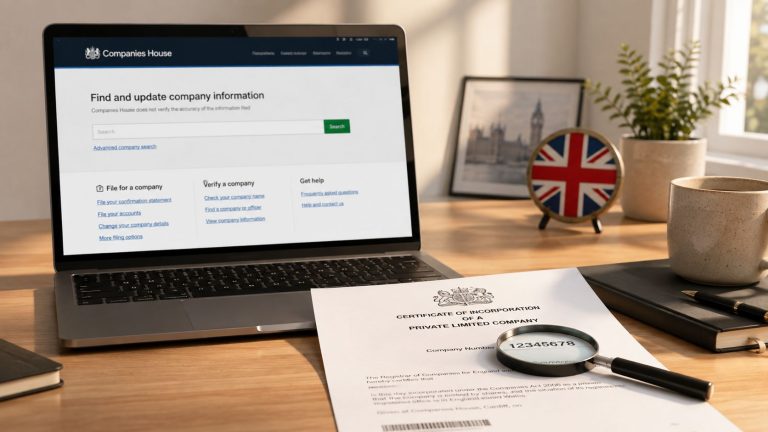
You're usually here because a form is waiting, a bank has asked for “the company number”, or a supplier has sent paperwork that doesn't quite match what you expected. The good news is that a company registration number lookup is usually straightforward once you know which identifier you're looking at and where to check it. The bad news is that most errors happen before the search even starts, when a trading name is mistaken for the legal name, or a VAT number is treated as if it were the company number.
A UK company registration number, often called a CRN, is the unique number Companies House assigns to a registered company. It's the cleanest way to identify the exact legal entity, especially when two businesses share similar names or one has changed trading style. If you've ever stared at an invoice, a contract, or a bank mandate and wondered whether the number in front of you is the right one, this guide is for that moment.
What a Company Registration Number Actually Is
A CRN identifies the company as Companies House knows it, not the brand name customers see on a website. That distinction matters because the name on the van, the footer of the site, or the sales invoice can be different from the legal name on the register. When you need to match a filing history, confirm status, or check whether a document belongs to the right entity, the CRN is the most precise key.

The identifiers people mix up
A CRN is not the same as a VAT registration number, a UTR, or an employer PAYE reference. Each number serves a different tax or payroll purpose, and Companies House cannot resolve all of them in the same way. If you want the company's filing record, status, and incorporation details, the CRN is the one that points you to the right public record.
For a new client, the quickest mental check is simple. If the document refers to incorporation, registered office, confirmation statements, or directors, you're probably dealing with the CRN or something closely connected to it. If the document is about VAT returns, payroll, or corporation tax, you may be looking at a tax identifier instead.
Practical rule: if the number is supposed to identify the legal company, look for the CRN first, then confirm the rest of the paperwork against that record.
For a fuller explanation of the company documents that sit around this number, see what a confirmation statement is at Companies House.
Finding a CRN on Companies House Step by Step
The most reliable starting point is the free government search at Companies House, because it's the statutory register and the public data is available without charge. The register now needs to handle a lot of movement, with 801,864 new company incorporations in 2024/25 and 726,735 companies removed from the register in the same period, which is why checking the correct record matters so much (Companies House public information and register statistics). A number-led search is often faster than trusting a name alone.
Start at the official search service and enter the exact legal name if you have it. If you already know the number, search by that instead, because the register is searchable by company number as well as by name and officer name, and the government confirms that all public data is free of charge (GOV.UK Companies House search service). Once the results appear, open the profile that matches the right entity, then read the company number, status, registered office address, and incorporation date together rather than in isolation.

How to disambiguate similar names
People go wrong here. Two companies can have almost identical names, and a trading name may not appear anywhere on the register. Use the registered office address first, then the incorporation date, then the company's filing history if you still have more than one plausible match. The company profile will show the CRN once you've selected the right entity, but don't click the first result that looks close enough.
If you're dealing with a name that has changed, the filing history is often the best clue, because older documents still sit on the record. A practical example is a supplier who trades under one label but is registered under a different legal name. If you only search the trading name, you can end up with the wrong profile and the wrong company number on your paperwork. For more context on what public company data can and can't tell you, see company information in the public domain.
The useful habit is to treat the first result as a lead, not proof. If the address and incorporation date line up with what's on the invoice or contract, you're probably on the right record. If they don't, keep searching.
For buyers and procurement teams who need company intelligence as part of their due diligence, Companies House tender insights can be a helpful side reference, especially when you're trying to connect a legal entity to a live tender trail.
A short video walkthrough can also help if you want to see the search flow before doing it yourself.
How to Get Your Own Company's CRN When You Have Lost It
If it's your own company and the number has gone missing, the fastest source is usually the certificate of incorporation. That document shows the company's full name, unique registration number, and incorporation date, so it resolves the issue in one step. It's the cleanest answer when you need the number for a bank, accountant, grant form, or supplier onboarding.
If the certificate isn't immediately to hand, the next place to look is the company's most recent confirmation statement or older annual return PDF. Those filings usually carry the company number in the header or on the front page. If you've got archived Companies House emails, the original incorporation message can also be enough to recover the number quickly, especially for companies that were set up electronically.
Ranked checklist for a missing CRN
- Certificate of incorporation. Fastest and most definitive if you can find it.
- Confirmation statement or annual return. Good backup because the number is usually printed clearly.
- Original incorporation email from Companies House. Useful if the director's inbox is still searchable.
- Filed accounts header. Often overlooked, but the company number is commonly shown there.
- WebFiling or the online company account. Best when you can still log in and view the record directly.
If the original paperwork is missing and the company was incorporated long ago, a digital copy from the register is often enough for everyday use. A certified document is only worth ordering when a third party insists on formal proof, or when you need a document that carries additional evidential weight. If correspondence has to be ordered through Companies House, allow time for the process rather than assuming it will appear instantly.
Keep the incorporation certificate in the same place you keep the company's statutory records. Directors often need it at short notice, and a five-minute search can turn into a wasted afternoon if it's buried in an old email thread.
Alternative Sources and When They Are Worth Using
Companies House should still be your first stop, but it isn't the only source worth checking. The right alternative depends on what you already have in front of you, and on whether you're trying to find a number or confirm that a number belongs to the right legal entity.
If you've only got a VAT number, the HMRC VAT checker can help you resolve that number back to the registered company name before you confirm the CRN in Companies House. That's useful when the invoice shows a trading style and the contract shows a legal name, because the VAT record can bridge the gap. If you're reviewing older paperwork, the company's own website footer, a contract, or a service address on an archived filing can also provide a clue, but those are supporting documents rather than the source of truth.
| Source | Cost | Best Used For | Trust Level |
|---|---|---|---|
| Companies House | Free | Confirming the legal company, status, and filing history | Highest |
| HMRC VAT checker | Free | Resolving a VAT number to the registered company name | High |
| Company website or contract | Free | Quick cross-checking when you already have a likely match | Medium |
| Paid third-party register | Paid | Faster bulk searching or added convenience | Varies |
| Credit-reference agency | Usually paid | Broader counterparty review, not just CRN confirmation | Medium to high, depending on provider |
A paid register earns its fee when speed, bulk searching, or broader due diligence matter more than the cheapest route. It does not replace the official record. If a third-party source disagrees with Companies House, the public register wins on identity and status every time.
For a focused VAT-number first workflow, this VAT registration number lookup guide is the nearest practical companion to a CRN search.
Real Situations Where the Lookup Actually Matters
The CRN matters most when another process depends on it. A bank opening a new business account wants the legal entity to match the mandate. A supplier wants the contract to name the right company. HMRC forms need the right registration details, and a wrong number can slow everything down before anyone realises the paperwork doesn't line up.

Four common moments where the number has to be right
A bank mandate is the most obvious one. The form needs the same legal entity that appears on the incorporation record, not just a trading style the owner prefers. If the number is wrong, the bank can query the submission and send the whole file back for correction.
Supplier contracts are another common trap. A procurement team may have the trading name on email, but the formal agreement needs the registered company name and number. If the contract refers to one entity and the invoice to another, payment delays often follow because accounts payable can't match the documents cleanly.
VAT registrations and deregistrations also depend on clean identity matching. A company may trade under one name, file under another, and use a separate VAT presentation on invoices. That's why a cross-check against secondary filing evidence matters, including compliant VAT invoices that show the company number and the HMRC VAT checker when the VAT number is the only reliable starting point (practical verification guidance).
Before any significant invoice or onboarding pack goes out, I'd use the same quick routine: verify the legal name, check the company number, compare the registered office address, and confirm the status on the register. If any one of those fields looks off, pause and investigate rather than assuming the counterparty has made a harmless typo.
For a real-world counterparty review where the paperwork doesn't quite fit, some owners also use corporate private investigations when the issue goes beyond basic identity checking and starts to affect risk, fraud concerns, or contractual exposure.
Common Mistakes and Quick Fixes
Most lookup failures come from small, repeated errors rather than from any flaw in Companies House itself. The register is usually fine. The problem is that people search the wrong name, copy the wrong number, or trust an old cached page that no longer reflects the live record.
The mistakes that catch people out
- Trading name instead of legal name. The symptom is a long list of near matches, or no sensible match at all. The fix is to use the registered company name from the invoice, contract, or footer, then narrow it with the address.
- CRN swapped with VAT number. The symptom is a number that looks valid but doesn't resolve to the expected company profile. The fix is to compare the number against the filing record and the VAT invoice together, not in isolation.
- Old third-party data. The symptom is a profile that shows outdated status or old officers. The fix is to go back to the live Companies House record.
- Ignoring company status. The symptom is assuming a record is active because the name still appears online. The fix is to check whether the register shows the company as active, dissolved, or in liquidation.
- Assuming a similar name means the same company. The symptom is a contract or invoice that points to the wrong legal entity. The fix is to compare the registered office and incorporation date before you file or pay.
Dissolved or struck-off companies need a slower, more careful review. A number that no longer maps to a current live record may still exist in the filing history, but that doesn't mean the company is active. If you're dealing with a restructuring, a name change, or a legacy entity, use the filing history and the original incorporation paperwork rather than relying on the first search result.
When the number and the name disagree, trust the live register first, then reconcile the supporting documents around it.
When to Bring in an Accountant for Filings and Verification
A one-off lookup is something most owners can handle themselves with the right checklist. The point where an accountant earns their keep is everything that follows, especially when the CRN has to match filings, confirmation statements, annual accounts, director changes, or a registered office update. That's where accuracy stops being a search task and becomes a compliance task.
If you want the ongoing work handled properly, Stewart Accounting Services can take over the filings that sit behind the lookup, including year-end accounts, Companies House filings, VAT returns, and bookkeeping on Xero. That's often the sensible next step for limited companies that want the register details checked, filed, and kept aligned without chasing paperwork every time a form lands. For owners in Central Scotland and across the UK, it's a practical way to keep the company record clean and reduce avoidable admin.
If you've got a CRN issue sitting in front of you right now, gather the invoice, contract, VAT paperwork, and any Companies House filings, then check them against the live register before you send or sign anything. If the documents don't line up, Stewart Accounting Services can help you straighten out the filing trail and keep the company record consistent from here on.