
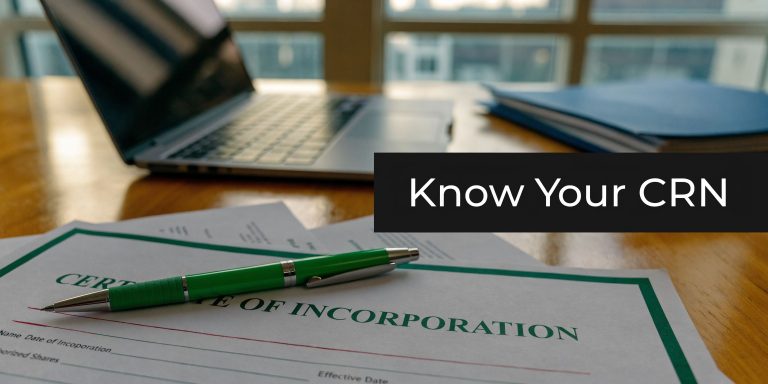
You’ve incorporated your company, opened the welcome email from Companies House, and now you’re staring at a certificate full of official wording and one short string of characters that seems oddly important. Most new directors skim past it.
That’s a mistake.
Your company registration number is one of the few details that follows your business almost everywhere. You’ll use it when filing with Companies House, dealing with HMRC, proving your business exists, and showing customers and suppliers that they’re dealing with the right legal entity. If it’s missing, wrong, or confused with another number, the problem isn’t just admin. It can affect trust, deadlines, and in some cases, penalties.
Your Business Has a Birth Certificate Its Company Number
When a company is formed, one document matters more than many directors realise. It’s the Certificate of Incorporation. On that certificate is your company registration number, often shortened to CRN.

Think of it as your business’s birth certificate number. Your trading name might appear on branding, your website, and your invoices, but the CRN is the fixed identifier that ties your company to the public register.
That matters because names can be similar. Directors can change. Addresses can change. Activities can change. Your CRN is the thread that keeps the legal identity clear.
For a new director, this often becomes relevant faster than expected. You might be setting up a business bank account, asking an accountant to register for Corporation Tax, or speaking to a lender. If you later move into specialist areas such as property investment through a company, guidance on limited company buy-to-let mortgages becomes much easier to follow once you understand which company identifier lenders and advisers are checking.
Why this number matters so early
It is often assumed that the hard part is incorporation itself. In reality, the harder part is using the right details consistently after incorporation.
A CRN helps people verify that:
- Your company exists legally and appears on the Companies House register
- They’ve found the right business, not one with a similar name
- Your filings match your company record
- Your paperwork looks professional and credible
Practical rule: If a form, invoice, email footer, or filing asks for your company details, pause and check whether it wants your company registration number rather than a tax number.
If you’ve only just started, it also helps to understand the wider setup process around incorporation, records, and next steps. This guide on https://stewartaccounting.co.uk/steps-to-register-a-new-company-in-the-uk/ is useful if you want the broader picture around forming a UK company properly.
What Exactly Is a Company Registration Number
A company registration number is the unique identifier issued by Companies House when a limited company or LLP is incorporated. It isn’t a tax number. It isn’t your VAT number. It isn’t your business name.
The simplest way to think about it is this. Your CRN is to your company what a National Insurance number is to an individual. It identifies one legal entity and stays attached to that entity as its core official reference.

What it looks like
The format depends on where the business is registered in the UK.
- England and Wales use eight digits, such as 01234567
- Scotland uses SC followed by six digits
- Northern Ireland uses NI followed by six digits
- LLPs can also use formats such as OC plus six digits in England and Wales, or SO plus six digits in Scotland
That format isn’t just cosmetic. It tells systems, advisers, banks, and government bodies what type of entity they’re dealing with and where it sits on the register.
When you get it
You get your CRN when the company is incorporated. According to Companies Made Simple’s summary of Companies House data, 753,168 companies were incorporated across the UK in the fiscal year from 2021 to 2022, and each was issued a unique CRN on incorporation. The same source notes that the active UK company population exceeded 4.5 million by 2022, and that a CRN remains unchanged for the life of the company.
That last point is important. Your business name can change. Your directors can change. Your registered office can change. The CRN usually remains the constant marker of the legal entity.
Why it exists
Companies House needs a way to distinguish one legal person from another. That sounds dry, but it’s practical.
If a supplier runs a check on your company, they’re not relying only on the name. If HMRC cross-references a filing, it needs the right company identifier. If a customer wants to confirm they’re paying the correct business, your CRN helps them find the exact company record.
For anyone choosing a name, it also helps to understand the difference between a trading identity and the underlying registered company. If you’re still at that stage, this guide to registering a business name with Companies House is a useful companion read.
A short explainer can also help if you prefer video.
Your company name is what people remember. Your company registration number is what systems trust.
How to Find Any UK Company Registration Number
A new supplier sends you an invoice. The bank details look fine, the branding is polished, and payment is due today. Before you approve it, take 60 seconds to check the company registration number against the public record. That small habit can save you from paying the wrong legal entity, dealing with a disputed invoice later, or explaining to your bank why funds went to a business that does not match the paperwork.
For your own company, the easiest place to start is the paperwork created when the business was born. Your Certificate of Incorporation will show the CRN, and you will often see it again on Companies House letters, filing reminders, and in your bookkeeping or company secretarial software. If your accountant or formation agent set everything up properly, the number should be recorded there too.
If you are checking another business, or you want to confirm your own details, use the Companies House search service. Search the legal company name, open the company profile, and check the registered number shown on the record. Treat it like checking a vehicle registration before buying a car. The trading name and branding may be familiar, but the public register tells you which legal entity you are dealing with.
That register does more than confirm a number. It lets you see whether the company exists, whether it is active, and whether the CRN on an invoice, email footer, or website matches the official entry. If you want more background, our guide to what information appears on the Companies House register explains what you can and cannot see there.
One point catches many new business owners out. Only incorporated entities such as limited companies and LLPs have a company registration number. Sole traders do not. Many partnerships do not. If someone searches for a CRN for a sole trader, they are looking for a number that does not exist. In practice, that confusion often leads people to use a UTR in the wrong place, which can cause delays, rejected checks, or documents that look less credible than they should.
A practical test works well when a document lands in your inbox. Start with the legal name, not the logo. Find the CRN on the invoice, website, or email footer. Then compare both details with the Companies House record before you approve payment or agree credit terms.
If the company name and CRN do not match the public record, pause the transaction and ask for corrected details.
That is not red tape. It is basic business hygiene. A wrong CRN can mean old stationery, sloppy admin, or, in the worst cases, a business presenting itself as a different legal entity.
CRN vs UTR vs VAT Number Decoding Business IDs
Many directors often find themselves confused. They know they have “a business number” but aren’t sure which one belongs where.
A company registration number identifies the legal company on the Companies House register. A UTR is for tax. A VAT number is for VAT registration and VAT invoices. They are not interchangeable.
UK Business Number Comparison
| Identifier | Issuing Body | Primary Purpose | Who Needs It? |
|---|---|---|---|
| Company Registration Number | Companies House | Identifies the legal entity on the public register | Limited companies and LLPs |
| Unique Taxpayer Reference | HMRC | Identifies the business or person for tax matters | Companies, sole traders, partnerships, and others dealing with HMRC |
| VAT Number | HMRC | Identifies a VAT-registered business for VAT administration | Businesses registered for VAT |
Why the distinction matters
If you put the wrong number on the wrong form, systems can reject the submission or delay the process.
The CRN format is especially important. According to Square’s glossary entry on company registration numbers, the UK CRN follows a precise jurisdiction-based format, and using the wrong format can delay corporation tax registration by up to 14 days because of automated validation failures. The same source says Companies House rejects about 2% of initial filings annually for format mismatches.
That tells you something useful. The issue isn’t only that a number is missing. A number that looks almost right can still create trouble.
A practical way to remember each one
Use this rule of thumb:
- CRN means “Who is the company?”
- UTR means “How does HMRC track this taxpayer?”
- VAT number means “Is this business VAT registered for VAT transactions?”
Common real-world mix-ups
A new limited company uses its UTR where a CRN is expected
This often happens during early setup when directors receive several official letters at once. They copy the newest number they’ve been sent and assume that’s the one every form wants.
That can derail onboarding with banks, software, finance providers, or accountants because those parties may be trying to verify the company on the Companies House register.
A sole trader looks for a CRN
A sole trader won’t usually have one because they are not a separate incorporated legal entity. They’ll normally be dealing with a UTR instead.
A VAT number ends up on documents where the company number should appear
This is common on invoices and websites. The business may be disclosing one identifier and forgetting the other.
If you’re checking whether a VAT number itself is genuine, this resource is handy: https://stewartaccounting.co.uk/check-a-uk-vat-number-is-authentic/
Useful test: Ask what the other party is trying to verify. If they need the public company record, give the CRN. If they’re dealing with tax, the UTR or VAT number may be the right reference instead.
The goal isn’t to memorise every code for the sake of it. It’s to stop using one identifier as a stand-in for another.
Where You Must Display Your Company Number by Law
A director sends an invoice on Friday afternoon. On Monday, the customer’s finance team spots that the company number is missing, puts the invoice on hold, and asks a simple question: which legal entity are we paying?
That is why display rules matter. Your company registration number is not just for Companies House forms. It also has to appear in the places where customers, suppliers, lenders, and procurement teams check who they are dealing with.

The legal footing comes from the Companies Act 2006 and The Company, Limited Liability Partnership and Business (Names and Trading Disclosures) Regulations 2015. Those rules set out when a limited company must show its registered details, including its registered number, on business communications and at its registered office.
Where directors should check first
Start with the items that leave your business every day or help strangers verify you online:
- Invoices and credit notes
- Order forms and business letters
- Email footers
- Your website, usually in the footer, contact page, or legal information page
- Other formal business documents used in day-to-day trading
A simple way to view this is to treat the CRN like the registration plate on a vehicle. Customers may know your brand name, but the number helps them confirm the legal entity behind it. If that number is wrong, missing, or inconsistent, the checks slow down straight away.
Why mistakes here create practical problems
The immediate risk is often not a fine. It is friction.
A missing or incorrect CRN can lead to payment queries, onboarding delays, due diligence questions, or concerns that the invoice does not match the company on the public register. That is especially common where a customer’s accounts team or procurement manager is comparing your details against Companies House before approving a supplier.
Website disclosures matter for the same reason. If your site shows one legal name, your invoice shows another variation, and the company number is absent, a cautious buyer may wonder whether your admin is sloppy or whether the business itself is unclear.
That doubt is avoidable.
The legal point directors should understand
The law is about disclosure, but the business effect is credibility. The Companies Act 2006 sets the framework for company information and business correspondence. The 2015 Trading Disclosures Regulations spell out where certain company details must be displayed by companies and LLPs.
You do not need to memorise the regulations like a lawyer. You do need to make sure your templates, website, and communications show the right legal identity consistently.
A practical disclosure checklist
Use this as a director’s review list:
- Website footer checked. Show the full registered company name and company number together.
- Invoice template checked. Confirm your software pulls the correct legal details every time.
- Email signatures standardised. Old staff templates often keep outdated details.
- PDF stationery reviewed. Check quotations, letterheads, proposals, and order forms.
- Registered office signage and records reviewed where relevant.
- Third-party platforms checked. Portals and marketplace profiles often lag behind your main records.
One small number, clear consequences
Clean disclosures make verification easy. Poor disclosures create hesitation.
A procurement manager checking three competing suppliers will notice which business has consistent, correct legal details, and which one does not. That small detail can shape how organised, reliable, and low-risk your company appears before anyone picks up the phone.
Common CRN Mistakes and Compliance Pitfalls to Avoid
A CRN error often shows up at the worst possible moment. A customer is ready to pay, a supplier is carrying out checks, or a bank portal is waiting for confirmation. Then one mismatched number slows the whole process down.
That is why this is less about definitions and more about consequences. A company registration number is small, but once it is copied into templates, software, and onboarding forms, one mistake can spread through the business like the wrong postcode on every letter you send.
Five moments to double-check your CRN
1. Before sending a first invoice to a new customer
Finance teams often verify supplier details before releasing payment. If the company number on the invoice does not match the legal entity they expect to see, the invoice may be queried or held back while they ask for clarification.
You still did the work. You just wait longer to get paid.
2. When completing supplier, lender, or platform onboarding
Onboarding forms are where copied errors become operational problems. If your CRN is entered incorrectly, your business can fail a verification check, trigger extra questions, or end up with duplicate records in someone else’s system.
That makes your company look harder to verify than it should be.
3. When setting up or changing accounting software and document templates
A wrong CRN in one template is annoying. A wrong CRN hard-coded into invoicing software, proposal PDFs, credit control emails, and purchase order paperwork creates a clean-up job across every department.
This is how a small admin slip turns into messy internal records. Staff start working from different versions, advisers spend time correcting basic details, and useful jobs get delayed by avoidable repairs.
4. After a re-registration or legal change
Re-registration is less common, but it does happen. When it does, the CRN changes. Every template, filing, and system needs updating.
Directors often update the headline items and miss the quieter ones, such as old PDF stationery, dormant website pages, payment portal profiles, or pre-filled forms inside software subscriptions.
5. Before sharing company details externally
Any place that publishes or passes on your legal details deserves a final check. That includes marketplaces, procurement portals, finance applications, insurance records, and partner databases.
If those records conflict with each other, other people have to decide which version is right. That hesitation affects trust before anyone discusses your service, price, or track record.
A CRN mistake rarely stays in one place. It moves from one copied field to the next, then shows up as delayed payments, stalled checks, and records that no longer agree.
A sensible habit helps. Keep one approved version of your legal entity details, and use it as the master record for software setup, document templates, and onboarding forms. That gives your business one clear identity everywhere it appears.
Accuracy here is not box-ticking. It protects cash flow, keeps admin time under control, and shows other organisations they are dealing with a company that has its house in order.
Let Stewart Accounting Services Handle the Details
A company registration number looks simple because it’s short. The work sits behind it.
It needs to be used correctly on filings, matched properly across HMRC and Companies House processes, shown where the law expects it, and updated when business changes create knock-on admin. That’s easy to overlook when you’re busy running sales, staff, cashflow, and growth.
Good accounting support removes that friction. It helps keep the legal entity details aligned with the practical side of running the company, from accounts and Corporation Tax to payroll, VAT, and routine compliance.
For directors who want fewer admin surprises, that matters. You get more confidence in the records, fewer avoidable queries, and more headspace for the commercial side of the business.
If you want experienced support with Companies House filings, HMRC deadlines, VAT, payroll, bookkeeping, or the wider compliance side of running a growing business, speak to Stewart Accounting Services. We help business owners get more time, more money, and a clearer mind.