

Mastering Company Secretarial Responsibilities

The duties of a company secretary stretch far beyond just ticking boxes and filing paperwork; they are the bedrock of strong corporate governance. This role is absolutely vital, covering everything from statutory compliance to making sure the board runs smoothly, all while advising leadership on the legal and regulatory maze so the company can operate lawfully and effectively.
The Modern Company Secretary's Expanding Role
If you're picturing a company secretary buried under stacks of paper, it's time for an update. Today, the role is much more like the company's conscience and strategic guide. Their primary job is to steer the business through a jungle of complex regulations, maintain open lines of communication between the board and its stakeholders, and give leadership the confidence to make sound, compliant decisions.
This isn't just a small change; it's a complete evolution. The role has transformed from a back-office administrative function into a strategic pillar of the business. Where the job was once about recording minutes and filing forms, it's now about safeguarding the company's integrity and enabling its leaders to manage effectively. It’s a role that demands foresight, strategic thinking, and the trust of the board.
From Administrator to Strategic Advisor
The company secretary now sits at the heart of corporate strategy and risk management. This change mirrors a wider shift in the business world, where transparency and accountability are no longer optional extras. Instead of just documenting what has already happened, they are actively involved in shaping what happens next.
This shift is becoming more and more recognised. By 2025, the role of UK company secretaries will have firmly moved from administrative compliance towards strategic governance leadership. The modern brief often includes advising the board on complex legal matters, corporate strategy, risk management, and upholding ethical standards—a world away from simply taking minutes and handling statutory filings.
Embracing New Tools and Responsibilities
Technology has been a huge catalyst for this transformation. With automation and digital tools now taking care of many routine tasks, the company secretary is free to focus on the high-value work that truly supports the board. Exploring advancements like ChatGPT for Company Secretaries highlights how AI is already changing the game, helping with everything from drafting complex documents to researching niche compliance questions.
A skilled company secretary doesn't just manage compliance; they build a framework for sound decision-making that protects directors and adds long-term value to the business.
Ultimately, getting to grips with these expanded company secretarial responsibilities is essential for any business owner. Whether you manage this function in-house or bring in an expert service like Stewart Accounting Services, it's a role that is fundamental to your company's health, reputation, and future success.
Meeting Your Core Statutory Duties in the UK
Think of your company's statutory duties as its annual MOT. It’s not optional. Just as a car needs to pass its inspection to be legally roadworthy, your business has a set of non-negotiable legal requirements it must meet to stay compliant with Companies House. These tasks are the bedrock of all company secretarial responsibilities.
Getting this right isn't just about good practice; it's a legal obligation. The consequences for getting it wrong can be surprisingly severe, starting with automatic financial penalties and, in the worst-case scenarios, leading to the company being struck off the register entirely. That’s why every director needs a firm grasp of these fundamentals.
This timeline shows just how much the company secretary role has shifted over the years, moving from a purely administrative job to a much more strategic, governance-focused position.
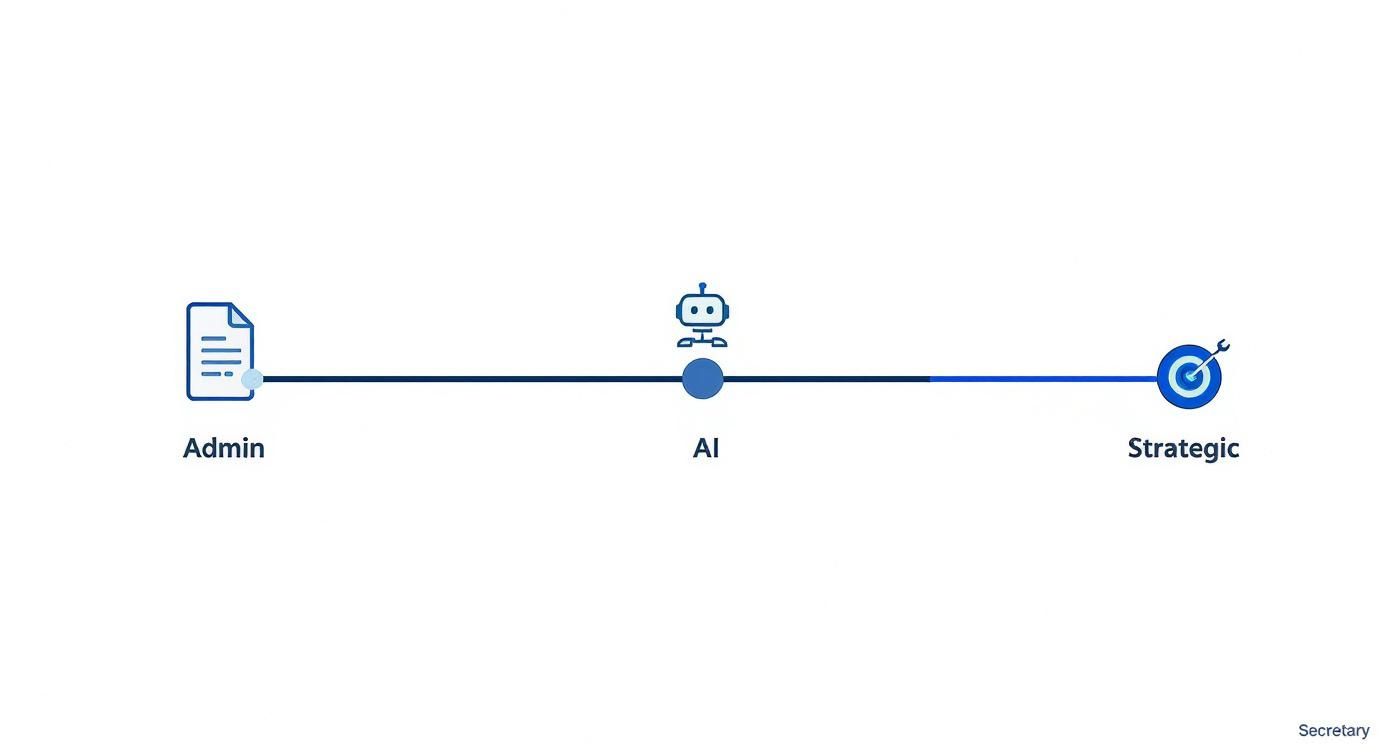
As you can see, the modern role is a balancing act between essential administrative tasks and a forward-thinking approach to good governance.
Maintaining Statutory Registers
Every single limited company in the UK is legally required to maintain a set of official records, often called statutory registers or books. These are essentially the company’s official logbooks, providing a transparent record of its ownership and management. They might sound like a simple bit of admin, but keeping them accurate and up-to-date is a legal must.
These key registers include:
- Register of Members: A definitive list of all shareholders and exactly how many shares each person holds.
- Register of Directors: The official record of every company director, including their service address.
- Register of PSCs: This holds information on any 'Persons with Significant Control'—the individuals who ultimately own or control your company.
Letting these registers fall out of date can cause real headaches, leading to fines and serious complications, especially if you’re ever going through an audit or looking to sell the business.
The Annual Confirmation Statement
At least once every 12 months, your company must file a confirmation statement. This isn’t a set of accounts, but rather a snapshot in time. Its purpose is to confirm that all the information Companies House holds about your company is correct on a specific date.
It's your company's annual check-in, verifying that details like the registered office address, director information, and PSC register haven't changed. If things have changed during the year, you need to report those updates first, before or at the same time as you file the statement.
A common pitfall is thinking the confirmation statement itself is how you update your company details. It's not. It simply confirms the data on record is accurate. If you've appointed a new director, for example, that needs to be filed separately using the correct form.
Filing Annual Accounts and Managing Deadlines
Submitting annual accounts is probably the most widely known statutory duty. These financial statements summarise your company's financial health over the past year and must be filed with both Companies House and HMRC.
The deadlines here are incredibly strict, and missing them triggers automatic penalties. These fines escalate sharply the longer the accounts are overdue. For a private limited company, the penalty kicks in at £150 for being up to one month late and can climb to a painful £1,500 for being more than six months late. Staying on top of these dates is absolutely critical. To learn more, take a look at our complete guide to Companies House filing deadlines.
Key Statutory Filing Deadlines at a Glance
Navigating these deadlines can feel overwhelming, but they are crucial for compliance. The table below breaks down the most common responsibilities and when you need to act.
| Responsibility | What It Involves | Typical Deadline |
|---|---|---|
| Annual Accounts | Filing a summary of the company's financial performance. | 9 months after the company's financial year-end. |
| Confirmation Statement | Confirming the company information held by Companies House is accurate. | At least once every 12 months. |
| Changes to Company Details | Notifying Companies House of changes (e.g., new director, address change). | Usually within 14 days of the change. |
| Corporation Tax Return | Filing the company's tax return (CT600) with HMRC. | 12 months after the end of the accounting period. |
Keeping track of these isn't just about avoiding fines; it's about maintaining your company's good standing and ensuring its records are always accurate and transparent.
Here at Stewart Accounting Services, we take this burden off your shoulders. We manage all these core duties for our clients, making sure every register is meticulously maintained and all filings are submitted correctly and on time. It's about giving you complete peace of mind.
Orchestrating Effective Board Meetings and Governance
Beyond the world of statutory filings, a company secretary's most visible role is often in the boardroom. Think of them as the conductor of an orchestra, ensuring every element of a board meeting—from setting the agenda to finalising the minutes—works in perfect harmony. This isn't just about shuffling papers; it's about shaping an environment where good, legally sound decisions can be made. It's the very heart of effective governance.
The work starts long before anyone sits down at the table. A crucial task is preparing and sending out the ‘board pack’. This isn't just a random assortment of documents; it’s a carefully curated collection of reports, financial updates, and strategy papers. The goal is to give directors everything they need to come prepared and make genuinely informed choices.

Crafting the Agenda and Guiding Discussion
A well-thought-out agenda is the roadmap for any productive meeting. The company secretary will work closely with the chairperson to build one that is both strategic and focused. It’s about prioritising what really matters, giving enough time for proper discussion, and making sure all the necessary legal and governance boxes are ticked.
Once the meeting begins, the secretary steps in as a procedural guide. They make sure the meeting follows the company's articles of association, that enough directors are present for a quorum, and that the conversation stays on track. This steady hand frees up the directors to concentrate on strategy, rather than getting bogged down in the rules. Deciding on the meeting format is also vital in today's business world; our guide explores the pros and cons of face-to-face versus online business meetings and how to get the most out of each.
The Art of Taking Accurate Minutes
The minutes of a board meeting are far more than simple notes. They are the official, legal record of every decision made. Getting them right is one of the most fundamental parts of the company secretary's job. These documents have to state clearly what was decided, who is responsible for the follow-up actions, and the thinking behind the board's key choices.
Good minute-taking is a real skill. It's a balancing act between capturing enough detail and maintaining clarity, creating a record that’s comprehensive without being a word-for-word transcript.
"The minutes should serve as a source of truth for the company. They protect the directors by providing evidence of due diligence and create a clear action plan that drives the business forward."
Ultimately, mastering meeting minutes is about creating records that are not only compliant but genuinely useful. As part of the company's official books, they can be critical in a legal dispute, which makes their accuracy non-negotiable. At Stewart Accounting Services, we take on this meticulous task for our clients, ensuring their board meetings are productive, perfectly documented, and offer total protection for the business and its leaders.
Public vs. Private Companies: A Tale of Two Rulebooks
When it comes to company secretarial duties, the first thing to grasp is that UK corporate law doesn’t treat all companies the same. There’s a crucial fork in the road depending on whether you’re a public limited company (PLC) or a private limited company. It's not just a subtle difference in terminology; the legal goalposts are in completely different fields.
Think of it this way: running a private company is like driving your own car. You need to follow the rules of the road, but the oversight is relatively straightforward. Running a PLC, on the other hand, is like piloting a commercial airliner. The regulations, qualifications, and public scrutiny are on an entirely different level because you're responsible for the public's investment.
For a PLC, appointing a company secretary isn't just a good idea—it's a non-negotiable legal requirement. The rules are iron-clad, designed to uphold the highest standards of corporate governance to protect shareholders and maintain public trust.
The Must-Have Role in Public Companies
The Companies Act 2006 really hammered home the importance of this role for PLCs. Since April 2008, every single public company in the UK has been legally obligated to appoint a formally qualified company secretary.
And the law sets a high bar. The person appointed must have the "requisite knowledge and experience" to handle the complex governance of a publicly listed entity. This typically means they are a qualified solicitor, barrister, accountant, or hold a membership with a recognised professional body like the Institute of Directors.
Why so strict? Because PLCs have a much wider circle of people to answer to, including thousands of public investors. The company secretary is essentially the guardian of the company’s compliance, making sure everything from stock market updates to shareholder meetings is handled by the book.
The Freedom—and the Catch—for Private Companies
On the flip side, the rules for private limited companies are far more relaxed. The very same law that made the company secretary mandatory for PLCs made the role optional for private companies. So, unless your own articles of association insist on it, there’s no legal gun to your head telling you to appoint one.
But here’s the catch, and it’s a big one: just because the role is optional doesn't mean the responsibilities vanish into thin air. They don't. All those essential statutory duties—keeping company registers up to date, filing annual accounts, and submitting the confirmation statement—still have to be done.
If a private company decides not to appoint a secretary, the legal buck for getting these tasks done stops squarely with the directors. Pleading ignorance won't get you very far if things go wrong.
This is a trap many business owners fall into. They see the word "optional" and assume the work is too. The reality is that the directors simply inherit these critical compliance duties on top of everything else they’re doing.
This is precisely why so many ambitious private companies, even without being legally forced to, decide to get professional help. At Stewart Accounting Services, we effectively become that company secretary for our clients. We take on those director-level compliance burdens, ensuring everything is done correctly and on time, which lets them get back to what they do best: growing their business.
How Outsourcing Your Secretarial Duties Boosts Your Business
Trying to run a business while keeping on top of the nitty-gritty of corporate compliance can feel like spinning plates. For many directors, the sheer weight of company secretarial responsibilities is a huge distraction, pulling their attention away from strategy, innovation, and looking after customers. This is exactly why outsourcing these tasks is a smart strategic move, not just an admin shortcut.
Think about a fast-growing start-up. The founders might be brilliant at what they do, but they’re losing hours every month wrestling with Companies House rules, updating statutory books, and getting ready for board meetings. That’s time they’ll never get back—time that could have been spent winning new clients or perfecting their product.

Handing these duties over to a specialist firm like Stewart Accounting Services completely changes the game. Suddenly, the burden of compliance is lifted. It stops being a business risk and becomes a professionally managed function you don't have to worry about.
Gaining Peace of Mind and Guaranteed Compliance
The most immediate win from outsourcing is wiping out the risk of simple human error. It’s so easy to miss a deadline for a confirmation statement or annual accounts, and that triggers automatic penalties which can stack up fast. A professional service, on the other hand, lives and breathes these deadlines. They make absolutely sure every filing is correct and on time. Every single time.
This proactive approach gives you invaluable peace of mind. Instead of losing sleep over changing legislation or a forgotten date, you can run your business knowing its legal standing is rock-solid. It’s like having a dedicated compliance officer on the team, but without the cost of a full-time salary. You'll find similar benefits when you look into the key advantages of outsourcing your bookkeeping, as both free you up to concentrate on growth.
"Outsourcing secretarial work isn’t about offloading tasks; it’s about importing expertise. It allows leaders to dedicate their energy to innovation and growth, knowing their corporate governance is in expert hands."
Unlocking Strategic Focus and Efficiency
Beyond just ticking the compliance boxes, outsourcing your secretarial duties buys back your most precious resource: your time. When you and your key people are no longer bogged down in administrative paperwork, that energy can be channelled into what actually grows the business.
This shift delivers real, tangible benefits:
- More time for strategy: Directors can finally get their heads up and focus on high-level planning, new market opportunities, and the long-term vision.
- Improved decision-making: With all the governance handled, board meetings become sharper and more focused on the issues that matter.
- Enhanced professionalism: Perfectly maintained records and punctual filings send a powerful message to investors, lenders, and partners. It tells them your business is credible and managed properly.
Here at Stewart Accounting Services, we take care of every facet of your company's secretarial needs. From keeping your statutory books in perfect order to handling all correspondence with Companies House, we become a seamless extension of your team. Our aim is to make compliance invisible, so you can get on with the real work of building a successful business.
The Real Value of a Good Company Secretary
It’s easy to think of a company secretary as a purely administrative role, someone who just takes minutes and files paperwork. But that's like looking at the tip of an iceberg and missing the massive, powerful structure hidden beneath the surface.
A truly skilled company secretary is a strategic powerhouse. They are a trusted advisor to the board, a guardian of the company’s governance, and a key player in its long-term health.
Their real value is in their foresight. By weaving good governance practices into the very fabric of the company, they empower the board to make tough decisions with clarity and confidence. This isn't just about ticking boxes to avoid penalties; it's about building a fundamentally stronger, more resilient business that can navigate stormy seas and capitalise on new opportunities.
A Highly Valued Profession
If you want proof of how vital the company secretarial responsibilities are, just look at the salaries. This isn't some entry-level admin job; it's a serious profession with a career path that reflects the deep expertise required.
Here in the UK, the numbers speak for themselves. A trainee might start on £20,000 to £35,000, but that figure climbs quickly. An assistant company secretary can expect to earn between £56,000 and £82,000, while a deputy role can command up to £130,000. At the top of the profession, a group company secretary in a large firm can earn over £310,000 a year. You can see a full breakdown of these salary insights on The Corporate Governance Institute website.
Investing in professional secretarial support is not a cost centre; it is an investment in robust governance, risk mitigation, and strategic leadership that protects the entire business from the top down.
This compensation shows that a company secretary is a senior, influential figure. Their guidance is essential for protecting the directors and the business itself, ensuring the board isn't just compliant, but truly effective.
Got Questions? We’ve Got Answers
The world of company secretarial duties can seem a bit murky, and it’s natural to have questions. Over the years, we’ve found a few key queries pop up again and again. Let's clear the air and tackle some of the most common concerns business owners have.
Do I Really Need a Company Secretary for My Small Limited Company?
This is easily the most frequent question we get. In short, the Companies Act 2006 removed the legal requirement for private limited companies in the UK to appoint a company secretary. So, technically, no.
But here’s the important bit: the responsibilities don't just vanish into thin air. They automatically fall onto the company's director. Many savvy business owners decide to outsource these tasks to a professional service to make sure everything is done by the book, without the overhead of an employee.
What’s the Big Deal If We Miss a Companies House Deadline?
Missing a filing deadline for your annual accounts or confirmation statement isn’t something you can just brush off. Companies House issues automatic late filing penalties, and they start ticking up fast.
The fines begin at £150 and can quickly escalate to over £1,500 for private companies, depending on how late the submission is.
It's not just about the money, though. Persistent failure to file can lead to the company being forcibly struck off the register and, in serious cases, can even result in the prosecution of its directors. Staying on top of deadlines is crucial to keeping your business in good legal standing.
Can I Be a Director and the Company Secretary at the Same Time?
Yes, you absolutely can. For a private limited company, it's very common for a director to wear both hats, especially in a smaller setup where roles naturally overlap.
There is one major exception to be aware of: if you are the sole director of the company, you cannot also be the company secretary. This rule is in place to ensure there's at least some separation in the core governance of the business. Public companies have much stricter rules, demanding a formally qualified secretary who is entirely independent of the directors to maintain strong corporate governance.
Feeling a bit overwhelmed by the rules? You don't have to figure it all out on your own. At Stewart Accounting Services, we handle the full spectrum of company secretarial duties, giving you the confidence that you're always compliant so you can focus on what you do best.
Ready for some peace of mind? Find out how we can help at https://stewartaccounting.co.uk.