

When you're self-employed, one date looms larger than any other: the 31st of January. This is the final, no-excuses deadline to get your tax return filed online and, crucially, to pay what you owe for the previous tax year.
If you’re one of the few who still prefer to file by post, you need to be far more organised. The deadline for paper tax returns is a full three months earlier, at midnight on the 31st of October.
Key Deadlines for Your Self-Employed Tax Return
Stepping into self-employment means you’re now the boss of your own finances, and the first rule of being a good finance boss is knowing your deadlines. Forgetting to file your self-employed tax return on time isn’t a simple mistake; HMRC can hit you with immediate penalties and start charging interest, so it pays to be prepared.
Think of the tax year as a journey with several key milestones. While the final destination for most is 31st January, there are other important stops along the way for getting registered, submitting paper forms, and making tax payments in advance. Getting these dates mixed up can seriously disrupt your cash flow and bury you in needless admin.
This simple timeline lays out the Self Assessment process, highlighting the different tracks for paper versus online filing.
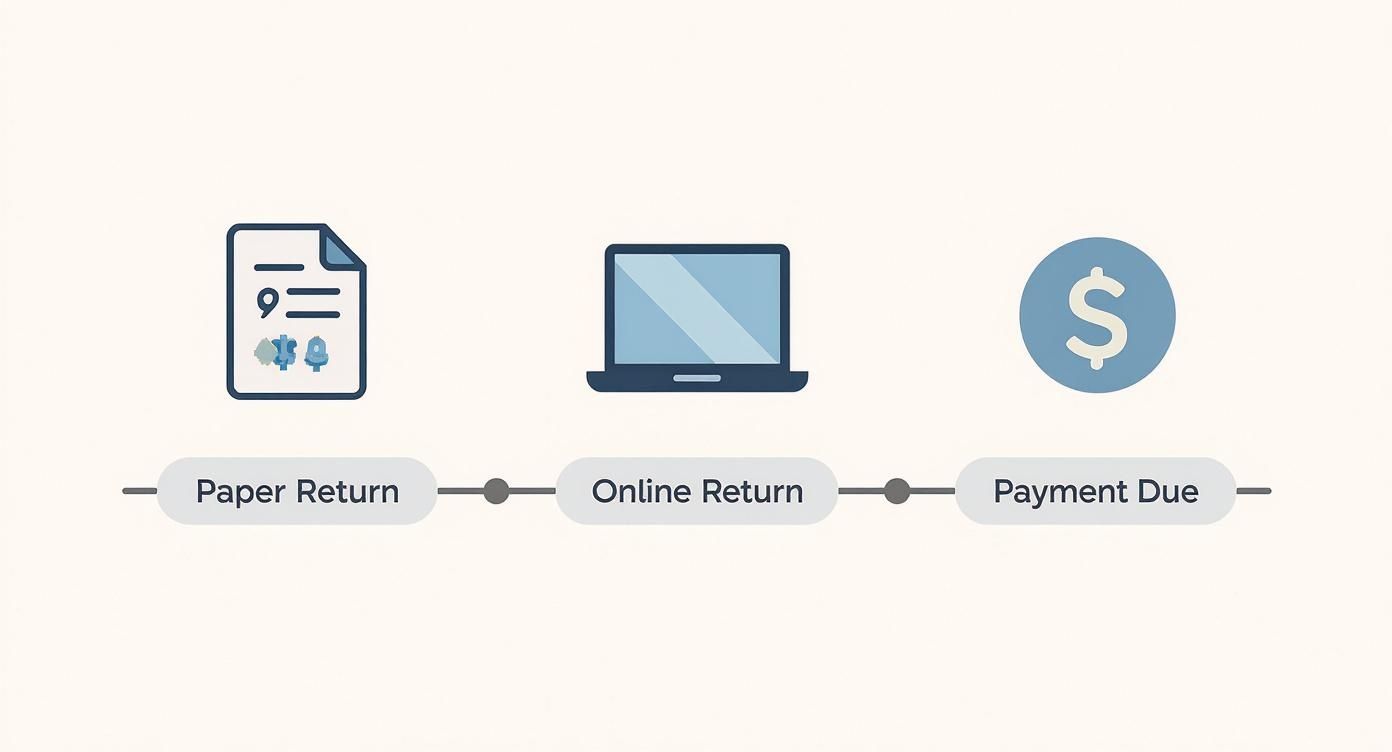
What really stands out is just how much more breathing room you get with online filing. It’s no wonder it’s the go-to choice for the vast majority of people.
Your Essential Tax Return Timeline
To help you get organised, here’s a straightforward breakdown of the dates you absolutely must have in your calendar. For the tax year that ran from 6th April 2023 to 5th April 2024, for instance, the deadline to file online and pay up is midnight on 31st January 2025. You can always find the latest official guidance on Self Assessment tax return deadlines on the GOV.UK website.
Staying on top of your self-employed finances isn’t about a mad dash to the finish line. It’s about being organised all year round. Knowing your deadlines is the first, and most important, step.
To make it even clearer, here’s a quick-reference table with all the key dates you need to know.
Key Self Assessment Deadlines at a Glance
This table summarises the most important dates that every self-employed person in the UK needs to be aware of for a typical tax year. Pop them in your diary now so they don't catch you by surprise later.
| Task | Deadline | Notes |
|---|---|---|
| Register for Self Assessment | 5th October | This is due after the end of the tax year in which you started your business. |
| Paper Tax Return Filing | Midnight, 31st October | The deadline for the previous tax year (e.g., 31st Oct 2024 for the 2023/24 tax year). |
| Online Tax Return Filing | Midnight, 31st January | The main deadline for almost everyone filing digitally. |
| Pay the Tax You Owe | Midnight, 31st January | This covers your final tax bill for last year and the first of your 'payments on account'. |
| Second Payment on Account | Midnight, 31st July | This is the second and final instalment you pay towards your estimated bill for the current year. |
Keeping this table handy is a great way to ensure you're always one step ahead of HMRC's deadlines.
Getting to Grips with the UK Tax Year and Registration
Before we dive into the deadlines for your self-employed tax return, we need to get one crucial thing straight: the UK tax year. It doesn't run from January to December like a normal calendar year. Instead, HMRC operates on a timeline that runs from 6th April to 5th April the following year.
Think of this as the financial year for your business. Every bit of income you earn and every expense you claim needs to fit neatly into this specific 12-month window. It's the bedrock of the entire Self Assessment system.
So, when you're frantically filing a return in January 2025, you're actually reporting on your business activities from the tax year that finished way back on 5th April 2024. Nailing this concept from the get-go is the first and most important step to staying on the right side of HMRC.
The First Deadline You Absolutely Cannot Miss
Long before you even think about filing, you have to officially let HMRC know you've started trading. This brings us to your very first deadline: registering for Self Assessment.
You must register by 5th October after the end of the tax year in which you first became self-employed.
Let's break that down. Say you started your freelance business in June 2024. That falls within the 2024/25 tax year. This means your deadline to register with HMRC is 5th October 2025. It might seem a long way off, but it gives HMRC plenty of time to get you set up and send you the details you'll need later.
The government's website is the best place to start the process.
As you can see, the online journey guides you based on your situation, whether you're a sole trader, part of a business partnership, or have other reasons for needing to file a return.
Who Actually Needs to Register?
It's a common misconception that Self Assessment is only for sole traders or freelancers. In reality, lots of people need to file a tax return, and it’s your responsibility to figure out if you're one of them. You'll need to register if, in the last tax year, you:
- Earned over £1,000 from self-employment.
- Were a partner in a business partnership.
- Had untaxed income from renting out a property.
- Received significant income from savings, investments, or dividends.
For contractors, understanding your employment status is particularly important. Getting into the weeds with further details on IR35 compliance is a must to make sure you're meeting all your legal obligations.
Once you’ve registered, HMRC will post you a letter containing your Unique Taxpayer Reference (UTR). This is a ten-digit number that's your personal ID for everything Self Assessment. Keep it safe – you’ll need it every time you file or contact HMRC.
Choosing Between Online and Paper Filing
When it comes to filing your Self Assessment, you’ve got two paths: the old-school paper route or the modern online one. This choice isn't just a matter of preference; it fundamentally changes your tax return deadline, making it a critical decision in your financial year.
Think of it like posting a letter versus sending an email. One requires you to plan ahead and has an early, non-negotiable cut-off. The other is faster, gives you instant confirmation, and offers a lot more breathing room.
The Case for Going Digital
Most self-employed people now file online, and for very good reason. The biggest advantage? Time. The online filing deadline is midnight on 31st January, which gives you a full three extra months compared to the paper option.
That extra time is a lifesaver, but the perks don't stop there. Filing online also gives you:
- Instant Confirmation: As soon as you hit submit, HMRC sends a receipt. No more worrying about whether your return got lost in the post.
- Automatic Calculations: The online form does the heavy lifting, calculating your tax for you and drastically cutting the risk of simple but costly mistakes.
- Sheer Convenience: You can file from your desk, the sofa, or pretty much anywhere with an internet connection, right up to the last second. The HMRC tax app makes it even easier, and you can find help to set up your tax app with HMRC in our dedicated guide.
HMRC is nudging everyone towards digital, so getting comfortable with the online system is essential. It's all part of the evolution of digital tax that's reshaping how businesses manage their finances.
Why Paper Filing Is Becoming a Rarity
If you’re set on filing a paper return, you need to be far more organised. The deadline is much, much earlier: midnight on 31st October. That means your return has to be filled out perfectly and in the post with plenty of time to spare.
While paper filing is still technically an option, the world has moved on. The push for digital isn't just about making things easier; it's about building a tax system that’s faster, more accurate, and more efficient for everyone.
The official numbers tell the story. For the 2022-23 tax year, a massive 97.11% of returns were filed online. And it seems many of us leave it late – a staggering 778,068 returns were filed on deadline day itself, with the busiest hour seeing over 61,000 submissions. You can read more about these last-minute filing statistics on GOV.UK.
Ultimately, going digital gives you a crucial safety net. It reduces the last-minute panic and helps you tackle your self-employed tax return deadline with confidence.
How Tax Payment Deadlines Actually Work
https://www.youtube.com/embed/thirM4wSKPc
Filing your tax return is one thing; paying the bill is another beast entirely. The 31st of January is a date burned into the memory of every self-employed person, and for good reason. It’s often a double-deadline: the day you file your return, and the day you pay what you owe for the previous tax year. This payment is known as the 'balancing payment'.
But that's not the whole picture. For most, there's another crucial element called Payments on Account. This is the system that often catches people out and can put a serious dent in your cash flow if you're not ready for it.
Demystifying Payments on Account
So, what are they? Think of Payments on Account as a prepayment plan for your next tax bill. HMRC doesn't fancy waiting a whole year to receive the tax you're earning right now. Instead, they get you to pay an estimate of your upcoming bill in two chunks during the year.
The whole idea is to help spread the cost and avoid one gigantic, unmanageable bill landing on your doormat. The first instalment is due on 31st January, at the same time as your balancing payment. The second is due six months later, on 31st July.
The key takeaway is that your January tax payment often covers two things: the remaining tax owed for the last tax year, and the first advance payment for the current tax year. This can make your first January payment significantly larger than you might expect.
Who Needs to Make These Payments?
You’ll usually have to make Payments on Account if your Self Assessment tax bill for the previous year was more than £1,000. There's a second condition too: less than 80% of your tax was already paid at source, like through a PAYE salary from an employer.
This means that once your business gets going, most successful sole traders, freelancers, and landlords find themselves in this system. HMRC calculates each payment as 50% of your previous year's tax bill.
Let's look at a quick example. Say your tax bill for the 2023/24 tax year was £3,000. HMRC will assume you'll owe a similar amount for 2024/25 and will ask for two Payments on Account:
- £1,500 by 31st January 2025
- £1,500 by 31st July 2025
It’s a system designed to keep tax payments flowing to the Treasury, but it’s absolutely vital that you budget for these dates. Thankfully, there are situations where you don't have to pay them, for instance, if your income has dropped significantly. It's well worth looking into when you don’t need to make payments on account to see if you can reduce your bill, as understanding these rules is crucial for managing your finances without any nasty surprises from HMRC.
The Real Cost of Missing a Tax Deadline
Let's be blunt: missing your Self Assessment deadline isn't just a minor slip-up. It's an expensive mistake with immediate and painful financial consequences. HMRC has a very clear price tag for procrastination, and the penalties are designed to escalate quickly, turning what might have been a manageable tax bill into a real headache.
The moment the clock ticks past midnight on 31st January, the penalty system kicks in automatically. What often surprises people is that you get an instant fine even if you have no tax to pay or are actually due a refund. The penalty is for the late submission of the form itself, completely separate from paying any tax you owe.
That initial fine is just the starting point. The longer you delay, the more the costs mount, creating a snowball effect that can be incredibly difficult to get out from under.
How Late Filing Penalties Escalate
HMRC’s penalty structure is tiered, meaning the fines grow substantially the longer your tax return is outstanding. The system is deliberately set up to punish prolonged delays far more harshly than a simple oversight of a day or two.
Anyone who fails to file by the 31st January deadline gets hit with an immediate £100 fixed penalty. If your return is still outstanding after three months, you’ll face daily penalties of £10 per day, which can run for up to 90 days. Leave it for six months, and another penalty of 5% of the tax due or £300 (whichever is greater) gets added to the pile. You can dig deeper into these UK tax submission statistics and penalties if you’re interested.
The crucial point here is that late filing penalties and late payment penalties are two different things. You can be fined for filing late even if you paid your tax on time, and vice versa. You have to hit both deadlines.
To show you just how quickly these costs add up, here’s a clear breakdown of what to expect if you miss those key dates.
HMRC Late Filing and Payment Penalty Structure
The table below breaks down the penalties and interest you can expect if you miss the Self Assessment deadlines. Notice how the charges for filing late and paying late are separate and can accumulate at the same time.
| Time After Deadline | Late Filing Penalty | Late Payment Penalty |
|---|---|---|
| 1 day late | £100 fixed penalty | Interest begins on the amount owed. |
| 30 days late | £100 fixed penalty | Interest plus a 5% charge on the tax due. |
| 3 months late | Daily penalties of £10 a day (for up to 90 days) | Interest continues to accrue. |
| 6 months late | Penalty of £300 or 5% of tax due (whichever is higher) | Interest plus an additional 5% charge. |
| 12 months late | Another £300 or 5% of tax due (whichever is higher) | Interest plus a third 5% charge. |
As you can see, the costs get serious very quickly.
On top of all this, HMRC also charges daily interest on both the unpaid tax and any late payment penalties, which only compounds the debt. The message couldn't be clearer: meeting the deadline for your self employed tax return is non-negotiable if you want to keep your finances in good health.
Your Action Plan for a Stress-Free Tax Return
Let's be honest, nobody enjoys tax season. But turning that annual dread into a calm, organised process is easier than you might think. The secret is to stop viewing the tax return deadline as a single, terrifying event and start treating it as a simple, year-round habit.
A little planning is all it takes to sidestep the usual last-minute scramble. Your first move? Get your documents in order from the get-go. This isn't a job for a frantic January weekend; it’s something you do all year.
Get Organised From Day One
The key is to have a simple system for logging every penny that comes in and goes out of your business. This could be a straightforward spreadsheet, or even better, some basic accounting software. Whatever you choose, make sure you're consistently tracking:
- All your sales invoices
- Business bank statements
- Receipts for every single business expense (yes, even that £2 coffee for a client meeting!)
- Details of any other income, like rent from a property
By setting aside just an hour or so each month to update these records, you turn a potential mountain of paperwork into a small, manageable task. This one habit is probably the single biggest step you can take towards a stress-free tax return.
The goal isn't just to meet the deadline, but to arrive at it fully prepared. A year of good bookkeeping makes filing your return a matter of entering totals, not frantically hunting for crumpled receipts.
Create Your Filing Timeline
Once your record-keeping is on track, it's time to decide how you're going to file. Are you going it alone, or will you hire an accountant? Make this decision early. If your finances are simple—say, one source of self-employed income and basic expenses—filing yourself using HMRC's online service is perfectly doable.
However, if you're juggling multiple income streams or have more complex expenses, an accountant can be worth their weight in gold. Just don't leave it until January to find one! The best accountants are often swamped by then. A good rule of thumb is to have them on board by the autumn.
For more practical advice, take a look at our tips for stress-free self-assessment tax filing.
Frequently Asked Questions
It’s completely normal to have a few questions swirling around as these dates get closer. Here, we've tackled some of the most common queries we get from self-employed people, contractors, and landlords just like you.
What If I Miss the Registration Deadline?
So, you’ve missed the 5th October deadline to register for Self Assessment. First off, don't panic, but do act quickly. The most important thing is to get in touch with HMRC as soon as you realise the oversight.
There isn't a specific penalty just for registering late. However, this delay often leads to penalties for late filing and late payment, as you won't be in the system to receive your UTR or get your return done on time. Getting it sorted immediately is your best bet to minimise any financial sting.
Can I Get an Extension on My Tax Return Deadline?
This is a big one. Unlike the tax systems in some other countries, HMRC is incredibly strict with its deadlines. The 31st January deadline for online returns is essentially set in stone for the vast majority of people.
The only wiggle room is for what HMRC calls a "reasonable excuse." This covers genuinely serious and unforeseen events, like a life-threatening illness or a close family bereavement right before the deadline. You’d need to contact HMRC directly to appeal any penalties, and they'll review it on a case-by-case basis.
What If I Can't Afford to Pay My Tax Bill?
Seeing the final figure and knowing you can’t pay it by 31st January is a stressful situation, but burying your head in the sand is the worst thing you can do. The key is to be proactive and contact HMRC’s Business Payment Support Service before the payment deadline passes.
You might be eligible for a Time to Pay arrangement. This is an agreement with HMRC that lets you pay your tax bill in instalments over a period you can afford. Taking this step shows you're trying to resolve the issue and can help you avoid the hefty late payment penalties, though interest will still be charged on the amount you owe.
If you're feeling overwhelmed by the thought of managing these deadlines and payments, we're here to help. At Stewart Accounting Services, we lift the weight of Self Assessment off your shoulders, making sure everything is filed correctly and on time, so you never pay a penny more in tax than you have to. Learn more about how we can support you by visiting our website at https://stewartaccounting.co.uk.