
Getting your head around what expenses you can claim for your limited company is one of the most important parts of running the business. The golden rule from HMRC is that any cost must be "wholly and exclusively" for business purposes. If it meets that test, you can use it to lower your Corporation Tax bill. This can cover a huge range of things, from staff wages and your office rent to software you use and professional advice you pay for.
What Expenses Can My Limited Company Claim?

So, let's get straight to the question every director wants answered: what can my company actually claim? Everything comes back to that "wholly and exclusively" rule from HMRC. It's a simple test, but a powerful one for every single cost your business has.
Think of it like this. You buy a new laptop for the business. If you only use it for work – drafting proposals, answering client emails, running your business software – then it clearly passes the test. The cost was entirely for your business. But what if you also use it to watch Netflix and do your personal online shopping? Now it has a dual purpose, and things get a bit more complicated.
Getting this principle right from the start is the key to managing your company’s finances effectively. This isn't just about ticking boxes for HMRC; it's a core strategy for improving your cash flow and legally reducing your Corporation Tax. Every allowable expense you claim reduces your company’s declared profit, and a lower profit means you pay less tax. It's as simple as that.
Key Expense Categories at a Glance
So, what sorts of costs usually fit the bill? In the UK, expenses must meet this strict "wholly and exclusively" test to be tax-deductible. If a cost has a personal element, it's generally disallowed unless you can clearly separate the business portion. You can find out more about how to manage limited company expenses and what you are allowed to claim.
Here are some of the most common areas where businesses claim expenses:
- Office and Staff Costs: This is usually the biggest expense category for any company. It covers everything from employee salaries and employer’s National Insurance contributions to pension payments. It also includes the cost of running an office, like rent, utility bills, and business rates.
- Travel and Accommodation: Any travel you do for genuine business reasons is allowable. This could be train tickets to visit a client, a hotel stay for a conference, or claiming mileage if you use your own car for work journeys.
- Marketing and Professional Fees: Money you spend promoting your business is a valid expense. Think digital advertising campaigns, website hosting costs, or printing new business cards. The fees you pay to your accountant or solicitor for business matters also fall into this category.
- Equipment and Subscriptions: This covers the essential tools you need to do your job. It includes things like software licences (think Microsoft 365 or Adobe Creative Cloud), industry-specific books, and subscriptions to professional journals.
The Golden Rule of Record-Keeping: Knowing what to claim is one thing, but being able to prove it is another. From day one, make organised record-keeping your best friend. Every single claim you make needs to be backed up by proof, like a receipt or an invoice. This isn't just good business sense—it's a non-negotiable requirement from HMRC.
Your A to Z Guide of Allowable Expenses
Trying to get your head around what you can and can't claim as a limited company expense can feel like wading through treacle. But getting this right isn’t just about ticking boxes for HMRC; it's one of the smartest things you can do for your company's bottom line.
Think of it this way: every legitimate expense you claim is a tool that legally shrinks your Corporation Tax bill. That means more of your hard-earned cash stays in the business, ready to be put back into growing your venture.
This guide will walk you through the most common expense categories, going beyond a simple list. We'll get into the nitty-gritty of HMRC's rules and limits, so you can feel confident you're claiming everything you're entitled to.
To kick things off, it helps to see how all these different costs fit together. This diagram gives you a bird's-eye view of the main branches of limited company expenses, from office costs to travel and professional fees.
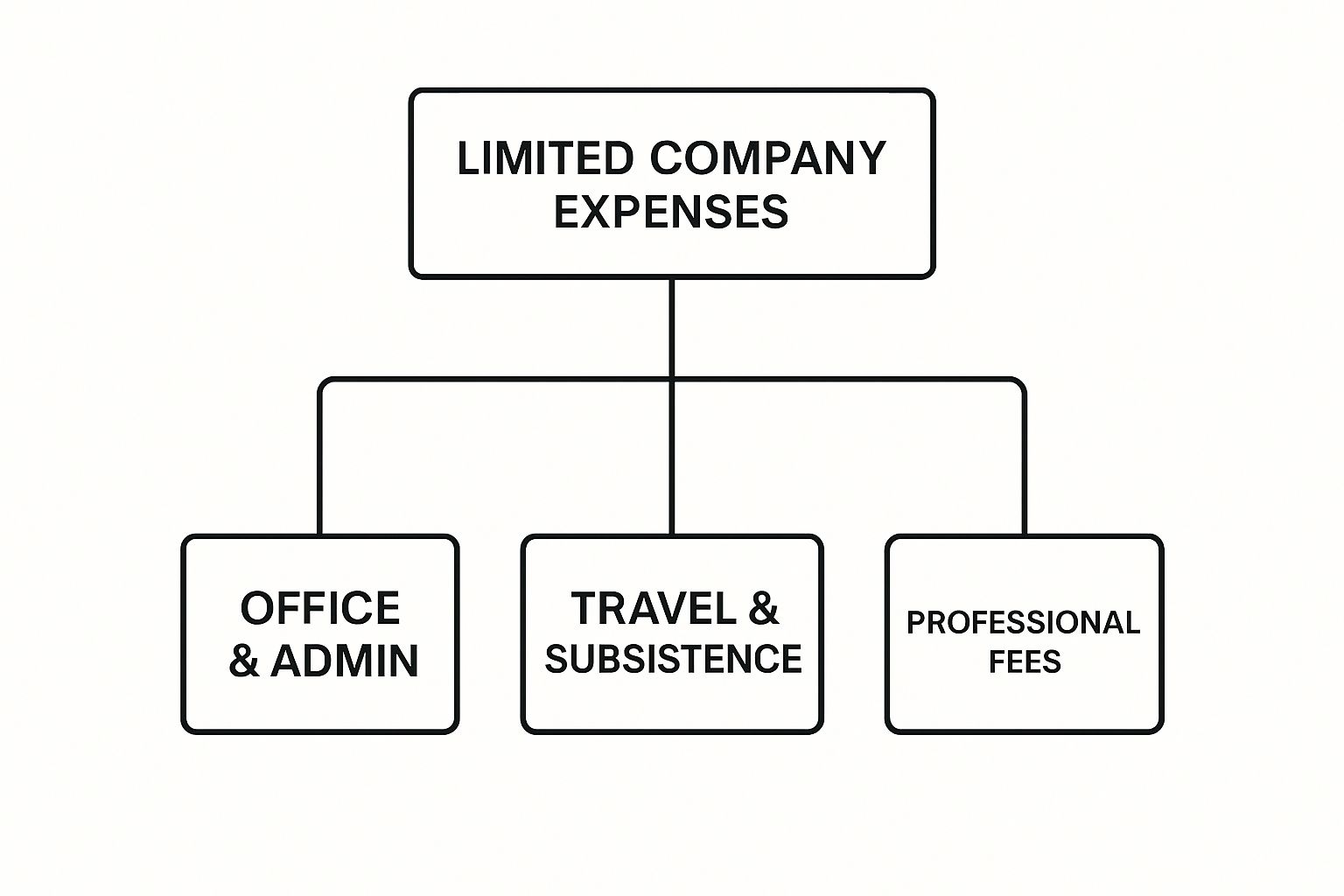
As you can see, most of your day-to-day running costs fall into one of these buckets. Each one has its own set of rules, so let’s dive into the details.
People and Personnel Costs
Your team is your biggest asset, so it makes sense that the costs of employing them are some of the most significant allowable expenses.
- Salaries and Wages: This is the big one. The gross salary you pay your employees—including yourself as a director—is fully tax-deductible.
- Employer's National Insurance Contributions (NICs): The Class 1 NICs your company pays on your team's earnings are also a deductible business expense.
- Pension Contributions: Company contributions to an approved workplace pension for your staff (and for you) are an allowable expense. This is a brilliant, tax-efficient way to top up remuneration.
- Staff Benefits: You can also claim for certain "trivial benefits" that cost £50 or less. Things like the annual staff Christmas party are also fine, as long as the cost doesn't go over £150 per head for the year.
These expenses are all about keeping your team running and motivated, which makes them a clear-cut business cost in the eyes of HMRC.
Workplace and Office Costs
Whether you’re in a smart commercial office or have carved out a corner of your spare room, you can claim for the costs of your workspace.
If you rent a commercial property, it's pretty straightforward. Your company can deduct the full whack: rent, business rates, and utilities like gas, electricity, and water. Any repairs needed to keep the place in good nick are also allowable.
Claiming for a home office is where you need to be a bit more careful. You’ve got two main options:
- HMRC's Flat Rate: The no-fuss approach. You can claim a flat rate of £6 per week (£26 per month) without needing to dig out any receipts. It's simple, but you might be leaving money on the table.
- Apportioned Costs: The more involved method. Here, you calculate the business portion of your actual household bills (things like mortgage interest, council tax, and utilities). It takes more work, but it often leads to a much larger and more accurate claim.
Key Insight: To use the apportioned cost method, you must have a reasonable way to back up your figures. A common way is to work it out based on the number of rooms in your house and how often your "office" is genuinely used for business versus personal life.
Travel and Accommodation
Business travel is another huge area for expense claims. The golden rule here is that the trip must be wholly and exclusively for business purposes—think visiting a client, attending an industry conference, or meeting a supplier. Your daily commute to your permanent office, however, doesn't count.
- Mileage Allowance: If you use your personal car for business trips, your company can reimburse you using tax-free mileage allowances. HMRC’s approved rates are 45p per mile for the first 10,000 miles in a tax year, and 25p per mile after that.
- Public Transport: The cost of train, bus, or plane tickets for business travel can be claimed in full.
- Accommodation and Subsistence: If a business trip requires an overnight stay, the reasonable costs for your hotel and meals are allowable.
HMRC can be very strict on travel rules, so keeping meticulous records of your journeys, including the purpose, is non-negotiable.
Marketing and Professional Subscriptions
You have to spend money to make money, and luckily, most of the costs involved in growing your business and staying on top of your game are tax-deductible.
This category is broad, covering everything you do to promote your company and sharpen your professional edge.
- Advertising: The cost of your Google or social media ads, any print advertising, or other promotional campaigns are all allowable.
- Website Costs: Expenses for hosting, your domain name, and general website maintenance are fully deductible.
- Professional Subscriptions: If you’re a member of a professional body or subscribe to trade journals directly related to your work, you can claim those fees.
Essentially, if you're spending it to boost your company's profile and expertise, it's likely a legitimate expense.
Tools of the Trade and Professional Support
You can't do the job without the right tools and advice, and these costs represent another core category of allowable expenses.
For example, essential software licences—whether it's a one-off purchase or a monthly subscription like Adobe Creative Cloud—can be claimed. The same goes for computer hardware like laptops, printers, and monitors, provided they are bought for business reasons.
Don't forget the fees you pay for expert help. These are fully deductible and include:
- Accountant Fees: The cost of having your year-end accounts prepared, your payroll managed, and your Corporation Tax return filed. At Stewart Accounting Services, we make sure our clients are maximising every single legitimate claim.
- Legal Fees: Costs for any business-related legal advice you need.
- Business Insurance: Premiums for things like professional indemnity or public liability insurance are also allowable.
These aren't just running costs; they're vital investments that protect and support your business, making them completely justifiable claims against your profit.
Common Allowable Expense Categories and Examples
To help you get a quick overview, here’s a table summarising some of the key expense categories and what you can typically claim. It's a handy reference to keep in mind as you track your spending.
| Expense Category | Examples of Allowable Costs | Key Consideration |
|---|---|---|
| Salaries & Staff Costs | Director/employee salaries, employer NICs, pension contributions, some staff events. | Must be paid through a formal payroll system (PAYE). |
| Office & Premises | Rent for commercial office, business rates, utilities, home office allowance (£6/week or apportioned costs). | Home office claims need careful calculation to be justifiable. |
| Business Travel | Mileage (45p/25p), train/bus/air fares, hotel stays for business trips, subsistence. | Commuting to a permanent workplace is not allowable. |
| Marketing & Advertising | Website hosting, domain fees, online ads (Google, social media), print marketing. | Must be for the purpose of promoting your business. |
| Equipment & Software | Laptops, printers, mobile phones (if contract is with the company), software subscriptions. | If an asset has significant personal use, you can only claim the business portion. |
| Professional Fees | Accountant fees, legal advice, professional body memberships, business insurance. | Must be directly related to your business activities. |
| Training & Development | Courses and training to improve skills and expertise in your current role. | Training for a new career path or business area is not allowable. |
By diligently tracking and claiming across all these categories, you're not just staying compliant—you're ensuring your company operates in the most tax-efficient way possible.
Building a Bulletproof Record-Keeping System

Knowing what you can claim is one thing. Actually tracking, documenting, and claiming those costs effectively is a whole different ball game. Let’s be honest, we’ve all been tempted by the shoebox-of-receipts method, but it’s a sure-fire way to miss out on valuable claims and cause a massive headache when your tax return is due.
Think of your record-keeping system as the financial command centre for your business. It needs to be organised, dependable, and ready for inspection at any time. This isn't just about ticking a compliance box for HMRC; a great system turns a boring admin task into a smart way to slash your tax bill and get a real-time pulse on your business's financial health.
What Makes a Record “HMRC-Proof”?
When HMRC asks for "records," they're looking for more than a quick note on a spreadsheet. They want the full story of each transaction—concrete proof that you spent the money and that it was for a genuine business reason.
So, what does that look like day-to-day? Every single expense you claim should be backed up with solid evidence. This typically means:
- A dated receipt or invoice: It must clearly show who you paid, the date, what you bought, and how much it cost.
- Proof of payment: The matching transaction on your business bank statement is the final piece of the puzzle, proving the money actually left your account.
- A note explaining the "why": For expenses that aren’t obvious, like a coffee meeting, a quick note like "Client lunch with Jane Smith, ABC Corp, to discuss Q4 project" is invaluable.
The aim is to eliminate any grey areas. Imagine an HMRC inspector looking at your accounts five years from now. They should be able to understand every single expense without needing to ask you a single question.
Let Digital Tools Do the Heavy Lifting
Spending hours manually typing up receipts is a terrible use of your time as a director. This is exactly why modern accounting software has become a non-negotiable tool for anyone running a limited company. Platforms like Xero or QuickBooks are built to take the grunt work out of expense management.
Managing expenses for a limited company has been a hot topic for decades, especially since the early 2000s when economic shifts put more pressure on businesses to be financially disciplined. HMRC has always hammered home the importance of detailed records because business expenses are a major focus during any audit. This consistent emphasis on the "wholly and exclusively" rule is what pushed so many of us towards digital accounting tools that make it easier to secure claims and stay compliant. You can read more about the history of expense management in the UK.
These platforms have some incredibly useful features:
- Receipt Scanning: Just snap a photo of a receipt with your phone. The software reads the important details and creates an expense entry for you. Simple.
- Bank Feeds: Link your business bank account, and your transactions are pulled in automatically every day. This lets you match receipts to payments on the go, meaning nothing gets forgotten.
- Smart Categorisation: You can teach the software to automatically categorise recurring bills, like your monthly Adobe subscription, saving you endless clicks.
From Your Records to Your Tax Return
Seeing how these carefully kept records actually save you money is what makes it all click. Every single allowable expense you log in your accounting system reduces your company's taxable profit.
When your financial year ends, your accountant takes all this data to calculate your final profit. That profit figure is what's used to fill out your Corporation Tax return (the CT600 form). It’s a simple equation: a lower profit means a lower tax bill.
By building a bulletproof record-keeping system, you're doing more than just getting ready for a potential audit. You are actively and strategically taking control of your company's tax position, making sure every pound you spend on your business is working hard for you.
How to Handle Tricky Dual-Purpose Expenses
When you're running a limited company, some expenses are a breeze to categorise. A new business laptop? 100% business. Client entertainment? Simple. But what about the costs that aren't so clear-cut? The ones that serve your business but also have a place in your personal life?
This is where many directors get nervous, worried about getting it wrong with HMRC. We’re talking about those common grey areas, like using your personal mobile for work calls or your home broadband to power both your work-from-home days and your family's Netflix nights. Ignoring these costs entirely means you’re missing out on tax relief your company is genuinely entitled to.
The secret to navigating this is a concept called 'apportionment'. It's simply HMRC's approved method for you to calculate and claim the business-related portion of a shared cost. All it requires is a fair and reasonable split.
Mastering the Art of Apportionment
Apportionment isn't some secret formula; it's just about applying a bit of logic. Your goal is to work out a calculation that you could comfortably explain if HMRC ever came knocking. You just need to establish a clear, justifiable percentage of business use for that particular service or asset.
Let's walk through a classic example: your personal mobile phone.
Imagine your monthly contract is £40. To figure out the business portion, you'd need to do a little homework.
- Gather your evidence: Grab an itemised bill for a typical month or two. Go through it and highlight all the calls, messages, and data usage that were for work.
- Calculate your percentage: After tallying it up, you might find that around 70% of your usage was directly related to your business – calling clients, checking emails on the move, and so on.
- Apply the figure: Your company can now reimburse you for that business portion. In this case, that’s 70% of £40, which comes to £28 per month. That £28 is now a perfectly allowable business expense.
You can apply this same thinking to your home internet. You might base the split on the number of hours you work from home each week compared to the total time the internet is active in your house. The most important thing is that your method is sensible and you keep a note of how you worked it out.
Navigating Specific Dual-Use Scenarios
Some dual-use expenses come with their own very specific rules, and it’s crucial to know what they are to keep your accounts in order.
-
Clothing: This is a tough one. A standard suit you wear for client meetings? HMRC won't allow it, because you could just as easily wear it to a wedding. But if you have a uniform with your company logo permanently stitched on, or you need specialist safety gear for your job (like steel-toed boots), that’s 100% deductible. The test is whether the item could be considered part of an ‘everyday wardrobe’.
-
Vehicles: This is perhaps the most complex area. Correctly handling car expenses is vital, and it starts with understanding the distinction between commercial and personal auto insurance. If your company owns a car that you can also use personally, it triggers a "benefit in kind," which has its own set of complicated tax rules. A much simpler route, if you use your personal car for work, is to claim the approved mileage allowance (45p per mile) instead of trying to apportion costs like fuel, insurance, and repairs.
Defensible Claims are Key: When splitting costs, remember the burden of proof is on you. Always document how you arrived at your figures. A quick note in a spreadsheet—"Calculated 60% business use for broadband based on 40 work hours out of a total of 68 active hours per week"—creates a clear and defensible record for your accounts.
By applying the principle of apportionment with a bit of common sense and keeping good records, you can handle these mixed-use expenses with confidence. It ensures you claim every penny you're entitled to without ever crossing a line with the taxman.
Common Expense Mistakes That Cost Directors Money

Running a limited company means navigating a minefield of expenses. It can feel like a tightrope walk where one misstep turns what you thought was a smart saving into a costly headache with HMRC. The best defence? Learning from the common blunders others have made to keep your own business compliant and financially sound.
Many directors stumble into the same predictable traps, leading to penalties, surprise tax bills, and stressful investigations. These aren't usually complicated tax avoidance schemes, but simple oversights. From misunderstanding travel rules to getting different types of spending mixed up, these small errors can escalate into major problems. Let's treat this section as your early-warning system.
Mixing Up Capital and Revenue Expenses
A fundamental and surprisingly common mistake is confusing capital expenditure with your everyday running costs, known as revenue expenses.
Think of it this way: revenue expenses are the fuel that keeps your business ticking over daily, like your electricity bill or a software subscription. Capital expenses are the engine itself—major assets you buy that will serve the business for years to come, like a company van or expensive new machinery.
You can't just write off the full cost of a new £20,000 piece of equipment against a single year's profit. Instead, you claim tax relief over several years through a system called capital allowances. If you accidentally log a huge capital purchase as a simple revenue expense, you'll drastically understate your profit. This leads to an incorrect Corporation Tax return and is a massive red flag for HMRC.
Fumbling Client Entertainment and Gifting
Client entertainment is a notorious tripwire for directors. Taking a potential customer out for lunch to seal a deal feels like an obvious business cost, right? Wrong. In almost every case, it is never tax-deductible for Corporation Tax. Your company can still pay for it, but you absolutely cannot use it to lower your tax bill.
Gifts to clients are another tricky area with very firm rules. Generally, you can claim for gifts as long as they meet all these conditions:
- They are not food, drink, or tobacco.
- They feature a prominent advertisement for your company.
- The total cost per recipient per year is no more than £50.
Go over that limit or gift the wrong kind of item, and the expense will be disallowed.
Overlooking Insurance and Risk Management
Beyond just claiming expenses incorrectly, a much bigger financial mistake is failing to manage business risks with the right insurance. This kind of oversight can be far more damaging than any disallowed expense claim. Too many small businesses are operating without a safety net, leaving them exposed to financial shocks that could be ruinous.
Statistics paint a sobering picture. UK small and medium enterprises (SMEs) make up 99.9% of the business population, and many find managing costs and risks a real struggle. A shocking 44% of SMEs have no commercial insurance whatsoever, leaving over 2.4 million businesses completely vulnerable. Even those with cover are often underinsured, a problem made worse by rising costs.
A Critical Reminder: Good financial management isn't just about what you claim; it's about what you protect. Having adequate professional indemnity, public liability, and asset insurance is an essential part of responsible business ownership.
On top of avoiding these pitfalls, actively looking for ways to trim your operational costs can prevent unnecessary spending in the first place. For instance, putting effective IT cost reduction strategies in place can have a big impact on your company’s bottom line. Being proactive is the key to building a stronger, more resilient business.
Your Top Limited Company Expense Questions, Answered
When you're running a limited company, certain expense questions seem to pop up again and again. These are often the tricky, grey-area scenarios that can leave even the most organised director feeling a bit unsure.
We get it. That's why we've put together clear, straightforward answers to three of the most common queries we hear. Think of this as your go-to guide for navigating those real-world dilemmas with confidence, ensuring you claim exactly what you’re entitled to without accidentally crossing any lines.
Let’s get into the specifics that often cause the most head-scratching.
Can I Claim for My Daily Commute?
This is easily one of the most frequent questions, and HMRC’s answer is almost always a resounding no. Your daily trip from home to your main office is considered 'ordinary commuting'—a personal expense, not a business one. It doesn't matter if you’re firing off emails on the train; the core purpose of the journey is to get you to your permanent workplace, which HMRC doesn't see as business travel.
However, there's a crucial exception: travel to a temporary workplace. If you have to travel to a location that isn't your usual office for a specific, short-term task, that journey is a different story. In most cases, it's an allowable business expense.
-
So, what makes a workplace 'temporary'? A workplace is temporary if you're only there for a limited time or a specific task. HMRC's rule of thumb is that if you spend (or expect to spend) more than 40% of your working time at one location for over 24 months, it stops being temporary and becomes a permanent workplace.
-
Here's a real-world example: Let's say your main office is in Stirling, but you land a three-week project at a client's site in Dundee. The cost of your train tickets or the mileage for driving to Dundee each day during that project is a legitimate business expense. Your regular journey from home to the Stirling office, however, remains a personal commute and can't be claimed.
Key Takeaway: Unless you're travelling to a site that HMRC's strict rules define as a temporary workplace, your daily commute is on your own time and dime.
What are the Rules for the Staff Christmas Party?
Treating your team to an annual event like a Christmas bash or a summer BBQ is a fantastic way to boost morale. Thankfully, HMRC offers a specific tax-free allowance for these get-togethers, but you have to play by the rules to keep it a legitimate, tax-deductible expense.
This is all about the annual event allowance. The magic number here is £150 per head. This isn't just a guideline; it's a cliff-edge limit. If the cost creeps up to £151 per person, the entire amount becomes a taxable benefit for your employees, not just the £1 that tipped it over.
To keep the taxman happy, your event must tick these boxes:
- It must be an annual event. This could be the Christmas party, a summer outing, or another yearly tradition.
- It must be open to all employees. You can't just throw a party for the directors and expect it to qualify. It has to be an inclusive company-wide event.
- The £150 limit is cumulative. This is the detail that often catches people out. The allowance covers all annual events in a single tax year. For instance, if a summer party costs £70 per head and the Christmas do costs £90, the £160 total pushes you over the limit. In that case, one of the events would become a taxable benefit.
Remember, the "per head" calculation includes the total event cost—food, drinks, transport, entertainment—divided by the total number of people attending, including employees and their partners.
How Should I Claim for My Home Office?
For countless directors, the home office is the heart of the business. Claiming for its use is perfectly acceptable, but you have two different ways to go about it. The best choice really depends on your situation and how much paperwork you're willing to tackle.
Method 1: The Simple Flat Rate
This is the no-fuss option. HMRC lets you claim a flat rate of £6 per week (£26 per month) without needing to show a single receipt. It's designed to be a simple way to cover the extra costs of heat, light, and internet from working at home.
- Pros: It’s incredibly straightforward and requires zero record-keeping.
- Cons: It's a blunt instrument. You could be claiming far less than your actual costs.
Method 2: Apportioning Your Actual Household Costs
This method is a bit more involved but often leads to a much larger and more accurate claim. It’s all about calculating the real business portion of your home's running costs.
You'll need to add up your annual bills for things like:
- Gas and electricity
- Council Tax
- Mortgage interest (but not the capital repayment part) or rent
- Home insurance
- Broadband
Once you have your total, you need a logical way to work out the business-use percentage. A common approach is to use the number of rooms. For example, if you have a five-room house and one room is your dedicated office, you could start by claiming 20% of your household bills. You might then refine this based on how many hours a day the room is used for work. The key is having a sensible calculation you can stand over if HMRC ever asks.
Choosing the right method ensures you're fairly reimbursing yourself for the use of your home and that your company is claiming every penny it's entitled to.
Managing your limited company’s finances, from tricky expenses to year-end accounts, can feel overwhelming. At Stewart Accounting Services, we specialise in helping directors navigate these complexities, giving you more time, more money, and a clearer mind. Discover how our expert accounting and business support services can help you grow.