

Getting a handle on your limited company expenses is one of the smartest ways to bring down your Corporation Tax bill. It’s pretty straightforward, really: for every pound you spend on a legitimate business cost, your taxable profit shrinks. This means more of your hard-earned money stays in your pocket. The golden rule is simple: if you bought it purely for the business, you can probably claim for it.
Understanding What You Can Claim as an Expense

Think of your company's expenses as the essential fuel that keeps your business running. Just like a car needs petrol, your company needs to spend money on things like software, materials, and travel to operate and grow. Claiming for these costs isn't some sneaky loophole; it's a core part of the UK tax system, designed to make sure you're only paying tax on your actual profits.
The most important idea you need to get your head around is HMRC’s "wholly and exclusively" rule. This is the ultimate test for any expense you want to claim. It means the cost must be for your business, and only for your business. If there’s a dual purpose—a bit for business, a bit for personal use—it usually won’t pass the test.
For instance, buying a new high-spec laptop for your graphic design work is a clear-cut business expense. But trying to claim for a family holiday where you had a single one-hour business meeting? That won't fly, because the main reason for the trip was personal. We dive deeper into this crucial distinction in our guide on how HMRC defines 'wholly and exclusively' for tax purposes.
Before we get into the nitty-gritty, this table breaks down the key ideas you'll need to remember.
Core Principles of Claiming Limited Company Expenses
| Concept | Simple Explanation | Why It Matters to You |
|---|---|---|
| Wholly and Exclusively | The cost must be 100% for business purposes, with no personal benefit. | This is HMRC's main test. Failing it means your claim will be rejected. |
| Allowable Expense | A cost that HMRC permits you to deduct from your income before tax is calculated. | Claiming these directly reduces your Corporation Tax bill. |
| Record Keeping | You must keep proof (receipts, invoices) for every expense you claim. | Without proof, you can't defend your claims if HMRC investigates. |
| Benefit in Kind (BIK) | A non-cash benefit given to an employee (like a company car for private use). | These have their own tax rules and aren't treated like simple expenses. |
Getting these basics right from the start will save you a world of headaches later on.
The Financial Impact of Smart Expense Claims
When you manage your expenses well, the impact on your bank balance is direct and powerful. Every valid claim you make lowers your company's profit figure before Corporation Tax is applied.
"To qualify as a deductible limited company expense, the cost must be wholly and exclusively for business use, meaning expenses with any personal element cannot be claimed. The proper claiming of these expenses can reduce taxable profits, thereby lowering corporation tax."
This framework is there to help you run your business tax-efficiently while staying on the right side of HMRC. Some of the most common allowable expenses include:
- Office Costs: This is a broad category, covering everything from the rent on your business premises to essentials like printer ink, stationery, and software subscriptions.
- Staff Salaries: The wages you pay your team—including your own director's salary—are fully deductible costs.
- Travel Costs: If you're travelling for work, like visiting a client or attending a trade show, the costs for transport and accommodation are generally allowable.
- Professional Fees: Paying for expert help? The fees for your accountant, solicitor, or business consultant are legitimate expenses.
In the UK, meticulous record-keeping isn't just good practice; it's a legal requirement. You need to be able to back up every single claim with a receipt or an invoice. This diligence not only keeps you compliant but also protects you from potential fines if HMRC ever decides to take a closer look.
The Essential Costs of Running Your Limited Company
Before we dive into the day-to-day operational expenses you can claim, let's talk about the bedrock costs. These are the non-negotiable fees you have to pay just for your limited company to exist and stay legally compliant. Think of them as the price of admission for trading as a limited company in the UK.
Getting this financial baseline right from the start is crucial. It helps you budget properly and clearly separates the cost of being a company from the expenses you incur while actually doing business.
Getting Started: Setup and Registration Fees
Your journey as a limited company officially begins at Companies House. The very first step is incorporation, which is the process of legally registering your business. This isn't free; there's a mandatory fee to get your company on the official register.
Right now, registering a new limited company online costs £50. This fee is for the administrative work of creating your company's unique legal identity and giving you a certificate of incorporation—the official birth certificate for your business.
But that's just the start. Beyond the initial registration, all UK limited companies must have their own dedicated business bank account. These almost always come with monthly fees, which can range anywhere from £5 to £20 depending on the bank and the features you need. To get a fuller picture of what to expect, you can learn more about the full spectrum of start-up costs in the UK on anna.money.
Keeping the Lights On: Ongoing Compliance Costs
Once your company is up and running, you'll face a handful of recurring costs to keep things ticking over smoothly and legally. These aren't optional extras; they're fundamental to staying compliant.
- Business Bank Account Fees: As mentioned, you need a separate bank account to keep your business finances ring-fenced from your personal money. Some banks might tempt you with an initial fee-free period, but most charge a regular monthly service fee.
- Business Insurance: Depending on what your business does, certain insurance policies are a must. If you hire anyone (even part-time), Employers' Liability insurance is a legal requirement. Others, like Professional Indemnity or Public Liability insurance, are often essential to protect your business from risk.
- Accountancy and Software Fees: While it's possible to do your own books, most company directors wisely choose to hire an accountant. Their fees, plus the cost of accounting software like Xero, are a vital investment in keeping your finances accurate and staying on the right side of HMRC.
- Confirmation Statement: Every single year, you have to file a confirmation statement with Companies House. This is simply to confirm that the details on the public record (like your address and director information) are still correct. The filing fee for this is currently £34.
Think of these foundational costs as the fixed overheads for your corporate structure. They're separate from the variable expenses that come from your actual trading activities, but just as important to manage prudently.
Getting a firm handle on these essential costs gives you a clear baseline. From there, you can explore proven ways to reduce business expenses and focus on maximising your profitability.
A Practical Breakdown of Common Business Expenses
Once you’ve got a handle on the core "wholly and exclusively" principle, figuring out what you can claim is really just about sorting your spending into the right buckets. Think of it like organising your toolbox; when you know where everything is, the job gets done much faster and with fewer mistakes. Let's break down the most common expense categories you'll encounter as a limited company director.
We’re going to go beyond just listing items. I'll walk you through the specific rules, point out the common tripwires for each category, and give you the confidence to make sure you’re claiming everything you’re entitled to.
At-a-Glance Guide to Common Expense Categories
To get started, here's a quick reference table that cuts through the noise. It covers the major expense areas, gives you concrete examples, and highlights the one key rule from HMRC you absolutely need to remember for each.
| Expense Category | Examples of What You Can Claim | The Key HMRC Rule to Know |
|---|---|---|
| Office & Equipment | Office rent, business rates, utility bills, stationery, printer ink, postage, business software (e.g., Xero, QuickBooks), business phone contracts. | If working from home, you can claim a flat rate of £6 per week or a calculated portion of actual household bills—but not both. |
| Travel & Subsistence | Train tickets, flights, fuel (via mileage), parking, tolls, hotel stays for business trips, and reasonable meal costs while away on business. | The journey must be to a temporary workplace. Your regular commute from home to your permanent office is not claimable. |
| Salaries & Staff Costs | Gross salaries (including your own as a director), employer's National Insurance, pension contributions, and specific staff benefits. | Staff entertainment (like a Christmas party) is allowable up to £150 per head, but client entertainment is almost always disallowed. |
| Marketing & Professional Fees | Website hosting, domain renewals, online advertising (e.g., Google Ads), accountancy fees for company accounts, and legal fees for business matters. | You can claim for professional fees related to the business, but if your accountant also does your personal tax return, that portion is not a business expense. |
| Training & Subscriptions | Courses to improve your existing skills, professional journal subscriptions, and membership fees to approved professional bodies. | The training must be relevant to enhancing your existing business activities, not for learning entirely new skills to start a different business. |
This table serves as a great starting point, but let’s dive deeper into the nuances of these categories.
Office and Equipment Costs
This is probably the broadest and most common category of expenses you’ll deal with. It covers all the essentials needed to run your workspace, whether that's a leased office or a spare room at home.
You can confidently claim for things like:
- Rent and Utilities: If you rent a commercial space, the rent, business rates, and bills for electricity, gas, and water are all straightforward allowable expenses.
- Stationery and Consumables: All those day-to-day items, from pens and notebooks to printer ink and postage, are fully deductible.
- Software Subscriptions: The costs for your accounting software, project management tools like Asana or Trello, and any specialist applications you need for your trade are claimable.
The home office is where people often get stuck. You've got two clear choices here. The easy route is to claim HMRC's flat rate of £6 per week (£312 a year), no questions asked and no receipts needed. The alternative is to calculate a proportion of your actual household bills (like mortgage interest, council tax, heating, and lighting). This requires more work to figure out the business-use percentage but can lead to a bigger claim if you have a dedicated space you use regularly.
Travel and Subsistence
Business travel is a non-negotiable for so many companies, but it’s also an area where HMRC pays close attention. The absolute golden rule is that the travel must be to a temporary workplace. Your normal commute doesn't count.
This image sums up the key areas perfectly.
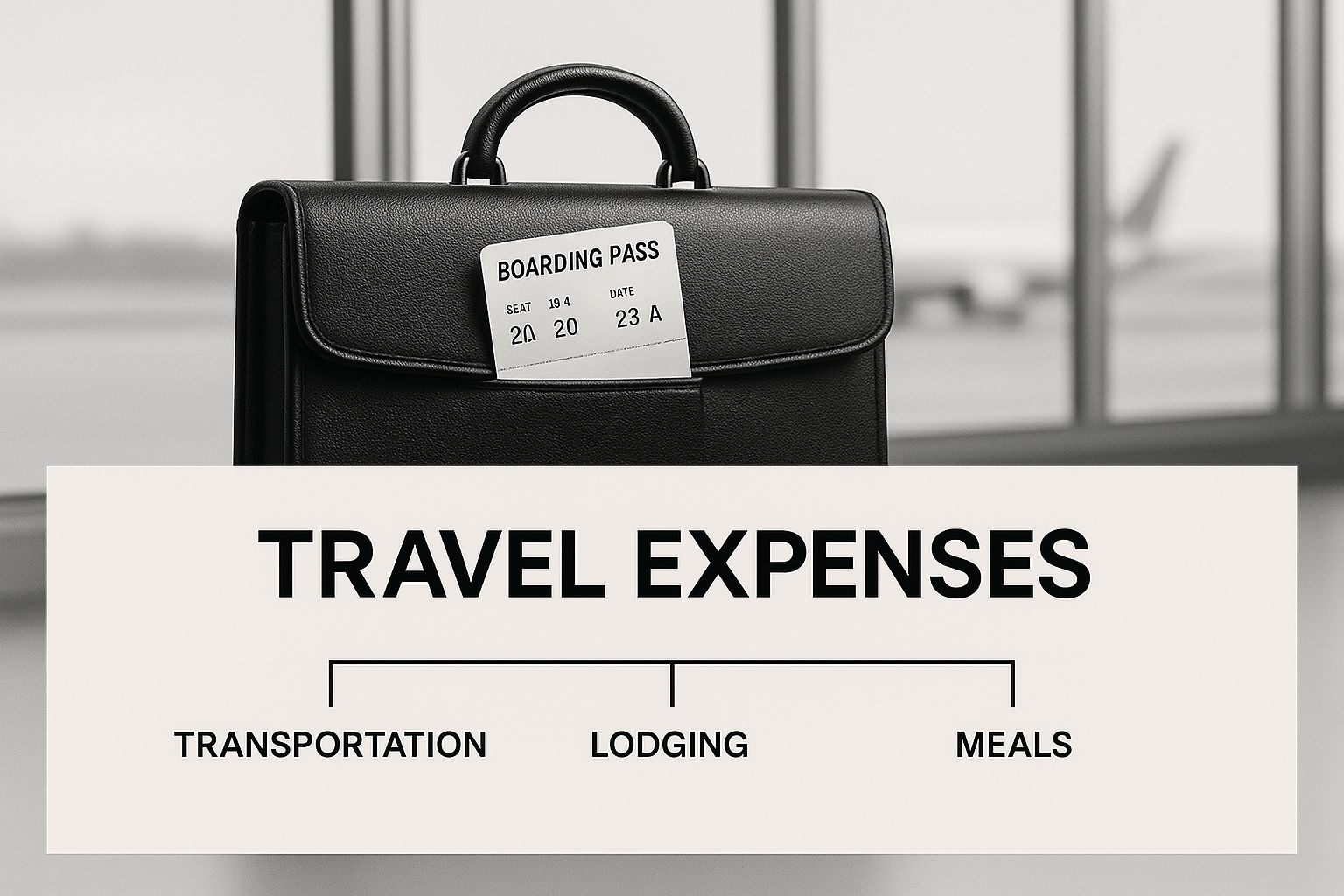
As you can see, it’s not just about the journey. Allowable travel expenses also cover your accommodation and reasonable meal costs when you’re on the road for work.
Here’s what that looks like in practice:
- Transport: This includes train fares, flights, buses, and taxis for business trips. If you use your personal car, you can claim mileage at HMRC’s approved rates, which is currently 45p per mile for the first 10,000 miles.
- Accommodation: The cost of a hotel or a sensible Airbnb for an overnight business trip is an allowable expense.
- Subsistence: This covers your food and drink while you’re away from your normal workplace. The keyword here is reasonable. A three-course meal at a Michelin-star restaurant will raise red flags, but a standard dinner and a drink are perfectly fine.
Just to be crystal clear, your daily trip from your front door to your main office is considered an ordinary commute, and HMRC does not allow you to claim for it.
Salaries and Staff Costs
Your people are your most valuable asset, and thankfully, the costs of employing them are some of the most significant allowable expenses for your business. This category is fairly straightforward but absolutely essential to get right.
The main claims include:
- Salaries and Wages: The gross salary you pay to your employees—and to yourself as a director—is a fully deductible expense.
- Employer's National Insurance Contributions: The Class 1 NI contributions you pay on behalf of your staff are an allowable cost.
- Pension Contributions: Any company contributions you make to an approved workplace pension scheme for your team are deductible.
- Trivial Benefits: This is a great little perk. You can give small gifts to staff (like for a birthday) tax-free, as long as the cost is £50 or less per gift. It can't be cash or a reward for performance, though.
Don’t forget about the annual staff party! You can claim up to £150 per head (including VAT) for an annual event, like a summer barbecue or Christmas do, as a tax-free benefit for your employees.
Marketing and Professional Fees
You have to spend money to make money, and HMRC recognises that investing in promoting your business and seeking expert advice are legitimate costs of being in business.
One of the most common mistakes new directors make is trying to claim for "client entertainment." Taking a potential customer out for a nice lunch feels like marketing, but HMRC explicitly disallows it as a deductible expense. Staff entertainment, on the other hand, is fine within the rules.
This category is pretty broad and can include:
- Advertising: Any money spent on Google Ads, social media campaigns, print adverts, or flyers is fully claimable.
- Website Costs: The fees you pay for your domain name, web hosting, and even a professional web developer to build or maintain your site are allowable.
- Accountancy Fees: The money you pay your accountant to handle your company’s accounts and tax returns is deductible. Be careful, though: if they also do your personal self-assessment, you can't claim the portion of the fee that relates to your personal tax.
- Legal and Professional Fees: As long as the advice relates directly to your business operations (e.g., drafting a contract), you can claim for it.
Getting your head around these categories is the first major step toward good financial discipline. By properly identifying and tracking these common expenses, you’re not just staying compliant—you’re making your business as tax-efficient as possible, which means more of your hard-earned money stays in the company to help it grow.
Mastering Your Record Keeping for HMRC
Claiming business expenses is a fantastic way to lower your Corporation Tax bill, but making the claim is only half the story. The other half? Proving it. This is where solid record-keeping stops being a chore and starts being one of your most important business habits. Think of your records as the financial memory of your company; without them, you're on shaky ground if HMRC ever comes knocking.
Well-organised, complete records are your best line of defence in a tax inquiry. They create a clear audit trail showing not just what you spent money on, but why it was a legitimate business cost. This isn't just about ticking a compliance box—it's about having total clarity and peace of mind over your finances.
What Counts as Proper Proof of Purchase?
When HMRC wants proof, a line on your bank statement just won't cut it. They need to see the full picture of the transaction, and the gold standard for that is a proper invoice or a detailed receipt.
To be considered valid, these documents need to show a few key details:
- The date of the purchase
- The name of the supplier you paid
- A clear description of what you bought (this is vital for proving it was for business)
- The total amount, including a VAT breakdown if you’re VAT registered
A simple credit card slip often falls short because it’s missing that all-important description. My advice is to always, always ask for a full, itemised receipt or invoice. It’s the only way to be sure you have the evidence needed to back up every single claim.
The Six-Year Rule You Can't Afford to Ignore
UK law is crystal clear here. For limited companies, you must keep your financial records for six years from the end of the financial year they relate to. This isn't a friendly suggestion—it’s a legal requirement.
Whether you keep paper copies in a filing cabinet or digital files stored securely in the cloud, holding onto them for the full six-year period is non-negotiable. You have to be able to pull them out if HMRC asks to see them at any point during that time.
Getting this wrong can lead to some hefty penalties, starting from £3,000. It's a simple rule to follow and one that will save you a world of stress and potential expense later on. For a deeper dive, our guide explains exactly what records you need to keep for your limited company accounts and for how long.
From Paper Piles to Perfect Pixels
Thankfully, we've moved on from the days of keeping shoeboxes overflowing with crumpled, faded receipts. Modern cloud accounting software and receipt-scanning apps have completely changed the game, making record-keeping simpler and far more effective.
These tools give you a brilliant way to capture, categorise, and store your expense records as you go. Just picture it: you snap a photo of a receipt on your phone, and the software instantly pulls out the key data and files it away for you.
Switching to a digital system gives you some huge advantages:
- It Saves a Ton of Time: Automation slashes the time you spend on manual data entry, letting you get back to actually running your business.
- You Can Access Records Anywhere: Everything is stored securely online, so you can find what you need in seconds, wherever you are. No more frantic searching through old files.
- You Get a Real-Time Financial Picture: By logging expenses as they happen, you get an up-to-the-minute view of your company's spending, helping you make smarter decisions on the fly.
- Compliance Becomes Effortless: Digital records are fully HMRC-compliant, easily searchable, and can be shared with your accountant at the click of a button. It makes year-end a breeze.
When you adopt these modern tools, you turn record-keeping from a tedious chore into a powerful business process. It makes compliance straightforward and gives you the live data you need to truly understand your company's financial health.
How Digital Tools Are Changing Expense Management
The days of frantically stuffing faded receipts into a shoebox are, thankfully, long gone. Technology has completely changed the game for how modern limited companies handle their expenses. What used to be a reactive, paper-shuffling chore is now a proactive, digital process.
This shift isn't just about going paperless for convenience's sake. It’s about saving countless hours once wasted on manual data entry and painstakingly cross-referencing bank statements. Think of modern expense apps and cloud accounting platforms as your tireless financial assistants, automating the most tedious parts of the job.
The Power of Automation and Real-Time Data
Imagine paying for a business lunch and, before you’ve even left the restaurant, the expense is already logged, categorised, and securely filed. This is the reality for thousands of UK businesses today. By simply snapping a photo of a receipt, optical character recognition (OCR) technology instantly pulls out the key details—vendor, date, and amount—and gets it all recorded.
This immediate capture and processing does two incredibly powerful things:
- It practically eliminates human error. Forget about typos or forgotten claims. Your financial records stay consistently accurate.
- It gives you a live financial dashboard. You no longer have to wait until month-end to get a clear picture of your company's spending. You get a real-time view of your cash flow, which helps you make smarter, more informed decisions on the fly.
The world of expense management is moving fast. We've seen a 17% increase in UK employees managing their own expenses, and the adoption of dedicated expense apps is climbing. This move away from manual spreadsheets is largely driven by HMRC’s Making Tax Digital (MTD) initiative, which requires more accurate and automated reporting. You can find more on these trends in the 2025 State of Expense Management report on findity.com.
Staying on top of this shift is vital for keeping your business compliant and competitive. Learning how to automate invoice processing is a great first step to cutting down on manual work and boosting accuracy.
Streamlining Compliance and Reimbursements
Beyond just tracking, digital tools are essential for staying compliant with HMRC's strict record-keeping rules. With every receipt digitised and stored safely in the cloud, you can be confident your records are always complete, searchable, and ready for any inspection. It makes year-end accounting far less of a headache and gives you a solid audit trail for any potential HMRC enquiry.
These platforms also make the whole employee reimbursement process so much smoother. Team members can submit expenses on the go from their phone, and directors can approve them with a single click. It creates a transparent, efficient workflow that gets staff paid back quickly, without all the old-school paperwork. Getting these systems in place is a key step in future-proofing your business; our guide can help you figure out if your digital bookkeeping is business-ready.
Common Expense Mistakes and How to Avoid Them

Navigating the rules around limited company expenses can feel like a minefield. But once you know where the common tripwires are, it becomes much easier to stay on the right path. Getting it wrong can lead to a lot of hassle and potential penalties from HMRC, so let's look at the mistakes we see time and time again.
The biggest one? Getting the "wholly and exclusively" rule wrong. It’s a classic stumble. Directors often think that if an item has some business use, the whole cost can be put through the books. Unfortunately, HMRC doesn't see it that way.
Take a new high-end camera, for instance. You might buy it to take product photos for the company website, but you also use it for family holidays and personal snaps. Because the camera has a clear dual purpose, claiming the full cost is a definite no-go. This is exactly the sort of thing that raises red flags.
Forgetting to Apportion Dual-Use Costs
This brings us neatly to the next major error: failing to split the cost when something is used for both business and personal life. If you don't apportion these expenses, you're over-claiming. It's that simple. You need to work out the business portion and claim only that.
A mobile phone contract is a perfect example. You use it for work calls, but you also use it to chat with friends and browse social media.
- The Mistake: Claiming 100% of the monthly bill.
- The Right Way: Go through your bills for a few typical months and figure out what percentage of your usage is genuinely for business. If it works out to be 60%, that's the portion of the bill you can claim.
The key here is to be fair and reasonable. As long as you have a logical way of calculating the split and can explain it if asked, HMRC will usually accept it. If you just claim the whole lot, they'll reject it. Good records are your best friend here.
Home broadband is another area where this comes up a lot. If you had the connection before starting your business, you can't just start claiming the entire bill. You have to calculate the business-use percentage.
Claiming Disallowed Expenses
Some costs just aren't allowed, no matter how much they feel like a legitimate business expense. Trying to claim them is like waving a red flag at HMRC, inviting them to take a much closer look at your accounts. The two big ones are client entertainment and your daily commute.
- Client Entertainment: Taking a client out for lunch to seal a deal might be great for business, but the cost is not an allowable expense for Corporation Tax. It's a hard and fast rule. Funnily enough, staff entertainment (like the annual Christmas party) is different and is allowable up to £150 per head.
- Commuting: The daily trek from your home to your normal place of work is just commuting. You can't claim the cost of your train ticket or the mileage. Travel to a temporary workplace, however—like visiting a client’s office for a one-off project—is a different story and is usually fine to claim.
By keeping these common traps in mind, you can manage your company’s expenses with a lot more confidence and keep everything above board.
Your Questions Answered
When it comes to company expenses, the same questions pop up time and time again. Let's tackle some of the most common queries we get from directors trying to navigate the rules.
Can My Company Pay for Training?
Yes, absolutely, but with one important catch. The training has to be all about sharpening the skills you already use to run your business. Think of a web developer taking an advanced course on a new coding language – that’s a clear-cut, allowable expense.
The line is drawn when the training is for a completely new skill set, perhaps for a future business idea or just for personal interest. HMRC won't allow you to claim for courses that aren't directly linked to your current trade.
What's the Best Way to Claim for My Home Office?
You've got two main routes here. The easiest by far is to use HMRC's flat rate. This lets you claim £6 per week (£312 a year) without needing to dig out any receipts or do complex sums. It's a simple, no-fuss option.
Your other choice is to calculate a portion of your actual household bills. This means working out how much of your home is used for business, for how long, and then applying that percentage to costs like mortgage interest, council tax, and electricity. It’s more work, but if you have a dedicated office that you use a lot, it could lead to a much bigger claim.
Are Business Bank Charges an Allowable Expense?
They certainly are. Any charges your business bank account racks up – be it monthly fees, interest on an overdraft, or loan charges – are considered costs of doing business. Because they are "wholly and exclusively" for your company, they are fully deductible and will help lower your Corporation Tax bill.
What Should I Do If I Lose a Receipt?
Losing a receipt isn't the end of the world, but you need to act fast. While the original is always best, you can create a record to stand in its place.
As soon as you realise a receipt is missing, make a detailed note of the transaction. Include the date, the exact amount paid, who you paid it to, and what you bought. You can then pair this note with the matching transaction on your business bank statement to back up your expense claim.
Getting your head around limited company finances can feel like a full-time job in itself, but you don’t have to figure it all out on your own. Stewart Accounting Services provides expert, practical advice to make sure you’re claiming everything you’re entitled to while staying on the right side of HMRC. Find out how we can help your business grow.