

What if your annual tax return was replaced by four digital updates and a final declaration every single year? For many, the upcoming shift to hmrc mtd self-employed landlords 2026 feels like an unwanted administrative burden. We understand that you might be feeling anxious about the transition, particularly when trying to distinguish between your “qualifying income” and your actual take-home profit. It’s a lot to take on when you’re already busy running a business or managing a property portfolio in Central Scotland.
We’re here to take that weight off your hands. This guide will show you exactly how to stay compliant with Making Tax Digital for Income Tax Self Assessment (MTD ITSA) while protecting your time and peace of mind. You’ll discover the clear timeline for the 6 April 2026 rollout for those with income over £50,000, how the quarterly reporting cycle actually works, and how to choose the right software to keep your costs down and your stress levels even lower.
Key Takeaways
- Identify whether you must join the scheme in April 2026 based on the new £50,000 qualifying income threshold for sole traders and landlords.
- Understand the transition from a single annual return to the new system of four quarterly updates and a final declaration under hmrc mtd self-employed landlords 2026.
- Learn how to correctly calculate your “qualifying income” by combining all gross revenue streams before any expenses or allowances are deducted.
- Discover how to organise your digital records using compatible software to turn complex bookkeeping into a simple, five-minute task.
- Find out how our “Three Freedoms” approach can take the compliance burden off your hands, giving you more time, more money, and less stress.
Who must join Making Tax Digital for Income Tax in April 2026?
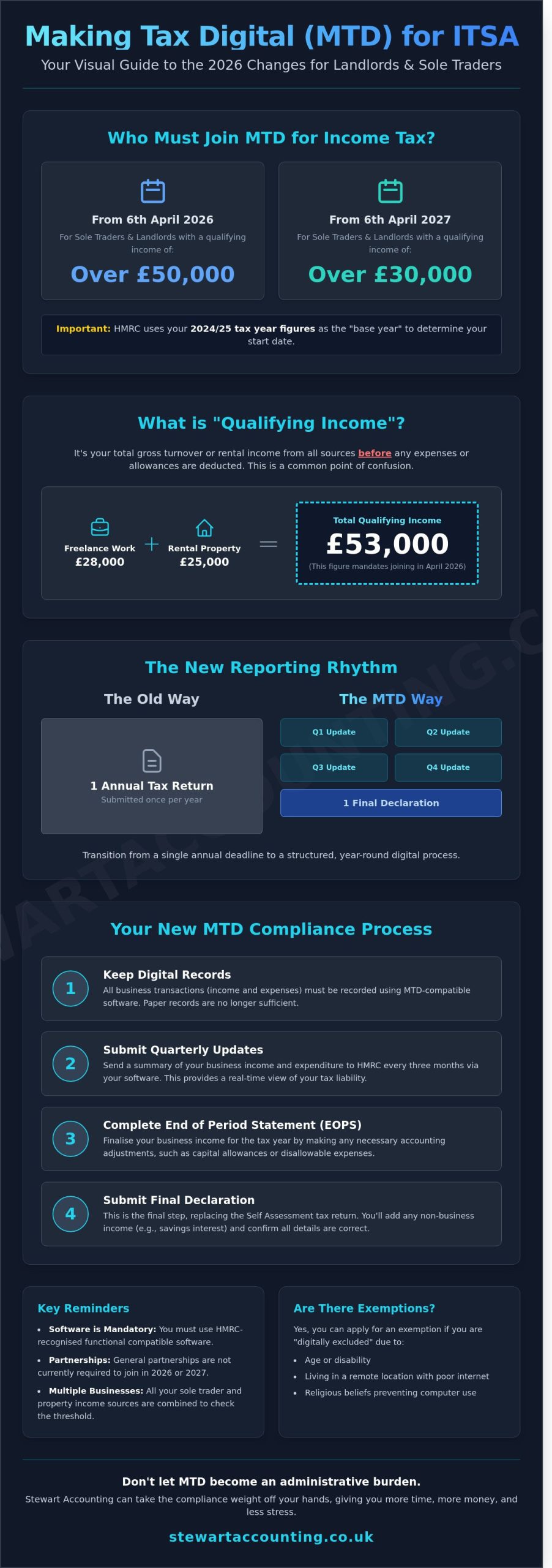
Sole traders and landlords with a qualifying income of more than £50,000 are required to join the hmrc mtd self-employed landlords 2026 mandate from 6 April 2026. This date marks a major shift in how you’ll report your earnings to the government. Instead of a single annual tax return, you’ll use functional compatible software to send quarterly updates. This transition is part of the wider Making Tax Digital programme, which aims to reduce manual errors and provide a real-time view of tax liabilities.
HMRC uses your 2024/25 tax year figures as the “base year” to determine your eligibility for the 2026 start date. It’s vital to understand that “qualifying income” refers to your gross turnover, not your final profit. If your total sales or rental receipts exceed £50,000 before any expenses are deducted, you’re in scope. We find this often catches people out. You might only take home £25,000 after costs, but if your turnover is £51,000, you must comply with the new digital rules. Focusing on turnover allows HMRC to see the full flow of your business transactions throughout the year.
The 2026 and 2027 MTD Thresholds Explained
The rollout follows a phased approach to help businesses adapt. While the £50,000 group starts in April 2026, those with a qualifying income over £30,000 will follow on 6 April 2027. If you have multiple income streams, such as a small trade and a rental property, you must add these together. For instance, earning £28,000 from freelance work and £25,000 from a buy-to-let property gives you a combined qualifying income of £53,000. This total places you in the first wave of the hmrc mtd self-employed landlords 2026 rollout. Currently, general partnerships are not required to join in 2026 or 2027, as the government is still reviewing how the mandate will apply to more complex business structures.
Exemptions and the “Digitally Excluded”
HMRC recognises that digital record-keeping isn’t practical for everyone. You can apply for an exemption if you’re considered “digitally excluded.” This usually applies if you cannot use digital tools due to your age, a disability, or because you live in a remote location with no reliable internet connection. Religious beliefs that prohibit the use of computers can also be a valid reason for exemption.
The criteria for “not practical” are specific. You’ll need to demonstrate why your circumstances make it impossible to use software or apps. If HMRC rejects your application for an exemption and you feel the decision is unfair, you have the right to challenge it. You can appeal through HMRC’s internal review process or take the matter to an independent tax tribunal. Our goal is to take the stress off your hands by helping you identify your status early, ensuring you have more time and less worry as the deadline approaches.
How the new quarterly reporting system works for landlords and sole traders
The transition to hmrc mtd self-employed landlords 2026 replaces the traditional yearly rush with a structured, four-step digital process. This new rhythm helps you stay on top of your finances throughout the year, rather than facing a mountain of paperwork every January. It’s designed to provide a real-time view of your tax liabilities, which helps with better cash flow management for your business or rental property.
Digital record-keeping is the foundation of this change. You’ll need to follow these four specific steps to stay compliant:
- Step 1: Keeping digital records. You must record every transaction, including income and expenses, using MTD-compatible software. Paper ledgers or simple spreadsheets will no longer be enough unless they’re linked to HMRC via bridging software.
- Step 2: Submitting quarterly updates. Every three months, you’ll send a summary of your business income and expenditure to HMRC. This isn’t a full tax return, but a digital snapshot of your activity.
- Step 3: Completing an End of Period Statement (EOPS). You’ll need to complete an EOPS for each source of income. This allows you to make adjustments for things like capital allowances or disallowable expenses.
- Step 4: Submitting the Final Declaration. This is the final step where you confirm all information is correct and include any other income, such as savings interest or dividends.
Detailed Official HMRC MTD Guidance confirms that these changes are part of a wider effort to reduce the £1.5 billion tax gap caused by manual entry errors. By moving to a digital system, the government aims to make the UK tax system one of the most advanced in the world.
The Deadlines for Quarterly Updates
You’ll submit updates based on standard quarterly periods ending 5 July, 5 October, 5 January, and 5 April. You have a one-month window after each quarter ends to send your data. These updates don’t require complex accounting adjustments; they’re simply a digital summary of your cash flow. This approach gives you a clearer view of your estimated tax bill much earlier in the year.
The Final Declaration vs. The Old Self Assessment
This final step replaces the main Self Assessment tax return you’re used to filing. It’s the moment you bring in other income sources, such as PAYE data or bank interest, to calculate your total tax liability. Even though you’re reporting more often, the 31 January payment deadline stays the same. If this new schedule feels overwhelming, our team can take it off your hands so you can focus on your goals.
Calculating your “Qualifying Income” for MTD 2026
Your qualifying income is your total gross income from self-employment and property before you deduct any business expenses or tax allowances. It’s the “top line” figure that HMRC uses to decide if you must join the hmrc mtd self-employed landlords 2026 mandate. If you run multiple businesses or have several rental properties, you don’t look at them in isolation. You must combine every stream of self-employed and property income together to see if you hit the threshold.
For example, if you earn £30,000 from a consultancy trade and £25,000 from a rental property, your qualifying income is £55,000. This total puts you above the initial £50,000 limit, meaning you’ll need to comply with digital record-keeping rules by 6 April 2026. Your 2024/25 tax return is the most important document for your 2026 preparation. HMRC uses the figures from this specific return to determine your entry point. If your gross income on that return exceeds £50,000, you’re in the first wave.
If your income fluctuates around the £50,000 mark, we recommend acting as if you’re already within the scope. A small increase in turnover could trigger a mandatory move to digital reporting, and being prepared early gives you more mind and less stress. It’s much easier to have a system in place than to scramble when a deadline approaches.
Common Pitfalls in Income Calculation
- Turnover vs. Profit: Don’t confuse your taxable profit with your turnover. Even if your expenses are high and your actual profit is only £10,000, a gross turnover of £52,000 means you must register for MTD.
- Joint Property: If you own a rental property 50/50 with a partner, you only count your individual share of the gross rent toward your threshold.
- One-off Receipts: Specific business grants or one-time payments often count as qualifying income. The NRLA on MTD Preparation notes how using approved software helps landlords track these unique receipts to ensure they don’t miss a threshold change.
What if your income drops below the threshold?
HMRC doesn’t allow for an immediate exit if your income dips for a single year. To leave the hmrc mtd self-employed landlords 2026 system, you generally need to show that your qualifying income has remained below the threshold for three consecutive tax years. This rule ensures that businesses don’t constantly hop in and out of the digital regime.
Given the long-term commitment required once you’re in the MTD system, some property owners may prefer to divest certain assets to simplify their tax obligations; Ready Steady Sell allows you to learn more about facilitating a quick and efficient property sale.
Many business owners in Central Scotland choose voluntary registration even if they’re under the limit. It’s a pragmatic way to get more time and more money by automating your bookkeeping early. We can take this off your hands to ensure your transition is smooth and your records are always HMRC-compliant.
Practical steps to prepare your business or property portfolio
Preparing for hmrc mtd self-employed landlords 2026 doesn’t have to be a last-minute scramble. The shift requires you to move away from paper ledgers and basic spreadsheets toward “functional compatible software.” This software creates a digital link with HMRC, allowing for seamless data transfer without manual entry errors. If you currently use Excel, you might consider bridging software. This acts as a digital pipe between your spreadsheet and HMRC systems. However, most property owners find that dedicated software saves more time in the long run.
Starting your digital transition in early 2025 provides a vital safety net. It gives you four full quarters to practice your digital bookkeeping before the legal mandate begins on 6 April 2026. By setting up automated bank feeds now, your quarterly filing becomes a simple five-minute review rather than a weekend of data entry. Our goal is to give you more “mind” by removing the stress of compliance before the deadline hits.
Choosing the Right MTD Software
HMRC-approved platforms like Xero and QuickBooks are the gold standard for modern bookkeeping. These tools do the heavy lifting by categorising transactions automatically. You should look for features like automated bank feeds, receipt scanning, and MTD filing modules that submit data with one click. We provide Xero training and support to ensure you feel confident using these tools. This support helps you transition smoothly so you can focus on growing your portfolio instead of worrying about software errors.
Digital Record Keeping Requirements
HMRC requires specific digital data for every single transaction. You must record the date of the expense, the amount, and the category, such as repairs or insurance. Capturing these details in real-time is the best way to avoid the “January rush” that plagues many self-employed individuals. Using mobile apps to scan receipts immediately means you’ll never lose a tax-deductible expense again. This approach ensures your records are accurate and ready for the quarterly updates required under hmrc mtd self-employed landlords 2026.
If you want to reclaim your time and reduce financial anxiety, let us help you get set up for the future.
Contact Stewart Accounting Services to take bookkeeping off your hands.
How Stewart Accounting simplifies MTD for Scottish landlords and sole traders
The shift to hmrc mtd self-employed landlords 2026 might feel like a heavy burden, but it doesn’t have to be. At Stewart Accounting, we use our “Three Freedoms” approach to help you reclaim your time, keep more of your money, and reduce your stress. We don’t just hand you a piece of software and expect you to figure it out. We “take it off your hands” by managing every quarterly submission and the final end-of-period statement on your behalf.
For landlords in Alloa or sole traders in Stirling, this change is a tool for better business growth. Digital records provide a real-time view of your finances that paper records simply can’t match. You’ll see your tax liability as it builds throughout the year, which means no more surprise bills in January. This clarity is a firm favourite for managing cashflow and planning your next property investment or business expansion.
The Stewart Accounting MTD Transition Programme
We’ve designed a specific programme to guide you through the upcoming deadlines. First, we assess your qualifying income to see where you fit. If you earn over £50,000, you must be ready by 6 April 2026. If your income is over £30,000, your start date is 6 April 2027. We set up your digital record-keeping system to ensure you’re compliant from the first day. By integrating your Self Assessment tax returns into this new digital workflow, we create a seamless process that removes the yearly shoebox panic and ensures every allowable expense is claimed.
Local Expertise, Nationwide Support
Handling HMRC’s digital tax system requires more than just software; it requires a partner who understands the rules. As Fully Qualified Chartered Accountants, we provide clear, jargon-free advice that cuts through the noise. While we support clients across Central Scotland and beyond, we remain a local firm at heart. You can visit us at the Alloa Business Centre or our Stirling offices for a free consultation. We’ll show you how we handle the technical side so you can focus on running your business. Our commitment to direct communication means you’ll always know exactly where you stand with the taxman, allowing you to sleep better at night.
Prepare Your Business for the April 2026 Deadline
The transition to digital tax reporting begins on 6 April 2026 for those with qualifying income over £50,000. Landlords and sole traders earning above £30,000 will follow in April 2027. This shift replaces the traditional annual filing with four quarterly updates and a final declaration. It’s a significant change to how you manage your records, but starting your preparations now ensures you aren’t caught out by the new requirements.
Staying compliant with hmrc mtd self-employed landlords 2026 regulations doesn’t have to be a source of anxiety. As Fully Qualified Chartered Accountants and Xero Platinum Partners, we specialise in making these transitions seamless. Our Three Freedoms promise is designed to give you more time, more money, and less stress. We’ll handle the technical software setup and reporting obligations so you can focus on your property portfolio or business growth. Let us take MTD off your hands; book a free consultation with our Alloa or Stirling team today. We’re ready to help you navigate these changes with confidence and ease.
Frequently Asked Questions
Do I still need to file a Self Assessment tax return under MTD?
Yes, you’ll still need to submit a final report to HMRC, though it’s officially called a Final Declaration instead of a traditional tax return. This process replaces the annual Self Assessment by pulling together your four quarterly updates and any non-business income. It ensures your tax bill is accurate for the year. We can handle this transition for you, ensuring you meet the April 2026 requirements without the usual January stress.
What happens if I miss a quarterly MTD update deadline?
You’ll face a points-based penalty system if you miss a quarterly update deadline. HMRC awards one point for every late submission; once you hit a threshold of four points, you’ll receive a £200 fine. This system is designed to be fairer than immediate fines, but the costs can add up quickly. Keeping your digital records up to date ensures you stay in HMRC’s good books and keeps your mind at ease.
Is there a penalty for not using MTD-compatible software in 2026?
Yes, HMRC will apply penalties if you don’t use functional compatible software to maintain digital records by your start date. Under the hmrc mtd self-employed landlords 2026 regulations, manual records or paper ledgers won’t be compliant for those earning over £50,000. Using the right software is a legal requirement that actually helps you see your profit in real-time. It’s a simple way to gain more control over your business finances.
How much does MTD-compatible software cost for a small landlord?
Basic MTD-compatible software typically starts from £10 to £20 per month for small landlords. Many providers offer entry-level packages specifically for property owners with simple requirements. While there’s a small monthly cost, the time you’ll save on manual admin usually outweighs the expense. We often help clients choose a tailored package that fits their specific portfolio size to keep costs down and efficiency high.
Can I use a spreadsheet for my MTD digital records?
You can use a spreadsheet, but it must be digitally linked to HMRC via bridging software. You can’t simply email a file or copy and paste data into an HMRC portal. This digital link ensures your data flows directly from your records to the government without manual intervention. It’s a practical option if you’re comfortable with Excel but still need to comply with the 2026 digital record-keeping rules.
What is the “qualifying income” for a jointly owned rental property?
Qualifying income is based on your individual share of the total rent, not the total amount the property generates. If you own a property 50/50 with a partner and the total rent is £60,000, your individual qualifying income is £30,000. This means you wouldn’t enter MTD until April 2027, when the threshold drops from £50,000 to £30,000. It’s vital to calculate this correctly to know exactly when you need to join.
When is the very first MTD quarterly deadline for the 2026/27 tax year?
The first mandatory quarterly update deadline is 7 August 2026. This covers your digital records for the period between 6 April 2026 and 5 July 2026. You’ll then have three more updates to submit throughout the year, followed by your final declaration. Marking these dates in your calendar now will help you stay organised and avoid any last-minute rushes as the new hmrc mtd self-employed landlords 2026 system begins.
Does MTD change the dates when I actually pay my tax to HMRC?
No, MTD doesn’t change the current tax payment deadlines of 31 January and 31 July. You’ll still pay your balancing payment and any payments on account on the same dates you do now. The main difference is that you’ll have a much clearer idea of what you owe throughout the year. This helps with budgeting and ensures there are no nasty surprises when your final bill arrives in January.