

Let's get straight to it: the big, unmissable deadline for your online HMRC tax return is 31 January. This isn't just some arbitrary date on the calendar; missing it triggers an instant penalty and can snowball into a major financial headache. It's a date millions of people across the UK have circled in red.
Why This Deadline Is So Important

Think of the Self Assessment deadline like a final exam you’ve known about all year. You have months to prepare, yet for many, it still ends in a mad dash to get it done. For freelancers, landlords, high earners, and anyone with non-PAYE income, this date is a critical fixture in their financial year. Get it right, and you're compliant. Get it wrong, and it costs you.
The sheer scale of this annual task is massive. For the 2023 to 2024 tax year, more than 11.5 million taxpayers got their returns in by the 31 January cut-off. What’s really telling is that a staggering 97.36% of these were filed online, highlighting just how much people have moved away from the old paper-based system. If you're interested in the numbers, you can dig into the official government filing statistics.
A Quick Look at the Deadlines at a Glance
To make things easier, here’s a quick-reference table with the key dates you need to know. These are the non-negotiables in the Self Assessment calendar.
| Action Required | Deadline |
|---|---|
| Register for Self Assessment | 5 October after the end of the tax year you need to send a return for. |
| Paper Tax Return Submission | Midnight, 31 October. |
| Online Tax Return Submission | Midnight, 31 January. |
| Pay the Tax You Owe | Midnight, 31 January. |
Keeping these four dates in mind will put you in a much stronger position and help you avoid any last-minute panic.
The Two Filing Deadlines You Can't Afford to Mix Up
When it comes to filing your tax return, you essentially have two paths, and each comes with its own firm deadline. It’s crucial you know which one applies to you.
- Online Filing Deadline: This is the one most people use. You have until midnight on 31 January to submit your return online. The big advantages are that you get instant confirmation from HMRC and the system does all the tax calculations for you. It’s faster, simpler, and gives you more time.
- Paper Filing Deadline: If you’re one of the few who still prefer to file by post, your deadline is much, much earlier: midnight on 31 October. If you miss this, you don't get a second chance with paper – you must then file online, and you'll likely face an immediate late filing penalty.
The logic behind these deadlines is simple. HMRC needs to collect the right amount of tax to fund the UK's public services, from the NHS to our roads. A structured timeline creates a predictable flow of revenue and allows the system to process millions of returns without grinding to a halt.
What This Guide Will Do for You
Navigating the world of Self Assessment can feel like a minefield, but it really doesn't need to be. We've put this guide together to break the whole process down into clear, manageable chunks.
Here's what we'll cover:
- Do You Actually Need to File? We'll help you figure out with confidence whether you fall into the Self Assessment net.
- Mastering the Timeline: Get a clear picture of every key date, from registering with HMRC right through to paying your bill.
- Avoiding Nasty Penalties: Understand what happens if you file or pay late and, more importantly, how to sidestep those fines.
- Preparing for a Smooth Tax Season: Learn some simple, practical habits that will make tax time a stress-free event every single year.
By the end of this guide, you won't just know the rules; you'll have a clear plan to tackle your tax return with confidence, not dread.
Who Actually Needs to File a Tax Return?
The term ‘Self Assessment’ trips a lot of people up. It’s easy to think it’s just for those who run their own business, but its reach is far wider. A better way to think of it is as a financial check-in for anyone who has income that hasn't already been taxed at the source through a standard payroll system.
If your only income is from a single employer via Pay As You Earn (PAYE), you can probably relax – the HMRC tax return deadline likely doesn’t apply to you. But the second your financial life gets a bit more varied, you might find yourself needing to register for Self Assessment.
Common Reasons You Might Need to File
It’s surprisingly common to get caught out by the need to file a tax return. This isn't just a requirement for company directors or full-time freelancers. You’ll almost certainly need to send one if any of these situations applied to you during the tax year (which runs from 6 April to 5 April):
- You were a self-employed ‘sole trader’ and earned over £1,000.
- You brought in £10,000 or more from renting out a property.
- Your income from savings or investments hit £10,000 or more.
- You have to pay the High Income Child Benefit Charge.
- You earned other untaxed income, maybe from tips or commission.
This isn’t a complete list, but it covers the main reasons people find themselves in the Self Assessment system. The core principle is simple: if you have an income stream where tax hasn’t been deducted automatically, you need to declare it.
Higher Earners and Other Specific Cases
Beyond those common scenarios, other thresholds and unique situations can pull you into the tax return net. It’s vital to know about these, as they often apply to people who assume their employer is handling all their tax obligations.
One of the biggest triggers is simply how much you earn.
You must send a tax return if your total taxable income from all sources was over £100,000 in the tax year. This is a hard-and-fast rule that catches many high-earning employees off guard.
Other, less frequent circumstances can also mean you need to file, such as:
- Getting income from a trust.
- Making a profit (a capital gain) when selling assets, like shares or a second home.
- Living abroad but still receiving an income from the UK.
- Needing to claim specific tax reliefs you can’t get through your regular tax code.
If you’re ever in doubt, it’s always better to check. HMRC has an online tool to help you figure it out, but professional advice can give you complete peace of mind. Knowing your responsibilities is the first step to hitting the HMRC tax return deadline without the stress and worry of potential penalties.
Navigating the Full Self Assessment Timeline
Most people fixate on the 31st of January, but that’s like only looking at the finish line of a marathon. The Self Assessment journey is a year-long cycle, and understanding the whole thing turns the HMRC tax return deadline from a single, scary event into a series of manageable steps.
Think of it like this: the tax year itself runs from 6 April to the following 5 April. Everything you earn and every allowable expense you incur during that time needs to be reported on your next return. Getting a clear picture of this timeline helps you stay on top of things and avoid that frantic last-minute rush.
This infographic lays out what’s at stake if you miss these key dates – a situation that, unfortunately, catches too many people out.
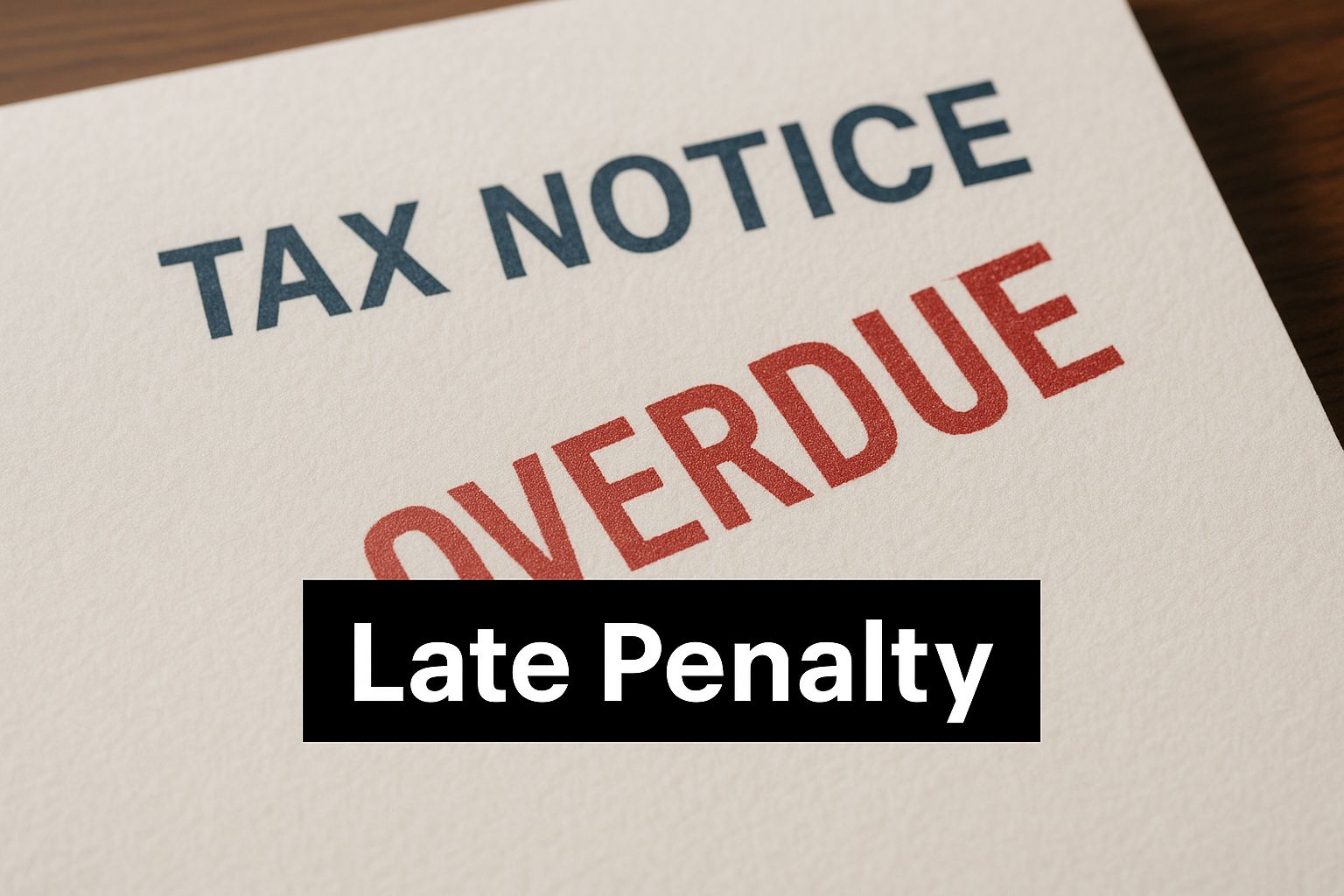
It’s a powerful reminder that late filing penalties aren't just a possibility; they're a very real consequence of not sticking to the schedule.
First Milestone: The Registration Deadline
Your first major checkpoint is 5 October. If you’ve just become self-employed, started earning from property, or need to file for the first time for any other reason, this is your deadline to register for Self Assessment.
Don't underestimate this step. Missing it can cause serious problems down the line because it takes time for HMRC to process your registration and send out your Unique Taxpayer Reference (UTR) number. You absolutely need your UTR to file your return, so without it, you're stuck and already on the back foot for meeting the main January deadline.
The Fork in the Road: Paper vs. Online Filing
As the year rolls on, you’ll face a choice that sets your next deadline: will you file the old-fashioned way on paper, or will you join the majority and file online?
- 31 October (Midnight): This is the final cut-off for submitting a paper tax return. It’s a full three months before the online deadline, and there’s no wiggle room.
- 31 January (Midnight): This is the big one for online tax returns. It’s also the deadline for paying the tax you owe.
Filing online is by far the most popular option for a reason. You get instant confirmation that HMRC has received your return, the system calculates your tax for you, and, most importantly, you have much more time to get it done.
The Main Event: The Big January Deadline
The 31st of January is the grand finale of the tax year. It’s a double-whammy: this date is your deadline to file your online return for the previous tax year and to pay the tax bill. This is the detail that often catches people out.
This is the date that causes the most stress, usually because so many people leave it to the last few days. While millions hit the deadline, a staggering number cut it incredibly fine. As the deadline for the 2023-24 tax year loomed, around 5.4 million taxpayers still hadn't filed. On the other end of the spectrum, some are exceptionally prepared—over 24,800 people filed on New Year's Day! You can find more fascinating stats on UK taxpayer filing habits on My News Desk.
The Summer Check-In: Payment on Account
Just when you think you can relax, there’s one more key date for your calendar. If your last tax bill was over £1,000 and less than 80% of your income was taxed at source (e.g., through a PAYE job), you’ll probably need to make 'payments on account'.
A payment on account is essentially an advance payment towards your next tax bill. It’s split into two equal chunks. The first is due on 31 January (along with your main bill), and the second is due on 31 July.
This summer deadline can be a real surprise if you're not expecting it. Forgetting about it can lead to interest charges, so it’s crucial to budget for this mid-year payment if it applies to you. Once you have these dates mapped out, you’ve got a clear roadmap to stay in control and keep HMRC happy.
The Real Cost of Missing the Deadline
https://www.youtube.com/embed/7Q5s6H8lGFU
So, what actually happens if you miss the HMRC tax return deadline? It’s not a minor admin slip-up you can just brush off. Missing the deadline kicks off an immediate and escalating series of penalties that can quickly spiral from a small headache into a serious financial problem.
Think of it like a snowball rolling downhill. It starts small but picks up speed and size with every turn. HMRC penalties work in much the same way. What begins as a manageable fine can grow alarmingly fast if you don’t sort it out quickly.
The moment the clock ticks past midnight on 31 January, an automatic £100 penalty lands on your account. This happens even if you have no tax to pay or have already paid everything you owe. The fine is for filing the return late, not for paying late.
The Penalty Timeline Unpacked
That initial £100 is just the opening act. HMRC's penalty system is designed to be a powerful nudge towards getting your paperwork in, and the charges ramp up significantly the longer you delay.
After three months, the penalties start to accelerate. From 1 May, a daily penalty of £10 per day can be added, up to a maximum of £900 over 90 days. If you still haven't filed by then, you could already be looking at a bill for £1,000 (£100 initial fine + £900 in daily fines).
This structured escalation shows just how seriously HMRC takes its deadlines. These fines are not a slap on the wrist; they are a substantial financial consequence for inaction.
Six Months and Beyond
Things get even more serious if your tax return is six months late. At this point, HMRC adds another penalty: the greater of £300 or 5% of the tax you owe. This is stacked on top of all the penalties you’ve already racked up.
If your return is a full year late, you’ll be hit with another charge of either £300 or 5% of the tax due. In the most severe cases, if HMRC believes you're deliberately holding back information, the penalty could be as high as 100% of the tax you owe.
The penalty system is strict. Late filers face an immediate £100 fixed penalty, with more fines added daily after 1 May. On top of this, late tax payments start gathering interest from 31 January, and a 5% tax-geared penalty is charged on any unpaid amounts on 2 March. You can learn more from the insightful analysis of filing statistics and penalties on ICAEW.
Interest Charges Add to the Pain
As if the late filing penalties weren't enough, HMRC also charges interest. This is where the costs can really start to sting. Interest is charged on both the outstanding tax and on the penalties themselves, creating a nasty cycle of compounding debt.
The interest starts ticking up from 1 February, the day after the payment deadline. The rate isn't fixed either; it tracks the Bank of England's base rate plus 2.5%, so it can change. This means the longer you put off paying, the more you'll owe, as interest is calculated daily.
To give you a clearer picture, let's break down how these penalties accumulate.
HMRC Penalty Structure for Late Self Assessment Returns
The following table lays out the standard penalties for filing your Self Assessment late. Remember, this doesn't include the added cost of interest on unpaid tax.
| Delay Period | Penalty Applied |
|---|---|
| 1 day late | Instant £100 fixed penalty. |
| 3 months late | A £10 daily penalty for up to 90 days (maximum £900). |
| 6 months late | The greater of £300 or 5% of the tax liability. |
| 12 months late | Another charge of the greater of £300 or 5% of the tax liability. |
Looking at this structure, the message from HMRC is crystal clear: filing and paying on time isn't just a suggestion, it’s a financial necessity. Missing the HMRC tax return deadline is a costly mistake, but thankfully, it's one that is entirely avoidable with a bit of planning.
How to Prepare for a Stress-Free Tax Season
Knowing the penalties for missing an HMRC tax return deadline is one thing, but avoiding them entirely is the real goal. So, let’s talk strategy. The aim here is to turn tax season from a dreaded, frantic rush into just another well-managed task on your to-do list.
It all boils down to one simple idea: consistency. Instead of a mad scramble in January to unearth a year's worth of receipts and invoices, the key is to make record-keeping a small, continuous habit. This single shift is the bedrock of a calm and collected tax filing experience.
Adopt Proactive Record-Keeping Habits
Think of it like packing for a big trip. You wouldn't just chuck everything into a suitcase ten minutes before leaving for the airport, would you? You'd gather things over a few days. The same logic works perfectly for your taxes. Staying on top of your records throughout the year is hands-down the best way to make filing easier.
Here are a few practical habits you can start right now:
- Go Digital: Get into the habit of snapping photos of receipts with your phone the second you get them. A dedicated cloud folder on Google Drive or Dropbox will keep them organised, safe, and easily accessible.
- Use Accounting Software: Tools like Xero or FreeAgent are built for exactly this. They let you log your income and expenses as they happen, taking care of most of the heavy lifting when it comes to categorising and calculating everything.
- Separate Your Finances: If you’re a sole trader, do yourself a massive favour and open a separate business bank account. This makes tracking your business finances a thousand times simpler and saves you the nightmare of untangling your personal spending from your business costs.
The Power of Filing Early
Getting your tax return filed long before the 31 January deadline is one of the smartest financial moves you can make. This isn't about being overeager; it’s a strategic decision with real, practical benefits. As soon as the tax year ends on 5 April, you have everything you need to get it done.
Filing early doesn't mean you have to pay early. Your payment is still due on 31 January. What it does do is give you a crystal-clear picture of your tax bill months ahead of time, giving you plenty of breathing room to plan and budget for it.
And there's another major perk: if you’re owed a tax refund, filing early means you get that money back in your pocket sooner. Leaving it until the last minute just means you’re letting HMRC hang onto your cash for longer than necessary.
What to Do If You Cannot Pay on Time
Even with the best planning in the world, life happens, and paying your tax bill on time can sometimes be a genuine struggle. If you find yourself in this situation, the absolute worst thing you can do is bury your head in the sand. HMRC is surprisingly approachable when you communicate with them upfront.
If you foresee a problem with the payment deadline, you might be able to arrange a Time to Pay arrangement. This is a formal agreement that lets you pay your tax bill in manageable instalments. The key conditions are that you must have filed your return and you need to contact HMRC before the payment deadline passes. Taking this step shows you're being responsible and can help you avoid penalties while you get your cash flow sorted.
To help keep the stress at bay and ensure you hit the HMRC tax return deadline, check out these effective time management tips that can help you get organised. By adopting these strategies—from diligent record-keeping to filing early—you can take full control of your tax affairs and make that deadline anxiety a thing of the past.
Gathering Your Information and Filing Your Return
Alright, it’s time to get down to business. Filing your tax return can feel like a mammoth task, but the secret to making it manageable is all in the preparation. Think of it like getting all your ingredients measured and ready before you start cooking – it just makes the whole process run smoothly. Diving straight into the forms without your numbers in front of you is a surefire way to get stressed and make mistakes.
So, before you even think about logging into the HMRC website, let’s get a checklist sorted. Taking a bit of time now to gather everything you need will save you from frantically searching for a missing document halfway through.
Your Essential Filing Checklist
Having these details on hand will make the actual submission a breeze and ensure you hit the HMRC tax return deadline without a last-minute panic. This isn't just about what you've earned; it’s the complete financial picture that determines your final tax bill.
First, the basics – your personal details:
- Unique Taxpayer Reference (UTR): This is your crucial 10-digit number from HMRC. You can't do anything without it.
- National Insurance Number: Essential for identifying you correctly.
Next, you need to pull together all your income from the tax year (which runs from 6 April to 5 April). This could include:
- Self-Employment Income: A summary of all your sales invoices and business takings.
- Employment Income: Your P60 form, or a P45 if you left a job during the year.
- Rental Income: All the rent you’ve received from tenants if you're a landlord.
- Other Income: Don't forget things like dividends, interest from savings, or any income earned abroad.
Finally, round up every single allowable expense. This is your chance to lower your tax bill, so it pays to be meticulous. We’re talking about receipts and invoices for business travel, office supplies, professional subscriptions – anything that's a legitimate cost of running your business.
Choosing Your Filing Method
Once you have all your paperwork in order, you’ve got a choice to make: file the old-fashioned way with a paper form, or join the vast majority and do it online. While both are technically options, there are compelling reasons why the digital route is now the default.
The deadline for a paper return is 31 October. If you choose to file online, however, you get a full three extra months, with the HMRC tax return deadline falling on 31 January. That extra breathing room can make a world of difference.
Submitting your tax return online isn't just about having more time. The system is smarter – it does the calculations for you in real-time, showing you what you owe as you fill it in. It even helps catch common errors before you can hit submit.
Filing online also gives you an instant confirmation that HMRC has received your return, which is great for peace of mind. With over 97% of people now filing online, it's clear which method works best. It's faster, easier, and just makes a lot more sense.
Common Questions About Tax Deadlines
Diving into the world of Self Assessment often raises more questions than it answers, especially when it comes to that all-important HMRC tax return deadline. To help clear the fog, we’ve tackled some of the most frequent queries we get from clients. Think of this as your go-to guide for those nagging uncertainties.
Getting these details right is absolutely critical. A simple misunderstanding can easily spiral into a missed deadline or an incorrect submission—headaches nobody needs. Let's get these common points straightened out so you can handle your tax return with confidence.
What If I Miss the Registration Deadline?
This is a big one. The cut-off for telling HMRC you need to file a tax return is 5 October. If that date has already passed, you need to act fast. Get registered as soon as you realise, because you literally can't file your return without the Unique Taxpayer Reference (UTR) number they send you.
Missing the registration deadline doesn't guarantee a penalty straight away, but it puts you on the back foot. It can take a few weeks for your UTR to arrive in the post, and without it, you're stuck. That delay can easily push you past the 31 January filing deadline, which will land you an automatic £100 penalty.
Can I Get an Extension on the Filing Deadline?
Honestly, it's very unlikely. HMRC is notoriously strict and doesn't grant extensions for reasons like being too busy, forgetting, or finding it too complicated. To get any leeway, you need what HMRC calls a ‘reasonable excuse’, which is usually reserved for serious, unexpected life events.
What counts as a reasonable excuse?
- A severe illness or the death of a close family member right before the deadline.
- Documented and widespread issues with HMRC's online service or major postal delays that were out of your control.
- Your business records being destroyed in something catastrophic like a fire or flood.
It's crucial to realise that simply not knowing the HMRC tax return deadline will never be accepted as a reasonable excuse. The responsibility to know your deadlines falls squarely on your shoulders.
If you think you have a legitimate reason, you must file your return as soon as you possibly can. Afterwards, you can formally appeal any penalty you receive, but you’ll need to provide solid evidence to back up your claim.
I Have No Tax to Pay – Do I Still Need to File?
Yes, you absolutely do. This is one of the most common and costly mistakes people make. If HMRC has sent you a notice to file a tax return, you are legally required to do it, even if your final calculation shows that you owe £0 in tax.
The penalty for filing late is completely separate from any penalty for paying late. That initial £100 fine is for failing to get the paperwork in on time, regardless of whether you have a tax bill. Don't get caught out by this—if you've been asked to file, you must file.
What Happens If I Realise I Made a Mistake?
We're all human, and mistakes happen. If you’ve already submitted your return and then notice an error—maybe you forgot to declare a bit of income or missed a claimable expense—don't panic. There's a process for this.
You have a window of 12 months after the original filing deadline to amend your return online. For the 2023-24 tax year, which has a filing deadline of 31 January 2025, you have until 31 January 2026 to make corrections. Just log back into your HMRC account, find the return you want to change, and make the updates. It's another great reason to file online; fixing a paper return is a much bigger hassle.
Feeling overwhelmed by deadlines and calculations? The expert team at Stewart Accounting Services can manage your entire Self Assessment process, ensuring your return is accurate, optimised, and filed on time, every time. Visit https://stewartaccounting.co.uk to discover how we can give you back your time and peace of mind.