

We’ve designed this guide to give you back your confidence and your time. You’ll learn exactly how to navigate the current market where the Bank of England base rate sits at 3.75% and inflation is at 2.8%. We’ll provide a clear roadmap of the required paperwork, from your personal allowance details to full company accounts. We’ll also share strategies to maximize your borrowing power so you can stop worrying about rejection and start planning your move. By the time you finish reading, you’ll have the expert insight needed to make the mortgage process feel straightforward and manageable.
Key Takeaways
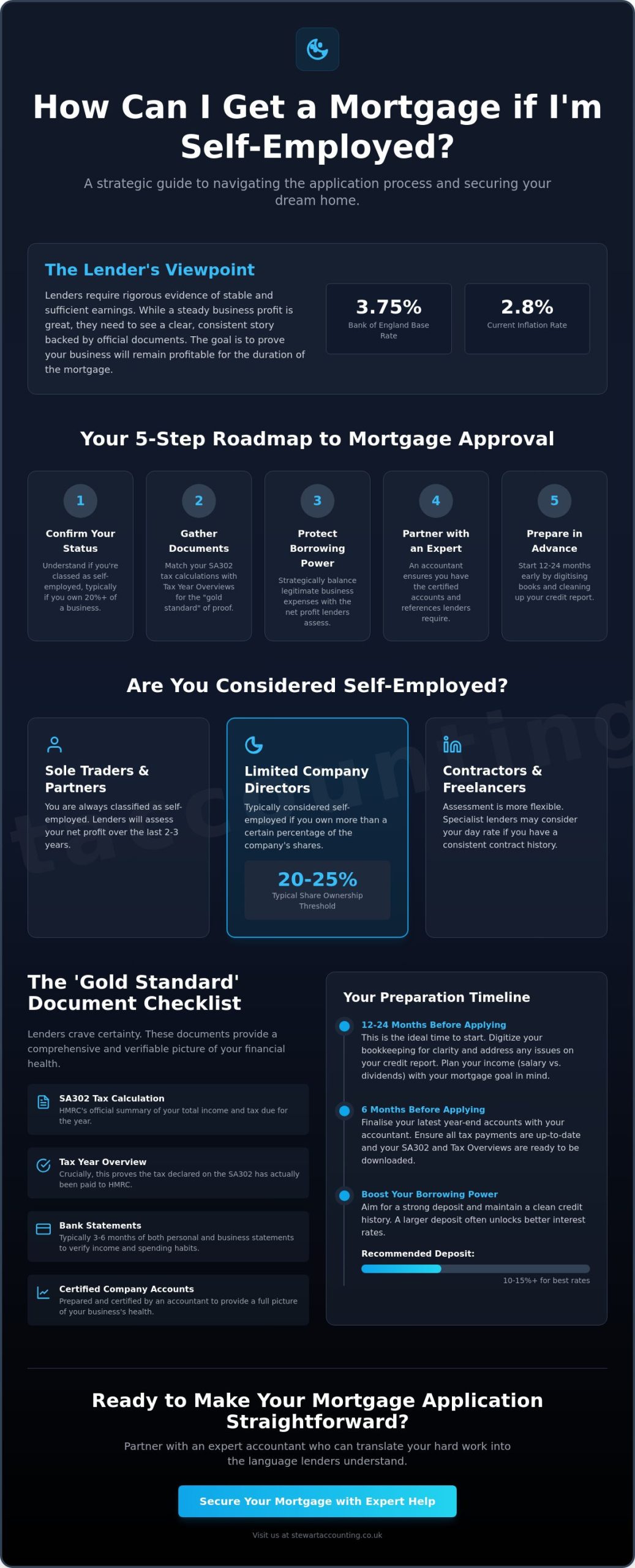
- Confirm your status as a self-employed borrower, which usually applies if you own 20% or more of a business.
- Gather the “gold standard” of documentation by matching your SA302 tax calculations with your official Tax Year Overviews.
- Learn how to balance legitimate business expenses with your net profit to protect your borrowing power and income multipliers.
- Partnering with an expert accountant for self employed mortgage application ensures you have the certified accounts and references lenders require.
- Start your preparation 12 to 24 months in advance by digitising your bookkeeping and addressing any discrepancies in your credit report.
How Can I Get a Mortgage if I Am Self-Employed?
To better understand how you can qualify for these products, watch this helpful video:
Are You Classed as Self-Employed by Lenders?
Lenders apply specific criteria to decide if you’re self-employed. If you’re a sole trader or a partner, the answer is always yes. However, limited company directors often find themselves in a grey area. Most providers will classify you as self-employed if you own 20% to 25% or more of the company’s shares. For contractors and freelancers, the assessment is slightly more flexible. Some specialist lenders will look at your daily rate and multiply it across the year, provided you have a consistent track record of contract renewals and minimal gaps in your employment history.
The Key Differences in the Application Process
The most significant change you’ll notice is the depth of the income verification. An employee’s payslip is a snapshot; your accounts are a story. Lenders now follow strict protocols for income analysis. While these differ by country, global mortgage industry standards often require specific forms and calculations to verify that a business owner’s income is both stable and sufficient. They want to see that your business isn’t just profitable today, but will remain so for the duration of the mortgage term.
This is why having an accountant for self employed mortgage application is so important. Your mortgage broker’s job is to find the right lender, but your accountant’s job is to ensure your financial records meet that lender’s high standards. For example, if you’re a limited company owner, we look at the consistency of your salary and dividends. Large, one-off spikes in income can sometimes be ignored by lenders, so we help you present a steady financial history that maximizes your borrowing power. By preparing your year end accounts with the mortgage application in mind, you can approach the bank with total confidence and a clear roadmap for success.
What Figures and Documents Do Lenders Actually Look For?
Understanding the SA302 and Tax Year Overview
The SA302 is often called the “gold standard” because it’s the official HMRC summary of your tax calculation. It details your total income from all sources and the tax due for that specific year. However, a calculation alone isn’t enough proof for a modern lender. They now require the Tax Year Overview to verify that the tax shown on the SA302 was actually paid to HMRC. You can download these yourself from your online account, but having your accountant provide them ensures everything matches your submitted returns perfectly. Minor errors in your Self Assessment, such as miscategorised income or incorrect relief claims, can trigger red flags and delay your offer by weeks.
Specific Requirements for Limited Company Directors
If you run a limited company, the bank will typically ask for at least two years of signed and certified Year End Accounts. This is where the assessment gets nuanced. Most high-street lenders look at your director’s salary plus your dividends. Some specialist providers, however, are willing to consider your share of the company’s retained profit. This can significantly increase the amount you’re allowed to borrow. Having your records verified by a Chartered Accountant builds vital trust with the underwriter. They know the figures are reliable and comply with professional standards. If you’re feeling overwhelmed by the paperwork, you can reach out to our team for help organizing your financial records and securing the right documentation.
How Much Can I Borrow and How Can I Boost My Chances?
Most lenders use a standard income multiplier of 4.5 times your annual earnings to determine your borrowing limit. If you’re a high earner or work in a specific profession, some providers may extend this to 5 or even 5.5 times. For a self-employed borrower, the challenge isn’t the multiplier itself, but how the lender defines your “income”. While high-street banks often average your last two years of profit, some specialist lenders will prioritize your most recent year if your business is growing. This is a crucial distinction that can significantly increase your budget.
Your business expenses play a massive role in this calculation. Every legitimate deduction reduces your taxable profit, which is great for your tax bill but potentially damaging for your mortgage application. If you invest heavily in new equipment or a company vehicle just before applying, your “on-paper” income drops. At a 4.5x multiplier, a £20,000 business purchase could technically reduce your borrowing capacity by £90,000. If you have an employed partner, a joint application can often provide a much-needed boost, as their stable PAYE income provides a solid foundation for the lender’s affordability stress tests.
The Conflict Between Tax Planning and Mortgage Affordability
There’s often a direct conflict between efficient tax planning and maximizing your mortgage. Aggressive strategies designed to minimize your tax liability can inadvertently leave you with an income that looks too low for the home you want. We help our clients find the “sweet spot” by balancing tax efficiency with the profit levels required by lenders. It’s vital to discuss your home-buying goals with an accountant for self employed mortgage application early in the process. Ideally, this conversation should happen while we prepare your Self Assessment Tax Return, well before you start viewing properties.
Practical Ways to Improve Your Mortgage Profile
Preparing for Your Application: A Timeline for Success
12 to 24 Months Out: Set the Foundation
The earliest stage is all about visibility. You need to ensure your financial records are accurate and accessible. Moving away from manual spreadsheets to professional Online Accounting Services provides the real-time data lenders love to see. This lead time allows you to identify trends and adjust your drawings or business spending if necessary. It’s the best time to ensure your business structure is optimized for your future borrowing needs.
6 Months Out: The Credit Check
Now is the time to review your credit report. Address any discrepancies, such as old addresses or incorrectly recorded late payments, that might trigger a red flag. You should avoid taking out any new business loans or significant personal credit during this window. Stability is the message you want to send to your future lender.
3 Months Out: Finalise the Numbers
Work with your accountant to finalise your latest year-end figures. While lenders often accept accounts up to 18 months old, providing the most recent data shows that your business is currently thriving. This is also when you should confirm your deposit is liquid and ready for transfer.
1 Month Out: The Final Pack
Gather your proof of deposit, the SA302s we discussed earlier, and your latest bank statements. Having everything organized in a digital folder saves hours of last-minute panic when the broker asks for “just one more thing.”
The Importance of Digital Record Keeping
Lenders are increasingly moving toward automated assessments. Using platforms like Xero through our Bookkeeping Services ensures your records are always “mortgage-ready.” This technology provides a transparent, professional view of your business performance. It replaces the old paper shoebox method with verified data that builds instant credibility with bank underwriters. Real-time visibility also means we can provide income references or certified statements much faster than firms relying on manual records.
When to Consult a Specialist Mortgage Broker
High-street banks offer competitive rates, but their rigid systems often struggle with complex self-employed income structures. A specialist broker understands which lenders are currently flexible regarding dividend income or retained profits. Your accountant for self employed mortgage application can work directly with your broker, providing the technical data they need to build a compelling case for you. This partnership removes the administrative burden from your shoulders and ensures the lender receives a perfectly packaged application. If you’re ready to start preparing your financial records for a future home purchase, contact our team today to discuss how we can support your application.
How Can Stewart Accounting Services Help Secure Your Mortgage?
How can you bridge the gap between running a successful business and satisfying a cautious mortgage underwriter? At Stewart Accounting Services, we specialize in making that transition as smooth as possible. We don’t just provide numbers; we provide the professional authority that lenders trust. As your accountant for self employed mortgage application, we ensure your certified accounts and tax overviews are prepared to the exact specifications required by modern mortgage providers. Our team provides local expertise across Alloa, Stirling, and Falkirk, supporting business owners who want to grow their roots in our community. We understand the specific challenges Scottish business owners face and we’re here to help you overcome them.
We help you integrate your mortgage aspirations into your long-term Business Plans. This ensures your growth today doesn’t limit your borrowing power tomorrow. By looking at the bigger picture, we help you balance tax efficiency with the profit levels needed to secure the property you want. It’s about restoring your personal liberty by ensuring your business works for your lifestyle goals, not against them. Our pragmatic approach focuses on tangible results, reducing your stress while optimizing your financial resources.
More Than Just Tax Filing
Many firms simply file what you give them. We take a more proactive approach. Whether you are one of the many Sole Traders we support or a limited company director, we review your financial standing through the lens of a lender. This means we help you prepare well in advance, ensuring your income is presented clearly and accurately. By delegating the complex paperwork to us, you’re free to focus on what you do best: running your business. We handle the technical references and income verification requests directly, removing the burden from your shoulders. This total transfer of responsibility allows you to reclaim your time and mental well-being during what is often a high-pressure period.
Take the Next Step Towards Your New Home
Getting a mortgage when you work for yourself shouldn’t be an uphill battle. It requires a partner who understands the nuances of self-employed income and the regional property market in central Scotland. Our goal is to give you total peace of mind, knowing that your application is backed by professional, chartered accounting support. We invite you to book a consultation where we can review your current standing and create a roadmap for your application. Contact Stewart Accounting Services today to take the first step towards securing your new home with confidence. Let’s work together to turn your professional success into personal security.
Secure Your Future Home with Confidence
Our team provides the expertise you need to navigate the market with ease. As your accountant for self employed mortgage application support, we handle the complex paperwork so you can focus on your business. We offer Chartered Accountant credibility to maximize your standing with lenders, providing comprehensive support for all your year-end documentation. You deserve the liberty to enjoy both your professional success and your personal milestones. Book a consultation with our Chartered Accountants in Alloa, Stirling, and Falkirk to review your current financial standing. We look forward to helping you step into your new home.
Frequently Asked Questions
Can I get a mortgage with only one year of self-employed accounts?
Yes, it’s possible to secure a mortgage with just one full year of accounts, though your choice of lenders will be more limited. While most high-street banks still prefer a two-year track record, a growing number of specialist providers now cater to newer businesses. You’ll need to provide a complete SA302 and a Tax Year Overview to prove your earnings from that first year are stable and sufficient for the loan.
Do lenders prefer sole traders or limited company directors?
Lenders don’t necessarily prefer one structure over the other; they simply assess them using different calculations. For sole traders, they typically look at the net profit shown on your tax return. For limited company directors, they usually assess salary and dividends. However, some lenders are increasingly flexible and may consider your share of retained profits, which can be a significant advantage for directors who don’t draw all their earnings.
What is an SA302 and how do I get one for my mortgage?
An SA302 is the official HMRC summary that confirms your total income and tax due for a specific year. It acts as the primary evidence of your earnings for most mortgage providers. You can download this document directly from your HMRC online portal or request it from your accountant. Your accountant for self employed mortgage application support can ensure this matches your Tax Year Overview to prevent any avoidable delays.
Will my mortgage be more expensive because I am self-employed?
No, you won’t be charged a higher interest rate simply because you work for yourself. Self-employed borrowers have access to the same market-leading rates as PAYE employees. The total cost of your mortgage is determined by your credit score and the size of your deposit. As of June 2026, with the Bank of England base rate at 3.75%, your personal financial health remains the primary driver of the interest rate you receive.
Can I use my latest year’s profit if it is much higher than the previous year?
Most lenders will average your profit over the last two years, but some specialist providers will consider your most recent year if your business is growing. If your latest figures show an increase, we can help you identify lenders who prioritize current performance over historical averages. This approach is particularly helpful for businesses that have successfully scaled up their operations or secured high-value contracts within the last twelve months.
What happens if my business made a loss in one of the last three years?
Making a loss in one year can make an application more complex, but it isn’t an automatic rejection. Lenders will want to understand the reason for the loss, such as a large one-off investment in equipment or a temporary market downturn. We can help you provide a narrative that explains the context of the loss and demonstrates that your business has returned to a stable, profitable state since then.
How much deposit do I need as a self-employed borrower?
Can I get a mortgage if I have a gap in my self-employment history?
Yes, you can still secure a mortgage, but you’ll need to provide a clear explanation for the gap. Lenders look for consistency, so gaps due to maternity leave, illness, or a planned career break are usually viewed more sympathetically than unexplained periods of inactivity. Providing a professional accountant for self employed mortgage application reference can help reassure the lender that your business remains viable and your current income is reliable.