

How Do Dividends Work and How Much Can I Take? | UK Guide

Dividends are your reward for being a business owner. They’re a way to pay yourself from your company’s success, but they come with strict rules. At its core, a dividend is a distribution of your company’s profits after it has paid all its bills and settled its Corporation Tax bill with HMRC.
The pot of money you can draw from is officially known as your distributable profits. This is the accumulated, retained profit your company has built up over time. Crucially, you must have enough of this profit available at the exact moment you declare the dividend.
Your Quick Answer to Taking Company Dividends

Let’s think about it like this. Imagine your limited company is a small bakery you own.
- You spend the month selling cakes, bringing in revenue.
- From that revenue, you pay for everything the business needs: ingredients, rent for the shop, and maybe a small salary for yourself.
- What’s left after all those costs is your profit.
- HMRC then takes its cut of that profit in the form of Corporation Tax.
- The money that remains is your retained profit—your distributable profits.
This is the only pot of money from which you can legally pay yourself a dividend. It’s your compensation for the risk you’ve taken as a shareholder. It’s not a free-for-all where you can dip into the business bank account whenever you fancy; it must be a formal distribution from these specific, after-tax profits.
The Legal Framework for Taking Dividends
The law on dividends is built on a very simple principle: a company can’t give away money it doesn’t have. If you pay a dividend that’s more than your available distributable profits, that payment is illegal. This can land you in hot water with HMRC. That’s why checking your numbers and calculating your available profits before every single dividend payment isn’t just good housekeeping—it’s a legal requirement.
The personal tax side of things has also changed dramatically. Before April 2016, a ‘notional tax credit’ system meant many directors paid no personal tax on their dividends. That system was scrapped and replaced with a dividend allowance. It started at a generous £5,000 but has been slashed over the years. For the 2024/25 tax year, it’s just £500. This makes careful tax planning more vital than ever before. You can find a deeper analysis of these dividend tax changes to see how they might affect you.
Key Takeaway: Dividends are not a business expense. They are paid out of profits that have already been hit with Corporation Tax. This is the fundamental reason you must calculate your profit after tax to figure out what you can legally take.
To make sure everything is above board, every dividend you take needs to be backed up with proper paperwork. This usually means board meeting minutes that show the company had enough profits when the dividend was declared. This paper trail is what protects you as a director and proves you’re following the rules.
To make this process crystal clear, here are the core steps you must follow.
Core Steps for Legally Taking a Dividend
| Step | Action Required | Why It Matters |
|---|---|---|
| 1. Calculate Profits | Review your management accounts to determine your company’s net profit after all expenses and Corporation Tax. | This is a legal non-negotiable. You can only pay dividends from accumulated, post-tax profits. |
| 2. Hold a Board Meeting | The directors must formally meet (even if you’re the only one) to declare the dividend. | Creates a formal record that the dividend was properly approved by the company’s management. |
| 3. Record the Minutes | Document the decision in the company’s board meeting minutes, stating the date and amount of the dividend. | This is your legal proof. It shows HMRC you had sufficient profits on the date the dividend was declared. |
| 4. Issue Vouchers | Create a dividend voucher for each shareholder receiving a payment. It must show specific details. | The voucher is the shareholder’s official receipt for tax purposes and proves the payment’s legitimacy. |
| 5. Make the Payment | Transfer the dividend amount from the company bank account to the shareholder’s personal bank account. | Completes the transaction and ensures funds are correctly moved from the business to the individual. |
Following these steps methodically isn’t just about bureaucracy; it’s about protecting yourself and your business from the serious consequences of getting it wrong.
What Exactly Is a Dividend?

We often hear that dividends come from company profits, but what does that really mean for you as a business owner? It’s absolutely essential to grasp that a dividend isn’t just another way to pay yourself, like a salary or a bonus. It’s a return on the financial risk you took by investing in your company.
Let’s think of your limited company like a community garden. You and any other shareholders are the members who put up the money for the plot, seeds, and tools. At the same time, you’re also the head gardener—the director—who does all the hard work of planting, watering, and weeding every day.
Over the year, the garden flourishes and yields a brilliant harvest. That’s your company’s revenue. But you can’t just take it all home. First, you have to set aside enough produce to cover next year’s seeds and tools (your business expenses). Then, you need to give a portion to the landowner (HMRC, for Corporation Tax).
What’s left over is your profit. A dividend is simply the act of sharing out this surplus harvest among the garden’s members—the shareholders—as a thank you for their initial investment and risk.
The Two Hats You Wear: Director and Shareholder
As a small business owner, you’re almost always wearing two hats: you’re the director who runs the show, and you’re the shareholder who owns the company. It’s crucial to keep these roles separate in your mind, especially when deciding how to take money out of the business.
- Your Director’s Salary: This is what you get paid for the actual work you do—the “gardening.” It’s treated as a business expense and is paid before the company calculates its profit.
- Your Shareholder’s Dividend: This is your slice of the profits after all the company’s costs and taxes have been settled. It’s a reward for being an owner, not for the hours you put in.
This isn’t just a technicality; it’s fundamental. You receive a dividend because you own shares in the business, plain and simple.
For anyone looking to invest in other companies, it’s just as important to understand a company’s financial health and cash flow, because this is what determines if it can consistently pay out dividends.
The Critical Role of Paperwork
I know, paperwork feels like a chore, but when it comes to dividends, proper documentation is your legal lifeline. When you decide to pay a dividend, you absolutely must record this decision formally. This isn’t just good practice; it’s a legal requirement under UK company law.
This paper trail proves to HMRC that the money you took was a legitimate distribution of profit and not something else, like an undeclared salary or a director’s loan. Getting this wrong can bring serious headaches, as HMRC could reclassify the payment and hit you with a bill for extra tax and National Insurance.
HMRC’s Viewpoint: Without formal records, a payment from your company to you is just a random transaction. Board minutes and a dividend voucher give it legal context, proving it was a properly declared dividend and not an attempt to sidestep tax.
So, what’s the non-negotiable paperwork?
- Board Meeting Minutes: Before paying any dividend, the directors must hold a meeting to formally declare it. Even if you’re the only director, you still need to minute the decision, recording the date and the amount in the company’s official records.
- Dividend Vouchers: For every single dividend payment, you must issue a “dividend voucher” to each shareholder. Think of it like a payslip for dividends; it’s an official document detailing the payment.
These documents are your proof. They show you’ve checked the accounts, confirmed there were enough distributable profits, and followed the correct legal steps. Whatever you do, don’t skip this part.
Right then, let’s get down to the brass tacks. We’ve talked about what dividends are, but now for the crucial part: how to work out exactly how much you can legally take from your company. This isn’t about glancing at your bank balance and guessing; it’s a specific calculation defined by company law.
Getting this number right is non-negotiable. One wrong move and you could end up paying an illegal dividend, which can land you in some seriously hot water. The entire process hinges on one key figure: your company’s distributable profits.
This image gives you a bird’s-eye view of how money flows from company earnings to your pocket as a dividend.
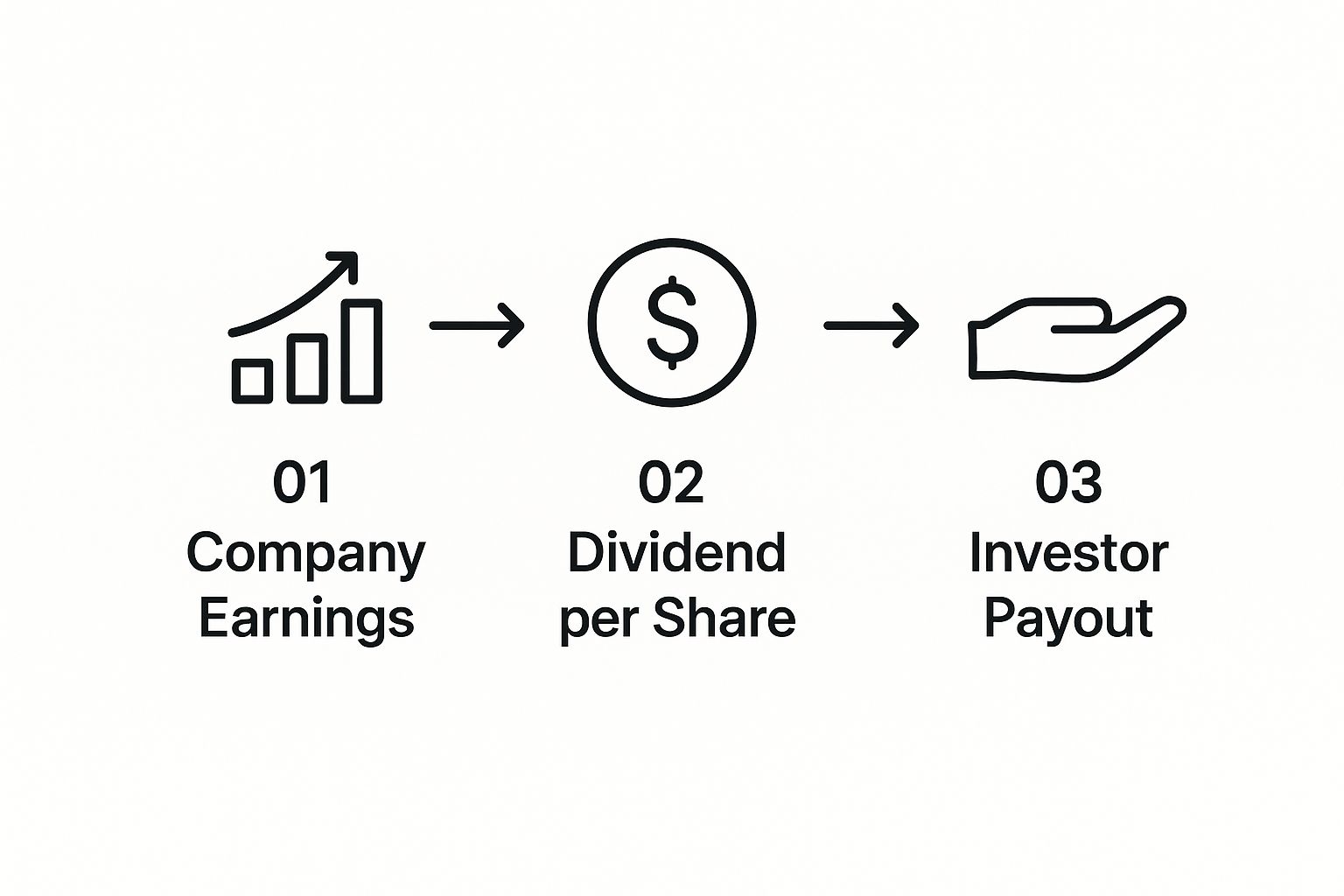
As you can see, it’s a formal journey. The company has to calculate its true, available profit before a dividend can even be considered.
The Core Formula for Distributable Profits
At its heart, the maths is surprisingly straightforward. You’re simply figuring out the total accumulated profit your company has left over after all its bills and taxes are paid or accounted for.
The formula looks like this:
Total Revenue – Business Costs – Corporation Tax + Last Year’s Retained Profit = Maximum Dividend Pool
Let’s break that down, because each part needs to be precise. This isn’t a back-of-a-fag-packet calculation; you need real, accurate figures from your accounts.
- Total Revenue: All the money your business has invoiced and earned in the current period.
- Business Costs: Every legitimate expense needed to run the company – director’s salary, software, rent, materials, you name it.
- Corporation Tax: The tax your company owes on its profits for the period. You must set this aside.
- Last Year’s Retained Profit: This is the secret sauce. It’s any profit left in the company from all previous years after any dividends were paid out.
The final number you get is your legal ceiling. You can’t pay out a single penny more in dividends than this amount.
Why You Can’t Rely on Last Year’s Accounts
A classic—and dangerous—mistake is looking at your year-end accounts from months ago and assuming that profit is still sitting there, ready to be taken. Business is fluid. A company that was solidly profitable six months ago could easily be running at a loss today after a few tough months.
Company law is crystal clear on this: you must have enough distributable profits at the moment the dividend is paid. Using old data is a massive gamble. For instance, if your March accounts showed a £20,000 profit, but you’ve since had a quiet quarter, you might now be in a loss-making position. Paying a dividend based on that old £20,000 figure would be illegal.
This is precisely why up-to-date management accounts are absolutely essential. They’re not just ‘nice to have’; they’re a director’s best friend for paying dividends safely. These internal reports, like a current profit and loss statement, show you where the business stands now, not where it was half a year ago.
A Practical Example: Calculating Distributable Profits
Let’s see this in action with a fictional small business, “Innovate Consulting Ltd.” The director and sole shareholder, Sarah, wants to know the maximum dividend she can take.
To do this properly, we’ll use her current management accounts, which have the most up-to-date figures. Here’s a simple table to walk through the calculation.
Example Calculation of Distributable Profits
| Financial Line Item | Amount (£) | Calculation Note |
|---|---|---|
| Total Revenue | £80,000 | Money earned in the current period. |
| Business Costs | (£30,000) | Includes salary, software, and other expenses. |
| Pre-Tax Profit | £50,000 | Revenue (£80k) minus Costs (£30k). |
| Corporation Tax | (£12,500) | Pre-Tax Profit (£50k) multiplied by 25%. |
| After-Tax Profit | £37,500 | Pre-Tax Profit (£50k) minus Tax (£12.5k). |
| Retained Profit | £15,000 | Profit carried forward from previous years. |
| Total Distributable Profits | £52,500 | After-Tax Profit (£37.5k) plus Retained Profit (£15k). |
Based on this step-by-step calculation, the absolute maximum dividend Sarah can legally declare from Innovate Consulting Ltd. is £52,500.
If she tried to pay herself more, it would be classed as an illegal distribution. Following this methodical approach is the only way to be 100% certain you’re staying on the right side of the law.
Understanding Your Personal Tax on Dividends
Okay, so you’ve worked out how much profit your company can legally distribute. That’s a massive first step. It tells you the maximum amount of cash the business can hand over.
But that’s only one side of the coin. The real question for you as a director is, “how much of that can I actually take home?” To answer that, you need to get your head around how that income is taxed once it lands in your personal bank account.
Your dividend income isn’t treated like a salary by HMRC. The good news is it completely avoids National Insurance. The catch? It has its own unique set of tax rules and rates. Nailing these down is crucial if you want to plan your finances effectively and avoid any nasty surprises come self-assessment time.
The first piece of the puzzle is the Dividend Allowance. Think of it as a small, tax-free buffer for your dividend income each year. Any dividends you receive that fit within this allowance are taxed at a lovely 0%, no matter what else you earn.
It’s really important to realise, however, that this allowance has been shrinking fast in recent years. This makes smart tax planning more vital than ever. For the 2024/25 tax year, the Dividend Allowance is just £500. For a complete breakdown of how this affects you, it’s worth reading this detailed guide on the UK dividend allowance.
How Your Total Income Sets Your Dividend Tax Rate
Once you’ve used up that £500 allowance, any more dividends you take will be taxed. The rate you pay isn’t fixed; it depends entirely on your overall income tax band for the year.
This is where people often get tripped up. HMRC doesn’t look at your dividends in isolation. They look at your total income to decide which tax bracket your dividends fall into. This means you have to add your dividend income on top of everything else you earn, like your director’s salary.
Here’s how it works in practice:
- Start with your non-dividend income: For most directors, this is your salary.
- Stack your dividend income on top: This gets added on after your salary.
- See where it lands: The tax band your dividends fall into determines the rate you’ll pay on them.
This “stacking” method is precisely why the classic small salary, larger dividend strategy works so well. Your small salary uses up your tax-free Personal Allowance, leaving the lower tax bands open for your dividends to be taxed at much friendlier rates.
Key Insight: Always think of your dividends as the ‘top slice’ of your income. They are taxed after all your other earnings, which is why your salary level has a direct impact on the tax rate you’ll pay on your dividends.
The UK Dividend Tax Rates
The main appeal of dividends is that their tax rates are lower than the rates for regular income tax. The system has changed quite a bit over the years, especially since 2016 when the old tax credit system was scrapped.
Today, the rates you’ll pay on dividend income above your £500 allowance are set by the standard income tax bands.
For the 2024/25 tax year, here are the rates:
- Basic Rate: 8.75% on dividends that fall within the basic rate tax band.
- Higher Rate: 33.75% on dividends that push you into the higher rate band.
- Additional Rate: 39.35% on any dividends falling into the top additional rate band.
Let’s put this into a real-world scenario. Imagine a director, David, who pays himself a salary of £12,570, perfectly using up his Personal Allowance. He then decides to take a £40,000 dividend.
The first £500 of his dividend is covered by his Dividend Allowance, so it’s tax-free. The remaining £39,500 falls squarely into the basic rate band, meaning he’ll pay tax at 8.75% on that amount. Knowing this allows you to plan your withdrawals and know exactly what your tax bill will look like.
Costly Dividend Mistakes and How to Avoid Them
Knowing the dividend rules is the easy part. The real trick is sidestepping the common pitfalls that can trip up even experienced company directors. Getting dividends wrong isn’t just a minor admin headache; it can lead to hefty penalties from HMRC, demands for repayment, and surprise tax bills that could seriously destabilise your company.
The single biggest mistake you can make is paying out an illegal dividend (sometimes called an ultra vires dividend). This happens when you declare and pay a dividend that’s more than your company’s available distributable profits at that exact moment. It’s a surprisingly easy trap to fall into, especially if you’re just eyeing the bank balance rather than doing the proper profit calculation first.
If HMRC spots an illegal dividend, the consequences are sharp. The payment is treated as void, meaning you, the shareholder, are legally obligated to repay the full amount back to the company. This becomes a massive problem if the company later becomes insolvent, as a liquidator will aggressively pursue you for that money.
The Peril of Mixing Up Dividends and Loans
Another costly error is blurring the line between a dividend and a director’s loan. A director’s loan is simply money you borrow from your company that isn’t a salary or an expense reimbursement. While they are perfectly legal, they have their own strict tax rules, and ignoring them can be painful.
Here’s the danger: if you take money out of the business without the correct dividend paperwork (board minutes and a voucher), HMRC can simply reclassify the payment. They might decide it was a director’s loan all along. If that loan isn’t repaid within nine months of your company’s year-end, the company gets stung with a nasty tax bill called s455 tax. This is essentially a holding tax, charged at a rate equivalent to the higher rate of dividend tax (33.75%), designed to stop directors from using loans as a long-term, tax-free perk.
- Dividend: A formal distribution of your company’s post-tax profits. Tax-efficient for you.
- Director’s Loan: Borrowing from your company. If not repaid quickly, it triggers s455 tax, creating a major cash flow headache for the business.
This is exactly why meticulous record-keeping isn’t just a suggestion—it’s essential. Without it, you leave the nature of your drawings open to HMRC’s interpretation, and that rarely ends well for you.
Skipping Paperwork Is a False Economy
It’s easy to look at the admin side of dividends—the board minutes and vouchers—and dismiss it as pointless bureaucracy. That’s a dangerous mistake. These documents are your legal proof, your defence against any challenge. They show that a payment was a legitimate distribution of profit, declared at a time when the company had enough reserves to cover it.
Without that paper trail, HMRC can argue that the payments you took were actually salary in disguise. If they make that argument stick, the financial fallout is significant:
The Reclassification Risk: HMRC can reclassify your ‘dividend’ as net salary. They will then demand that the company pays employer’s National Insurance, employee’s National Insurance, and PAYE income tax on the grossed-up amount. A tax-efficient payment can suddenly become a financial nightmare costing you thousands.
Just look at how sensitive business owners are to tax changes. When dividend tax rates were hiked in 2016, a huge number of directors rushed to pay out dividends beforehand to lock in the old, lower rates. This behaviour, known as ‘dividend forestalling’, was so widespread that it was estimated to have boosted tax receipts by a staggering £4 billion in a single year. You can read more about this in the official analysis of dividend tax policy changes.
This just goes to show the high stakes involved. Staying organised and following the proper procedure for every single dividend isn’t just about ticking boxes. It’s about protecting the tax efficiency you’ve worked hard to build.
Frequently Asked Questions About UK Dividends

Even once you’ve got a handle on the rules, real-world situations can throw up tricky questions. This section cuts straight to the chase, answering the practical queries that company directors and shareholders in the UK face all the time when figuring out dividends.
Can I Take a Dividend if My Company Made a Loss This Year?
Believe it or not, the answer can be yes. The key is understanding that dividends aren’t paid out of this year’s profit alone. They come from your company’s total accumulated distributable profits – a pot that includes all the retained earnings from previous years.
Think of it like this: your company started the year with £20,000 in retained profits. If you then made a £5,000 loss this year, your distributable profit pot is now £15,000. You could still legally declare a dividend up to this amount.
But, if that loss had been £25,000, it would wipe out your retained profits and push you into a deficit. In that case, you’d have zero distributable profits available and couldn’t legally pay a dividend. The golden rule is to always check your up-to-date, cumulative financial position first.
What Is the Difference Between a Dividend and a Salary?
This is one of the most important distinctions to grasp. It sits at the very heart of tax-efficient profit extraction for UK limited company owners. While both put money in your pocket, they are worlds apart in the eyes of HMRC.
A salary is what you get for being an employee or director. It’s a business expense, which means it gets deducted from revenue before your company calculates its Corporation Tax bill. Salaries are hit with both Income Tax and National Insurance Contributions (NICs) for you and the company.
A dividend, on the other hand, is a slice of the profits shared with shareholders as a return on their investment. It is not a business expense and is paid from profits that have already had Corporation Tax paid on them.
The Key Difference: The crucial advantage is that dividends are not subject to National Insurance Contributions. This simple fact is why a low-salary, high-dividend structure is so often the most tax-efficient strategy for owner-directors.
Do I Need an Accountant to Pay Dividends?
Legally speaking, no, you don’t have to use an accountant to declare and pay dividends. However, doing it yourself is a bit like performing your own dental work – it’s possible, but highly recommended that you don’t.
An accountant is your safety net. They ensure your distributable profits are calculated correctly, protecting you from the serious legal and financial fallout of declaring an illegal dividend by mistake. They also take care of the crucial paperwork, like board meeting minutes and dividend vouchers, to keep everything compliant.
Beyond the admin, a good accountant provides strategic advice on the most tax-efficient mix of salary and dividends for your specific circumstances. The tax they can save you often far outweighs their fee, making their expertise an incredibly valuable investment.
Can I Pay Different Shareholders Different Dividend Amounts?
This is a common source of confusion, and the answer hinges entirely on your company’s share structure. If all your shareholders hold the same class of shares (for example, ‘Ordinary Shares’), then you absolutely cannot pay them different amounts per share.
The fundamental rule is that dividends must be paid proportionally based on how many shares each person owns. For any single class of share, the dividend declared per share must be identical for every shareholder who holds that class.
If you want the flexibility to pay different dividend rates to different people, your company may need to issue different classes of shares. For example:
- ‘A Ordinary’ Shares could be held by one person.
- ‘B Ordinary’ Shares could be held by another.
This setup allows the directors to declare a dividend of, say, £10 per share for the ‘A’ class and just £2 per share for the ‘B’ class. Be warned, this is a complex area of company law that changes shareholder rights, so you must get professional advice before creating new share classes to ensure it’s done correctly.
Navigating the complexities of dividend payments, tax efficiency, and company compliance can be challenging. At Stewart Accounting Services, we provide clear, expert guidance to ensure you are taking profits from your business safely and effectively. Contact us today to see how we can help you achieve more time, more money, and a clearer mind.