

Did you know that a simple oversight in your Stirling Council registration could cost you a £170 late fee before you even begin to calculate your HMRC obligations? It’s natural to feel anxious about the 2026/27 tax year, especially with the introduction of Making Tax Digital (MTD) for landlords with a gross income over £50,000. Balancing unique Scottish tax bands with new quarterly reporting requirements often feels like an exhausting burden on your time and mental well-being.
We want to restore your personal liberty by simplifying these complex financial changes. This guide provides the clarity you need to manage your landlord tax return Stirling with total confidence, ensuring you remain fully compliant while minimizing your tax liability. We’ll walk you through the seven distinct Scottish income tax rates, explain the mandatory digital record-keeping rules, and outline the specific Stirling Council fees you must track to avoid penalties. By the end of this article, you’ll have a pragmatic plan to protect your finances and secure your professional future.
Key Takeaways
- Understand the critical 31st January deadline for your Self Assessment and how the shift toward digital-first reporting affects your 2026/27 obligations.
- Learn how to navigate the seven unique Scottish tax bands and ensure you meet Stirling Council’s specific registration requirements to avoid heavy late fees.
- Discover if your rental income triggers the new Making Tax Digital mandates, requiring you to file a landlord tax return Stirling using quarterly software updates.
- Identify which “wholly and exclusively” expenses are deductible, allowing you to legally minimize your tax liability and protect your rental profits.
- See how delegating your tax planning and filing to a local expert can provide peace of mind and significantly reduce the risk of costly HMRC enquiries.
How do I file a landlord tax return in Stirling for the 2026/27 tax year?
Filing your landlord tax return Stirling for the 2026/27 tax year requires a transition from traditional annual filing to a more structured digital approach. Essentially, you must report all rental income through the HMRC Self Assessment system. For most property owners, the final deadline for online submission and payment is midnight on 31st January 2027. However, the 2026/27 cycle is unique because it marks the official start of stricter digital reporting mandates. You’ll need to calculate your taxable profit by subtracting allowable property expenses from your gross rent received. This process can feel overwhelming, but Stewart Accounting Services is here to manage the entire HMRC interface on your behalf, restoring your peace of mind and professional liberty.
The core components of a landlord tax return
To file accurately, you must first identify every source of property income. This includes traditional residential lets, holiday rentals, and commercial units. You’ll then need to gather meticulous records of deductible expenses to ensure you don’t pay more than necessary. Understanding how these figures fit into the wider UK tax system is vital, as rental profits are often treated differently than your standard salary or dividend income. It’s crucial to differentiate between your personal income and your rental profits to avoid being pushed into a higher tax band unnecessarily. Our team specializes in Self Assessment Tax Returns, ensuring every detail is captured precisely and every allowance is utilized.
Key deadlines every Stirling landlord must know
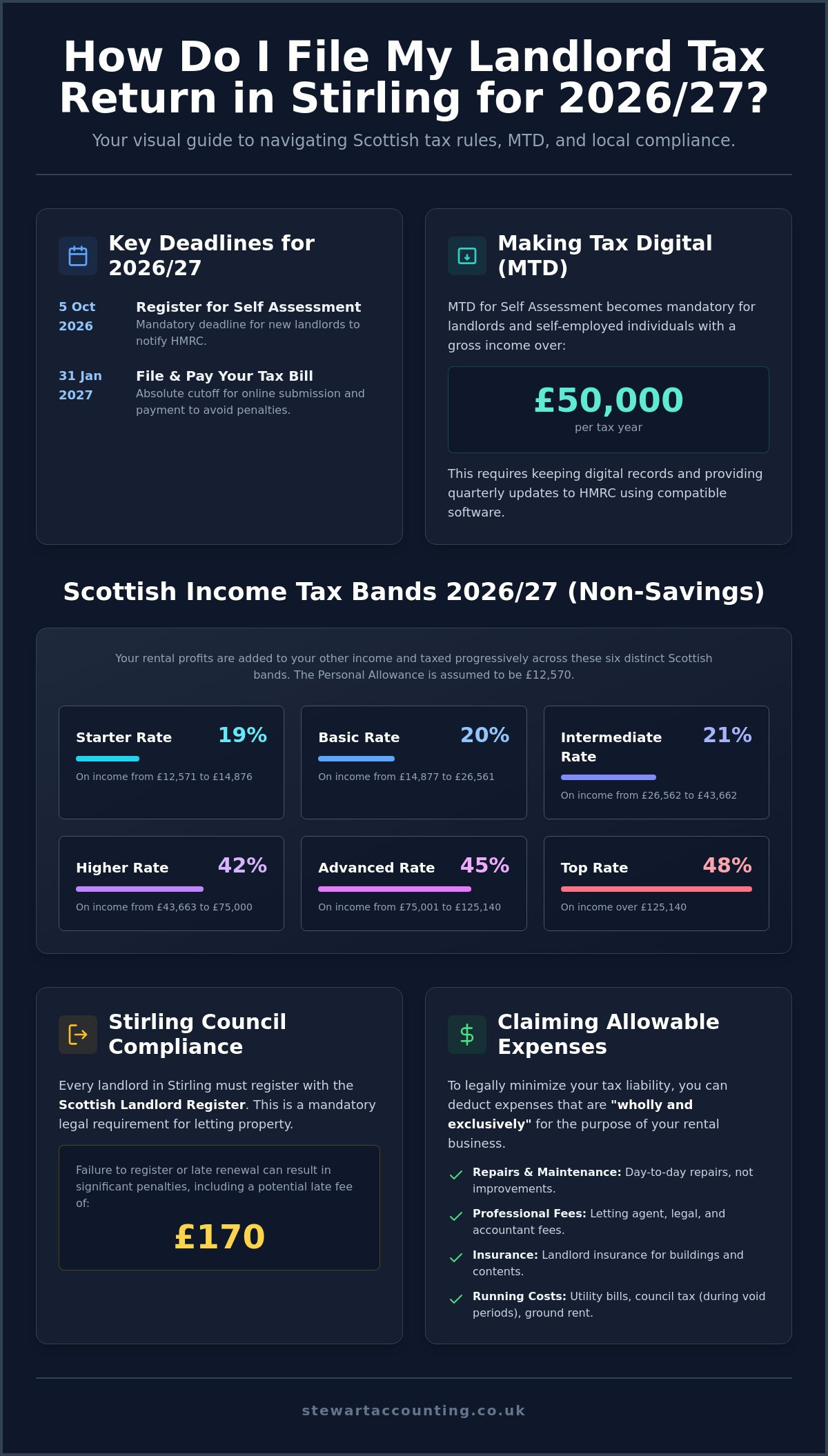
Missing a date can result in frustrating penalties from HMRC. If you’re a new landlord, you must register for Self Assessment by 5th October 2026. Following this, the 31st January 2027 deadline is the absolute cutoff for filing and paying your bill. Filing your landlord tax return Stirling early is a pragmatic choice. It allows for better cash flow forecasting and removes the last-minute stress that often plagues the New Year. We encourage all our clients to prepare their documentation well in advance. This proactive approach helps us identify tax-saving opportunities and ensures your registration with local authorities is correctly reflected in your filings. By delegating these tasks to us, you can focus on your life in Stirling while we handle the technical complexities of accounting for landlords.
What are the specific Scottish tax rules and local Stirling obligations?
Being a landlord in Stirling involves more than just finding tenants. You must navigate a legal landscape that differs significantly from the rest of the UK. Unlike landlords south of the border, you’re subject to the Scottish income tax system, which features more granular bands and different rates. Additionally, local compliance through Stirling Council is a mandatory prerequisite for legal letting. Failing to align your local registration with your landlord tax return Stirling can trigger unwanted attention from both the council and HMRC. We aim to remove this burden from your shoulders by ensuring every local and national requirement is met with precision.
Understanding Scottish Income Tax bands for 2026/27
For the 2026/27 tax year, Scotland maintains a progressive system that requires careful planning. Your rental profits, when added to other non-savings income, are taxed across six distinct tiers. These include the Starter Rate at 19% for income up to £16,537, the Basic Rate at 20%, and the Intermediate Rate at 21%. For higher earners, the rates jump to 42% for the Higher Rate, 45% for the Advanced Rate, and 48% for the Top Rate on income over £125,140. It’s easy for rental income to push you into a higher bracket, especially with thresholds frozen. Understanding how paying tax on your rental income works within these specific Scottish bands is essential for accurate liability forecasting and protecting your mental well-being.
Stirling Council registration and your tax return
Every Stirling landlord must register with the Scottish Landlord Register. This isn’t just a local formality; it’s a legal requirement that HMRC expects you to fulfill. When filing your landlord tax return Stirling, you can use these registration costs to your advantage. The Stirling Council principal fee of £85 and the property fee of £20 are considered “wholly and exclusively” for business purposes. This means they’re fully deductible expenses. However, don’t let registration slide. Stirling Council charges a late application fee of £170, which is a stressful and unnecessary cost that eats into your profits. If you’re managing multiple tenants, you might also need an HMO licence, with fees starting at £890 for up to five occupants for the 2026/27 period.
Legal compliance also extends to the Private Residential Tenancy (PRT) agreement, which is the standard for let properties in Scotland. Ensuring your tenancies are legally sound protects your income stream and simplifies your year-end reporting. Managing these overlapping local and national rules often feels like a full-time job. If you’re feeling overwhelmed by the paperwork, you might consider speaking with our Stirling-based team to see how we can handle these details for you, giving you back your time and peace of mind.
How does Making Tax Digital (MTD) change things for Stirling landlords in 2026?
From 6 April 2026, the way you manage your landlord tax return Stirling will undergo its most significant transformation in decades. If your total gross income from property and self-employment exceeds £50,000, you’ll be required by law to follow the Making Tax Digital (MTD) for Income Tax Self Assessment (ITSA) rules. This isn’t just a minor tweak to the system; it’s a complete shift toward digital record-keeping. The era of keeping paper receipts in a shoebox or managing complex spreadsheets is ending. While this change might feel daunting, it’s designed to reduce errors and provide a clearer picture of your finances throughout the year. If your income is between £30,000 and £50,000, you have a little more time, but you should prepare now for the April 2027 rollout.
The transition from annual to quarterly reporting
The biggest shift under MTD is the move from a single annual submission to quarterly updates. Instead of one frantic deadline in January, you’ll send HMRC a digital summary of your business income and expenses every three months. These updates aren’t full tax returns; they’re snapshots that help HMRC provide a real-time view of your estimated tax liability. This prevents the “tax bill shock” that many Stirling property owners face at the end of the year. Once the four quarters are complete, you’ll submit a Final Declaration by 31st January to finalize your tax for the year. This structured approach helps you stay organized and ensures your bookkeeping is always up to date, which significantly reduces year-end stress.
Choosing MTD-compatible software for your Stirling property
To comply with these new rules, you must use MTD-compatible software to maintain your records and communicate with HMRC. We often recommend platforms like Xero and QuickBooks because they’re user-friendly and offer powerful automation. These tools make it easy to track Stirling property maintenance costs, insurance premiums, and letting agent fees in real time. For those who aren’t tech-savvy, our online accounting services provide a vital bridge. We can set up your digital systems, provide training, or even take over the entire bookkeeping process for you. Using digital software isn’t just about compliance; it’s a pragmatic way to gain better control over your cash flow. By delegating the technical setup to us, you can ensure your landlord tax return Stirling is handled correctly while you focus on managing your properties and enjoying your free time.
What expenses can Stirling landlords actually claim to reduce their tax bill?
Minimizing your tax liability is a pragmatic way to protect your rental profits and ensure the long-term viability of your property portfolio. When preparing your landlord tax return Stirling, the golden rule is that expenses must be “wholly and exclusively” for the purpose of renting out the property. This means you can’t claim for personal costs, but you can certainly deduct the legitimate overheads required to keep your business running smoothly. By identifying every allowable deduction, you restore your financial liberty and reduce the stress of a larger-than-expected HMRC bill.
It’s vital to distinguish between maintenance and capital improvements. General repairs, such as fixing a leaking pipe or repainting between tenancies, are fully deductible from your rental income. However, capital improvements, like adding a new conservatory or a significant structural extension, are generally not deductible from your annual profits. Instead, these costs are typically offset against Capital Gains Tax when you eventually sell the property. For furnished lets in Stirling, you can also utilize the “Replacement of Domestic Items Relief” to claim for the cost of replacing sofas, beds, or white goods on a like-for-like basis.
Common deductible expenses for Stirling properties
Keeping accurate records is the foundation of a successful claim. We recommend using professional bookkeeping services to ensure no receipt is missed. Common deductible items include:
- Insurance premiums: This covers buildings, contents, and specific landlord liability policies.
- Professional fees: Letting agent fees, legal advice for tenancy agreements, and accountancy costs are all claimable.
- Stirling Council costs: Your £85 principal registration fee and £20 property fees are fully deductible business expenses.
- Void periods: If your property is empty, you can claim for the Council Tax and utilities you pay during that time.
The Mortgage Interest Tax Credit (Section 24)
One of the most complex areas of a landlord tax return Stirling involves mortgage interest. Under Section 24 rules, you can no longer deduct mortgage interest or other finance costs directly from your rental income before calculating tax. Instead, you receive a tax credit equal to 20% of your mortgage interest payments. For landlords in the Higher or Top Scottish tax bands, this often results in a higher effective tax rate. Managing your cash flow under these rules requires careful tax planning to ensure you have the funds set aside for your final bill. If you’re concerned about how these interest restrictions affect your take-home profit, get in touch for a personalized tax review to explore strategies for optimizing your property finances.
Why should you partner with a Stirling chartered accountant for your tax return?
Why do many property owners feel a sense of dread as the tax year progresses? Managing a landlord tax return Stirling involves more than just plugging numbers into a form. It requires an intimate understanding of the Scottish property market’s unique nuances and the specific local requirements of Stirling Council. By partnering with a chartered accountant, you ensure a level of expertise and ethical standards that unregulated tax preparers simply lack. We focus on our “Thematic Triad” of service: liberating your time, optimizing your finances, and restoring your mental well-being. This isn’t just about compliance; it’s about giving you back the freedom to enjoy your life while we handle the technical heavy lifting on your behalf.
Moving from anxiety to authority with professional support
The transition from feeling overwhelmed to feeling in control happens the moment you choose full delegation. We take over the entire responsibility for your tax return, ensuring every figure is verified and every deadline is met with precision. Professional oversight significantly reduces the risk of HMRC enquiries, as our formal qualifications build a foundation of trust and competence with tax authorities. We believe in proactive, year-round tax planning rather than last-minute scrambles in January. For instance, we recently helped a local Stirling landlord with a multi-property portfolio navigate the shift to Making Tax Digital. By setting up automated software feeds and digital record-keeping, we turned a complex quarterly reporting requirement into a smooth, manageable process that saved them hours of manual data entry.
Getting started with Stewart Accounting Services in Stirling
Our regional anchoring is a core part of our identity. We are active members of the local community, supporting property owners and small businesses across Stirling, Alloa, and Falkirk. When you get started with us, your initial consultation focuses entirely on your specific needs, desires, and long-term objectives. We’ll review your current property portfolio, identify potential tax-saving opportunities, and create a pragmatic roadmap for the 2026/27 digital changes. Knowing that your property investments are fully compliant with both Stirling Council and HMRC provides a profound sense of peace. You can stop worrying about late fees or filing errors and start focusing on your professional growth. Our goal is to remove the physical and mental burden of tax management from your shoulders entirely, allowing you to move forward with absolute confidence in your financial future.
Secure Your Property Future in Stirling
Addressing the 2026/27 tax year requires a proactive mindset. You now understand how the six Scottish tax bands interact with your rental profits and the vital importance of the April 2026 Making Tax Digital transition. Managing your landlord tax return Stirling shouldn’t be a source of constant stress. By tracking allowable expenses like Stirling Council registration fees and professional insurance, you can effectively minimize your tax liability while staying fully compliant.
Our team provides the expertise needed to navigate these digital changes with ease. As a Chartered Accountant firm with local offices in Stirling, Alloa, and Falkirk, we are specialists in Scottish Landlord Tax compliance. We’re here to remove the physical and mental burden of financial reporting from your life, restoring your personal liberty. Let us handle your landlord tax return so you can focus on your property portfolio. You’ve built a valuable asset in Stirling; let’s work together to ensure it continues to thrive through 2027 and beyond.
Frequently Asked Questions
Do I need to file a tax return if my Stirling rental property is making a loss?
Yes, you should still file a tax return to report the loss and carry it forward to offset against future rental profits. This is a pragmatic way to reduce your future tax liability and ensure you don’t pay more than necessary when the property becomes profitable. Reporting the loss also maintains a complete financial history for HMRC, providing peace of mind and professional clarity for your records.
How much can I earn from a lodger in my Stirling home before paying tax?
You can earn up to £7,500 per year tax-free under the Rent-a-Room Scheme if you let out a furnished room in your main residence. If your gross receipts are below this threshold, the income is automatically exempt, and you don’t need to report it to HMRC. However, if you earn more, you must declare the excess on your return. This scheme is an excellent way to boost your finances while maintaining your personal liberty.
What is the penalty for a late landlord tax return in Scotland?
HMRC applies an immediate £100 automatic penalty if your online return is even one day late after the 31st January deadline. If the delay continues beyond three months, daily penalties of £10 per day may be added, up to a maximum of £900 for that period. These costs can quickly escalate, adding unnecessary stress to your life. We recommend filing early to avoid these avoidable financial burdens and keep your property business compliant.
Can I claim the cost of traveling to my rental property in Stirling?
Yes, you can claim travel expenses as long as the journey is “wholly and exclusively” for the purpose of your rental business. For the 2026/27 year, you can use the approved mileage rate of 45p per mile for the first 10,000 miles and 25p thereafter when using a personal vehicle. Keeping a detailed mileage log is essential to support your claim and ensure you accurately minimize your landlord tax return Stirling liability.
Is the Stirling Council landlord registration fee tax-deductible?
The Stirling Council principal fee of £85 and the £20 property fee are fully tax-deductible business expenses. Because these costs are mandatory for legal letting in Scotland, they meet the “wholly and exclusively” criteria set by HMRC. You should include these in your annual accounts to reduce your taxable profit. Delegating the tracking of these small but important receipts to a professional ensures nothing is overlooked during the busy filing season.
How does the 2026 Making Tax Digital change affect small-scale landlords?
For the 2026/27 tax year, only landlords with a gross income over £50,000 are mandated to use MTD-compatible software for quarterly updates. If your income is below this threshold, you can continue filing your landlord tax return Stirling via the traditional annual Self Assessment system for now. However, those with income over £30,000 must prepare for their mandatory transition starting in April 2027. Early adoption can help you gain better control over your cash flow.
What is the difference between a repair and a capital improvement for tax purposes?
A repair restores an item to its original condition, such as fixing a broken window, and is deductible from your annual rental income. A capital improvement, like installing a new extension or upgrading a kitchen with high-end materials, adds value and is usually offset against Capital Gains Tax when the property is sold. Correctly categorizing these costs is vital for compliance and ensures you maximize your available tax relief each year.
Do I pay Scottish or UK income tax rates on my Stirling rental income?
You must pay Scottish income tax rates on your rental profits because the property is located in Scotland and you are a Scottish taxpayer. These rates include the Starter, Basic, Intermediate, Higher, Advanced, and Top rates, which differ from the bands used in England and Wales. Applying the correct regional rates is a critical part of your filing process to ensure you remain fully compliant with devolved tax legislation.