

How Do I Go About Setting Up Payroll for the First Time?

Could a single missing HMRC registration form be the only thing standing between your business growth and a costly penalty? For many new employers across Scotland, the prospect of setting up payroll for the first time feels less like an exciting milestone and more like a mountain of complex paperwork. You’ve worked hard to reach the stage where you can hire staff, so it’s natural to feel anxious about getting the technical details right. Whether you’re worried about miscalculating the 15% employer National Insurance rate or confusing Scottish tax codes with those used elsewhere in the UK, that “what if” feeling is a common burden for growing firms.
We believe that managing your team shouldn’t come at the cost of your mental well-being or your free time. This guide provides the clarity you need to move from confusion to complete control. We’ll walk you through the essential steps of HMRC registration, choosing the right software, and staying compliant with specific Scottish tax regulations. By the end of this article, you’ll understand how to transform a complex admin task into a streamlined, automated process. Our goal is to help you remove these administrative weights, giving you the freedom to focus entirely on your business’s future.
Key Takeaways
- Learn exactly when to register with HMRC as an employer and how the PAYE system functions to keep your business compliant from day one.
- Understand the critical differences in Scottish tax codes and how to apply the correct income tax bands for your local team.
- Discover the essential data you need for setting up payroll for the first time, including P45s and National Insurance details.
- Compare the time commitment of managing monthly RTI submissions in-house versus the benefits of delegating to a professional.
- Find out how automating your payroll process can restore your personal liberty and allow you to focus on your business growth.
What are the first legal steps to register as an employer?
Transitioning from a solo venture to a team-based business is an exciting milestone. However, the administrative side often creates unnecessary stress for those setting up payroll for the first time. Before you can legally pay your staff, you must register with HMRC. This process formally enters your business into the Pay As You Earn (PAYE) system. PAYE is the method HMRC uses to collect Income Tax and National Insurance directly from an employee’s wages. It’s vital to understand What is Payroll? and how these deductions work to ensure your business remains compliant and your employees are paid correctly.
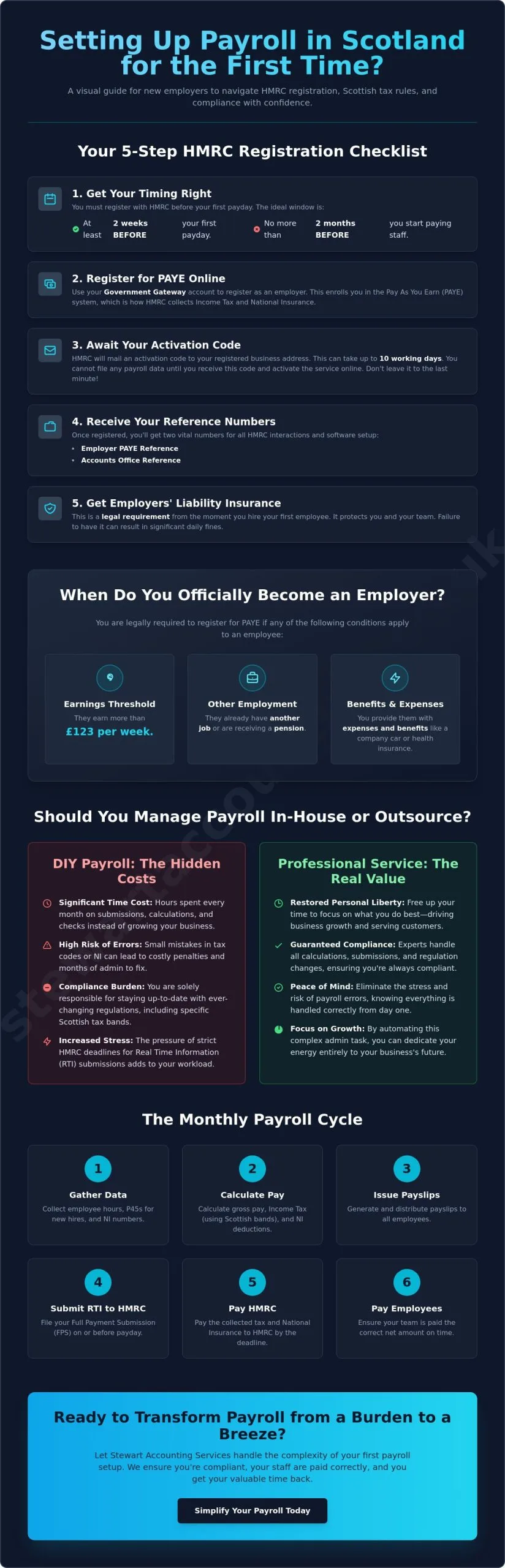
Timing is everything. You cannot register as an employer more than two months before you start paying people. Most businesses should aim to register at least two weeks before their first intended payday to allow for processing time. Once registered, you’ll receive two critical identifiers: your Employer PAYE Reference and your Accounts Office Reference. You’ll need these numbers for every interaction with HMRC and for configuring your chosen payroll software. While a sole trader only needs to register if they hire others, limited company directors must often register even if they’re the only person on the payroll, as they’re technically employees of their own company.
Registering with HMRC and PAYE Online
The registration happens through the Government Gateway. If you already have a login for Corporation Tax or VAT, you can usually add the employer service to your existing account. If not, you’ll need to create a new one from scratch. A common frustration for new business owners in Stirling or Falkirk is the 10-day lag. After you apply, HMRC sends an activation code by post to your registered address. You can’t submit any payroll data until this code arrives and you activate the service online. Don’t leave this until the last minute, as you’ll be unable to file your first return without it.
When do you officially become an employer?
Should you manage payroll in-house or outsource to a professional?
Deciding how to handle your monthly pay run is a critical choice when setting up payroll for the first time. While “free” or low-cost DIY software might seem like a budget-friendly option, the hidden costs often outweigh the savings. You aren’t just paying for a subscription; you’re spending your own valuable time. Monthly RTI (Real Time Information) submissions are mandatory. They must be filed with HMRC on or before every single payday without exception. For a business owner in Stirling or Alloa, spending several hours every month wrestling with tax codes and NI thresholds is time taken away from customer acquisition or service delivery. It’s a trade-off that often costs more in lost opportunities than the price of a professional service.
HMRC rarely accepts a busy schedule as a valid excuse for missing a deadline. Even a small mistake in your initial configuration can lead to a cascade of errors that take months to unpick. By evaluating the true cost of your time, you’ll likely find that the DIY route is more expensive than it first appears. Professional management ensures that your compliance is handled accurately from day one, protecting your business from the financial and reputational damage of payroll errors.
Choosing HMRC-recognised payroll software
If you choose the in-house route, cloud-based solutions like Xero are essential. Manual spreadsheets are a dangerous trap. They lead to frequent errors in calculating the 15% employer National Insurance or the new £123.25 SSP rates. HMRC-recognised software automates these figures, ensuring you don’t accidentally underpay the taxman or your staff. However, software is only as good as the data entered. You still need to ensure the system handles statutory payments correctly. Maternity leave, sick pay, and shared parental pay involve specific legal timelines. A simple spreadsheet just can’t track these accurately, leaving you vulnerable to compliance breaches.
The case for professional payroll delegation
This is where the concept of the “thematic triad” comes in. By choosing to outsource, you liberate your time, protect your finances from penalties, and improve your mental well-being. When you are setting up payroll for the first time, professional delegation removes this anxiety entirely. A Chartered Accountant doesn’t just “do the numbers”; they act as a buffer between you and HMRC. If a complex query arises regarding a Scottish tax code or a pension auto-enrolment threshold, you don’t have to spend hours on hold with a government helpline. Our payroll services are designed to take this weight off your shoulders. We ensure your setup transitions into a smooth, automated monthly process, allowing you to focus on your business goals while we handle the technical compliance.
What are the specific Scottish tax and pension rules for employers?
Many business owners in Central Scotland are surprised to find that the UK tax system isn’t uniform. When you’re setting up payroll for the first time, you must account for the distinct rules set by the Scottish Parliament. These differences aren’t just minor details; they affect exactly how much take-home pay your employees receive and how much you, as an employer, need to deduct. Identifying a Scottish taxpayer is the first step. Generally, if an employee’s main home is in Scotland, they’re a Scottish taxpayer. HMRC will notify you of this by adding an “S” prefix to their tax code, such as S1257L. Using the wrong code isn’t just a clerical error; it can lead to your staff being significantly undercharged or overcharged for tax.
Navigating Scottish Income Tax
For the 2026/27 tax year, Scotland maintains a six-tier income tax system, which is more complex than the three tiers used in the rest of the UK. This structure includes several unique bands:
- Starter Rate: 19% on earnings between £12,571 and £16,537.
- Basic Rate: 20% on earnings from £16,538 to £29,526.
- Intermediate Rate: 21% on earnings from £29,527 to £43,662.
- Higher Rate: 42% on earnings from £43,663 to £75,000.
- Advanced Rate: 45% on earnings from £75,001 to £125,140.
- Top Rate: Applied to all earnings above £125,140.
Because these thresholds differ from those in England and Wales, you can’t rely on generic UK payroll calculators. Your software must be specifically configured to handle these Scottish residents. This ensures that the 21% intermediate rate or the 42% higher rate is applied at the correct pound, keeping your business compliant and your employees’ finances stable.
Auto-Enrolment and Workplace Pensions
Alongside tax, you have a legal duty to provide a workplace pension for eligible staff. This obligation starts the moment your first employee joins. You must enroll any staff member who is aged between 22 and the State Pension age and earns more than the £10,000 annual earnings trigger. Currently, the minimum total contribution is 8% of qualifying earnings. As the employer, you’re required to contribute at least 3%, with the remaining 5% typically coming from the employee’s wages.
Many new firms in Alloa and Falkirk choose NEST as their provider because it’s designed to be straightforward for small businesses. Once your scheme is live, you must complete a Declaration of Compliance with The Pensions Regulator. This must be done within five months of your duties start date. Setting up payroll for the first time involves juggling these moving parts, but getting the pension foundations right ensures you avoid the heavy daily fines associated with non-compliance. We focus on making this transition as smooth as possible, allowing you to fulfill your duties without the administrative headache.
How do you manage the monthly payroll cycle effectively?
Once you’ve cleared the initial hurdle of setting up payroll for the first time, your focus shifts to the monthly rhythm of data collection and reporting. This cycle requires strict attention to detail to ensure your team is paid accurately and on time. You’ll need to gather essential information for every new hire, including their P45 from a previous employer, their National Insurance number, and verified bank details. If a P45 isn’t available, you must ask the employee to complete a starter checklist. This data forms the foundation of your payroll run. Accuracy here prevents the stress of correcting pay packets later in the month.
Most employers now issue digital payslips rather than paper versions. This isn’t just more efficient; it’s often more secure. These documents must show gross pay, individual deductions like tax and National Insurance, and the final net amount. Once the calculations are complete, you must pay HMRC the tax and NI you’ve deducted. Most small businesses pay monthly, usually by the 22nd of the following month, though some very small firms may qualify for a quarterly schedule. If you want to move away from these manual tasks, our payroll services can automate the entire cycle for you.
The “On or Before” Payday Rule
HMRC operates under a strict Real Time Information (RTI) regime. This means you must send a Full Payment Submission (FPS) to HMRC on or before every single payday. If you pay your staff on the last Friday of the month, the report must reach HMRC by that Friday at the latest. Reporting late triggers automatic penalties that can quickly eat into your business margins. This report includes details of all payments made to employees, along with their tax and NI deductions. Handling mid-month changes, such as new starters or leavers, requires immediate updates to your records to ensure your FPS remains compliant.
Statutory Payments and Deductions
Managing a payroll cycle also involves calculating statutory payments when employees are away from work. As of April 2026, Statutory Sick Pay (SSP) is £123.25 per week and is payable from the very first day of absence. Similarly, Statutory Maternity Pay (SMP) and other parental payments are £194.32 per week, or 90% of average earnings if that’s lower. You may also need to handle student loan repayments or attachment of earnings orders from the courts. Precision is vital here. You are legally required to keep these payroll records for six years, including details of pay, leave, and sickness. This documentation is your primary defense in the event of an HMRC compliance check. By delegating these complex calculations, you ensure your business stays on the right side of the law without sacrificing your own time.
How can Stewart Accounting Services simplify your first payroll setup?
Taking the leap from a solo venture to becoming an employer is a significant achievement. However, the technicalities of setting up payroll for the first time can quickly dampen that excitement. At Stewart Accounting Services, we specialize in helping small and medium-sized enterprises in Falkirk, Stirling, and Alloa turn this complex hurdle into a seamless, background process. We don’t just provide a service; we act as a dependable local partner dedicated to your growth. By delegating your payroll to us, you’re choosing to restore your thematic triad of personal liberty. You regain your time, safeguard your finances from HMRC penalties, and significantly improve your mental well-being.
Our approach is built on pragmatic, real-world experience. We understand that payroll isn’t an isolated task. It’s a vital component that must integrate perfectly with your Year End Accounts Preparation and VAT Return Services. When these systems work in harmony, your business runs more smoothly. We ensure that every deduction is accurate, every Scottish tax code is correctly applied, and every RTI submission is filed on time. This holistic view allows us to spot potential issues before they become expensive problems. We give you the confidence to lead your team without the weight of administrative anxiety.
Our approach to first-time payroll setup
We guide you through the entire journey, starting with HMRC Registration and Authorisation. We handle the paperwork to secure your Employer PAYE Reference, ensuring you’re ready for that first successful payday. For those who prefer to stay hands-on, we offer expert Xero training and support. This hybrid approach gives you the best of both worlds: the efficiency of modern cloud software combined with the safety net of professional oversight. We take care of the technical details so you don’t have to. Our team effectively removes the mental load of compliance from your daily schedule.
Get started with a free consultation
We want to physically remove the burden of payroll from your desk. During a free consultation, we look beyond the basic monthly pay run. We consider how your payroll costs impact your wider Business plans and Cashflow Forecast. This strategic alignment ensures that your hiring decisions are sustainable and grounded in financial reality. If you’re ready to stop worrying about tax codes and start focusing on your business’s future, we are here to help. Contact Stewart Accounting Services for payroll support today to discover how professional delegation can transform your business operations.
Ready to grow your team with confidence?
Transitioning from a solo entrepreneur to an employer is a significant milestone in your business journey. You’ve seen that while the technical side of setting up payroll for the first time involves specific HMRC registrations and unique Scottish tax codes, these are manageable hurdles. By establishing a clear monthly cycle and choosing the right software, you protect your business from penalties and ensure your team remains motivated and well-paid.
As Chartered Accountants in Scotland, we specialize in removing these administrative weights from your shoulders. Our local teams in Alloa, Stirling, and Falkirk bring expert SME payroll services directly to your doorstep. We focus on the intricate details of compliance so you don’t have to, allowing you to reclaim your time and mental well-being. This professional delegation doesn’t just solve a problem; it provides the liberty you need to lead your business forward.
Let us handle your payroll setup so you can focus on your business. You’ve worked hard to reach this stage of growth, and we’re here to ensure your next steps are smooth and stress-free. We look forward to helping your business thrive.
Frequently Asked Questions
Do I need to register for payroll if I am the only director of a limited company?
Yes, you must register for PAYE if you pay yourself a salary above the lower earnings limit of £123 per week. As a director, you’re technically an employee of your company. Registering ensures you can draw a salary legally and maintain your National Insurance contributions for your State Pension. Even as a solo director, you’re required to submit monthly reports to HMRC to stay compliant.
What information do I need to collect from a new employee on their first day?
You must collect their P45, National Insurance number, date of birth, and full home address. If the employee doesn’t have a P45 from their previous job, you’ll need them to complete a starter checklist. You also need their bank details to ensure payments are processed correctly. Gathering this data on day one prevents errors in your first RTI submission and ensures the correct tax code is applied.
How much does it cost to set up payroll for the first time?
The total cost varies depending on whether you manage the process in-house or outsource to a professional firm. Software providers charge different subscription rates, while professional fees are usually based on the number of employees you have. While “free” tools exist, many business owners find the investment in professional support is offset by the time saved and the total removal of HMRC penalty risks.
What is the difference between a P45 and a P60?
A P45 is a document an employee receives when they leave a job, while a P60 is an annual summary provided at the end of the tax year. The P45 helps you put a new starter on the correct tax code immediately. The P60 confirms the total pay and deductions for the entire year. Both are essential for precise record-keeping, but you’ll only need the P45 during the initial hiring process.
Can I run payroll using a simple spreadsheet instead of software?
While you can calculate figures manually, you cannot easily meet HMRC’s Real Time Information (RTI) requirements without recognised software. HMRC requires you to submit an electronic report on or before every payday. Spreadsheets don’t have the functionality to communicate directly with HMRC’s systems. Using dedicated software or a professional service ensures you accurately calculate complex figures like the £123.25 weekly Statutory Sick Pay rate.
What are the penalties for late payroll submissions to HMRC?
HMRC issues automatic monthly penalties if you fail to send your Full Payment Submission (FPS) on time. For small businesses with 1 to 9 employees, the penalty is £100 per month. These fines increase for larger workforces. If you also fail to pay the tax and NI you’ve deducted by the deadline, HMRC will charge interest and may apply additional percentage-based penalties that can damage your business cashflow.
How do Scottish tax codes differ from English tax codes?
Scottish tax codes feature an “S” prefix and follow a six-tier system that is distinct from the rest of the UK. When setting up payroll for the first time in Scotland, you must apply specific rates like the 19% starter rate or the 21% intermediate rate. Because the thresholds for the 42% higher rate also differ, using English tax bands for Scottish residents will lead to incorrect deductions and compliance issues.
When is the deadline for paying HMRC the tax and NI I have deducted?
The deadline is the 22nd of the month for electronic payments, or the 19th if you are paying by post. This payment covers the deductions made in the previous tax month. If your total monthly payments are typically less than £1,500, you can request to pay HMRC quarterly. Staying on top of these deadlines is vital when setting up payroll for the first time to avoid unnecessary interest charges and stress.
Recent Posts
17 Oct, 2026
17 Oct, 2026