

How Does Capital Gains Tax in Scotland Work for the 2026/26 and 2026/27 Tax Years?

If you live in Stirling or Falkirk and pay the Scottish Higher Rate of income tax, did you know you might still qualify for the lower rate of Capital Gains Tax? It’s completely normal to feel overwhelmed when your local tax bands don’t align with the UK-wide rules for selling assets. Between the shrinking annual exemption of just £3,000 and the intricacies of tax planning for small business scotland, the anxiety of an unexpected HMRC penalty is a heavy burden for any owner to carry.
This guide clears that confusion by explaining exactly how the 2025/26 and 2026/27 rates apply to your specific situation. You’ll discover how the interaction between devolved income tax and UK-wide CGT creates unique opportunities to minimise your liability legally. We’ll outline the latest thresholds, show you how to maximise your basic rate band, and explain why delegating these complex filings to a professional can restore your peace of mind and financial liberty. By the end of this article, you’ll have a clear roadmap for protecting your hard-earned gains while staying fully compliant with the latest regulations.
Key Takeaways
- Understand that while CGT is a UK-wide tax, your specific liability is directly influenced by the interaction with devolved Scottish income tax bands.
- Learn how to navigate the reduced £3,000 annual tax-free allowance and the updated 2026/27 rates for residential property and business assets.
- Discover how proactive tax planning for small business scotland can help you utilise the basic rate band to lower your overall tax percentage.
- Identify key exemptions like Private Residence Relief and the benefits of gifting assets to a spouse to protect your family wealth.
- See how delegating your tax reporting to experts in Alloa, Stirling, and Falkirk removes the burden of HMRC compliance and ensures total accuracy.
What is Capital Gains Tax in Scotland and How Does it Differ from the UK?
Capital Gains Tax (CGT) is the tax you pay on the profit when you sell or “dispose of” an asset that has increased in value. It is the gain you make that is taxed, not the total amount of money you receive. Many residents in Stirling and Falkirk assume that because their Income Tax is different from the rest of the UK, their CGT must be too. However, Capital Gains Tax in the United Kingdom is a reserved matter. This means the rates and rules are set by the UK Government in Westminster, not the Scottish Parliament in Holyrood.
The Devolved Tax Confusion: What Scottish Residents Must Know
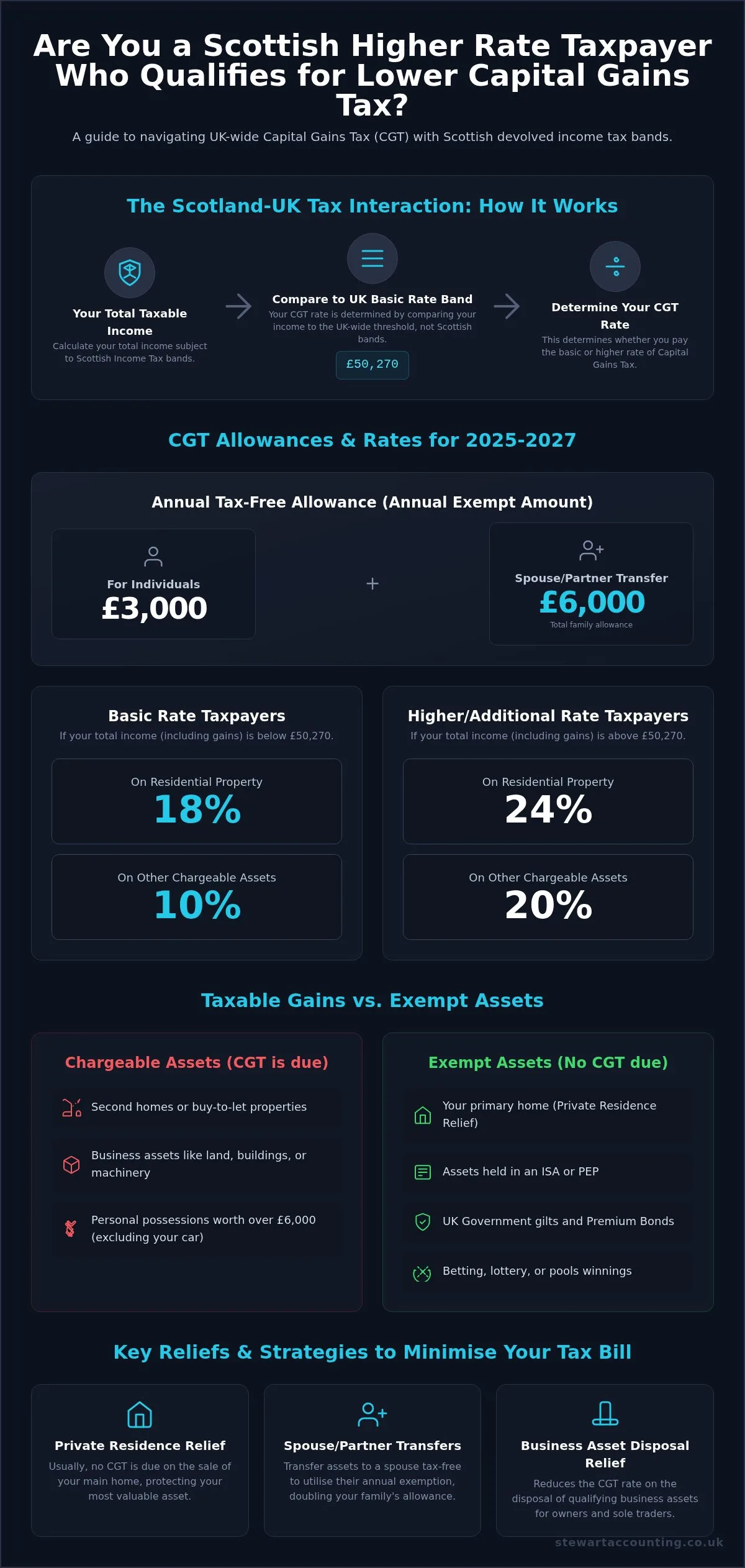
Although the tax itself is UK-wide, your residency in Scotland plays a vital role. Your Scottish “S” tax code dictates which Income Tax bands apply to your earnings. Because your total taxable income determines whether you pay the basic or higher rate of CGT, the decisions made by the Scottish Government regarding income thresholds indirectly change your final bill. Effective tax planning for small business scotland involves looking at your total financial picture, as your Scottish starter or intermediate rates don’t exist for CGT purposes. Instead, we must map your Scottish income against the UK-wide basic rate threshold of £50,270 to find your correct CGT percentage.
Chargeable Assets vs. Exempt Assets in 2026
Knowing what is taxable and what is exempt is the first step toward reducing your anxiety during tax season. For a Scottish small business owner, a chargeable asset is any piece of equipment, property, or shareholding used in your trade that you sell for more than you originally paid. Identifying these early allows for smoother financial management and fewer surprises when filing your Self-Assessment.
- Chargeable Assets: Second homes or buy-to-let properties, business assets like land or machinery, and personal possessions worth more than £6,000 (excluding your car).
- Exempt Assets: Your primary residence (thanks to Private Residence Relief), ISAs or PEPs, UK Government Gilts, and betting or lottery winnings.
Strategic tax planning for small business scotland helps you identify which assets will trigger a bill before you even put them on the market. Delegating the tracking of these disposals to a professional in Alloa can save you significant time and stress. We ensure that every disposal is recorded accurately, helping you stay compliant while you focus on growing your business and enjoying your personal liberty.
What are the Capital Gains Tax Rates and Allowances for 2025/26 and 2026/27?
For the 2025/26 and 2026/27 tax years, the rates you pay are determined by your total taxable income. Basic rate taxpayers pay 18% on gains from residential property and other assets. If your income pushes you into the higher or additional rate brackets, that rate climbs to 24%. This 6% difference can represent a significant sum for residents in Central Scotland who are selling a second home or a valuable asset. Consulting the official UK government guidance on Capital Gains Tax is a good starting point to see which rate applies to your specific disposal.
The Shrinking CGT Allowance: Planning for 2026
The annual tax-free allowance has decreased sharply over the last few years. For the 2026/27 tax year, the Annual Exempt Amount remains at just £3,000 for individuals. This reduction creates a higher tax burden for small-scale investors in Alloa and Falkirk who might have previously stayed under the threshold. Effective tax planning for small business scotland often involves “bed and spouse” transfers. This strategy allows you to transfer assets to a spouse or civil partner tax-free, effectively doubling your family’s exempt amount to £6,000. It’s a practical way to protect your profit, provided the transfer is handled correctly before the final sale. Reporting these gains promptly is essential. HMRC is strict about deadlines; late filings quickly lead to unnecessary penalties and interest charges.
Business Asset Disposal Relief (BADR) Changes for SMEs
If you’re a sole trader or a partner in Stirling thinking about selling your business, you need to be aware of the shifting rates for Business Asset Disposal Relief. From April 2026, the BADR rate increases to 18%, up from 14% in the 2025/26 tax year. While this is an increase, it remains significantly lower than the standard 24% higher rate. To qualify, you must have owned the business for at least two years and meet specific criteria regarding the sale of all or part of your enterprise. There’s a lifetime limit of £1 million on qualifying gains. Keeping a meticulous record of your past claims is vital for your long-term strategy. Implementing robust tax planning for small business scotland ensures you don’t miss out on these reliefs before the rates change again. We can help you review your eligibility and track your remaining allowance to ensure your exit strategy is as tax-efficient as possible. This level of professional delegation removes the stress of complex calculations and gives you the liberty to focus on your next venture.
How Do Scottish Devolved Income Tax Bands Affect Your Capital Gains Tax Bill?
Your total taxable income is the foundation of your CGT calculation. HMRC uses the “Income + Gain” rule, where your capital gains are effectively stacked on top of your annual earnings to see which tax band they land in. For residents in Stirling or Alloa, this creates a unique situation. While you deal with Scottish-specific income tax bands for your salary, the Capital Gains Tax rates and allowances are tied to UK-wide thresholds. This distinction is vital for effective tax planning for small business scotland, as it often leads to confusion during the filing process.
In Scotland, you become a “Higher Rate” income taxpayer once your earnings exceed £43,663. However, for CGT purposes, the higher rate (24%) only triggers when your combined income and gains cross the UK-wide threshold of £50,270. This means a business owner in Falkirk could be paying 42% income tax on their top slice of earnings but still only pay the basic 18% rate on their capital gains. It is a rare area where the misalignment of devolved and reserved taxes can actually work in your favour, provided your income stays within that specific gap.
Consider a Stirling-based resident with a £35,000 salary and a £20,000 capital gain from selling shares. After deducting the £12,570 personal allowance, their taxable income is £22,430. We then subtract the £3,000 CGT exemption from the gain, leaving £17,000 taxable. When we add that £17,000 to the taxable income, the total is £39,430. Since this remains well below the £50,270 UK threshold, the entire gain is taxed at the basic 18% rate, even though the individual is nearing the Scottish Higher Rate for their salary.
The Interaction Between Scottish Income Tax and CGT
To get your calculation right, you must first identify your unused basic rate band. You start with the UK-wide limit of £50,270 and subtract your taxable income after all personal allowances are applied. Whatever remains is the “space” you have to tax gains at the lower 18% rate. For more detail on how your salary is taxed before this step, see our guide on Understanding Scottish Tax Bands: A Quick Guide. This methodical approach is the core of tax planning for small business scotland, ensuring you don’t overpay due to threshold confusion.
Reporting Gains via Self-Assessment in Scotland
Once you’ve calculated your liability, reporting it correctly is the next hurdle. If you sell a UK residential property, you don’t wait for your annual return; you must report and pay within 60 days of completion. For other assets, like business equipment or shares, you use your annual filing. Our team handles Self Assessment Tax Returns for clients across Central Scotland, taking the technical burden off your plate. This delegation ensures every Scottish band and UK threshold is applied accurately, protecting your mental well-being and your financial liberty.
Which Tax Reliefs and Exemptions Are Available to Scottish Small Businesses and Landlords?
Identifying the right reliefs is the most effective way to lower your tax bill and protect your hard-earned profit. While the 2026/27 rates are non-negotiable, the UK tax system offers several exemptions that specifically benefit property owners and entrepreneurs in Central Scotland. Effective tax planning for small business scotland often starts with the simplest strategy: transferring assets to a spouse or civil partner. Because these transfers happen on a “no gain, no loss” basis, you can effectively use two sets of the £3,000 annual allowance, shielding £6,000 of profit from HMRC entirely.
Private Residence Relief and the Lettings Relief Trap
For most homeowners in Alloa or Falkirk, Private Residence Relief (PRR) ensures that selling your main home is tax-free. You don’t need to report the sale if the property has been your only residence throughout your ownership. However, landlords often fall into a costly trap regarding Lettings Relief. In years past, this relief was widely available to anyone who had once lived in their rental property. Today, it’s strictly limited to those who live in the property alongside their tenant. If you’re selling a former home that is now a full-time rental, you might face a much higher bill than expected. Our specialized Accounting Services for Landlords can help you calculate the exact proportion of PRR you’re entitled to, ensuring you don’t overpay.
Maximising Reliefs for Small Business Owners
If you’re looking to grow or pass on your legacy, two specific reliefs are vital. Incorporation Relief allows you to defer capital gains when you transfer your sole trader business into a limited company structure in exchange for shares. This is a common step for businesses in Stirling reaching a certain level of turnover. For those planning for the next generation, Gift Hold-Over Relief is an essential tool. It allows you to give away business assets without triggering an immediate tax charge; instead, the recipient “inherits” your original cost base and pays the tax only when they eventually sell the asset. This is particularly useful for family business succession planning across Scotland.
Don’t forget the power of capital losses. If you’ve sold an asset at a loss in previous years, you can carry that loss forward indefinitely to offset your 2026/27 gains. This reduces your taxable total and can often bring you back under the annual threshold. To ensure you’re utilizing every available relief and keeping your records compliant, you can book a tax planning consultation with our team. We handle the technical details of Limited Company Accounting and personal disposals, giving you the liberty to focus on your future goals while we manage the burden of HMRC reporting.
How Can Professional Tax Planning with Stewart Accounting Services Protect Your Mental Well-being?
Managing capital gains on your own can feel like taking on a second job you never applied for. The weight of compliance, coupled with the fear of an HMRC enquiry, often leads to sleepless nights for business owners across Central Scotland. At Stewart Accounting Services, we believe that professional tax planning for small business scotland should do more than just lower a bill. It should restore your personal and professional liberty by removing the complex burden of tax reporting from your shoulders entirely. Our team takes over the technical heavy lifting, allowing you to focus on your family and your future.
The Thematic Triad: Time, Money, and Mental Well-being
Our service is built around a three-part promise to improve your quality of life. First, we liberate your time. Professional delegation removes the manual burden of calculating complex adjusted cost bases or racing to meet the 60-day reporting deadline for property sales. You won’t have to spend your weekends deciphering HMRC manuals or worrying about whether you’ve applied the correct Scottish income tax threshold to your UK-wide capital gains.
Second, we protect your finances through expert accuracy. The financial benefit of proactive planning is clear, especially with the Business Asset Disposal Relief rate set to rise to 18% in April 2026. By identifying your eligibility for reliefs before these changes take effect, we ensure you don’t pay a penny more than you legally owe. Third, we provide mental well-being. There is a specific type of peace that comes from knowing a Chartered Accountant has verified every figure on your return. This total transfer of responsibility eliminates the anxiety of potential penalties and late-filing interest charges.
Get Started with a Scottish CGT Review
Local expertise is essential when your tax bill depends on the interaction between Holyrood’s income bands and Westminster’s CGT rates. Our approach is straightforward and helpful. We begin with a consultation to assess your potential liability and identify which exemptions, such as Gift Hold-Over Relief or capital loss offsets, apply to your situation. This proactive strategy ensures there are no nasty surprises when it’s time to file your Self-Assessment.
Local support is available whenever you need it. With offices in Alloa, Stirling, and Falkirk, we are deeply grounded in the regional business community. We understand the specific challenges facing Scottish landlords and SMEs because we live and work in the same towns. You don’t have to face complex tax changes alone. Contact our Scottish Tax Experts for a CGT Review today to see how we can simplify your finances and restore your peace of mind through expert tax planning for small business scotland.
Take Control of Your Capital Gains Strategy
Understanding the unique interplay between Scottish income tax and UK-wide Capital Gains Tax is the first step toward securing your financial future. We’ve explored how the shrinking £3,000 allowance and the upcoming 2026 rate changes for Business Asset Disposal Relief make proactive planning essential. By identifying the right exemptions and utilizing your basic rate band, you can significantly reduce your liability while staying fully compliant with HMRC.
Effective tax planning for small business scotland shouldn’t be a source of stress or confusion. As Chartered Accountants with local offices in Alloa, Stirling, and Falkirk, we specialize in navigating these complex devolved tax rules for you. We take the technical burden off your plate, restoring your time and mental well-being so you can focus on your business goals. Our team acts as a trusted partner for Central Scotland SMEs and landlords, ensuring every relief is maximized.
Ready to protect your profits and gain total peace of mind? Contact our Scottish Tax Experts for a CGT Review today. We’re here to help you move forward with confidence and clarity.
Frequently Asked Questions
Is Capital Gains Tax different in Scotland than in England?
No, Capital Gains Tax is not a devolved tax. The rates and rules are the same in Scotland as they are in England. However, your residency matters because your Scottish Income Tax bands determine whether you pay the basic or higher rate of CGT. This interaction makes tax planning for small business scotland essential to ensure you aren’t overpaying based on your specific regional thresholds.
What is the Capital Gains Tax allowance for the 2026/27 tax year?
The annual exempt amount for the 2026/27 tax year is £3,000 for individuals. This is a significant reduction from previous years, meaning you pay tax on any gains above this relatively small buffer. If you’re married or in a civil partnership, you can often combine your allowances to shield up to £6,000 of profit from HMRC, provided you plan the asset transfer correctly before the sale.
Do I pay Capital Gains Tax when I sell my main home in Scotland?
You usually don’t pay Capital Gains Tax when selling your main home thanks to Private Residence Relief. As long as the property’s been your only or main residence for the entire time you’ve owned it, the gain is typically tax-free. If you’ve used part of the home for business or let it out, you might have a partial liability, which our team can help you calculate accurately.
How long do I have to pay Capital Gains Tax after selling a property in Scotland?
You must report and pay any Capital Gains Tax due on the sale of UK residential property within 60 days of completion. This is a strict deadline that catches many people off guard. For non-residential assets, such as business equipment or shares, you typically report the gain through your annual Self-Assessment return, with the payment deadline usually falling on 31st January following the tax year.
Can I use my Scottish Income Tax losses to reduce my Capital Gains Tax?
No, you cannot use income tax losses to offset your capital gains. The two systems are separate; income tax applies to your earnings, while CGT applies to the profit from asset disposals. However, you can use capital losses from the same or previous tax years to reduce your total taxable gain. Tracking these losses over time is a core part of effective tax planning for small business scotland.
Do I need to report a capital gain if it is below the allowance?
You generally don’t need to report a gain if your total gains for the year are below the £3,000 allowance. However, you must still report the disposal if the total value of the assets you sold was more than four times the annual exempt amount. Reporting is also necessary if you want to claim a capital loss to use against future gains, which protects your long-term position.
What are the CGT rates for Scottish landlords in 2026?
For the 2026/27 tax year, Scottish landlords pay 18% on residential property gains if they’re basic rate taxpayers and 24% if they’re higher rate taxpayers. These rates apply to the profit made after deducting your £3,000 allowance and any eligible costs. Because these rates are significant, delegating the calculation to a professional ensures you utilize every available relief to protect your hard-earned investment income.
How do I report Capital Gains Tax to HMRC if I live in Stirling or Alloa?
You report your gains to HMRC online using the Capital Gains Tax on UK Property service for residential sales or through your annual Self-Assessment return. If you live in Stirling or Alloa, our local offices can handle this entire process for you. We manage the digital submissions and ensure your “S” tax code is correctly applied to determine the right tax percentage for your specific situation.
Recent Posts
22 Oct, 2026
21 Oct, 2026