

How to Calculate Markup and Margin for Profit
Let’s get straight to it. Markup is the amount you add to your cost to get a selling price, while margin is the slice of your revenue that's pure profit. Getting this difference right is the foundation of smart pricing—and getting it wrong can quietly drain your profits.
Markup vs Margin: Unpacking the Core Pricing Concepts

It’s one of the most common mix-ups I see with small business owners, but mistaking markup for margin can lead to you seriously underpricing your products and services. Both metrics use the exact same inputs—your cost and your selling price—but they view profitability from completely different angles.
Imagine a local bakery making a celebration cake. All the ingredients—flour, sugar, eggs—plus the baker's time, add up to the Cost of Goods Sold (COGS). If the total cost comes to £15 and they decide to sell the cake for £45, the markup is the extra bit they've added on top of that initial £15.
Margin, on the other hand, starts with the final selling price of £45 and asks, "What percentage of this final price is actually profit?" It's a much clearer indicator of how efficient and financially healthy your business really is.
Why the Difference Matters in Practice
This isn't just about semantics; it has a huge impact on your real-world pricing strategy and financial planning. For a retailer, markup is king. It’s a straightforward way to ensure every single item on the shelf contributes a set amount towards covering overheads. This cost-plus approach works well when you’re pricing a huge inventory of different products.
For a service business like ours, though, we live and die by our profit margin. Our main "cost" is our time and expertise, so knowing what percentage of each client's fee is actual profit is absolutely critical for our long-term sustainability. A big markup on a project means very little if your overheads chew away at the final margin. If you want to dig deeper into this, our guide on valuing and pricing goods and services is a great next step.
I've seen it countless times: a business owner aims for a '30% profit' by adding a 30% markup. The reality is that a 30% markup only yields a 23% profit margin. This seemingly small mix-up can be the difference between a profitable year and a struggle to break even.
Markup vs Margin at a Glance
To make this crystal clear, I've put together a quick comparison table. Think of it as a handy cheat sheet.
| Concept | Markup | Margin |
|---|---|---|
| Calculation Basis | Calculated as a percentage of the cost. | Calculated as a percentage of the selling price. |
| Purpose | Primarily used for setting initial prices. | Primarily used for measuring overall profitability. |
| Perspective | Looks forward: "How much should I add to my cost?" | Looks backward: "How profitable was that sale?" |
| Formula | (Profit / Cost) * 100 |
(Profit / Selling Price) * 100 |
Once you've got this foundation locked in, working through the formulas becomes much more intuitive. Understanding why you’re running the numbers is just as important as knowing how.
It's also useful to know where your pricing fits in the bigger picture. Data from the Office for National Statistics shows that average markups in Great Britain increased by about 9.14% between 1997 and 2019, with the services sector driving much of that growth. Realising these broader trends helps put your own pricing decisions into context.
Applying the Markup Formula to Your Business

Okay, let's get practical. Theory is all well and good, but the real test is applying pricing formulas to your own products or services. The markup formula itself is refreshingly simple: Markup % = ((Selling Price – Cost) / Cost) * 100. It gives you a clear percentage of how much you're adding on top of your costs.
To bring this to life, we'll step into the shoes of three different UK small business owners. You’ll see how the same logic applies whether you're selling a physical product, a cup of coffee, or a professional service.
Pay close attention to how each one breaks down their costs. A truly accurate cost goes way beyond just the obvious materials. Nailing this detail is the only way to set a price that genuinely covers all your expenses and gives you the profit you need to grow.
Example 1: The Brighton Craft Jeweller
Let's start with a craft jeweller working from a small studio in Brighton. She’s pricing a new bespoke silver necklace and needs to figure out a retail price that’s both fair to her customers and profitable for her.
First things first, she needs to total up every single direct cost. It’s easy to remember the silver, but the smaller bits and her time are just as crucial.
- Silver Chain and Pendant: £18.50
- Gemstone: £7.00
- Clasp and Fittings: £2.50
- Gift Box and Packaging: £3.00
- Labour: 2 hours at £20/hour = £40.00
This brings her total direct cost to £71.00. After researching the market, she decides a fair selling price is £150.00.
Now, let's pop those numbers into our formula:
Markup % = ((£150.00 – £71.00) / £71.00) * 100
Markup % = (£79.00 / £71.00) * 100
Markup % = 1.112 * 100 = 111.2%
By marking up her costs by 111.2%, she sets her selling price. This markup needs to cover all her indirect costs—things like workshop rent, marketing, and website fees—with the remainder being her hard-earned profit.
Example 2: The Manchester Coffee Shop
Next, we're off to a busy coffee shop in Manchester. The owner wants to double-check that the markup on his bestseller, a large latte, is where it needs to be.
Calculating the cost of a single coffee requires a surprising amount of detail. Every little component adds up.
- Coffee Beans: £0.35
- Milk (Oat): £0.40
- Cup, Lid, and Sleeve: £0.25
- Sugar and Stirrer: £0.05
- Portion of Labour: £0.80
The total cost for one latte is £1.85. He sells it to customers for £3.95.
Let's run the numbers:
Markup % = ((£3.95 – £1.85) / £1.85) * 100
Markup % = (£2.10 / £1.85) * 100
Markup % = 1.135 * 100 = 113.5%
That 113.5% markup on every latte is what helps him pay for the café's significant overheads—rent, business rates, energy bills, and all the other running costs that aren't in the cup itself.
Remember: Forgetting to account for small costs like packaging or a sachet of sugar can significantly erode your profits over thousands of sales. A precise cost base is the only reliable foundation for a profitable markup.
Example 3: The Bristol Web Developer
So, how does this work when you don't have a physical product? Let's look at a freelance web developer in Bristol quoting for a small business website.
In this case, the 'cost' is mostly the developer's time and the software he relies on. He estimates the project will take him 40 hours from start to finish.
- Developer's Time: 40 hours at a cost rate of £30/hour = £1,200
- Software Licences (pro-rata for the project): £50
- Project Management Tool Subscription (pro-rata): £25
- Stock Photography Budget: £75
His total project cost comes to £1,350. He quotes the client £3,000 for the finished website.
Here's his markup calculation:
Markup % = ((£3,000 – £1,350) / £1,350) * 100
Markup % = (£1,650 / £1,350) * 100
Markup % = 1.222 * 100 = 122.2%
This 122.2% markup doesn't just cover his time. It reflects his expertise, years of experience, and the real value he’s providing to his client's business. The profit he makes goes towards his other business expenses like insurance, marketing, and pension contributions.
Calculating Profit Margin for a Clearer Financial Picture
While markup is the tool you use to set your prices, profit margin is the gauge that measures your actual profitability. It gets right to the heart of the matter, answering the one question every business owner needs to know: "Out of every pound I bring in, how much is actually mine?"
Getting a handle on your margin is fundamental to understanding your business's financial health.
The formula for profit margin is a subtle but powerful tweak on the markup calculation: Margin % = ((Selling Price – Cost) / Selling Price) * 100.
Did you spot the difference? The key is that we're now dividing by the selling price, not the cost. This shift in perspective is what gives margin its true power, as it measures profit as a percentage of your total revenue. It’s also why your margin percentage will always be lower than your markup for the same item—a crucial detail that stops you from overestimating how much money you're really making.
Revisiting Our UK Business Scenarios
To see how this plays out in the real world, let's circle back to our three business owners and calculate their profit margins using the same figures. Seeing the numbers side-by-side really makes the distinction click.
- The Brighton Jeweller: Her necklace costs £71 and sells for £150.
- The Manchester Barista: His latte costs £1.85 and sells for £3.95.
- The Bristol Web Developer: His project costs £1,350 and is invoiced at £3,000.
Now, let's plug these into the profit margin formula.
Example 1: The Jeweller’s Margin
The jeweller's cash profit is still £79 (£150 – £71), but this time we divide it by her selling price to find the margin.
- Margin % = ((£150 – £71) / £150) * 100
- Margin % = (£79 / £150) * 100
- Margin % = 0.526 * 100 = 52.6%
Her markup was a hefty 111.2%, yet her profit margin is 52.6%. This tells her that for every pound earned from a sale, 52.6 pence is gross profit available to cover her workshop rent, marketing, and other running costs. It’s a much more grounded view of her business's performance.
Example 2: The Coffee Shop's Margin
Next up, the Manchester barista. We know the profit on each latte is £2.10.
- Margin % = ((£3.95 – £1.85) / £3.95) * 100
- Margin % = (£2.10 / £3.95) * 100
- Margin % = 0.531 * 100 = 53.1%
Once again, the 53.1% margin is a more sobering figure than the 113.5% markup. It means just over half the revenue from each coffee sold can go towards paying staff, rent, and utility bills. For a more efficient way to consolidate these figures, it's worth learning how to calculate profit in Excel.
A veteran retailer I know once put it perfectly: "Markup helps you set the price, but margin tells you if you’ll survive." This perfectly captures the strategic difference. Markup is an operational tool; margin is a financial health check.
Example 3: The Web Developer’s Margin
Finally, let's look at the Bristol developer, who makes £1,650 in gross profit on the project.
- Margin % = ((£3,000 – £1,350) / £3,000) * 100
- Margin % = (£1,650 / £3,000) * 100
- Margin % = 0.55 * 100 = 55%
His 122.2% markup translates into a 55% profit margin. This is the number he needs for financial planning. It tells him exactly what percentage of his total invoiced revenue is left to reinvest in software, pay taxes, and draw a salary. Understanding your gross profit is essential, and you can learn more about what is gross profit margin in our detailed guide.
By consistently looking at your profit margin, you get a clear, reliable snapshot of how your business is really doing. It empowers you to make smarter decisions on everything from pricing and discounts to cost control and growth.
Dealing with VAT, Discounts, and Other Pricing Headaches
Once you’ve got a handle on the basic formulas, it’s time to get into the messy reality of pricing. Real-world business isn't a neat calculation; it's a constant juggle of things like VAT, sales promotions, and trying to figure out what your competitors are doing.
For any VAT-registered business in the UK, getting VAT right is non-negotiable. A surprisingly common slip-up is to calculate your profit on the VAT-inclusive price. This one mistake will completely throw off your numbers, making you think you're more profitable than you actually are.
Here’s the golden rule: always base your markup and margin calculations on the VAT-exclusive price. This is the only figure that represents the actual revenue your business keeps. If a customer pays you £120 for an item, £20 of that is just passing through your hands on its way to HMRC (assuming the standard 20% rate). Your real revenue is £100. Calculating your margin based on the £120 figure gives you a dangerously skewed view of your business's health.
If you need a more detailed refresher, our guide offers a clear breakdown of pricing exclusive of VAT.
The True Cost of a Discount
Discounts are a fantastic way to drive sales, but they can be absolutely brutal on your profit margins if you’re not careful. A small-looking discount on the price tag has a much bigger, and often painful, effect on your actual profit.
Let's look at a real-world example. Imagine you sell a handmade leather wallet:
- Cost to Make: £40
- Selling Price (ex. VAT): £100
- Profit: £60
- Profit Margin: ((£100 – £40) / £100) * 100 = 60%
Now, you decide to run a 20% off sale. This drops your selling price from £100 to £80. The impact on your profit is far more significant than you might think.
The table below shows exactly what that 20% discount does to your bottom line.
| Metric | Before Discount | After Discount |
|---|---|---|
| Selling Price (ex. VAT) | £100 | £80 |
| Cost to Make | £40 | £40 |
| Profit per Item | £60 | £40 |
| Profit Margin | 60% | 50% |
That 20% discount didn't just knock 20% off your profit. It slashed your profit per item from £60 down to £40 – that’s a 33.3% reduction in the cash you actually make. Your profit margin also took a ten-point hit.
Always model the impact of a discount on your net profit and margin, not just the headline selling price. It forces you to ask the crucial question: "How many more of these do I need to sell just to make the same profit I was making before the sale?"
How to Switch Between Markup and Margin
Ever looked at a competitor's pricing and wondered how they got there? Being able to convert between markup and margin is a seriously useful skill for competitor analysis. It lets you peel back the layers and understand their underlying strategy. Luckily, the formulas are pretty straightforward.
Converting From Markup to Margin
If you know the markup, you can find the margin.
- Margin % = (Markup % / (100 + Markup %)) * 100
For example, if you know a competitor uses a 100% markup (they double their cost price), their margin is:
- Margin % = (100 / (100 + 100)) * 100 = (100 / 200) * 100 = 50%
Converting From Margin to Markup
And if you know their margin, you can work out their markup.
- Markup % = (Margin % / (100 – Margin %)) * 100
These quick conversions are your secret weapon for making sense of the market. They help you gauge the real profitability of other businesses, which is invaluable when you're setting your own prices.
This level of detail has never been more important. Recent UK retail data from the British Retail Consortium highlights just how tightly pricing strategies are now linked to inflation and what customers are willing to pay. While sales volumes might be creeping up, constant cost pressures are squeezing profitability hard. This means businesses have to be on the ball, constantly tweaking their pricing to protect their margins against rising supplier costs.
By mastering these more complex bits of pricing, you move beyond just covering your costs and start building a genuinely resilient and profitable business.
Pricing Tools and Common Mistakes to Avoid
Putting all this theory into practice means grabbing the right tools and, just as crucially, knowing which pricing traps to sidestep. You don't need fancy, expensive software to get started. In fact, a few simple spreadsheet formulas can automate your calculations and bring a ton of clarity right away.
For instance, in Google Sheets or Excel, finding your markup is a breeze. If your cost is in cell A2 and your selling price is in B2, the formula is just =((B2-A2)/A2). Set it up once, and you’ve got a dynamic pricing tool you can use again and again. For those a bit further down the road, accounting software like Xero or QuickBooks can integrate these calculations directly into your inventory and invoicing systems, making everything seamless.
While tools are great, they’re only as smart as the numbers you feed them. It's also worth remembering the pitfalls of relying on online rental calculators and similar simplistic tools, as they often miss the full picture. Genuine financial control comes from steering clear of the common mistakes I’ve seen trip up countless business owners over the years.
Forgetting About the Hidden Costs
One of the most common blunders I see is building a price based only on the obvious, direct cost of a product. It's like planning a road trip and only budgeting for petrol, completely forgetting about insurance, parking, and the inevitable service station snacks.
These "hidden" costs add up quickly and can silently eat away at your profit if you don't account for them from the get-go.
- Shipping and Returns: Don’t just factor in the cost to send an item out; what about the average cost of processing returns? It all counts.
- Marketing Spend: How much did it cost you in advertising to get that customer? A slice of your marketing budget belongs in your cost calculation for every sale.
- Payment Processing Fees: That 1.5% – 2.5% fee on every card transaction is a direct cost of making the sale and absolutely must be included.
- Software Subscriptions: That monthly bill for your e-commerce platform or booking system is a cost of doing business.
The infographic below really brings this to life, showing how different factors like VAT and discounts add layers of complexity to your pricing.
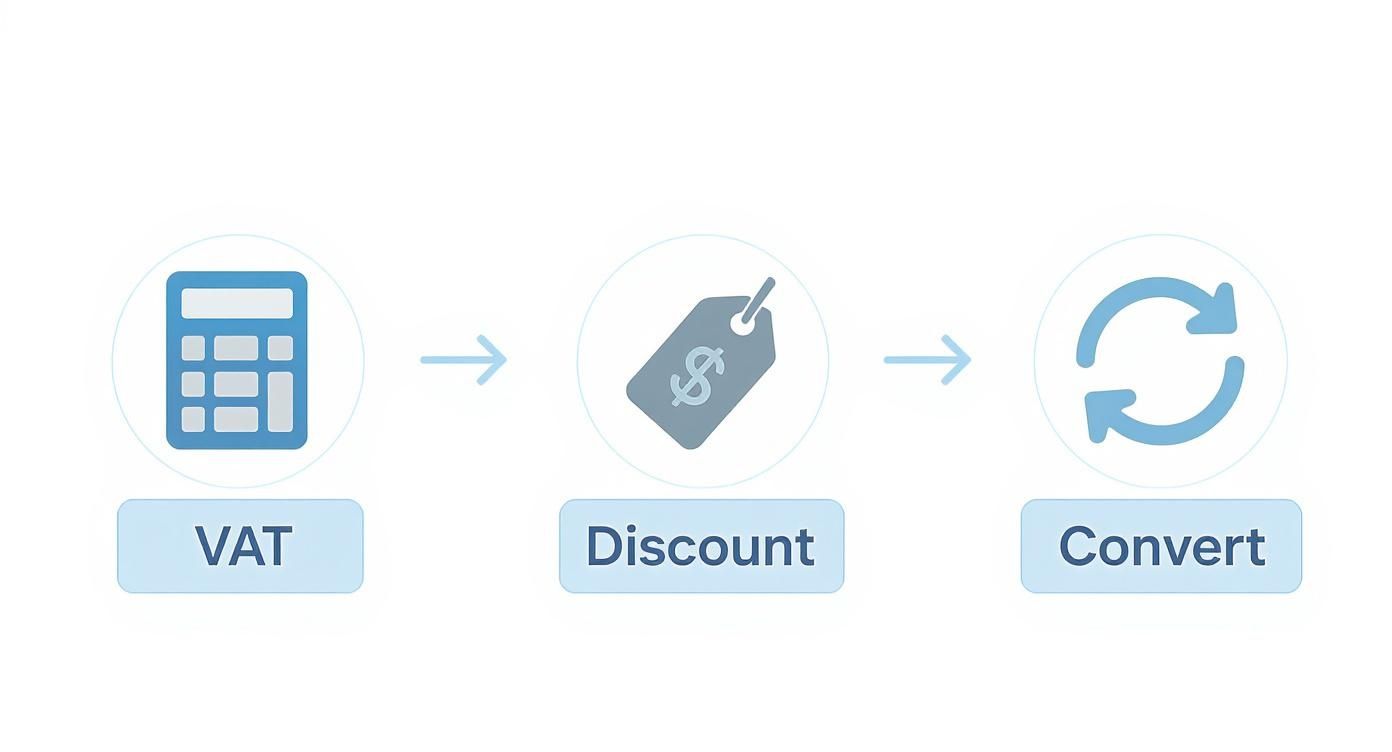
As you can see, your initial markup is just the starting point. The real world of commerce quickly adds more things to consider.
Using a Blanket Markup for Everything
Applying the same markup percentage across your entire product line is easy, I'll give you that. But it's rarely effective. Your best-selling, high-demand product can almost certainly handle a higher markup than a slower-moving item in a more competitive space. A one-size-fits-all approach means you're leaving money on the table with some products while potentially overpricing others.
A much smarter strategy is to segment your products. Dig into your sales data to identify your stars, your steady sellers, and your slow-movers. You can then apply a higher markup to the stars, a standard one to the steady sellers, and a lower, more competitive markup to help shift older stock. This dynamic approach will do wonders for your overall profitability.
Confusing Markup with Margin for Planning
The final critical error is relying on markup for any kind of high-level financial planning. Markup is a pricing tool, not a performance metric. It tells you nothing about the actual health of your business because it completely ignores all your overheads.
You might have a fantastic 150% markup on your products, but if your rent, salaries, and utility bills are too high, your business could still be losing money. For the big strategic decisions—like whether you can afford to hire a new team member or invest in new equipment—your profit margin is the only number that truly matters. It shows you what’s actually left in the pot after all the bills are paid.
Your Questions on Markup and Margin Answered
Getting the formulas right is one thing, but applying them in the real world? That’s where the tricky questions always seem to surface. I've pulled together the most common queries I hear from UK business owners to give you some straight, practical answers.
Think of this as moving beyond the calculator and learning how to use these numbers as genuine strategic tools to help your business grow.
What’s a Good Profit Margin for a Small Business in the UK?
This is the million-pound question, isn't it? The most honest answer I can give is: it really depends on your industry. A "good" margin in one sector could be a disaster in another.
A high-volume retail shop, for example, might be perfectly healthy with a gross margin of 25-35%. On the other hand, a service business like a design agency or a consultancy has far lower direct costs but chunky overheads like salaries. They’d likely be aiming for a much higher gross margin, somewhere in the 60-75% range, just to be sustainable.
The best approach is twofold:
- Do your homework: Look for industry benchmarks. See what businesses of a similar size and in your sector are reporting.
- Know your own numbers inside out: Your margin has to be robust enough to cover every single one of your overheads, from rent to software, meet your tax obligations, and still leave you with a decent net profit at the end of the day.
Should I Include My Own Salary When Calculating Costs?
Yes. Absolutely. 100% yes.
This is one of the most common, and most damaging, mistakes I see new business owners make. If you're not factoring in a salary for yourself when you work out your costs, you are fundamentally working for free.
Put it this way: if you weren't there, you'd have to hire someone to do your job, and you'd have to pay them. Your time has a real, monetary value. Forgetting to include it gives you a dangerously false picture of your profitability.
My Advice: Pay yourself first, at least on paper. Work out a realistic hourly or annual rate for your own time and build it directly into your cost of goods sold (if you're making the product) or your overheads (if you're running the business). This is the only way to price for long-term survival.
How Often Should I Review My Prices?
Pricing is definitely not a ‘set it and forget it’ task. The market, your suppliers, and your customers are always on the move, and your pricing needs to keep pace if you want to stay profitable.
As a rule of thumb, I tell clients to do a full-scale review of their entire pricing strategy at least once a year. That said, some events should trigger an immediate look at your numbers:
- Your supplier costs go up: If your raw materials or stock cost more, you have to consider passing that on to protect your margin.
- The market changes: A major new competitor appears, or you notice a shift in what customers are willing to pay.
- You launch a new product or service: This is the perfect opportunity to assess your entire pricing structure.
Being proactive here is key. It stops your hard-earned profit from being slowly chipped away by rising costs or a changing market.
Getting these financial details right is what separates a struggling business from a resilient one. The team at Stewart Accounting Services specialises in helping SMEs across the UK build robust financial strategies that actually drive growth. If you’re ready for real clarity and control over your business finances, get in touch with us.
Recent Posts
30 Sep, 2026
27 Sep, 2026