

Let's get straight to it. To figure out your operating profit margin, you divide your operating profit by your total revenue, then multiply that by 100.
The formula is simply: (Operating Profit ÷ Revenue) x 100.
This simple calculation reveals a crucial piece of information: how much profit your core business activities are actually generating for every pound you make in sales. It's a pure profitability measure, stripping out the effects of interest and tax.
What Operating Profit Margin Really Tells You About Your Business

Think of the operating profit margin as a health check for your business. It gives you an unfiltered view of how efficiently your company runs day-to-day by isolating the profitability of your main operations. It answers the most fundamental question: is my core business model actually working?
This tight focus is exactly what makes it so useful. While other metrics are important, they tell a different story. Gross profit margin only looks at the cost of what you sell, and net profit margin gets muddied by everything from taxes to one-off gains. The operating margin, however, zooms in on your operational effectiveness.
For any SME owner in the UK, getting a firm grip on this figure is a non-negotiable for building a sustainable business.
Why It Matters More Than You Think
Let’s take a local retail shop as an example. It might have a fantastic gross margin on its products, which looks great on the surface. But if sky-high rent, staff wages, and marketing costs are draining that profit, its operating margin will tell the real story—and it won't be a good one. It's a clear signal that the business's overheads are too high for its current sales.
It’s the same for a fast-growing tech startup. They might be shouting about impressive revenue numbers, but if the costs of software development and a huge sales team are out of control, the business isn't genuinely profitable from its main activities. The operating profit margin cuts right through that noise and exposes the underlying reality.
By focusing on operating profit, you get a pure measure of how well your core business activities create economic value. It removes the distortions of financing decisions and tax structures, allowing you to see operational performance clearly.
Benchmarking Your Performance
Understanding this KPI is the first step, but comparing it is where the real insights lie. National statistics are a great place to start. According to the Office for National Statistics (ONS), UK manufacturing companies recently had a net rate of return—a metric closely tied to operating profitability—of 7.3%. Service-based firms, which cover many SMEs, hit 15.1%.
You can dig into the full dataset on the ONS website covering UK company profitability.
These figures show why knowing your margin is so important when you're preparing accounts for Companies House and HMRC. It's one of the key financial metrics every business owner should monitor, as it helps guide your pricing, cost-cutting, and overall business strategy.
Finding the Right Numbers in Your Financials
To get to your operating profit margin, you first need to grab two specific numbers from your company’s Profit and Loss (P&L) statement. This report, which you might also know as an income statement, is the go-to document for seeing how your business has performed over a set period. The two figures we’re after are Total Revenue and Operating Profit.
Finding the first one is usually dead simple. Total Revenue—often called ‘turnover’ or just ‘sales’ here in the UK—is almost always the very first line you’ll see on the P&L. It’s the total pot of money you’ve brought in from doing what you do best, before a single cost has been taken out.
Unpacking Your Operating Profit
The second figure, Operating Profit, sometimes requires a little more digging. It’s not always laid out with its own dedicated line item, so you might have to work it out yourself. The maths is straightforward: it’s your Total Revenue, less your Cost of Goods Sold (COGS), and less your Operating Expenses (OpEx).
So, what actually counts as an Operating Expense for a typical UK business? Think of all the day-to-day running costs:
- Salaries and Wages, including the associated National Insurance bits.
- Rent and Rates on your premises, whether it’s an office or a workshop.
- Utilities like electricity, gas, and water.
- Marketing and Advertising spend.
- Software Subscriptions for the tools that keep your business ticking over.
- Insurance and any professional fees you pay out.
What’s crucial to remember is what isn't included. Interest payments and corporation tax are always left out. Why? Because they’re related to how you finance your business and your tax obligations, not the actual, core operational performance. For a more detailed walkthrough of these documents, our guide on how to read financial statements is a fantastic starting point.
Using Accounting Software to Find Your Data
If you’re running your business on modern cloud accounting software like Xero, QuickBooks, or FreeAgent, this whole process becomes a walk in the park. Forget about hunting through spreadsheets. To make sure you're pulling the right data accurately, it's worth investing in one of the best accounting software for small businesses.
Generating a P&L report is usually just a matter of a few clicks. You’ll typically head over to the 'Reports' section, pick 'Profit and Loss' (or 'Income Statement'), and set the date range you want to look at.
The software will then spit out a nicely organised report. Your revenue will be right at the top, followed by a breakdown of all your expenses. Most of these platforms will give you a ‘Gross Profit’ subtotal (Revenue minus COGS) and then list out your operating expenses below that. From there, just subtract the total operating expenses from your gross profit, and you’ve got your operating profit.
Key Takeaway: Your P&L statement is the source of truth here. Revenue is your top line, and operating profit is what’s left after you’ve paid for everything needed to run the business itself—both the direct costs (COGS) and the indirect ones (OpEx).
Calculating Your Operating Profit Margin: A Practical Walk-Through
Right, let’s get down to the brass tacks. Theory is one thing, but seeing how the numbers work in a real-world scenario is where the value truly lies. We'll use a fictional UK-based creative agency to bring this calculation to life and show you how to turn your own financial data into a powerful business insight.
Let’s imagine "BrightSpark Creative," a growing agency with an annual turnover of £500,000. To figure out their operating profit margin, the first place we need to look is their Profit and Loss (P&L) statement for the year. This is your treasure map for all the figures we'll need.
Assembling the Financial Puzzle Pieces
First up, we need to identify the agency's Cost of Goods Sold (COGS). For a service business like this, COGS isn't about raw materials; it’s the direct costs of delivering their work. Think freelance designer fees or project-specific software licences. For our example, let's say BrightSpark's COGS for the year totalled £150,000.
Next, we pull together all their operating expenses (OpEx). These are the day-to-day costs of keeping the lights on and the business ticking over, completely separate from the direct project costs we just looked at.
A typical list for an agency like BrightSpark would include:
- Team Payroll: All salaries and National Insurance contributions, totalling £120,000.
- Office Rent and Rates: The cost for their workspace, coming to £30,000.
- Software Subscriptions: General business tools like Xero, project management platforms, and CRMs, costing £10,000.
- Marketing and Sales: The budget for advertising campaigns and client acquisition, adding up to £25,000.
- Utilities and Overheads: General costs like electricity, insurance, and phone bills, amounting to £15,000.
This simple flowchart shows you exactly where to look on your P&L to find the key data points.
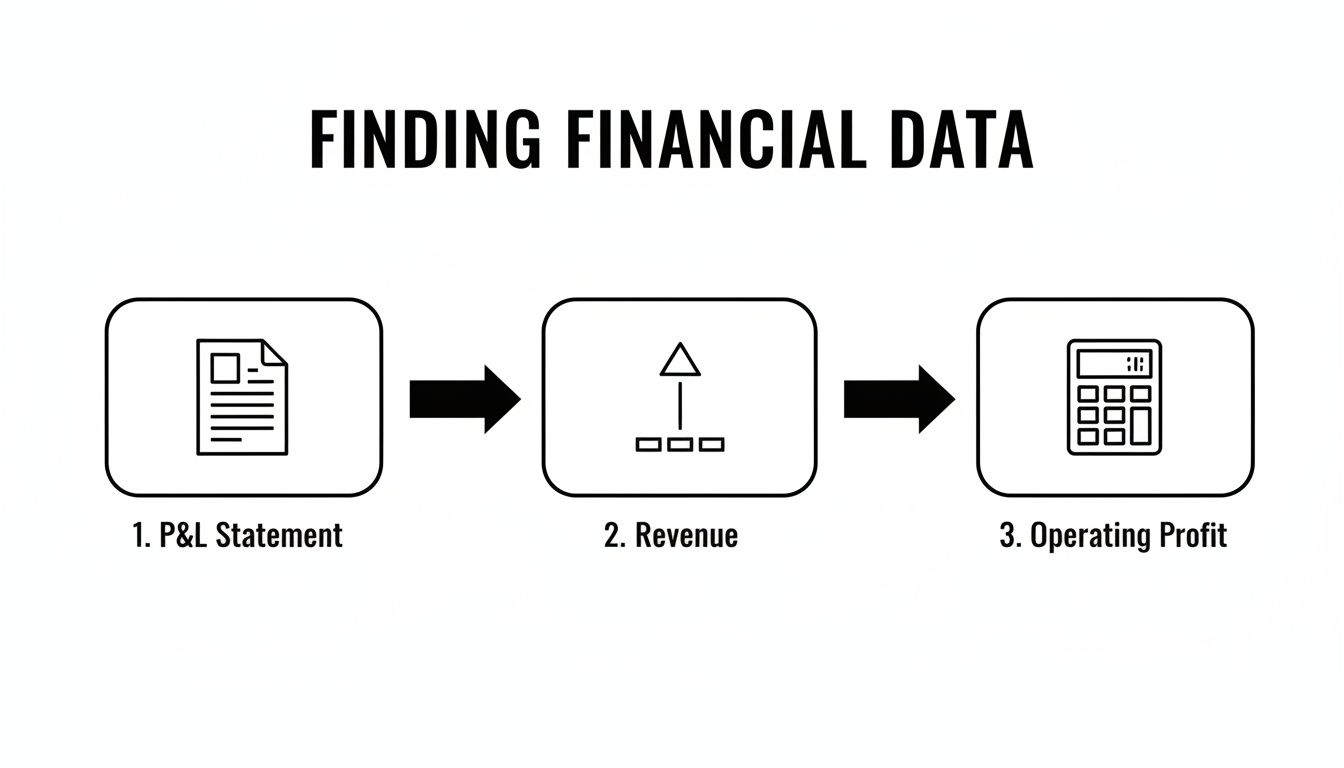
As you can see, you start with your P&L statement to find your Revenue, then calculate your Operating Profit – the two core ingredients for the margin formula.
Putting the Numbers to Work
With all the figures in hand, we can finally get calculating. The first step is to simply add up all those operating expenses.
Total OpEx = £120,000 (Payroll) + £30,000 (Rent) + £10,000 (Software) + £25,000 (Marketing) + £15,000 (Utilities) = £200,000
Now we have what we need to find the operating profit. Remember the formula: Operating Profit = Revenue – COGS – OpEx. If you need a quick refresher on the first part of that sum, you can read our guide on how to calculate gross profit.
So, for BrightSpark:
Operating Profit = £500,000 (Revenue) – £150,000 (COGS) – £200,000 (OpEx) = £150,000
The last step is to plug this into the margin formula. Easy.
Operating Profit Margin = (Operating Profit / Revenue) x 100
Operating Profit Margin = (£150,000 / £500,000) x 100 = 30%
The Result: BrightSpark Creative has an operating profit margin of 30%. In simple terms, for every pound of revenue they generate from their core business, they keep 30 pence as profit before paying any interest or tax.
By following this example, you can apply the same logic to your own P&L statement. It’s a straightforward way to transform a sheet of numbers into a clear, practical indicator of your business's operational health.
What Your Operating Profit Margin Is Really Telling You
So, you’ve run the numbers and have your operating profit margin. It’s tempting to see that percentage as the finish line, but it’s actually the starting pistol. The real work begins now: figuring out what that number says about the health of your business.
Think of it as a direct measure of your core business model's profitability. A high margin is a great sign. It might mean you’ve got serious pricing power in your market, your cost control is watertight, or you’ve built a brand that people are happy to pay a premium for. On the other hand, a low or shrinking margin can be a major red flag, pointing to problems like fierce competition driving down prices, ballooning overheads, or just plain old inefficiency in how you get things done.
But a number in isolation is just trivia. A 20% margin sounds fantastic, but what if you were hitting 25% last year? And how does it look next to your competitors? Context is everything.
How Do You Stack Up? Benchmarking by Industry
What’s considered a “good” margin is completely different depending on your line of work. A software-as-a-service business with minimal variable costs might easily post margins of 30% or more. For a high-volume, low-margin business like a supermarket, however, a 3% margin could be a cause for celebration.
This is why you absolutely have to look at industry benchmarks. They provide the reality check you need to understand your own performance.
Take UK grocery retailers, for example. It's a classic case of a sector defined by thin margins. While their weighted average operating margin has risen recently, it’s still hovering around the 3.0% mark for the big players. That’s just the nature of their business. Digging into broader historical data, like this detailed analysis of UK profit rates, shows just how much these figures can shift and vary over time and between sectors.
To give you a clearer picture, here are some indicative operating profit margins for various UK industries. See where your business might fit.
Indicative Operating Profit Margin Benchmarks by UK Industry
| Industry Sector | Typical Operating Margin Range |
|---|---|
| Software & IT Services | 15% – 30%+ |
| Professional Services (Consulting, Legal) | 10% – 25% |
| Manufacturing (Specialised) | 8% – 15% |
| Construction | 5% – 10% |
| Retail (General) | 3% – 8% |
| Hospitality (Restaurants, Hotels) | 4% – 12% |
| Grocery & Food Retail | 2% – 5% |
| Transport & Logistics | 3% – 7% |
Remember, these are just ballpark figures. Your specific niche, business model, and scale will all play a part. The goal isn't to hit an exact number but to understand the typical performance range for your field and ask why you might be different.
The Real Story Is in the Trend
Even more important than a single industry comparison is your own performance over time. A static number is just a snapshot; a trend tells a story. When you track your margin quarter-on-quarter or year-on-year, you start to see the bigger picture.
- An improving margin? Fantastic. This is proof that the changes you’re making—whether it’s tightening up expenses, adjusting prices, or finding new efficiencies—are working.
- A declining margin? This is your early warning system. It’s telling you to investigate. Are supplier costs creeping up? Is new competition forcing you to discount? Or are your overheads simply growing faster than your sales?
- A flat margin? This might feel safe, but it can also be a sign of stagnation. Are you leaving money on the table? Could you be operating more effectively?
Your operating profit margin isn't just a score for last quarter's performance. It’s a vital, forward-looking tool. By tracking it consistently, you turn a simple calculation into a powerful guide for your strategic decisions.
Ultimately, this one metric gives you the focus to ask the right questions. Why are our material costs up? Are we priced correctly for the value we deliver? Where are the hidden operational drags we can fix? When you learn to listen to what your operating profit margin is telling you, you shift from just measuring the past to actively building a more profitable future.
So, How Do You Actually Improve Your Operating Profit Margin?
Knowing your operating profit margin is one thing; doing something about it is where the real work begins. Boosting this number isn’t about one single, dramatic move. It’s about making a series of smart, deliberate decisions that fall into two main buckets: making more money and spending less to do it.
Often, the quickest wins don't come from chasing brand-new customers. The real gold is usually found by getting more from your existing revenue streams and plugging the leaks in your operational spending. By attacking both sides of this equation, you can make a serious, long-lasting difference to your bottom line.
Strategies to Squeeze More Out of Your Revenue
Before you start taking a red pen to your expenses, it’s always worth looking at ways to increase the income from your core business activities. You’d be surprised how small, strategic tweaks can have a massive impact without turning your whole business upside down.
Here are a few tactics I’ve seen work time and time again:
- Be brave with your pricing. Are you genuinely charging what you're worth? A modest 5% price increase can have a huge effect on your margin, and if you handle it well, you’ll see very little pushback from customers. If you're nervous, try testing a small increase on a single product or service first.
- Double down on what works. Dive into your sales data and figure out which products or services are your most profitable. Once you know what they are, point your sales and marketing efforts directly at them. It’s all about focusing your energy where you get the biggest bang for your buck.
- Master the art of the upsell and cross-sell. Your existing customers already trust you, which makes them your most valuable asset. Train your team to spot opportunities to offer them complementary services (cross-selling) or to upgrade them to a better version of what they already have (upselling). Think of a web design agency offering an ongoing SEO management package—it’s a natural fit.
A classic mistake is assuming that all revenue is good revenue. It isn't. The aim of the game is to generate more profitable revenue. By zeroing in on high-margin services and looking after your current customers, you start working smarter, not just harder.
Tactics for Getting a Grip on Your Costs
The other side of the coin is controlling your operating expenses. This isn't about cheaping out or cutting corners that affect quality. It's about being ruthless with waste and getting more efficient in everything you do. A disciplined review of your spending can uncover savings you never even knew were possible.
A great place to start is to print out your Profit and Loss statement and go through it line by line. Question every single expense. Is it absolutely essential? Can we get the same thing for less elsewhere? This simple habit almost always reveals some low-hanging fruit.
Here are a few practical steps to take:
- Go back to your suppliers. Don't just let contracts and agreements auto-renew. Make a habit of speaking with your key suppliers. Can you negotiate better rates? A discount for buying in bulk? More favourable payment terms? Your loyalty should be worth something to them.
- Let technology do the heavy lifting. Repetitive, manual tasks are a huge drain on both time and money. Use modern software to automate things like sending invoices, managing your books, or sending customer reminders. This frees up your team to focus on work that actually makes you money.
- Scrutinise your overheads. Take a long, hard look at all those recurring costs: software subscriptions, office rent, utilities. Are you paying for software licences that no one is using? Could you downsize your office space? These small, incremental savings really do add up over the course of a year.
Common Questions About Operating Profit Margin

Now that we've walked through how to calculate operating profit margin, let's tackle some of the questions that often come up. Think of this as a quick-fire round to clear up any lingering confusion, so you can start using this metric with confidence.
Getting these details right is the difference between simply crunching a number and truly understanding the story it tells about your business's core health.
What Is the Difference Between Operating Profit and EBITDA?
This is a big one, and it’s easy to get them mixed up. The distinction, however, is crucial.
Operating Profit (which you'll also see called EBIT, for Earnings Before Interest and Taxes) is your profit from core business activities. It’s a pure, clean measure of how well your day-to-day operations are performing before financing and tax enter the picture.
EBITDA, on the other hand, stands for Earnings Before Interest, Taxes, Depreciation, and Amortisation. It takes your operating profit and adds back non-cash expenses, like the wear and tear on your machinery (depreciation) or the write-down of intangible assets (amortisation).
While operating profit is the best gauge of day-to-day operational efficiency, EBITDA is often used as a rough proxy for a company's operational cash flow. For most UK SMEs, operating profit provides a clearer, more direct insight.
How Often Should I Calculate My Operating Profit Margin?
At an absolute minimum, you should be checking in on this quarterly. This rhythm lines up nicely with VAT returns and gives you a structured checkpoint to assess performance.
But if you want to be proactive, the answer is monthly.
Running this calculation alongside your monthly management accounts turns it from a historical record into a powerful management tool. Monthly tracking helps you to:
- Spot a downward trend early before it spirals into a real problem.
- React quickly if your costs are creeping up or sales are dipping.
- Keep a constant pulse on the financial wellbeing of your business.
Can a Business Have a High Gross Margin but a Low Operating Margin?
Yes, absolutely. In fact, it’s a classic business challenge.
This scenario tells you that while your company is very profitable on the actual products or services it sells (a healthy gross margin), your overheads are eating away at that profit before it can hit the bottom line.
Imagine a trendy café that sells a coffee for £4, and the beans and milk only cost £1. That’s a fantastic 75% gross margin. But if their prime location comes with sky-high rent, hefty staff wages, and a big marketing budget, the operating margin could be dangerously thin. It’s a textbook sign that the business needs to get its operating expenses under control.
Navigating your business finances and improving profitability requires a clear strategy and expert support. At Stewart Accounting Services, we help businesses across the UK get a firm grip on their numbers, optimise their operations, and build a more profitable future. To see how we can help you achieve your goals, get in touch with us at https://stewartaccounting.co.uk.