Working out your self-employment tax in the UK can feel a bit like putting a puzzle together. It's not one single payment but a combination of Income Tax and National Insurance Contributions (NICs), all based on how much profit your business makes.
The basic process is to figure out your trading profit, take off your Personal Allowance, and then work out the tax you owe based on the current rates. On top of that, you'll add the necessary Class 2 and Class 4 National Insurance. Let's break down how it all fits together.
Getting to Grips with UK Self-Employment Tax

If you're feeling a bit lost in the world of UK self-employment tax, you're not alone. Let's clear the air. What you're dealing with isn't a single "self-employment tax" but two separate liabilities that are calculated from your business profits: Income Tax and National Insurance Contributions (NICs).
Getting your head around this fundamental point makes the actual calculations much less daunting. Think of this as laying the groundwork. Once you understand the components, the final figure you need to pay will make a lot more sense.
The Two Pillars of Your Tax Bill
Your total tax liability is built on two main parts. They're worked out differently, but both hinge on your business profits for the year.
- Income Tax: This is the tax you pay on your earnings once they go over a specific threshold called the Personal Allowance. The rate you pay depends on which tax band your profits fall into—the higher your profits, the higher the percentage.
- National Insurance Contributions (NICs): These payments are what build up your entitlement to state benefits, like the State Pension. If you're self-employed, you'll usually be paying two kinds: Class 2 and Class 4.
Key Takeaway: Remember, your self-employment tax isn’t a single charge. It’s the total of your Income Tax bill plus your National Insurance contributions, both of which are calculated from your annual business profit.
Why Your Trading Profit Is the Magic Number
Everything starts and ends with your trading profit. This is the figure you get when you subtract all your allowable business expenses from your total business income. It's the most critical number in this whole process because both your Income Tax and your NICs are calculated from it.
This is where accurate financial records are non-negotiable. Keeping on top of your numbers ensures you don't accidentally overstate your income or, just as importantly, miss out on claiming legitimate expenses that could lower your final bill. For more on this, our guide to self-employed record keeping has some really practical tips to help you stay organised.
The tax system for the self-employed is a massive part of the UK's public finances. In the 2023/24 tax year, taxes from employment—including those from sole traders—brought in a staggering £454.8 billion, which was 45% of all public sector income. It just goes to show the huge role that freelancers and small business owners play in keeping the country running.
Finding Your Taxable Profit: The Starting Point
Before you can even begin to think about your final tax bill, you need to pin down one crucial figure: your taxable profit. This number is the foundation of your entire Self Assessment tax return. It’s not just your total sales or invoices for the year; it's your total income after you’ve subtracted every single business expense HMRC lets you claim.
Getting this figure right is the most effective way to legally reduce how much tax you owe. The accuracy of this number directly impacts everything that follows, from your Income Tax to your National Insurance contributions.
How The Calculation Works
First things first, add up all your business income for the tax year. This means every payment from a client, every sale, and any other money your business has brought in. Once you have that total, the real work starts.
From your total income, you get to deduct your allowable business expenses. Understanding and applying all the common self-employed tax deductions is the key to finding your true taxable profit. HMRC's golden rule is that these costs must be incurred "wholly and exclusively" for your business. This is where diligent record-keeping really pays off.
Let's look at a quick example. A freelance photographer earns £40,000 in a year. Throughout that year, they spend £8,000 on essentials like new camera gear, software subscriptions, insurance, and travel for shoots. Their taxable profit isn't £40,000. The figure they'll use to start their tax calculations is actually £32,000.
Everyday Examples of Allowable Expenses
For most sole traders and freelancers, these expenses are just a normal part of doing business. Forgetting to claim them means you're simply paying more tax than you need to.
Here are some typical examples:
- Office Costs: Things like stationery, postage, and software subscriptions (think Adobe Creative Cloud or Microsoft 365).
- Travel Costs: You can claim for fuel, train tickets, and parking when travelling for business.
- Use of Home as Office: If you work from home, you can claim a portion of your household bills, including heating, electricity, and Council Tax.
- Marketing and Advertising: The costs of running your website, any social media ads, or printing business cards are all deductible.
My Top Tip: Keep every single receipt and bank statement organised. I always recommend using digital accounting tools or even simple apps for this. They let you snap photos of receipts and categorise expenses on the go, which makes filing your tax return so much easier and ensures you don't miss a thing.
The UK's self-employed workforce is incredibly diverse, and incomes vary massively. Office for National Statistics data from 2018 showed that 4.73 million people filed Self Assessment returns, declaring a combined income of nearly £89.4 billion. The same data also pointed to a significant 'tax gap', which shows just how important accurate calculations are for everyone involved. You can dive deeper into the findings on self-employment income from the ONS for more context.
Calculating Your National Insurance Contributions
Once you've nailed down your final profit figure, the next piece of the tax puzzle is National Insurance Contributions (NICs). This isn't just another tax; paying it builds your entitlement to crucial state benefits like the State Pension.
For those of us who are self-employed, we're concerned with two types: Class 2 and Class 4. It helps to think of them as two separate calculations, both stemming from that same profit figure you've already worked out. They have their own rules and rates, but they're more straightforward than they first appear.
Class 2 National Insurance
This one is a simple, flat-rate contribution. Years ago, it was a weekly payment, but thankfully things are simpler now, and it’s all handled annually through your tax return.
For the 2024/25 tax year, you only start paying Class 2 NICs once your profits exceed the Lower Profits Threshold of £12,570. An interesting quirk is that if your profits fall between £6,725 (the Small Profits Threshold) and £12,570, you don't actually have to pay, but you still get the credit for a qualifying year towards your State Pension. It's a bit of a freebie.
What if your profits are below £6,725? You aren't required to pay, but you have the option to make voluntary Class 2 contributions. I often see clients do this—it's a smart, low-cost way to ensure you don't have gaps in your National Insurance record that could affect your pension later on.
Class 4 National Insurance
Now for Class 4. This contribution is a percentage of your annual profits, so it works a bit more like Income Tax. It’s calculated on profits that fall between two specific thresholds.
- You'll pay a rate of 6% on profits between £12,570 and £50,270.
- On any profits you make above £50,270, the rate drops to just 2%.
Key Takeaway: You only pay Class 4 NICs on profits within these specific bands. Any profit you make below £12,570 is completely exempt from Class 4 contributions.
National Insurance Rates at a Glance
To make this crystal clear, here’s a quick summary of the current thresholds and rates you need to be aware of.
| Contribution Type | Profit Threshold | Rate |
|---|---|---|
| Class 2 | Profits under £6,725 | Voluntary contribution |
| Class 2 | Profits £6,725 – £12,570 | £0 (credited automatically) |
| Class 2 | Profits over £12,570 | £3.45 per week (paid annually) |
| Class 4 | Profits up to £12,570 | 0% |
| Class 4 | Profits £12,570 – £50,270 | 6% |
| Class 4 | Profits over £50,270 | 2% |
This table should give you a good at-a-glance reference when you're working through your own figures.
A Practical Calculation Example
Let's put this into practice. Imagine you're a freelance graphic designer and your final profit for the year, after all expenses, is £35,000. Here’s how the NICs would break down:
-
Class 2 NICs: Your profit of £35,000 is well above the £12,570 threshold. This means you’ll need to pay the full annual amount for Class 2.
-
Class 4 NICs: Your profit sits squarely in the 6% band. You don't pay anything on the first £12,570. You only pay 6% on the portion of profit above that lower limit.
- The taxable part of your profit is: £35,000 – £12,570 = £22,430
- Your Class 4 NICs bill would be: £22,430 x 6% = £1,345.80
Pulling together all the elements of a sole trader self assessment means paying close attention to each of these steps. With your NICs figured out, you’re now ready to move on to the final part of the calculation: your Income Tax bill.
Bringing It All Together: Your Final Income Tax Bill
Now that we've got your profit figure and National Insurance sorted, we've reached the final hurdle: Income Tax. This is usually the biggest chunk of your tax bill, so it pays to get your head around how it's calculated. It's not as daunting as it sounds. We’ll take your profit, apply your tax-free allowance, and then work out how the rest fits into the UK's tax bands.
First things first, let's talk about the Personal Allowance. This is a fantastic perk every taxpayer gets. For the 2024/25 tax year, it’s £12,570. Think of it as the amount of money you can earn before HMRC starts asking for a slice.
You just knock this straight off your taxable profit. The number you're left with is the figure you'll actually pay tax on. Simple as that.
How to Apply the UK Tax Bands
With your taxable income figured out (that's your profit minus the £12,570 Personal Allowance), it's time to apply the Income Tax rates. The UK uses a progressive tax system, which is a fancy way of saying you don't pay one flat rate on everything. Instead, your income is carved up into different portions, with each portion taxed at a different rate.
For the 2024/25 tax year, the main bands for England, Wales, and Northern Ireland are:
- Basic Rate: 20% on income between £12,571 and £50,270.
- Higher Rate: 40% on income from £50,271 up to £125,140.
- Additional Rate: 45% for any income you earn over £125,140.
It’s worth noting that Scotland has its own set of tax bands and rates, so if you're based there, you'll need to check the specific Scottish figures.
Let's walk through an example to see how this works in the real world.
A Freelance Writer's Tax Bill in Action
Let's imagine a freelance writer named Sarah. After carefully tallying up her income and subtracting all her allowable business expenses, she's left with a profit of £55,000 for the year. Here's how her Income Tax is calculated.
Factor in the Personal Allowance: Sarah first gets to deduct her tax-free allowance.
- £55,000 (profit) – £12,570 (Personal Allowance) = £42,430 (her total taxable income).
Calculate the Basic Rate Tax: A portion of her £42,430 of taxable income falls into the basic rate band. This band covers the first £37,700 of taxable income (£50,270 – £12,570).
- £37,700 taxed at 20% = £7,540.
Calculate the Higher Rate Tax: The rest of her taxable income tips into the higher rate band. We just need to work out how much.
- Total taxable income: £42,430
- Income already taxed at basic rate: £37,700
- This leaves £4,730 to be taxed at the higher rate (£42,430 – £37,700).
- £4,730 taxed at 40% = £1,892.
Find the Total Income Tax Bill: Finally, she just adds the two amounts together.
- £7,540 (basic rate) + £1,892 (higher rate) = £9,432.
So, Sarah’s total Income Tax for the year comes to £9,432. This figure gets added to her National Insurance contributions to give her the grand total she owes HMRC.
What If You’re Juggling Other Income?
It's really common for self-employed people to have other streams of income, maybe from a part-time job, dividends, or a rental property. Don't worry, this doesn't overcomplicate things.
HMRC simply looks at all your income sources combined to get your total figure for the year. Your Personal Allowance is usually applied against your PAYE employment income first through your tax code. Your self-employed profit is then essentially 'stacked' on top, meaning it gets taxed at your highest rate. That's why it's so important to declare everything on your Self Assessment tax return to make sure your calculations are spot on.
Let's See It in Action: A Full Self-Employment Tax Calculation
Theory is one thing, but nothing makes the numbers click quite like a real-world example. So, let's walk through the entire process from start to finish. We'll follow a freelance web developer named Alex to see exactly how their Self Assessment tax bill comes together.
Think of this as a practical template you can follow for your own calculations.
First, Nail Down the Profit
Before anything else, Alex needs to figure out their total profit for the tax year. Luckily, they've been keeping good records.
- Total Business Income: Alex invoiced clients for a total of £62,000.
- Allowable Expenses: They spent £7,000 on legitimate business costs, including software, a new work laptop, professional indemnity insurance, and their accountant's fees.
Finding the starting point is a simple subtraction sum.
£62,000 (Income) – £7,000 (Expenses) = £55,000 (Total Profit)
This £55,000 profit figure is the cornerstone for every calculation that comes next.
This simple infographic breaks down the core flow of a typical US self-employment tax calculation, which shares a similar logic of starting with profit and applying set tax rates.
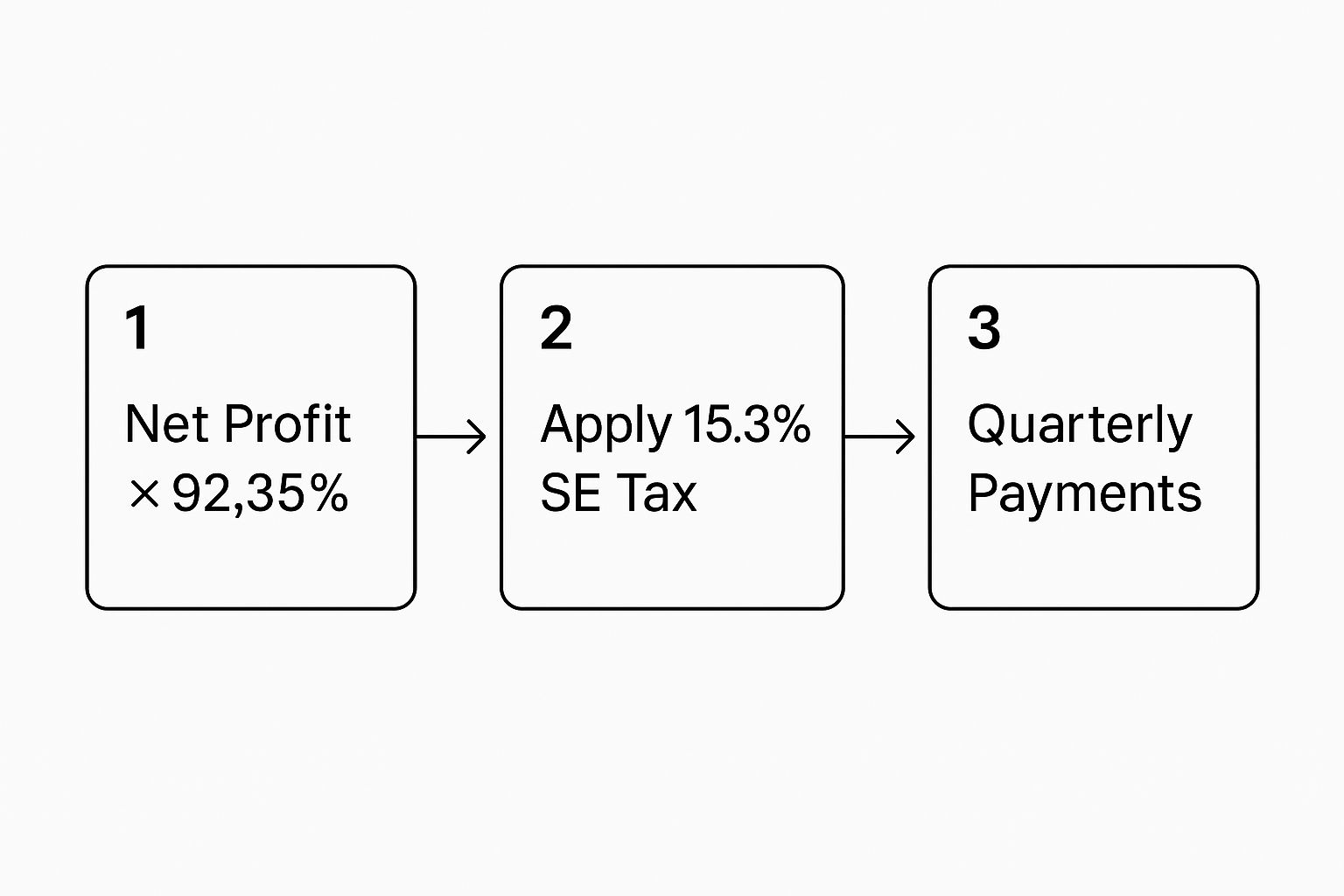
While the UK system involves different rates and rules for National Insurance and Income Tax bands, the core principle of working from your net profit is exactly the same.
Calculating the National Insurance Bill
With the profit figure sorted, Alex can now work out their National Insurance contributions. This is split into two parts.
Class 2 National Insurance
Alex's profit of £55,000 is well clear of the £12,570 Small Profits Threshold. This means they'll pay the standard flat weekly rate.
- The calculation is £3.45 x 52 weeks, which comes to £179.40.
Class 4 National Insurance
Next up is Class 4, which is a percentage of profits. It’s calculated in tiers:
- The first £12,570 of profit is charged at 0%.
- The slice of profit between £12,570 and £50,270 is taxed at 6%. For Alex, this portion is £37,700 (£50,270 – £12,570).
- Any remaining profit over £50,270 is taxed at 2%. This leaves a chunk of £4,730 (£55,000 – £50,270).
Let’s add that up:
- (£37,700 x 6%) + (£4,730 x 2%) = £2,262 + £94.60 = £2,356.60
Alex’s total National Insurance bill is the sum of both classes: £2,536 (£179.40 + £2,356.60).
Working Out the Final Income Tax
Now for the last major piece of the puzzle: Income Tax. Alex gets to deduct their Personal Allowance from their profit first.
- £55,000 (Profit) – £12,570 (Personal Allowance) = £42,430 (This is the taxable income)
This taxable income figure is then split across the relevant tax bands.
- The first £37,700 of it falls neatly into the basic rate band, which is taxed at 20%. This works out to £7,540.
- The leftover amount, £4,730 (£42,430 – £37,700), pushes into the higher rate band, where it's taxed at 40%. This part of the bill is £1,892.
So, Alex's total Income Tax bill is £9,432 (£7,540 + £1,892).
The Grand Total Owed to HMRC
To get the final figure, Alex just needs to add the two main tax bills together. It’s the home stretch.
- Total Tax Bill: £9,432 (Income Tax) + £2,536 (National Insurance) = £11,968
Your Self-Employment Tax Questions Answered
Even the most thorough guides can leave you with nagging "what if" questions when it’s time to sort out your tax return. Getting these details right is absolutely essential, so I’ve pulled together answers to the queries I hear most often from freelancers and sole traders.
Getting your head around these common sticking points now can save you a real headache down the line. It's all about knowing what to expect from the Self Assessment system.
What Happens If I Have a Job and a Business?
It’s incredibly common to be juggling a full-time job while running a business on the side. When you're employed, your employer sorts your tax through PAYE, and your tax-free Personal Allowance is almost always applied to your salary first. This means it's usually used up before your business profits even enter the picture.
You still have to report all your self-employment profit on your annual Self Assessment tax return. Think of this profit as being stacked on top of your employment income, which will determine which tax band it falls into. You'll then pay Income Tax, plus Class 2 and Class 4 National Insurance, specifically on that business profit. It's completely separate from the tax and Class 1 NICs you paid through your job, and it’s vital you declare everything to pay the correct amount.
A Quick Tip: I always tell clients to view their business profit as the "top slice" of their total income. It will be taxed at your highest marginal rate, so getting that profit figure spot-on is critical.
Do I Have to Make Payments on Account?
This is the big one that catches so many people out. Payments on account are essentially advance payments towards your next year's tax bill. If your last Self Assessment tax bill topped £1,000 and less than 80% of the tax you owed was collected automatically (like through a PAYE job), then you'll almost certainly have to make them.
HMRC will ask for two separate payments, each being 50% of your previous year's bill. The deadlines are always 31 January and 31 July. While this system is designed to help you spread the cost, it can feel like you're being hit twice in your first year of making them. The good news? If you know your profits are going to be lower in the coming year, you can formally ask HMRC to reduce your payments on account.
What Are the Most Common Mistakes?
From my years of experience, a few recurring slip-ups cause the most trouble. Steer clear of these, and you'll save yourself a world of time, money, and stress.
- Messy Records: This is the number one culprit. If you don't track every sale and every expense properly, you're almost guaranteed to overpay tax. Worse, you could face penalties if HMRC decides to investigate. Use accounting software or, at the very least, a detailed spreadsheet. A solid Self Assessment checklist can be a real lifesaver here.
- Missing Deadlines: The 31 January online filing deadline is firm. Missing it means an instant £100 penalty, which gets progressively worse the longer you leave it. Don't be late.
- Claiming Personal Costs: You can only claim for expenses that are "wholly and exclusively" for your business. It can get murky, so if you're ever in doubt, it’s best to be cautious. For more complex scenarios or just to ensure you're fully compliant, using professional tax preparation services can be a huge help.
At Stewart Accounting Services, we help sole traders and small business owners navigate these very questions every single day. If you're looking for clarity and peace of mind, get in touch with our team to see how we can help you manage your tax obligations effectively. Learn more at https://stewartaccounting.co.uk.