
That moment when your year-end accounts are finalised and you see the final Corporation Tax figure can be a source of significant stress. It’s easy to feel that the bill is unfairly high, sparking worries about whether you’ve missed out on legitimate deductions. For many UK business owners, the question of how to reduce my corporation tax bill isn’t just about saving money; it’s about gaining peace of mind and ensuring you’re not paying a penny more than you legally have to.
The good news is that navigating UK tax legislation doesn’t have to be complicated. This guide is designed to help you do just that. We will walk you through clear, practical, and entirely legitimate, HMRC-approved strategies to lower your company’s tax liability. From maximising your allowable expenses and claiming capital allowances to taking advantage of specific tax reliefs and smart investment planning, you’ll discover actionable steps you can take today. Our goal is to give you the confidence to keep more of your hard-earned profit in the business-fuelling growth and reducing your year-end worry.
Key Takeaways
- Maximise your claims by understanding all allowable business expenses; it’s the most direct way to lower your company’s taxable profit.
- Discover how investing in business assets like equipment and vehicles can significantly reduce your tax liability through Capital Allowances.
- For company directors, structuring your personal remuneration through a smart mix of salary and dividends is a key tool for tax efficiency.
- Exploring advanced government schemes like R&D Tax Credits is a powerful step if you’re asking how to reduce my corporation tax bill through innovation.
First, Understand Your Corporation Tax Bill
When business owners ask us, “how to reduce my corporation tax bill?”, our first step is always to go back to basics. Before you can legally and effectively lower what you owe, you must understand how it’s calculated. Many people mistakenly believe tax is paid on their total revenue or turnover. In reality, Corporation Tax is only paid on your company’s profits, which is a very different figure.
The key to smart tax planning is focusing on one thing: your ‘taxable profit’. Understanding this concept is the foundation for every strategy we’ll discuss. For a deeper dive into the tax’s history and structure, you can read this overview of UK Corporation Tax Explained, but for now, let’s focus on the essentials you need to know.
What is Taxable Profit?
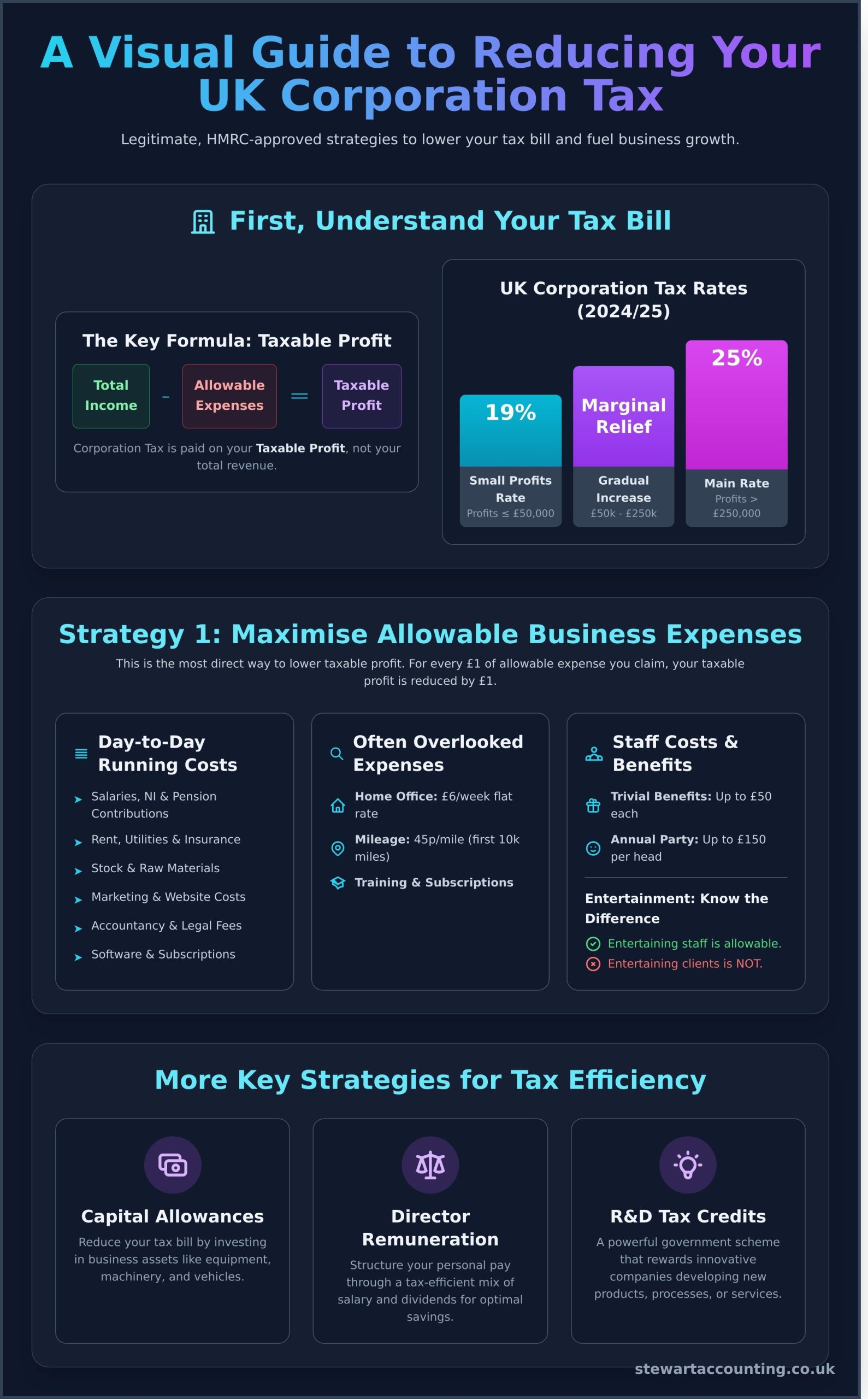
Taxable profit is the figure HMRC uses to calculate your Corporation Tax. The formula is refreshingly simple: Total Income – Allowable Expenses = Taxable Profit. ‘Allowable expenses’ are the running costs your business incurs purely for trade purposes, such as staff salaries, rent, and utility bills. Think of it like a retail shop: the taxable profit isn’t the total cash in the till, but what’s left after paying for stock, rent, and wages. Every strategy for reducing your tax bill is designed to legally reduce this final profit figure.
Current UK Corporation Tax Rates
Understanding the current rates helps you see the direct impact of reducing your taxable profit. For the 2024/25 financial year, the rates are structured as follows:
- Main Rate: 25% for companies with profits over £250,000.
- Small Profits Rate: 19% for companies with profits of £50,000 or less.
- Companies with profits between £50,001 and £250,000 pay the main rate but can claim Marginal Relief to provide a gradual increase in the effective tax rate.
Don’t let these figures cause you any stress. The goal of this guide is to show you how to manage your Corporation Tax bill effectively using legitimate, HMRC-approved methods. Every tip that follows is a practical step you can take to ensure you only pay what you legally owe, helping you keep more of your hard-earned money in the business.
Strategy 1: Maximise All Your Allowable Business Expenses
One of the most straightforward and effective approaches to lowering your taxable profit is to ensure you claim for every single allowable business expense. It sounds simple, but many business owners inadvertently pay more tax than necessary by missing out on legitimate claims. The principle is direct: for every £1 of allowable expense you claim, your taxable profit is reduced by £1, saving you tax at the current corporation tax rate. This is the foundation of learning how to reduce my corporation tax bill.
Success here depends on meticulous record-keeping. Keeping organised receipts, invoices, and bank statements is non-negotiable, as it provides the evidence needed to support your claims if HMRC ever asks.
Claiming Day-to-Day Running Costs
These are the costs incurred wholly and exclusively for business purposes. While some are obvious, it’s vital to be comprehensive and not let small items slip through the net. Ensure you are claiming for:
- Salaries, employer’s National Insurance, and pension contributions
- Rent for business premises and utility bills
- Stock, raw materials, and costs of goods sold
- Marketing, advertising, and website costs
- Professional fees (e.g., accountant and legal costs)
- Software subscriptions, insurance, and bank charges
- Minor office supplies like stationery and postage
Often Overlooked Expenses You Might Be Missing
Beyond the basics, several valuable expenses are frequently forgotten. Are you claiming for use of your home as an office? You can claim a flat rate of £6 per week without receipts, or calculate a proportion of your actual household running costs. Likewise, if you use a personal vehicle for business journeys, you can claim Approved Mileage Allowance Payments (AMAPs) at 45p per mile for the first 10,000 miles. Don’t forget costs for relevant staff training, professional subscriptions, and memberships to trade bodies.
Staff Costs, Trivial Benefits, and Entertainment
Rewarding your team can also be a tax-efficient way to reduce your corporation tax bill. You can provide employees with ‘Trivial Benefits’ worth up to £50 each, tax-free, as long as it isn’t cash or a cash voucher. The cost of an annual staff event, such as a Christmas party, is also an allowable expense, provided the cost does not exceed £150 per head. It’s important to note the distinction with entertainment: entertaining staff is an allowable expense, but entertaining clients or suppliers is not.
Strategy 2: Smart Investments and Capital Allowances
One of the most effective answers to the question “how to reduce my corporation tax bill?” is to reinvest in your own business. Rather than seeing purchasing new assets as just a cost, you can view it as a strategic tax-saving activity. HMRC encourages this through a system called Capital Allowances, which allows you to deduct the value of business assets from your profits before tax is calculated.
Put simply, it’s the government’s version of depreciation for tax purposes. By making smart investments, you not only improve your business operations but also directly lower your tax liability, freeing up cash for further growth.
Understanding the Annual Investment Allowance (AIA)
The Annual Investment Allowance (AIA) is one of the most valuable reliefs for small and medium-sized businesses. It allows you to claim a 100% deduction on qualifying assets in the year of purchase, up to a generous limit of £1 million. This provides immediate and significant tax relief. Qualifying assets include a wide range of essential items:
- Office equipment (computers, printers, desks)
- Vans, lorries, and commercial vehicles
- Tools and machinery for your trade
- Computer software
Full Expensing for New Equipment
For larger investments in new and unused equipment, Full Expensing offers another powerful way to reduce your taxable profits. While the AIA covers both new and second-hand assets, Full Expensing is specifically for new plant and machinery. If your capital spending exceeds the £1 million AIA limit, this relief allows you to deduct 100% of the additional cost in the first year, providing a major incentive for significant business expansion and modernisation.
Purchasing Electric Vehicles Through the Company
If you’re considering a new company car, choosing electric is an incredibly tax-efficient move. Your company can claim a 100% first-year allowance on the purchase of a new, zero-emission electric car, writing off the entire cost against profit immediately. This is far more generous than the allowances for petrol or diesel cars. For directors, the personal tax benefits are also huge, with extremely low Benefit-in-Kind (BIK) rates, making it a win-win for both you and your business.
Strategy 3: Tax-Efficient Director Remuneration
For directors of owner-managed businesses, how you pay yourself is one of the most significant tax planning tools at your disposal. The goal is to extract profits from your company in the most tax-efficient way possible, minimising the combined impact of Corporation Tax, Income Tax, and National Insurance (NI).
Structuring your remuneration correctly can lead to substantial savings, giving you more money in your pocket and less stress managing your tax affairs.
The Optimal Salary vs. Dividend Mix
The classic and often most effective strategy is to pay yourself a small salary combined with larger dividend payments. By taking a salary up to the National Insurance Primary Threshold, you can build up qualifying years for the state pension without actually paying any NI contributions. Any further profit can then be extracted as dividends. While dividends are paid from post-tax profits, they are not subject to National Insurance, which can result in significant savings. You can also take advantage of the tax-free Dividend Allowance each year. This strategy requires regular review, as tax and NI thresholds change annually.
Director Pension Contributions: A Tax ‘Double Win’
One of the most powerful answers to the question of how to reduce my corporation tax bill is through director pension contributions. When your company pays directly into your personal pension scheme, it creates a ‘double win’:
- The contribution is treated as an allowable business expense, directly reducing your company’s profit and therefore its Corporation Tax liability.
- You, as the director, receive the full contribution into your pension pot without paying any personal Income Tax or National Insurance on it.
This is an exceptionally efficient way to build personal wealth for your future while simultaneously cutting your company’s immediate tax burden.
Other Tax-Free Benefits for Directors
Beyond salary and dividends, your company can provide several other valuable benefits that are tax-free for you and tax-deductible for the business. These perks add value to your overall package without creating a tax headache. Common examples include:
- Relevant Life Policies: A form of life insurance that is paid for by the company as a legitimate business expense.
- Mobile Phone: The company can provide you with one mobile phone and pay the contract, tax-free.
- Annual Health Check: Providing one health screening or medical check-up per employee (including directors) per year is a tax-exempt benefit.
Getting your remuneration structure right is a crucial part of smart tax planning. It can feel complicated, but our expert team can take the worry off your hands. Let us help you structure your pay tax-efficiently.
Strategy 4: Advanced Tax Reliefs for Innovative Companies
Once you have maximised all standard allowable expenses, the next level of tax planning involves exploring specialised, government-backed reliefs. These are designed to reward UK companies for innovation, but many business owners wrongly assume they are only for high-tech labs or large-scale manufacturers. In reality, they are far more accessible than you might think.
Understanding these complex reliefs is a core part of how to reduce my corporation tax bill effectively. As Chartered Accountants, we specialise in helping businesses identify and claim these valuable incentives, taking the stress and complexity off your hands.
Research & Development (R&D) Tax Credits
When people hear “R&D”, they often picture scientists in white coats. However, HMRC’s definition is much broader. Your business could be eligible if you are developing new software, creating a more efficient manufacturing process, or designing an innovative new product. The scheme allows you to deduct an extra percentage of your qualifying costs from your profit, significantly lowering your tax bill. For companies not yet in profit, it can even result in a cash payment from HMRC.
Using Business Losses to Your Advantage
Making a loss is never the goal, but it doesn’t have to be entirely bad news. UK tax rules allow you to use these losses strategically. You can ‘carry back’ a trading loss to offset it against profits made in a prior year, which often generates an immediate Corporation Tax refund from HMRC – a welcome cash injection. Alternatively, losses can be carried forward to reduce your tax liability on future profits, helping you get back on your feet faster.
The Patent Box Scheme
This is a more niche but incredibly valuable relief for innovative companies. If your business holds qualifying patents and earns profits from its patented inventions, you can apply a much lower Corporation Tax rate of just 10% to those profits. It’s a powerful government incentive to develop and commercialise intellectual property here in the UK.
Navigating the eligibility criteria for these schemes requires specialist knowledge, but the savings can be substantial. It’s a key strategy for any ambitious business owner asking how to reduce my corporation tax bill. Think you might qualify for these reliefs? Ask our experts. We can help you explore your eligibility and manage the entire claim process for you.
Your Next Step to a Lower Tax Bill
As we’ve explored, reducing your corporation tax bill isn’t about finding loopholes; it’s about smart, strategic planning. By maximising your allowable expenses, leveraging capital allowances, and considering tax-efficient remuneration, you can legitimately lower your company’s liability and keep more of your hard-earned profits.
While these strategies provide a strong foundation, the most effective answer to the question of ‘how to reduce my corporation tax bill‘ often comes from tailored, expert advice. Navigating the complexities of tax planning can be stressful, and that’s where we come in. As Fully Qualified Chartered Accountants with local offices in Alloa, Stirling, and Falkirk, we specialise in helping small and medium-sized businesses achieve their financial goals. We take the complexity off your hands, giving you more time, more money, and less worry.
Ready to build a more tax-efficient future for your business?
Take the stress out of tax. Speak to our Chartered Accountants today.
Frequently Asked Questions
Is it better to pay myself a higher salary or more dividends?
For most limited company directors, the most tax-efficient structure is a combination of a low salary and higher dividends. The salary is typically set up to the National Insurance threshold, meaning no NI is paid. Dividends are then drawn from post-tax company profits. This strategy minimises your overall tax burden, but the optimal balance depends on your personal circumstances and the company’s profitability. We can help you find the right mix.
Can I claim my personal car as a business expense for my limited company?
While you can’t claim your personal car itself, you can claim for the business journeys you make in it. The simplest way is to claim the HMRC-approved mileage allowance, which is currently 45p per mile for the first 10,000 business miles in a tax year. It is essential to keep a detailed log of your business trips, including dates, destinations, and mileage, to support your claim and ensure you’re compliant.
What are the deadlines for paying my Corporation Tax bill?
The deadline for paying your Corporation Tax is nine months and one day after the end of your company’s accounting period. It’s important not to confuse this with the deadline for filing your Company Tax Return, which is 12 months after your year-end. Missing the payment deadline will result in interest charges from HMRC, so it’s a date you can’t afford to forget. We ensure our clients never miss these crucial deadlines.
What happens if I make a mistake on my Corporation Tax return?
It’s important to act quickly. You can amend your Company Tax Return online up to 12 months after the filing deadline. If you discover a mistake, you should correct it and resubmit it to HMRC as soon as possible. Genuine errors are usually treated fairly, but penalties can be applied for carelessness. Letting a professional handle your return is the best way to avoid the stress and worry of making a costly mistake.
How much does a good accountant really save you in tax?
While every business is different, a good accountant provides value far beyond just filing your accounts. We save you money by identifying all allowable expenses, advising on tax-efficient investments, and structuring your finances to minimise liability. We also protect you from costly penalties by ensuring full compliance. The peace of mind and time saved, allowing you to focus on running your business, is often the most valuable saving of all.
Is it worth buying a new van before my company year-end to save tax?
Yes, this can be an excellent tax planning strategy. Purchasing a van or other qualifying equipment allows your company to claim Capital Allowances, which reduces your taxable profit. Using the Annual Investment Allowance (AIA), you can often deduct 100% of the cost in the year of purchase. This is a very effective answer to the question of how to reduce my corporation tax bill, as it provides a direct and immediate tax saving.
Can I claim for meals and subsistence as a business expense?
You can claim for meals, but only under specific circumstances. The cost must be incurred while on a business journey that is outside your normal pattern of work, such as visiting a client in another city or attending a trade show. Everyday meals, like buying a sandwich for lunch at your usual workplace, are not allowable. Keeping clear records and receipts is crucial to prove the expense was wholly for business purposes.