

Figuring out the best way to pay yourself from your limited company is one of the most important financial decisions you'll make as a director in the UK. For years, the go-to method for most has been a smart combination of a low salary topped up with dividends. It’s a tried-and-tested approach that works because it uses your tax-free Personal Allowance for the salary and then takes advantage of the lower tax rates on dividends.
The Smart Way to Pay Yourself From Your Limited Company

When you set up a limited company, you create a distinct legal entity. This is a crucial point many new directors miss – you can't just dip into the company bank account whenever you like. Every penny you take out has to be accounted for properly through official channels. Get this right, and you'll keep more of your hard-earned cash while keeping HMRC happy.
The gold standard for most small business owners involves wearing two hats: you're both a director (an employee) and a shareholder (an owner). This dual role is what unlocks the ability to draw your income in two very different, and tax-efficient, ways.
The Salary and Dividend Mix
The real magic of this strategy lies in striking the right balance. By paying yourself a small salary, you're officially an employee, and this comes with some handy perks. Firstly, that salary is a business expense. This is great because it comes out before your company pays Corporation Tax, which in turn reduces your company's overall tax bill.
Secondly, if you set your salary at the right level, you can make qualifying National Insurance (NI) contributions. This is vital for your State Pension entitlement and other benefits, and you can often do it without actually having to pay any NI contributions. It's a real win-win.
Dividends are the other half of the puzzle. These are payments to shareholders, taken from the company's profits after Corporation Tax has been paid. Because the company has already been taxed on this money, the personal tax rates you'll pay on dividends are much lower than the income tax rates you'd face on a larger salary. This is where the big tax savings kick in.
Key Takeaway: Combining a small, tactical salary with larger dividend payments can dramatically lower your personal tax bill compared to taking everything as a salary.
This approach also gives you a ton of flexibility. Your salary can be a steady, predictable payment each month, while you can declare dividends whenever the company has built up enough profit. This puts you in control.
Before you dive in, there are a few compliance boxes you absolutely have to tick:
- You must register the company as an employer with HMRC.
- You need to run a proper payroll (PAYE) for your director's salary.
- Crucially, you must have enough retained profit in the company before you can declare a dividend.
- All dividend payments need a paper trail, which means board meeting minutes and dividend vouchers.
This method isn't just a tax-saving trick; it's the foundation of a solid payment plan. It gives you a regular income, helps with future planning like pensions, and ultimately maximises what you take home. We'll get into the nitty-gritty of setting the perfect salary level and managing dividends next.
Nailing Your Director's Salary for Maximum Tax Efficiency
Your director's salary is much more than just a paycheque; it's one of the most powerful tools you have for managing your finances. When you're figuring out how to pay yourself from your limited company, getting this number right is crucial. It’s a delicate balance that lets you minimise your personal tax, build up state benefits, and lower your company's Corporation Tax bill all at once.
The aim is to find that 'sweet spot'—a salary that gives you personal benefits without triggering unnecessary tax for either you or your company. For most directors, this means paying close attention to government thresholds, especially the Personal Allowance and National Insurance (NI) limits.
These figures are a moving target, changing almost every year. Staying on top of them is the difference between a smart payment strategy and a costly oversight.
Finding the Sweet Spot for Your Salary
So, what does this look like in practice? For most directors, the best approach is to pay a salary that’s high enough to count as a qualifying year for your State Pension but low enough that you don't actually have to pay any income tax or employee's National Insurance Contributions (NICs). This way, you're building a foundation for retirement without taking a hit on your income today.
For the 2025/26 tax year, the most tax-efficient salary to pay yourself from a limited company is generally £12,570 per year. This specific figure is so effective because it lines up perfectly with the Personal Allowance, meaning you won’t pay a penny of income tax on it. It also hits the Primary Threshold for National Insurance, so you get your qualifying year for the State Pension without any NI deductions from your pay.
There's a key change to be aware of, though: the employer's NI Secondary Threshold has dropped to £5,000. This means your company will have to pay employer's NICs on the portion of your salary between £5,000 and £12,570. Even with this cost, setting your salary at this level is often still the smartest move for maximising what you take home. If you want to dive deeper, you can find an excellent breakdown of the optimal director's salary on itcontracting.com.
Remember, your director's salary is a qualifying business expense. This means it's deducted from your company's profits before Corporation Tax is calculated, which directly reduces your company's tax bill.
Let's see how this works with a quick example.
Scenario: Sarah, a Solo Director
Sarah runs a thriving graphic design consultancy and sets her annual salary at £12,570.
- Income Tax: Her salary matches the Personal Allowance, so she pays £0 in personal income tax.
- Employee's NI: She's right at the Primary Threshold, which means she pays £0 in employee's NI.
- State Pension: Despite paying no NI herself, she still gets a qualifying year towards her State Pension.
- Corporation Tax: Her company gets to claim the full £12,570 as an expense, reducing its taxable profits by that amount.
This strategy is a win-win. Sarah gets the personal benefits while also creating a tax advantage for her business.
Why Not Go Higher or Lower?
You might be thinking, "Why not just pay a salary of £5,000 to avoid employer's NI altogether?" You could, but there's a catch. A salary that low is beneath the Lower Earnings Limit, so you wouldn't earn a qualifying year for your State Pension without making separate voluntary contributions. For most, that trade-off isn't worth it.
On the flip side, paying yourself a much higher salary—say, £20,000—quickly becomes inefficient. Anything you earn over £12,570 will attract both income tax and employee's NI, taking a significant chunk out of your net pay. Your company's employer NI bill also gets bigger. This is precisely why the combination of a tax-efficient salary topped up with dividends is the go-to strategy for company directors.
To put this plan into action, your company needs to be registered with HMRC as an employer and run a PAYE (Pay As You Earn) payroll scheme. This just means you'll report your salary payments to HMRC, typically every month.
Here’s a quick summary of the key thresholds for the 2025/26 tax year to keep in mind:
- Personal Allowance: £12,570 (earn up to this amount before paying Income Tax).
- NI Lower Earnings Limit (LEL): £6,396 (earn above this to qualify for benefits like the State Pension).
- NI Primary Threshold (PT): £12,570 (earn above this and you start paying employee's NI).
- NI Secondary Threshold (ST): £5,000 (if the salary is above this, the company starts paying employer's NI).
By setting your salary at £12,570, you expertly navigate these thresholds, securing your pension credit without triggering any personal tax. Now that your salary is sorted, the next step is learning how to take out additional profits using dividends.
Withdrawing Profits Through Company Dividends
Once you've set up your small, tax-efficient salary, dividends are how you’ll take home the rest of your company's profits. Think of it this way: your salary is for your role as a director, but dividends are your reward as a shareholder – a return on your investment in the business.
Dividends are paid out of profits after your company has paid its Corporation Tax. This is a key distinction from a salary, which comes out before tax as a business expense. It might seem like a disadvantage at first, but the magic happens when you look at your personal tax bill. The tax you pay on dividend income is much lower than the tax on salary income, which is the very reason this salary-and-dividend mix works so well for so many directors.
Before you can touch a penny, though, there's a non-negotiable rule: your company must have enough retained profits. This isn’t just about what’s in the bank. It’s the pot of money left over after you've settled all business costs, liabilities, and, of course, taxes. Paying a dividend you can't afford—known as an 'illegal dividend'—is a serious misstep and can land you in hot water.
A Word of Warning: I’ve seen many new directors glance at their company bank balance and assume it’s all available. It’s not. You absolutely must check your company's accounts to confirm your retained profits before declaring any dividend.
The Right Way to Declare a Dividend
You can't just move money from your business account to your personal one and call it a day. To keep everything above board and satisfy UK company law, you need a clear paper trail.
Even if you're a one-person band acting as the sole director and shareholder, you need to hold a quick board meeting to formally "declare" the dividend. In reality, this just means you need to create board meeting minutes. These minutes are the official record of the decision and must be kept safely with your company's other important documents.
After the meeting, you then issue a dividend voucher to each shareholder. This is essentially a payslip for your dividend and proves the payment is legitimate.
Your dividend voucher must clearly show:
- Your company's name
- The date of the dividend payment
- The names of the shareholders receiving the dividend
- How many shares each person holds
- The dividend rate per share
- The total dividend amount being paid to that shareholder
Don't skip this paperwork. It’s your evidence for HMRC that these payments are genuine dividends, not a disguised salary that would be taxed at much higher rates.
Understanding the Tax on Your Dividend Income
It’s a common myth that dividends are completely tax-free. They aren't, but they are taxed very favourably. For the 2025/26 tax year, every UK taxpayer has a £500 tax-free Dividend Allowance. You can receive this much in dividends before paying a single penny of tax on it.
To put this in perspective, this image shows the foundational steps of setting up your director's payroll, which needs to be in place before you can start drawing dividends.
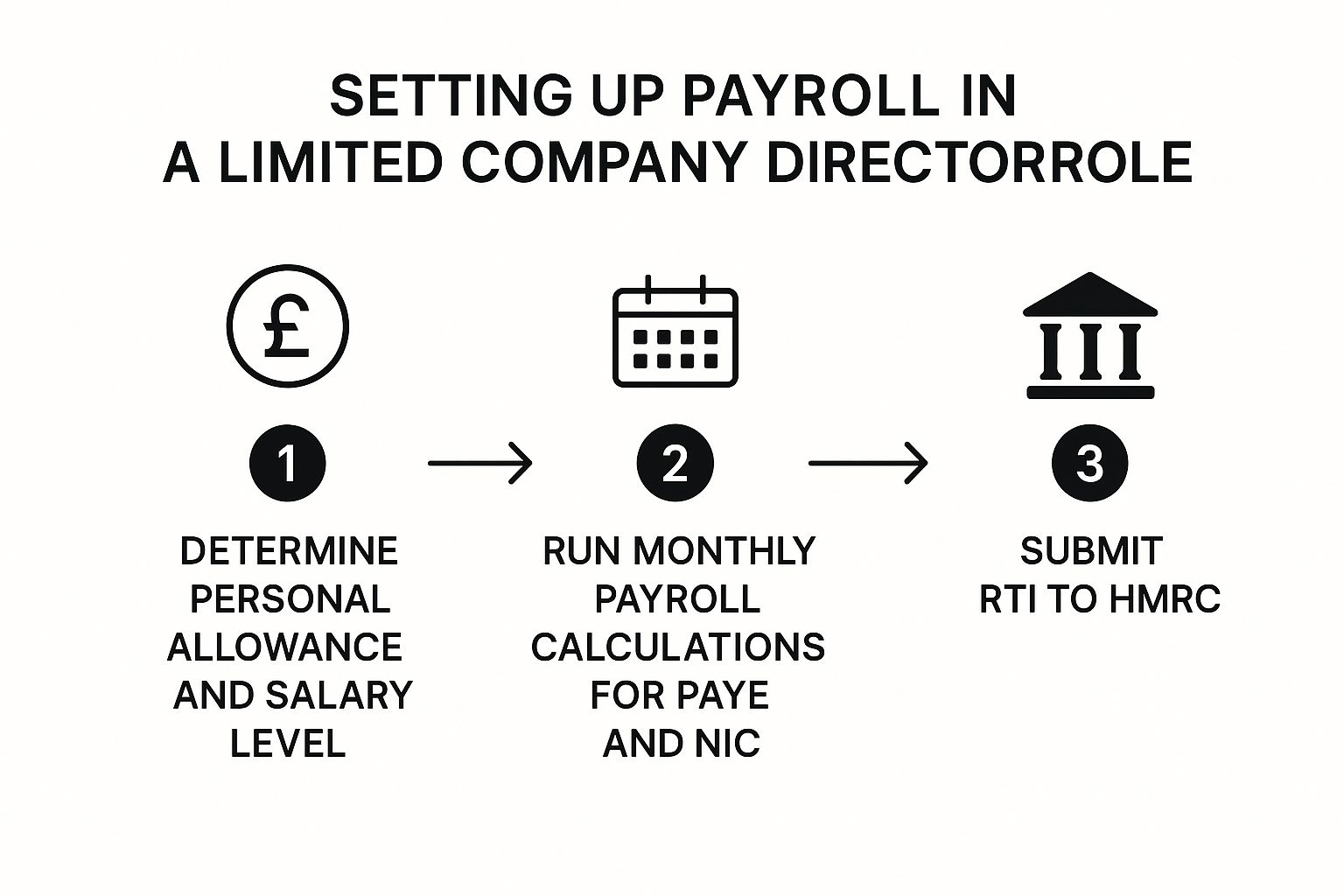
This flow—from deciding your salary to running payroll and filing with HMRC—is the formal process you must follow. Only then can you move on to taking dividends.
Once you’ve earned more than your £500 allowance, you'll start paying tax. The rate depends entirely on your total income for the year, which includes your director’s salary plus any other income you might have. Your total income determines which Income Tax band you fall into.
For the 2025/26 tax year, the dividend tax rates are:
- Basic Rate: 8.75%
- Higher Rate: 33.75%
- Additional Rate: 39.35%
You can find a clear breakdown on the official government page for dividend tax.
To figure out what you’ll owe, you simply add your dividend income on top of your other income (like that £12,570 salary). For instance, if your salary has already used up your Personal Allowance, your dividends will be taxed starting at the basic rate of 8.75%. That’s a huge saving compared to the 20% basic rate you'd pay on salary income.
Just remember, it's your personal responsibility to declare this income to HMRC. You’ll do this by filing a Self Assessment tax return each year. Getting your head around dividends is a massive part of paying yourself efficiently from your limited company.
Navigating the Changing Landscape of Director Pay

Figuring out how to pay yourself from your limited company isn't a one-and-done task. The rules of the game, especially around tax and National Insurance (NI), are constantly being tweaked by the government. What made perfect sense last year might not be the most tax-efficient strategy today.
Keeping on top of this evolution is the secret to a payment strategy that's both compliant and smart. A quick look back shows just how much things can shift and why a yearly review of your finances is an absolute must for any serious director.
How the 'Optimal Salary' Has Evolved
The whole idea of an "optimal salary" for a director is tied directly to the tax thresholds of the day. These numbers are the foundation of any good remuneration plan, and even small changes can have a big financial ripple effect.
Looking back, the standard advice for UK directors has bounced around quite a bit in response to tax and NIC rules. For instance, before the 2022/23 tax year, the sweet spot for a director's salary was often around £9,100 a year. This was a smart move because it lined up with what was then a higher employer's National Insurance Secondary Threshold, letting directors sidestep employer NI costs completely.
But things have changed. A dramatic drop in this Secondary Threshold to just £5,000 for 2025/26 has rewritten the rulebook, making it more expensive for companies to pay higher salaries. This has forced many directors back to the drawing board with their salary and dividend mix. If you want to dive deeper into how these shifts affect today's numbers, you can discover more insights about director salaries on admaccountancy.co.uk.
This isn't just a history lesson—it proves a critical point for every business owner: your payment strategy has to be flexible. Relying on old advice is a surefire way to hand over more tax than you need to.
Key Takeaway: Tax and NI thresholds are moving targets. The 'best' director's salary changes with government policy, making an annual review a financial necessity, not just a suggestion.
These constant adjustments really bring home the value of professional guidance. A good accountant lives and breathes these changes, making sure your strategy is always built on the latest figures and rules.
The Role of the Employment Allowance
While the shifting NI thresholds have introduced new costs for many, there’s a crucial relief measure that can change the entire calculation: the Employment Allowance.
This government scheme is a helping hand for smaller businesses, aimed at easing the burden of their employer's Class 1 National Insurance liabilities. For the 2025/26 tax year, eligible companies can use it to slash their annual employer's NI bill by up to £10,500.
So, does your company qualify for this valuable perk?
- Your total employer Class 1 National Insurance liability in the previous tax year must have been under £100,000.
- It's generally not available for 'single-director companies' where the only employee is the director.
If your company has other employees on the payroll besides yourself, you’re likely in the clear. This can be a complete game-changer for your payment strategy.
How Eligibility Changes Your Strategy
If your company can claim the Employment Allowance, the maths behind your optimal salary flips on its head. The allowance essentially soaks up the employer's NI costs that a salary above the £5,000 Secondary Threshold would normally trigger.
This means that for an eligible director, taking a salary right up to the Personal Allowance (£12,570 for 2025/26) suddenly becomes a much better deal. The employer's NI contributions that would otherwise be due on that salary are cancelled out by the allowance, wiping out the main drawback.
This creates two very different strategic paths:
- Without Employment Allowance: A director has to carefully weigh the NI cost against the Corporation Tax saving.
- With Employment Allowance: A director can pay up to the Personal Allowance, securing their State Pension credit and maximising the company's Corporation Tax deduction without an NI hit.
This one factor alone shows why you need personalised advice. When it comes to paying yourself from a limited company, there is no one-size-fits-all answer. The right move depends entirely on your company's unique situation.
Other Ways to Extract Value From Your Company
While a low salary topped up with dividends is the classic playbook for most company directors, it's far from the only move you can make. Getting the most out of your limited company means looking beyond the monthly pay run and understanding all the tools at your disposal.
Exploring these other avenues isn't about finding loopholes; it's about smart, compliant financial planning. Things like director's loans, legitimate business expenses, and pension contributions can offer you crucial flexibility and build long-term wealth in ways your salary just can't.
Using a Director's Loan Account
At its heart, a director's loan is just what it sounds like: money you borrow from your company that isn't a salary or a dividend. This isn't a casual IOU scribbled on a napkin; it's a formal loan from the business to you, and every penny must be tracked in your director's loan account.
I've seen directors use this as a fantastic short-term cash flow fix. Maybe a large personal expense pops up, but you're weeks away from being able to declare a dividend. A director's loan can neatly bridge that gap.
But you have to tread very carefully here. If that loan isn't paid back to the company within nine months and one day of your company's financial year-end, your company gets hit with a painful tax charge. It’s called the s455 charge, and it's currently a whopping 33.75% of whatever you still owe. This rule is specifically designed to stop directors from taking what would otherwise be indefinite, tax-free loans. The good news? Your company can reclaim this tax from HMRC once you repay the loan, but it can create a serious cash flow headache in the meantime.
A director’s loan can be a useful, flexible tool for short-term needs. But be warned: failing to repay it on time brings a substantial tax penalty for your company. Always treat it as a formal, temporary arrangement.
Claiming Business Expenses
This one sounds simple, but you'd be surprised how many directors leave money on the table. One of the most direct ways to get value from your company is to make absolutely sure it pays for all legitimate business costs. So many business owners dip into their personal pockets for something work-related and then simply forget to claim it back.
Every pound the company reimburses you for a valid business expense is a tax-free pound back in your wallet. The crucial rule is that the expense must be "wholly and exclusively" for business purposes.
We're talking about everyday costs that are essential to your work:
- Travel Costs: Fuel for a trip to a client's office or a train ticket to visit a temporary workplace.
- Office Supplies: That software subscription you need, your business stationery, or a new monitor.
- Professional Subscriptions: Your annual fee to remain a member of your industry's professional body.
- Use of Home as Office: You can claim either a flat rate or a carefully calculated portion of your household bills if you work from home.
This isn't creative accounting; it's fundamental financial discipline. By having the company pay these costs directly or by diligently claiming them back, you lower the amount of your own money you have to spend. As a bonus, these expenses also reduce your company’s profit, which means a lower Corporation Tax bill.
Making Company Pension Contributions
Of all the methods for extracting profit, this is the one that really gets financial planners excited. Making pension contributions directly from your company is, without a doubt, one of the most tax-efficient strategies available to a director.
Here’s why it’s so powerful: when your limited company pays into your personal pension, that payment is almost always treated as an allowable business expense. This means the entire contribution is deducted from the company's profits before the taxman calculates your Corporation Tax bill. It’s a huge win for the business.
The perks for you personally are just as good. The money lands in your pension pot without you paying a single penny of income tax or National Insurance on it. It completely bypasses your personal tax return and gets to grow in a tax-sheltered fund until you retire.
This is how you can move significant sums out of your company's bank account and into your own name for the future, all while cutting your company's tax bill today. While direct payments are a start, directors often build this into a bigger picture; for comprehensive retirement planning services, working with specialised advisors is often the next step. It’s the kind of forward-thinking strategy that separates good financial management from great financial management.
Answering Your Top Questions About Director Pay
Even with the best plan, real-world questions always come up. Getting your head around the salary and dividend model is one thing, but knowing how to handle the little details is what keeps you compliant and stress-free.
Let's walk through some of the most common questions we hear from directors day-in and day-out.
Can I Pay Myself a Different Salary Each Month?
In theory, yes, you can. But in practice, it’s a bad idea. While you have the flexibility as a director, chopping and changing your salary every month creates a real administrative headache. It complicates your payroll submissions and makes your own personal financial planning a nightmare.
The smart move? Set a fixed, tax-efficient annual salary—like the £12,570 we've been discussing—and pay it in consistent monthly amounts. This keeps your PAYE submissions to HMRC simple and predictable. For everything else, use dividends. They are the perfect tool for drawing out larger, flexible sums when the company has the profits to support it.
A Word of Advice: We always tell our clients to set a consistent monthly salary. It simplifies everything. Use dividends for what they're designed for: taking out variable profits when the business is doing well. It's standard practice for a reason.
This approach gives you a stable baseline income while still allowing you to reward yourself when you have a great quarter.
What if My Company Can't Afford My Salary?
This is a situation many business owners face, especially in the early days or during a tough patch. If the company’s bank account can't cover your director's salary, don't panic. You have a couple of solid options.
You could simply pause or reduce your salary for a while. A more common approach, however, is to keep running the salary through payroll each month but leave the cash in the company.
Doing this creates a credit on your director's loan account.
- The company owes you money: Your unpaid salary is logged as a debt the business owes you personally.
- Draw it down later: When cash flow improves, you can withdraw that money tax-free. It's just the company settling its debt with you.
This clever method means you still build up your National Insurance qualifying year (as long as your salary is above the Lower Earnings Limit) without putting a strain on your company's finances.
Do I Really Need an Accountant for This?
Legally, no. You can do it yourself. But should you? That's a different question entirely. The rules around payroll, Corporation Tax, dividend declarations, and director's loans are notoriously complex and always shifting.
A good accountant is more than just a form-filler. They’ll give you strategic advice on setting up your pay in the most tax-efficient way possible, make sure you never miss an HMRC deadline, and help you avoid the kind of simple mistakes that can end up costing you thousands. For most directors, the accountant's fee is easily covered by the tax savings and sheer peace of mind they bring.
Think of it less as a cost and more as an investment in your company's financial stability. It frees you up to do what you're best at—running and growing your business.
We've covered the common questions, but you might still have some specific queries about your own situation. To help, we've put together a quick FAQ table to clear up any lingering confusion.
| Director Payment FAQ |
|---|
| Question |
| Can I take a dividend whenever I want? |
| You can, but only if your company has sufficient retained profits to cover it. You must hold a board meeting (even if you're the only director) to declare the dividend and create a dividend voucher. Taking money without sufficient profit is an illegal dividend. |
| Do I need a separate business bank account? |
| Absolutely. A limited company is a separate legal entity from you. All company funds must be kept in a dedicated business bank account. Mixing business and personal finances is a recipe for compliance issues and a major headache for your accountant. |
| What happens if I take more money than my salary and declared dividends? |
| Any amount you withdraw that isn't salary, a dividend, or an expense reimbursement is treated as a director's loan. If you owe the company more than £10,000 at any point, it can trigger tax complications for both you and the company. It's best to track this carefully and repay it promptly. |
| Is it better to take a higher salary and lower dividends? |
| For most directors, a low salary (up to the National Insurance threshold) and higher dividends is the most tax-efficient structure. A higher salary would attract both employee's and employer's National Insurance contributions, significantly increasing the tax bill. The optimal balance saves the most tax overall. |
| Can my spouse also be paid a salary or dividends? |
| Yes, but it must be commercially justifiable. If your spouse is a genuine employee or company director performing a real role, they can be paid a salary. If they are a shareholder, they can receive dividends. The payment must reflect their actual contribution or shareholding to avoid being challenged by HMRC. |
Hopefully, that table adds another layer of clarity. Getting your payment structure right from the start sets a strong foundation for your company's financial health.
Managing your director payments can feel like a lot, but you don’t have to figure it all out on your own. Stewart Accounting Services specialises in helping limited company owners navigate these challenges, ensuring your payment strategy is both compliant and optimised for tax efficiency. Get in touch with us today to see how we can help you keep more of your hard-earned money.