

Figuring out the best way to pay yourself from your own limited company can feel like a bit of a puzzle at first. But once you get your head around the options, it's actually quite straightforward. For most UK company directors, the most tax-efficient route is almost always taking a low salary topped up with higher dividend payments.
This strategy is all about making the tax system work for you, letting you draw a healthy income while keeping your personal tax and the company's National Insurance bills to a minimum.
The Smart Way to Pay Yourself From Your Limited Company
One of the biggest perks of being a director and shareholder is the flexibility you have in structuring your pay. You're not stuck with a simple PAYE salary like a regular employee. Instead, you can blend different payment methods to find the most efficient mix.
It's crucial to remember that your company's money isn't your personal cash. As a separate legal entity, any money you take has to be accounted for properly. Just dipping into the company bank account can land you in hot water with HMRC. The legitimate ways to draw money are through a director's salary, dividends as a shareholder, or occasionally, a director's loan.
Balancing Salary and Dividends
The go-to strategy for most directors is the salary-and-dividend split. Here’s why it works so well:
A small salary acts as a tax-deductible expense for your business, which shaves a little off your Corporation Tax bill. Dividends, on the other hand, are paid out from profits after tax has been paid. That might sound less attractive, but the real magic is that dividend tax rates are much lower than income tax rates.
Even better, neither you nor your company pays any National Insurance on dividends. This combination of a tax-deductible salary and NI-free dividends is a powerful way to maximise what you take home.
Key Takeaway: The game isn't just about moving money from your business account to your personal one. It's about structuring it smartly to legally minimise your tax burden and maximise your net income. A well-planned salary and dividend mix is the bedrock of a solid payment strategy.
While you're planning your remuneration, it’s also a good idea to think about protecting your income. As a director, you don't have the same safety net as an employee. Looking into options like Income Protection and Redundancy Cover can provide real peace of mind and should be part of any comprehensive financial plan.
To break it down further, let's look at a quick comparison of the main ways you can draw money from your company.
Director Payment Methods At a Glance
This table gives you a high-level overview of the primary methods, highlighting the key tax implications of each.
| Payment Method | Tax Efficiency | National Insurance Impact | Company Tax Effect |
|---|---|---|---|
| Director's Salary | Moderate – subject to Income Tax and NI contributions. | Employee and Employer NI are payable above certain thresholds. | It is a tax-deductible business expense, reducing Corporation Tax. |
| Shareholder Dividends | High – taxed at lower rates than salary and no NI is due. | No National Insurance contributions for you or the company. | Paid from post-tax profits, so it does not reduce Corporation Tax. |
| Director's Loan | Low (for long-term borrowing) – can incur significant tax charges if not repaid promptly. | Not applicable. | Can lead to a temporary Corporation Tax charge (s455 tax) on the company. |
As you can see, each method has its own distinct impact on both your personal tax position and the company's finances. Understanding these differences is the first step to building an effective and tax-efficient payment strategy.
Finding Your Optimal Director's Salary

Getting your director's salary right is the very first step in building a smart payment strategy. It's tempting to think a big salary is the way to go, but from a tax perspective, that's rarely the case. The real goal is to find the 'sweet spot'.
This is a salary that keeps your personal tax and your company's National Insurance (NI) bill to a minimum, while still making sure you qualify for crucial state benefits like the State Pension. It’s about creating a tax-free baseline for your annual income, leaving dividends to handle the rest.
Getting to Grips with NI Thresholds
To find that sweet spot, you need to understand the key National Insurance thresholds HMRC sets each year. These numbers are the bedrock of deciding how to pay yourself from a limited company.
- Lower Earnings Limit (LEL): This is the magic number you need to earn above to get a 'qualifying year' towards your State Pension. Hitting this is non-negotiable for your future security.
- Primary Threshold (PT): As soon as your salary crosses this line, you personally start paying employee's NI contributions. A core part of the low-salary, high-dividend strategy is to keep your salary right at or just below this level.
- Secondary Threshold (ST): This is the point where your company has to start paying employer's NI contributions. It's a direct business cost, so you need to keep a very close eye on it.
For the 2025/26 tax year, the most tax-efficient salary for most directors is widely agreed to be £12,570 per year. This figure is so effective because it lines up perfectly with both the personal tax-free allowance and the NI Primary Threshold. The result? You pay zero income tax and zero employee's NI on that amount.
While it's high enough to secure your State Pension credit, it does go over the employer's NI Secondary Threshold, which means the company will have a small NI bill to pay. For more detailed insights on the latest figures, the team at 1st Formations keeps this information up to date.
A Quick Note on State Benefits: Earning more than the Lower Earnings Limit (£6,500 for 2025/26) while paying no NI might feel like you've found a loophole. It's not—it's a legitimate and essential part of this strategy. You get the credit for your State Pension without the cost.
A Practical Salary Example
Let's break down what this looks like in the real world. Say you're the only director of your company and you set your salary at the optimal £12,570 for the tax year.
Here’s how the tax and NI plays out:
| Payment Component | Your Contribution | Company's Contribution | The Bottom Line |
|---|---|---|---|
| Income Tax | £0 | N/A | Your salary is fully covered by your £12,570 Personal Allowance. |
| Employee's NI | £0 | N/A | Your salary is at the £12,570 Primary Threshold, so you don't pay any. |
| Employer's NI | N/A | ~£478 | The company pays 13.8% on earnings between the Secondary Threshold (£9,100) and your salary (£12,570). |
That small employer's NI bill of around £478 is often a smart investment. Why? Because your entire £12,570 salary is a tax-deductible business expense. This reduces your company's profit, which means it also reduces your final Corporation Tax bill.
Why Not Go Lower and Avoid All NI?
It's a fair question. You could pay yourself a salary below the employer's NI Secondary Threshold (e.g., £9,100) to completely wipe out any NI liability for the company. But for most, this is actually less efficient.
The Corporation Tax saving you get from the higher £12,570 salary usually more than covers the cost of the employer's NI bill. And critically, a salary below the Lower Earnings Limit would mean you don't get that qualifying year for your State Pension.
By setting your salary at the Personal Allowance, you create a solid, tax-free foundation. From there, you can draw any further profits as dividends, which are taxed at much more favourable rates. That’s the next piece of the puzzle.
Maximising Your Income with Dividends

Once you've sorted your director's salary, dividends are where the real magic happens for taking money out of your company. Think of a salary as a business expense, but a dividend is different—it's a share of the profits. It's the reward for the risk you've taken as a business owner.
For most directors who are also the main shareholders, this blend of a small salary and larger dividends is the most tax-efficient route. Why? Because dividend tax rates are much kinder than income tax rates. Even better, there are no National Insurance contributions to worry about, either for you or the company.
It’s such a well-established method that it’s become the go-to strategy for the vast majority of small business owners. In fact, most accounting experts would estimate that 80-90% of UK limited company directors use this exact salary-and-dividend model. It just makes sense, allowing you to use your tax-free allowances smartly to maximise what you take home. You can find out more about the optimal director's salary for the 2025-26 tax year.
The Golden Rule of Dividend Payments
Before you even think about paying yourself a dividend, there's one rule you absolutely cannot break: your company must have enough retained profits.
This is the money left in the pot after you’ve covered all your business costs, paid salaries, and settled your Corporation Tax bill. If there isn't enough profit left over to cover the dividend, you can't pay it. It's as simple as that.
Paying a dividend when the company can't afford it is called an 'illegal dividend,' and it can land you in hot water with HMRC. If you’re ever unsure, just check your accounts or have a quick word with your accountant to confirm you're good to go.
Getting to Grips with Dividend Tax Rates
While dividends are certainly tax-friendly, they aren't completely tax-free. The amount of tax you'll pay depends on your total annual income, which determines your tax band.
For the 2025/26 tax year, every shareholder gets a £500 tax-free Dividend Allowance. It's not a huge amount, but it means the first £500 of dividends you receive each year won't cost you a penny in tax.
For any dividend income you take above that £500 allowance, the tax rates are:
- Basic Rate Taxpayers: 8.75%
- Higher Rate Taxpayers: 33.75%
- Additional Rate Taxpayers: 39.35%
To figure out which band you're in, you need to add up all your income for the tax year—that includes your director's salary, your dividends, and anything else you might have earned, like rental income.
A Quick Tip from Experience: Your salary always uses up your Personal Allowance first. Your dividend income is then stacked on top of that. This is precisely why keeping your salary low is so effective—it leaves more room in the lower tax bands for your more tax-efficient dividends.
A Real-World Dividend Calculation
Let’s walk through a practical example. Say you've paid yourself the optimal director's salary of £12,570 for the year. Business has been good, and your company has £40,000 in profits left after tax. You decide to pay yourself a dividend of £38,200.
Here’s how the personal tax on that would work out:
- Salary Covered: Your £12,570 salary is completely covered by your £12,570 Personal Allowance. No income tax or NI here.
- Tax-Free Dividend: The first £500 of your dividend is tax-free thanks to the Dividend Allowance. That’s £0 tax.
- Basic Rate Band: Your income up to £50,270 falls into the basic rate band. Your salary has already used up £12,570 of this, leaving £37,700 available (£50,270 – £12,570).
- Taxable Dividend: You have £37,700 of your dividend left to tax (£38,200 total dividend minus the £500 allowance).
- The Tax Bill: Since that remaining £37,700 fits perfectly into your available basic rate band, the tax is calculated at 8.75%. That comes to £3,298.75 (£37,700 x 8.75%).
In this scenario, your total take-home pay would be your salary (£12,570) plus your dividend (£38,200), minus the tax (£3,298.75), which gives you £47,471.25.
Don’t Forget the Paperwork
You can’t just move money from the business account to your personal one and call it a dividend. To keep HMRC happy and everything legally sound, you need to follow the proper procedure.
This means creating a clear paper trail. The two key documents you need are:
- Board Meeting Minutes: You need to formally record the decision to declare a dividend. This involves holding a board meeting (even if it's just you in your home office!) and minuting the decision, noting the date and the dividend amount.
- A Dividend Voucher: For every dividend you pay, each shareholder must receive a dividend voucher. This is essentially a payslip for your dividend.
The voucher needs to contain some specific information:
- Your company name
- The date of payment
- The name of the shareholder
- The total dividend amount
Keeping this paperwork in order is non-negotiable. It's your legal proof that the dividend was declared correctly, which is vital if HMRC ever decides to take a closer look at your accounts.
Getting to Grips with Current Tax Rules

The world of tax and National Insurance (NI) never sits still. What worked perfectly as a tax-efficient strategy last year might not be the smartest move today. Staying on top of these shifts isn't just about ticking boxes for compliance; it's fundamental to keeping your pay structure financially sound.
Recent tweaks to the rules have directly impacted the classic low-salary, high-dividend model that many directors favour. You need to understand these changes to figure out the best way to pay yourself, as they can have a real effect on both your company's payroll costs and the money that ends up in your pocket.
Key Tax and NI Changes for 2025/26
As we moved into the 2025/26 tax year, the government rolled out several updates that changed the maths behind the optimal director's salary. Let's break down what's new.
The employer NI secondary threshold (the point at which your company starts paying) was slashed to £5,000 per year from its previous £9,100. At the same time, the primary NI rate for employees dropped from 10% to 8%, while the employer NI rate climbed from 13.8% to 15%.
To soften the blow for small businesses, the Employment Allowance doubled to £10,500. On top of that, the dividend allowance is holding steady at a slim £500, and the personal allowance remains frozen at £12,570. These numbers are the building blocks of your payment strategy.
The Power of the Employment Allowance
One of the most valuable tools for small businesses is the Employment Allowance. It’s designed to let eligible employers cut down their annual employer's National Insurance bill.
So, how does it work?
- Who gets it? Your company can generally claim it if its total employer Class 1 NI liability was under £100,000 in the last tax year.
- What's the catch? This is a big one: it’s not available for companies where a single director is the only employee. If that’s you, this benefit is unfortunately off the table.
But for companies that are eligible—maybe you have a co-director or at least one other person on the payroll—the Employment Allowance is a game-changer. It can completely wipe out the employer's NI bill on a director's salary set right at the Personal Allowance threshold.
My Take: If your business qualifies, the increased Employment Allowance makes taking a salary up to the £12,570 Personal Allowance a no-brainer. Your company gets the full Corporation Tax relief on that salary, but you don't actually pay any NI. It’s the best of both worlds.
How This Shapes Your Payment Strategy
What does all this mean for you in practice? It really comes down to whether your company can claim the Employment Allowance.
If you’re a sole director and can’t claim it, that new £5,000 employer NI threshold is a critical number. Pushing your salary above this point makes it more expensive for your company. You might decide to cap your salary right at this level to avoid any NI liability at all, even though you’ll miss out on a bit of Corporation Tax relief.
On the other hand, if you can claim the Employment Allowance, the higher employer NI cost is effectively neutralised. In that scenario, paying yourself a salary of £12,570 is usually the most efficient route. It lets you squeeze the maximum Corporation Tax savings out of your salary without any NI penalty.
Of course, your director's pay is just one part of the picture. To get a handle on your overall personal tax situation, it’s worth looking at broader ideas like these 7 Best Tax Strategies for High Income Earners. Thinking strategically can help you structure all your income sources in the most effective way.
Getting to Grips with the Director's Loan Account
Salaries and dividends are the bread and butter of taking money out of your company. But what about when you need a bit of short-term flexibility? That's where the Director's Loan Account, or DLA, comes into play.
Think of it as an internal IOU between you and your business. It’s a formal record of any money you borrow from the company or lend to it. It’s a handy tool, but it's definitely not a free-for-all cash dispenser. Get it wrong, and you can find yourself in hot water with HMRC.
When you take money that isn't a salary, dividend, or a legitimate business expense, your DLA becomes 'overdrawn'. In simple terms, you owe the company money. On the flip side, if you put your personal cash into the business to help with cash flow, your account is 'in credit'.
Keeping track of which way the balance is leaning is absolutely crucial, because an overdrawn DLA can lead to some surprisingly hefty tax bills if you’re not careful.
The Big Risk: An Overdrawn Loan Account
The main thing to watch out for with an overdrawn DLA is a nasty little surprise called the s455 tax charge. This is a significant, albeit temporary, tax that HMRC slaps on the company if a director's loan isn't paid back on time.
You get nine months and one day from your company's financial year-end to repay the loan in full. Miss that deadline, and your company is on the hook for a tax bill of 33.75% of whatever is still outstanding. That’s a massive chunk of cash, and it's deliberately set at the same level as the higher rate of dividend tax.
Imagine you still owe your company £20,000 when the repayment deadline passes. The result? A sudden tax bill of £6,750 for your business. That can be a real killer for cash flow.
The s455 charge is technically reclaimable. Once you do repay the loan, the company can claim the tax back from HMRC. But be warned, this can be a slow and drawn-out process. It's far, far better to just avoid the charge altogether by keeping your DLA in check.
Don't Forget the Personal Tax Implications
It’s not just the company that needs to worry. If your overdrawn loan balance creeps above £10,000 at any point during the tax year, you could trigger a personal tax charge as well.
If you’re not paying a commercial rate of interest on a loan this size, HMRC views it as a Benefit in Kind – basically, a perk of the job. You’ll have to declare this on your personal Self Assessment tax return and pay income tax on the "benefit" you've received. To add insult to injury, your company will also get hit with a Class 1A National Insurance bill on the value of that benefit.
Here’s a quick example to see how it works:
- You borrow £15,000 from your company for the full tax year.
- You pay zero interest on it.
- Let's say HMRC's official interest rate for the year is 2.25%.
The taxable benefit here is £337.50 (£15,000 x 2.25%). If you're a higher-rate taxpayer, that's an extra £135 in income tax for you (£337.50 x 40%), plus the NI bill for your company. It all adds up.
Best Practices for Managing Your DLA
To sidestep all these tax headaches, you need to treat your Director's Loan Account with respect. It’s a short-term cash flow tool, not a long-term way to fund your lifestyle.
Here are a few golden rules I always advise my clients to follow:
- Keep Flawless Records: Every single penny that moves between you and the company needs to be recorded. This is non-negotiable. Using good accounting software like Xero makes this infinitely easier.
- Repay Quickly: Make it a habit to clear any overdrawn balance well before your company’s year-end. Don't leave it until the last minute of the nine-month window.
- Watch Out for 'Bed and Breakfasting': HMRC is wise to this trick. You can't just repay the loan right before the deadline and then draw the same amount back out a few days later. This is seen as tax avoidance and the s455 charge will still apply.
- Charge Interest on Larger Loans: If you know you'll need to borrow more than £10,000, get it formally documented and have the company charge you interest at or above HMRC's official rate. This neatly avoids any Benefit in Kind issues.
Stick to these guidelines, and you can use your DLA for what it's intended for—a bit of breathing room when you need it—without creating a costly tax mess down the line.
Your Year-Round Action Plan for Paying Yourself
Alright, let's move from theory to practice. Knowing how to pay yourself is one thing, but actually managing it throughout the year requires a solid routine. This is the simple, repeatable process I guide my clients through to keep everything organised and compliant.
First things first, before you even think about a salary, you have to get set up properly. This means registering your limited company as an employer with HMRC. It’s a one-off job, but it's absolutely essential – it's what legally allows you to run a payroll.
The whole process can be broken down into a simple cycle, as you can see here:
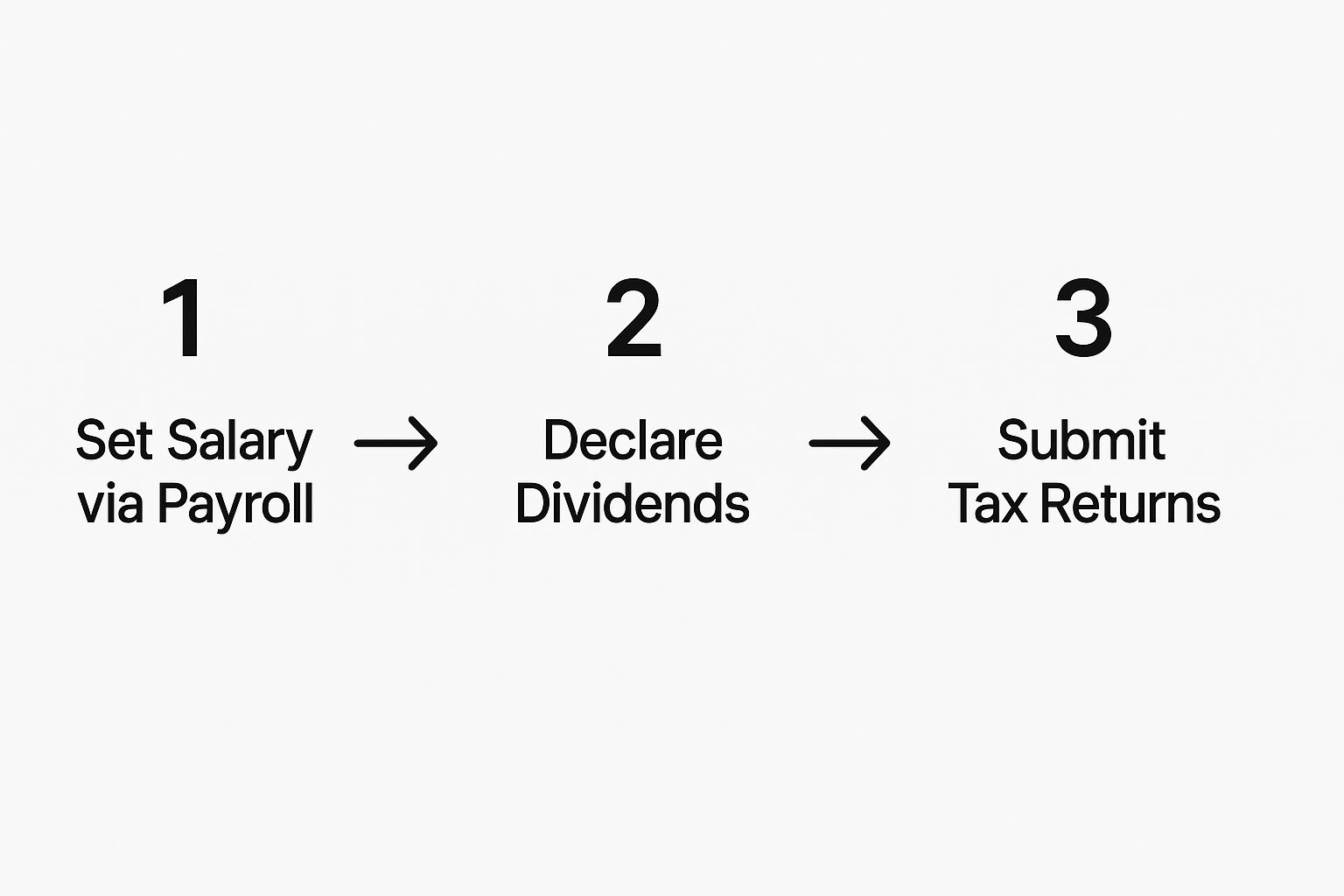
This gives you a bird's-eye view of the regular loop: run payroll, handle dividends, and stay on top of your tax duties. Let’s break that down further.
Your Regular To-Do List: Monthly & Quarterly Tasks
Once you're registered, you'll fall into a rhythm of regular tasks. These are the non-negotiables that keep your records clean and HMRC happy.
- Run Payroll: Whether you do it every month or each quarter, you need to officially process your director's salary. Your payroll software will handle the calculations for tax and National Insurance.
- Report to HMRC: Every single time you run payroll, you must send what's called a Real Time Information (RTI) report to HMRC. It’s a snapshot that tells them exactly what you’ve been paid.
- Declare and Document Dividends: Before taking a dividend, you have to be certain your company has enough post-tax profit to cover it. You then need to hold a quick board meeting (even if you're the only one there!) to formally declare it and create a dividend voucher. This paperwork is crucial.
- Keep Your Books Spotless: This is the golden rule. Every salary payment, every dividend, every single expense needs to be meticulously logged in your company's accounts.
My Go-To Tip: I always recommend using good cloud accounting software. Tools like Xero or FreeAgent can automate most of this, from generating payslips to submitting RTI reports. Crucially, they give you a live view of your retained profits, so you never have to guess if you can legally issue a dividend.
The Big Annual Deadlines
Finally, a few key responsibilities pop up at the end of the financial year. Getting these right ensures both you and your company are fully square with UK tax law.
- File Your Personal Tax Return: All the income you’ve taken – both salary and dividends – must be declared on your Self Assessment tax return. The deadline for filing this online is 31st January. Don’t leave it until the last minute!
- Submit the Company's Corporation Tax Return: Your director's salary is a legitimate business expense, which helps reduce your company's taxable profit. This needs to be correctly reported on the CT600 form you file with HMRC.
- Prepare and File Annual Accounts: Lastly, your company's accounts need to be officially filed with Companies House. This creates a public record of your business's financial health for the year.
Got More Questions About Director Pay?
Once you’ve got the basics down for paying yourself, some of the finer details and ‘what-if’ scenarios naturally start to pop up. Here are some of the questions I get asked most often by company directors.
Can I Chop and Change My Salary and Dividends?
Absolutely, there's a lot of wiggle room here.
Your director's salary is usually something you set once for the tax year and run consistently through payroll. While you can change it, doing it too often just creates extra admin with your payroll submissions, so it’s generally best to stick with it.
Dividends, on the other hand, are a different story. They’re incredibly flexible. You can declare a dividend whenever the company has enough profit after tax to cover it. That might mean you take a hefty dividend one month when cash flow is strong, and then nothing for the next three. This flexibility is one of the biggest perks of the whole salary-and-dividend setup.
What if the Company Doesn't Make a Profit? Can I Still Take a Dividend?
This is a big one, and the answer is a firm no. You can only pay dividends out of post-tax profits.
If your company hasn't made a profit after paying all its bills and taxes, you cannot legally pay a dividend. If you do, it's considered an 'illegal dividend'. HMRC doesn't take kindly to this and can demand the full amount is repaid, sometimes with penalties on top.
In a year where the business makes a loss, you'll have to rely solely on your director's salary for your income.
A Quick Tip From Experience: Don't forget about your pension. Funnelling money directly from the business into your personal pension is one of the smartest, most tax-efficient moves you can make. These contributions are almost always a fully deductible business expense, which lowers your Corporation Tax bill. Better yet, you don't pay a penny of personal tax or National Insurance on them.
Honestly, when profits are a bit tight or you're just planning for the future, boosting your pension is often a much better move than taking a higher salary. It’s a brilliant way to build personal wealth while slashing your company’s tax bill.
Trying to figure out the best salary level, when to declare dividends, and how to handle pension contributions can feel like a full-time job in itself. At Stewart Accounting Services, we help limited company directors all over the UK get this right. We take care of the complex stuff so you can get back to running your business. To get the three freedoms of more time, more money, and a clearer mind, visit our website to learn more.