

At its core, lowering your corporation tax bill is all about legally reducing your company's taxable profits. The game plan involves a few key moves: meticulously claiming every single allowable expense, maximising capital allowances when you buy assets, and tapping into valuable government schemes like R&D tax relief. Each of these directly chips away at the profit figure that HMRC uses to calculate your bill.
Getting to Grips With Corporation Tax
Before we jump into the nitty-gritty tactics, it’s vital to understand the playing field. Think of it like studying the map before planning your journey—knowing the rules, rates, and deadlines gives you the foundation for making smart, strategic decisions that will genuinely save your company money.
UK Corporation Tax is a direct tax on the profits your limited company makes. For most business owners, this is one of the biggest bills they'll face each year, so getting a handle on it is non-negotiable. It's not just a single flat rate, either; the system is deliberately structured to give smaller businesses a bit of a leg-up.
This structure has changed quite a bit over the years. The UK corporation tax rate has fluctuated wildly, averaging around 30% since 1981 but hitting highs of 52% and, more recently, lows of 19%. From April 2023, a new framework came into effect, which makes it more important than ever to know exactly where your profits sit. For anyone interested in the history, the government's official statistics offer a detailed breakdown of these changes.
The Current UK Tax Rates Explained
The current system essentially has two main rates, determined by your profit levels. It's crucial to know which band your business falls into, as this directly shapes your tax planning.
- Small Profits Rate: If your company's annual profits are £50,000 or less, you’re in luck. You’ll pay corporation tax at 19%. This is designed to support smaller, growing businesses.
- Main Rate: For companies with profits shooting past £250,000, the main rate of 25% applies.
- Marginal Relief: Now, what if you're in the middle? For profits between £50,000 and £250,000, you don't just jump straight from 19% to 25%. A system called Marginal Relief kicks in, creating a tapered rate that climbs gradually as your profits approach the upper threshold.
To make this clearer, let's look at the rates and thresholds in a simple table.
UK Corporation Tax Rates at a Glance
This table provides a quick summary of the current Corporation Tax rates applicable to UK limited companies based on their annual profits.
| Profit Threshold | Applicable Corporation Tax Rate | Key Consideration |
|---|---|---|
| Up to £50,000 | 19% (Small Profits Rate) | Designed to support smaller businesses and startups. |
| £50,001 to £250,000 | A tapered rate between 19% and 25% | Marginal Relief applies here, gradually increasing the effective tax rate. |
| Over £250,000 | 25% (Main Rate) | The standard rate for companies with substantial profits. |
Understanding these bands is what moves you from simply doing your accounts to actively planning your tax strategy.
My Two Cents: Your company's profit level is the single biggest factor dictating your tax rate. This makes accurate profit calculation and forecasting absolutely critical. Get this wrong, and you could be leaving a lot of money on the table.
For instance, if you see your profits are hovering just over the £50,000 mark, it might be the perfect time to bring forward a significant allowable expense or a planned asset purchase. This could nudge your taxable profit back down into the 19% band. It’s this foundational knowledge that empowers you to use the more advanced strategies we'll cover next with real confidence.
Claiming Every Allowable Business Expense
One of the most powerful and direct ways to reduce your corporation tax is already happening within your day-to-day operations. Every single pound you spend on a legitimate business cost directly lowers your taxable profit, yet so many companies leave money on the table by overlooking expenses they're entitled to claim.
The rule of thumb is simple: an expense must be incurred “wholly and exclusively” for business purposes. While the obvious costs like office rent, staff salaries, and utility bills are easy to spot, the real tax savings often come from the less obvious, but perfectly legitimate, deductions.
This is where a meticulous approach to tracking your spending becomes non-negotiable. It’s about more than just stuffing receipts in a folder; it’s about actively questioning every business outlay and understanding exactly how it fits within HMRC's guidelines.
Digging Deeper Into Common Expense Categories
To make a real dent in your tax bill, you need to get into the habit of scrutinising everything your business spends money on. I find that many business owners are genuinely surprised by what they can claim once they start looking closer.
Think about a small marketing agency in Stirling, for example. Of course, they’ll claim their office rent and payroll. But what else?
- Software Subscriptions: All those monthly fees for Adobe Creative Suite, SEO tools, and project management software add up. They are fully deductible.
- Freelancer and Contractor Fees: The cost of bringing in external designers, copywriters, or consultants is a direct business expense.
- Professional Subscriptions: Is the company paying for memberships to bodies like the Chartered Institute of Marketing (CIM)? That's a claim.
- Staff Entertainment: While you can't deduct the cost of schmoozing clients, you can claim for "annual events" for your team, like a summer BBQ or Christmas party, up to a certain limit per head.
This logic applies across every industry. A construction firm in Falkirk would be claiming for specialised tools, personal protective equipment (PPE), the running costs for its vans, and payments to subcontractors. The key is to shift your mindset from simply recording costs to actively identifying every single tax-deductible spend.
A Note from Experience: I once worked with a client who ran a thriving e-commerce business from home but had never thought to claim for the portion of their house used as a stock room and office. By properly calculating the allowable household expenses—a percentage of their mortgage interest, council tax, and utilities—we managed to knock several thousand pounds off their taxable profit each year. It’s a classic example of an overlooked but significant deduction.
Uncovering Often-Missed Deductions
Some of the most valuable expenses are the ones business owners either don't know are allowed or just assume are too much hassle to claim. This is where a proactive accountant can make a massive difference to your final tax calculation.
Director and Employee Pension Contributions
This is one of the most tax-efficient moves a limited company can make. Employer contributions into a pension scheme for directors and staff are almost always treated as an allowable business expense.
Put simply, if your company pays £10,000 into a director's pension, that's £10,000 of profit you won't pay corporation tax on. At the main rate of 25%, that single action saves your company £2,500 in tax.
Staff Training and Development
Investing in your team isn't just great for morale and growth; it's great for your tax bill. Any costs for courses, workshops, or training materials that are relevant to an employee's role are fully deductible.
This could be anything from a management course for a team leader to a software certification for a developer. As long as the training helps the employee do their job better, it qualifies.
Professional Insurance and Bank Charges
Don't forget the small but consistent costs that keep the wheels turning. These often slip through the cracks but they all add up.
- Professional indemnity insurance
- Public liability insurance
- Monthly bank account fees and transaction charges
- Interest paid on business loans or overdrafts
Individually they might seem small, but over a full financial year, these costs make a real difference. By systematically tracking and claiming every allowable expense, you ensure you are only paying corporation tax on the profit you've truly made.
Getting Smart with Capital Allowances
Investing in your business is how you grow, but the upfront cost of new assets can be a real sting. This is exactly where capital allowances come into play. Honestly, they're one of the most powerful tools in your tax-planning arsenal, letting you write off a big chunk – and sometimes all – of an asset's cost against your profits.
Think of it like this: your day-to-day running costs, like rent or electricity, are deducted from your profits straight away. But when you buy something with a longer lifespan, like a van or a new server, you can't just expense the whole lot in one go. Instead, HMRC lets you claim its value back through capital allowances, either over time or, in some very useful cases, all at once.
This is a critical area to get right. By strategically timing your purchases to make the most of these allowances, you can unlock significant tax savings and keep that cash in your business where it belongs.
Maximising Full Expensing for New Kit
One of the best capital allowances available right now is Full Expensing. This was made a permanent fixture in the 2023 Autumn Statement, and for companies investing in new plant and machinery, it's a genuine game-changer.
Put simply, it allows you to deduct 100% of the cost of a qualifying new asset from your profits in the year you buy it. The impact is immediate, providing a direct and often substantial cut to your corporation tax bill.
So, what kind of things qualify? The list is pretty broad, covering the essentials most businesses need:
- IT Equipment: Think computers, servers, and printers.
- Office Furniture: Desks, chairs, and all your storage units.
- Machinery: This covers everything from manufacturing equipment to specialist tools.
- Commercial Vehicles: Vans and lorries are in, but just be aware that cars don't qualify for this one.
Let’s look at a real-world example. Imagine a printing company based in Alloa has taxable profits of £120,000. They decide to invest £50,000 in a new state-of-the-art printing press. Using Full Expensing, they can deduct that entire £50,000 from their profit straight away. This brings their taxable profit right down to £70,000, delivering a very real and immediate tax saving.
Getting to Grips with the Annual Investment Allowance
Alongside Full Expensing, you have the Annual Investment Allowance (AIA), which is another fantastic opportunity. The AIA also lets you deduct 100% of the cost of assets, but up to a very generous annual limit of £1 million.
The crucial difference here is that the AIA can be used for both new and second-hand assets. Full Expensing is strictly for new and unused equipment. This makes the AIA incredibly useful if you’re buying refurbished machinery or a used commercial vehicle to save on costs.
Let's picture a joinery firm in Falkirk that's kitting out a new workshop.
- They buy a brand-new CNC machine for £40,000, which they claim under Full Expensing.
- They also pick up a used delivery van for £15,000, which they claim using the AIA.
In this scenario, the company gets to write off the full £55,000 against its profits that year by combining the two allowances. For most small and medium-sized businesses, the £1 million AIA threshold is more than enough to cover 100% of their asset spending each year.
Don't Overlook Structures and Buildings Allowances
We've covered machinery and equipment, but what about the actual building you work from? That’s where the Structures and Buildings Allowance (SBA) comes in. It's designed to give you tax relief on the costs of constructing or renovating non-residential properties.
The SBA works a bit differently. Instead of a 100% deduction in the first year, you claim a steady 3% of the qualifying costs each year for just over 33 years.
Qualifying costs for the SBA include things like:
- The cost of building a new factory or office from scratch.
- Fees for design, planning permission, and the construction work itself.
- The costs involved in renovating or converting an existing commercial building.
While the annual relief might seem smaller, it adds up to a consistent, long-term reduction in your tax bill on major property projects. It’s an essential allowance to factor into your thinking whenever you’re considering buying or developing business premises. Getting familiar with these allowances means you can turn necessary investments into smart, tax-saving opportunities.
Tapping into Specialist Tax Reliefs and Schemes
Once you’ve got a handle on the day-to-day expenses and capital allowances, there's another, often-missed, layer of tax savings that can make a huge difference. The government actively wants to encourage innovation, and it does so with a range of specialist tax reliefs. The surprising thing is how many qualifying businesses never even make a claim.

These schemes aren't just for scientists in white lab coats. They're designed for businesses across countless sectors, from software developers to small engineering firms, who are solving technical problems or creating original work. Getting to grips with these can seriously cut your corporation tax bill, and sometimes even lead to a cash payment directly from HMRC.
Knowing how to access these reliefs is a cornerstone of smart tax planning. It shows that the headline tax rate is only part of the story; the real savings are often found in knowing which specific schemes your business qualifies for. These reliefs are constantly being tweaked, which shows how important they are to the government's economic strategy. For instance, between 2010 and 2018, the main corporation tax rate was slashed, but the effective rate companies actually paid stayed pretty stable. This was largely because the rules around reliefs were tightened to balance things out. You can dig into the data on how allowances impact the effective tax rate on the OBR website.
Diving Into Research and Development (R&D) Tax Relief
When you hear "R&D", your mind might jump to a pharmaceutical lab, but HMRC's definition is far more generous. R&D tax relief is for any company seeking to make an advance in science or technology.
This could be you if you're:
- Building new software with unique functionality that didn't exist before.
- Engineering a more efficient or sustainable manufacturing process.
- Creating a new product with genuinely improved performance.
- Integrating existing technologies in a novel way to solve a tough technical problem.
The key is this: if your project involved technical uncertainty and you had to experiment to find a solution, you could well have a valid R&D claim.
The payoff is significant. For a profitable SME, the scheme gives you an enhanced deduction, which shrinks your taxable profits. But for a loss-making business, it gets even better – you can often claim a payable cash credit from HMRC. For a startup, that’s a vital injection of cash without giving up any equity.
A Practical R&D Scenario
Let’s say a small engineering firm in Stirling is hired to design a bespoke component for a new renewable energy system. The project forces them to develop a new material composite that can handle extreme temperatures but still be incredibly lightweight.
All the costs they sink into solving that specific challenge – the engineers' salaries, the materials for prototyping, even a portion of their software and utility bills – could form the basis of an R&D claim. Their innovative work is directly translated into a tangible tax benefit.
Expert Insight: Don't write yourself off. So many business owners I talk to are just heads-down, solving problems for their clients. They don't realise that their day-to-day problem-solving is exactly what HMRC considers innovation. It's always worth exploring.
Protecting Your Profits with the Patent Box
If your innovation results in a patented invention, another powerful tool comes into play: the Patent Box. This scheme lets your company apply a much lower rate of corporation tax – just 10% – to profits earned from those patented inventions.
The whole point is to encourage companies to develop, keep, and commercialise their intellectual property here in the UK. If your company holds a qualifying patent (or has exclusively licensed one in), you can apply this reduced rate to the profits from:
- Worldwide sales of the patented product.
- Sales of a larger product that incorporates the patented invention.
- Licensing fees or royalties you earn from your patent rights.
- Income you get from selling the patent rights themselves.
For any business built on innovation, a patent strategy isn't just about legal protection; it's a fundamental part of long-term tax planning. The gap between paying tax at 25% and 10% on a huge chunk of your profits is massive.
Reliefs for the Creative Industries
The government also has a family of tax reliefs specifically for companies in the creative sector. These are designed to boost industries that are vital to the UK's culture and economy.
There are dedicated schemes for:
- Film Production: For films that are certified as culturally British.
- High-End Television and Animation: Covering scripted TV, kids' shows, and animation.
- Video Games Development: For games that pass a cultural test for "Britishness".
- Theatre, Orchestra, and Museums & Galleries: To support live performances and cultural exhibitions.
Much like the R&D scheme, these reliefs work by giving you an enhanced deduction against your profits or, in some situations, a payable cash credit. If your business is in any of these fields, looking into the relevant creative industry tax relief is non-negotiable.
Weaving Tax Efficiency into Your Financial Strategy
Reducing your corporation tax bill isn't a last-minute scramble before your year-end. It’s the result of smart, year-round financial planning. This is about moving from simply recording what’s happened to proactively shaping your company’s financial future.
It means thinking strategically about when you make major financial moves—from how you pay your directors to when you invest in new assets. The aim is to build a rhythm where every significant decision is made with an eye on its tax implications, ensuring you grow your business while legally minimising what you owe HMRC.
This chart shows just how powerful a proactive strategy can be, demonstrating how claiming all your entitled reliefs and deductions can dramatically lower your effective tax rate.
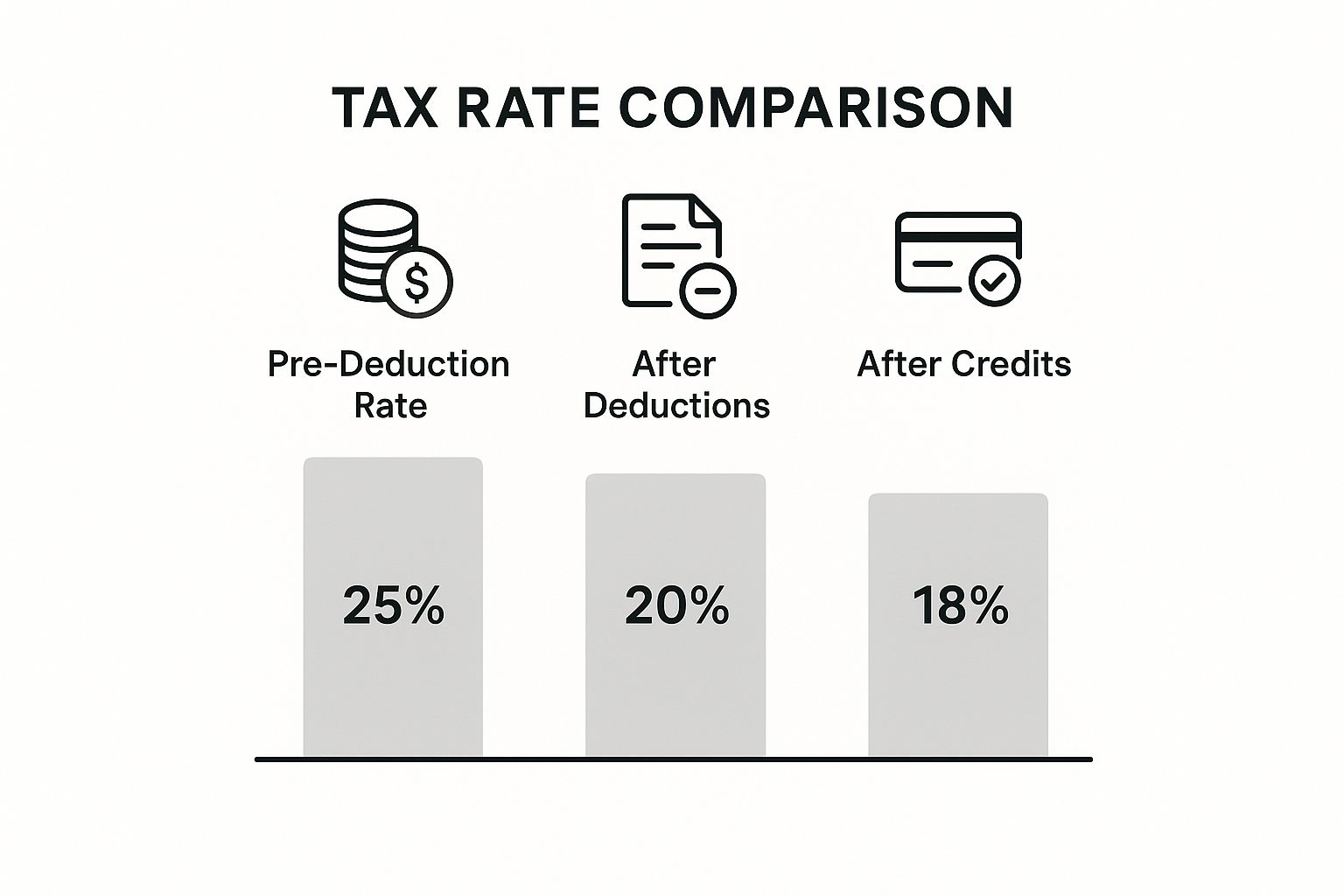
As you can see, even with a headline corporation tax rate of 25%, a strategic approach can slice a significant amount off the final bill.
Rethink How You Pay Your Directors
For many limited companies, one of the most powerful levers you can pull is director remuneration. Simply taking a big salary or bumper dividends often isn't the most tax-efficient way to extract profits. A far savvier approach can be making substantial pension contributions.
Why? Because company pension contributions are almost always an allowable business expense. This means they reduce your taxable profits before the tax is even calculated.
For a company paying the main rate, a £20,000 pension contribution could immediately save £5,000 in corporation tax. Even better, this pulls money out of the business without triggering National Insurance contributions for the company or the director. It’s a clean, efficient way to reward key people.
To give you a clearer picture, let's compare the common ways of extracting profit from your company.
Director Remuneration Tax Efficiency Comparison
| Remuneration Method | Corporation Tax Impact | Personal Tax Impact | Best For |
|---|---|---|---|
| Salary | Reduces taxable profit, saving corporation tax. | Subject to Income Tax and employee/employer National Insurance. | Providing a regular, predictable income and qualifying for state benefits. |
| Dividends | Paid from post-tax profits, so no corporation tax saving. | Lower personal tax rates than salary, with no National Insurance. | Tax-efficient profit extraction, especially after a small salary. |
| Pension Contributions | Reduces taxable profit, saving corporation tax. | No immediate personal tax. Tax-free growth until retirement. | Long-term wealth building and maximum tax relief for the company. |
This table makes it clear that while salaries and dividends have their place, pension contributions offer a unique, tax-advantaged route for long-term planning.
My Take: I always tell clients to think of director pension contributions as a triple-win. You cut your corporation tax bill, you reward yourself or your top talent in a very tax-efficient way, and you're building a serious asset for the future.
Get Smart with the Timing of Big Purchases
We've already touched on powerful tools like Full Expensing and the Annual Investment Allowance (AIA). The real expert move is timing your capital expenditure to get the maximum bang for your buck.
Let's imagine it's nearing your financial year-end. Your forecasts show that your profits are creeping up towards that £250,000 threshold where the main 25% rate kicks in. If you were planning to buy a new bit of machinery in a couple of months, why wait?
Bringing that purchase forward could be a game-changer. Buying it now reduces your taxable profit for this year, potentially keeping you in a lower tax band and saving you a significant sum. It’s a simple shift in timing that can have a big impact.
Of course, this kind of proactive planning requires a crystal-clear view of your finances throughout the year. Having your accounts in good order is non-negotiable, which is why optimizing financial systems like Xero is a cornerstone of smart tax management.
Turn a Tough Year into a Future Tax Saving
Not every year is a record-breaker. For start-ups or businesses weathering a downturn, making a loss is a reality. But a trading loss doesn't have to be a dead end—you can carry it forward to reduce your tax bill in future, more profitable years.
Here’s how it works in the real world:
- Let's say your company made a £30,000 loss in the 2023/24 financial year.
- The next year, 2024/25, is fantastic. You post a profit of £80,000.
- You can offset last year's £30,000 loss against this profit, bringing your taxable profit down to just £50,000.
This is a vital mechanism that helps smooth out the peaks and troughs of business, ensuring your tax bill reflects your performance over the long haul. Keeping meticulous records is key to making sure these losses are properly reported and carried forward.
Support Good Causes and Reduce Your Tax Bill
Making corporate donations to registered charities is another excellent way to reduce your corporation tax liability. It works a bit differently from personal gift aid. The company simply deducts the entire value of the donation from its profits before tax.
If your company donates £1,000 to a chosen charity, you can knock that full £1,000 off your profits. For a business paying the main 25% rate, that act of generosity also saves you £250 in corporation tax. You get to support causes you believe in while also reaping a direct financial benefit.
Common Questions on Reducing Corporation Tax
When it comes to corporation tax, I find that business owners tend to ask the same handful of questions. They’re the practical, day-to-day things that can genuinely make a difference to your bottom line. Let's run through some of the most frequent queries I hear.
Can I Claim for Working from Home?
Absolutely. If you're a director running your business from home, you're entitled to claim for the associated costs. HMRC gives you two ways to go about this.
The easiest route is to claim the flat rate of £6 per week (£26 per month). There's no paperwork, no need to dig out utility bills – you just claim it. It's a straightforward way to get a bit of tax relief for using your home as an office.
For a potentially bigger claim, you can work out the actual costs. This means calculating what portion of your household running costs is directly related to your business activities.
- What can you include? A percentage of your utility bills, council tax, mortgage interest, and home insurance.
- How do you calculate it? Imagine your home has ten rooms and you use one exclusively as your office. You could reasonably claim 10% of those household bills as a business expense.
This method does require you to keep good records to back up your claim if HMRC ever asks, but it often leads to a much healthier tax deduction, especially if you have a dedicated workspace you use all the time.
Is It Better to Buy or Lease a Company Car?
This is a classic question, and these days, the answer almost always comes down to one thing: is the car electric? The tax rules have shifted so dramatically that green vehicles are now heavily favoured.
If you’re thinking about an electric vehicle (EV), buying it brand new through the company is incredibly tax-efficient. The magic here is something called capital allowances. Your business can write off the entire cost of the car against its profits in the year you buy it. That’s a huge, immediate dent in your corporation tax bill.
For traditional petrol or diesel cars, and even most hybrids, the capital allowances are much less generous, making an outright purchase a lot less appealing from a tax standpoint.
Don’t forget about Benefit-in-Kind (BIK) tax. This is the personal tax you pay for the privilege of having a company car. For EVs, BIK rates are incredibly low (around 2%), but they can be painfully high for cars with hefty CO2 emissions. While lease payments are usually a straightforward deductible expense, a high BIK rate can wipe out any corporation tax savings.
So, the takeaway? For electric cars, buying often comes out on top. For anything else, leasing might seem simpler, but you've got to watch out for that personal BIK tax hit.
What Happens if I Make a Mistake on My Tax Return?
Finding a mistake on a filed tax return is a heart-sinking moment, but it’s not the end of the world. The key is to be upfront and fix it as soon as you can.
If you spot the error within 12 months of the filing deadline, it's a simple fix. You can just go online and amend your CT600 return through the government portal.
Once that 12-month window closes, you’ll need to write to HMRC directly to make a voluntary disclosure and explain what happened.
The consequences really depend on the nature of the mistake:
- An honest error: If it was a genuine slip-up, you’ll likely just have to pay the tax you owe, plus any interest.
- Carelessness: If the mistake was due to a lack of 'reasonable care', HMRC can issue a penalty of up to 30% of the extra tax due.
- Deliberate errors: Intentionally getting it wrong is a serious matter. This can attract penalties of up to 100% of the tax owed.
My advice is always to be proactive. Owning up to a mistake as soon as you find it shows HMRC you're acting in good faith and can significantly reduce any potential penalties.
Getting your head around everything from allowable expenses to capital allowances is fundamental to running a financially healthy business. At Stewart Accounting Services, we help businesses across Central Scotland and the UK do more than just file their taxes; we help them build a proactive strategy for a more profitable future. We bring the clarity and expertise you need to lower your tax bill and hold on to more of your hard-earned cash. If you're ready to get smarter about your tax planning, get in touch with our team of Chartered Accountants today. https://stewartaccounting.co.uk