

Structuring your business plan isn't about just filling in sections. It's about telling a compelling story in a logical order. Think of it as a journey, starting with the big-picture Executive Summary and your Company Vision, then diving into the nitty-gritty of your Market Analysis, Organisation and Management, and Services and Marketing, before culminating in the all-important Financial Projections. This structure is your strategic roadmap.
Why Your Business Plan Structure Matters
Let’s get one thing straight: a business plan isn't just another document to tick off your to-do list. It’s the architectural blueprint for your entire venture. A logical and compelling structure is probably the most powerful tool you have for making sharp decisions, navigating the often-tricky UK market, and convincing investors that your idea is worth backing.
A clear framework is what turns a promising concept into a fundable, actionable strategy. It forces you to connect the dots between your vision, the people you want to sell to, and the cold, hard numbers that will make or break your business. Without it, you’ve got a collection of good ideas. With it, you’ve got a roadmap to success.
From Idea to Investment
The path from a spark of an idea to having cash in the bank is a structured one, and your business plan is the vehicle that will get you there. It’s what transforms your passion into a language that lenders and investors understand.
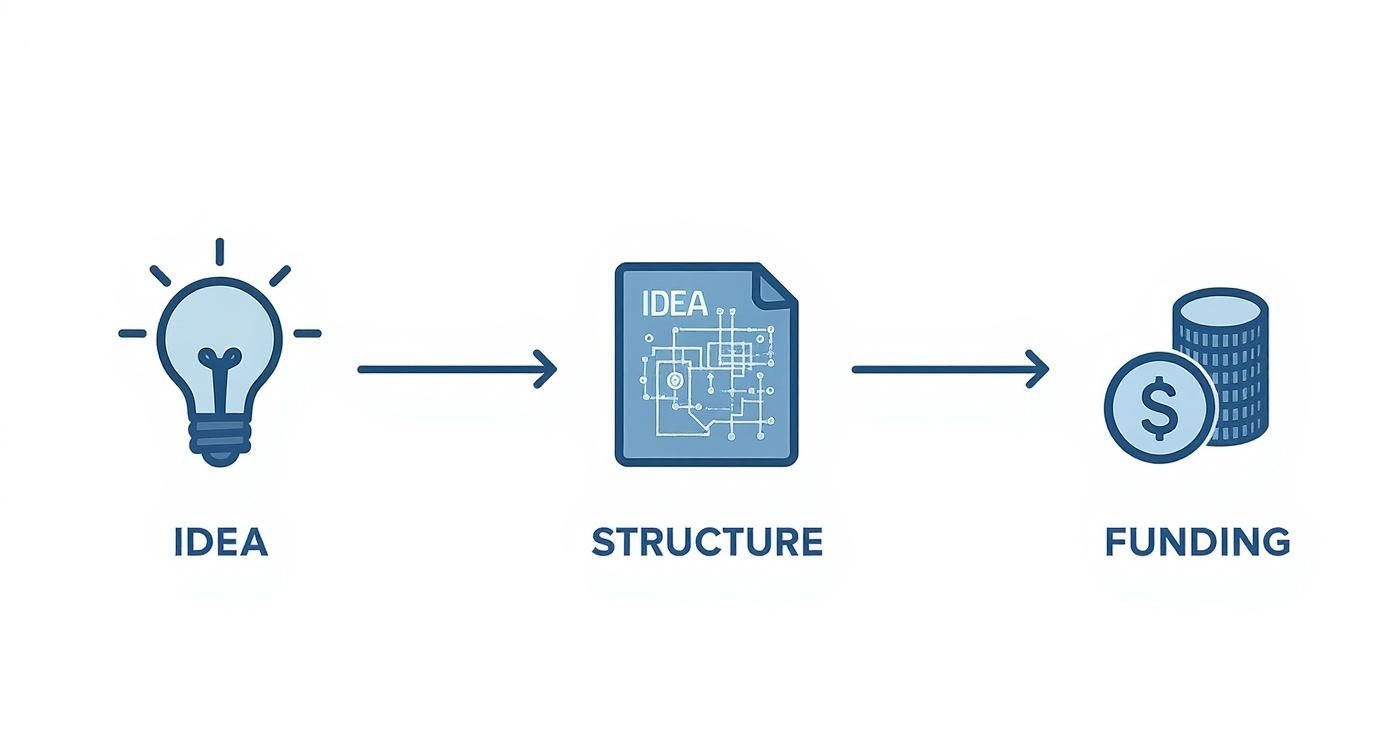
As you can see, the flow is simple but crucial: a solid idea, refined and validated by a robust structure, leads directly to the potential for funding. The structure itself is the critical bridge between your concept and the capital you need to make it happen.
The evidence for this is hard to ignore. Studies have shown that entrepreneurs who take the time to prepare a detailed plan are 152% more likely to actually get their venture off the ground. And it doesn't stop there. Businesses with a formal plan tend to grow 30% faster and are far more successful at securing investment.
If you want to really understand the impact, https://stewartaccounting.co.uk/benefits-of-a-business-plan/ — a structured approach can literally double your chances of growth.
The Foundation for Growth
A well-structured plan is far more than just a pitch document for securing loans or investments. Its real power often lies in the internal functions it serves, which are absolutely crucial for long-term stability and growth.
- It creates clarity and focus. The process forces you to nail down and articulate your mission, objectives, and strategies in plain English.
- It's a decision-making tool. When you're facing tough choices down the line, your plan becomes your North Star, ensuring your decisions align with your core goals.
- It acts as a performance benchmark. A good plan sets measurable targets, allowing you to track your progress and make smart adjustments when things don't go as expected.
A business plan should be a living document. It’s not meant to be written once and then shoved in a drawer. It should evolve as your business grows, adapting to new market conditions and unexpected opportunities.
Ultimately, appreciating the real benefits of a business plan is the first step. This guide will now walk you through each essential section, giving you the practical, no-nonsense advice needed to build a plan that is both convincing and, most importantly, achievable.
Getting Started: The Executive Summary and Company Vision
Think of your executive summary as the film trailer for your business plan. It's often the first—and sometimes only—part a busy investor or bank manager will read, so it absolutely has to grab their attention. This is your one shot to make a killer first impression, boiling down your entire plan into a short, sharp, and compelling story.
It’s more than just an introduction; it’s a standalone pitch. It needs to be punchy enough to explain the core of your business in the time it takes to drink a coffee. That's why you should always, always write this section last. Once you’ve wrestled with the details of your financials and market analysis, you can pull out the most powerful highlights and create a summary that’s genuinely representative of your full plan.
Boiling Your Business Down to a Powerful Pitch
The goal here is to give a high-level overview without getting lost in the weeds. Anyone reading your executive summary should walk away with a crystal-clear picture of what your business does, its potential for success, and why they should be excited about it.
Make sure you hit these key points:
- The Mission: Kick off with a bold statement. What problem are you on a mission to solve?
- Company & Product Snapshot: In a sentence or two, what is your company and what do you actually sell? Be direct. Is it a service, a physical product, or a piece of software?
- The Market Opportunity: Briefly touch on who you're selling to and why now is the perfect time to launch. What's the gap in the market you’ve found?
- Your Competitive Edge: What makes you different from everyone else? Nail your unique selling proposition (USP) and state it clearly.
- The Financials in a Nutshell: Don’t be vague. Give them the key numbers, like your revenue forecast for the first three years and, crucially, how much funding you’re looking for.
Keep it tight—one or two pages, max. Use strong, active language and steer clear of industry jargon. You're aiming for impact and clarity, giving the reader every reason to turn the page and dive into the detail.
Defining Your Company and Its Purpose
Right after the summary, your company description lays the groundwork. This section moves past the high-level pitch and starts telling the real story of your business. It's where you anchor your big vision in reality, explaining the 'who' and 'what' that drives your mission.
This isn’t just about ticking the box on your legal structure. It's about weaving a narrative. A new fintech app, for instance, might describe itself as a Limited Company set up to disrupt clunky, traditional banking with clean, user-focused tech. On the other hand, a local artisan bakery might proudly operate as a sole proprietorship dedicated to reviving old-school baking techniques for its community. The structure should feel like a natural extension of the mission.
Your company description sets the stage. It needs to clearly communicate your business's identity and legal setup, but also its core purpose and the unique value it delivers. This is where you connect the dots between your day-to-day operations and your long-term aspirations.
When you're fleshing this out, make sure you cover these bases:
- Business Name and Legal Structure: State your registered business name and whether you’re a Sole Trader, Partnership, or Limited Company. It’s a small detail that immediately signals professionalism.
- Mission and Vision Statements: Your mission is what you do now. Your vision is where you want to be in the future. Keep both short, sharp, and inspiring.
- Core Values: What principles guide your decisions when things get tough? Nailing down 3-5 core values—like 'sustainability,' 'customer obsession,' or 'radical transparency'—helps shape your culture from day one.
- The Team's Expertise: You’ll go into more detail later, but a brief mention of the key players and their experience here builds instant credibility.
- The Problem You're Solving: Get specific about the pain point you eliminate. For an accountancy firm like ours, that problem is often the overwhelming complexity and stress SMEs face when managing their finances.
By weaving these elements together, your company description does more than just state the facts. It starts to build a brand, showing potential backers that you've thought things through and have a clear direction. This level of detail is a fundamental part of how to structure a business plan that actually works.
Getting to Grips with Your Market and Competition
Right, let's talk about the part of your business plan where you prove you’ve done your homework. A deep, honest understanding of your industry, customers, and competitors isn't just a nice-to-have; it's absolutely crucial for convincing anyone—especially investors—that you’re serious. It shows your business isn't just a brilliant idea floating in a vacuum, but a solid venture ready for the real world.
Think of it as your pre-battle reconnaissance. You need to map out the terrain (your market), size up the other players on the field (your competitors), and know exactly who you're trying to win over (your customers). A well-researched analysis gives both you and your potential backers the confidence that people actually want and need what you're selling.

Defining Your Target Market and Its Size
Before you can win over a market, you have to know what it looks like. This starts with creating a really detailed picture of your ideal customer. Forget vague descriptions like "people who need my product." You need to get specific. What are their demographics, what do they care about, what problems keep them up at night?
A local coffee shop, for instance, isn't just for "coffee drinkers." Its sweet spot might be remote workers aged 25-40 who appreciate ethically sourced beans and need a quiet space to focus.
Once you know who you're talking to, you need to work out how many of them there are. This is your market size. There are a couple of common ways to get a handle on this:
- Top-Down Analysis: You start big and narrow it down. For that coffee shop, you'd begin with the total UK coffee market, then drill down to your local town, and finally estimate the percentage of that population that fits your target demographic.
- Bottom-Up Analysis: This is the reverse. You start with your own capabilities and build upwards. Calculate how many customers you could realistically serve each day, multiply that by the average spend, and then project that over a year.
Getting this right is especially important for new businesses, and a good guide on market analysis for startups can be an invaluable resource to get you started.
Running a Proper Competitive Analysis
Let's be clear: every business has competition. Your plan needs to show that you've not only identified your main rivals but also that you genuinely understand their game. This isn't just about listing their names; it’s about dissecting their strategies to carve out your own unique position.
It helps to split them into two camps:
- Direct Competitors: These are the businesses doing the exact same thing for the same people. Think of another artisan bakery just a few streets away.
- Indirect Competitors: They solve the same core problem but with a different product. For the artisan bakery, a supermarket's in-store bakery is a classic indirect competitor.
For each of your main rivals, dig into their pricing, marketing, product quality, and what their customers are saying about them online. This intelligence is gold dust. It helps you spot gaps in the market and figure out how to gain a competitive advantage.
A thorough competitive analysis isn't just a defensive tactic; it's a powerful strategic tool. By understanding where your rivals are falling short, you can position your business to meet those unmet needs and clearly communicate why you're the better choice.
Remember, the UK business world is incredibly varied. The largest sector is still professional, scientific, and technical services, making up 15.3% of all registered companies. Businesses in this space often need incredibly detailed market analysis to navigate tricky regulations and stand out.
Pulling It All Together with a SWOT Analysis
The SWOT analysis is a classic for a reason—it’s simple, effective, and forces you to be honest. It's a framework for organising all your research into a clear picture of where you stand. It covers your Strengths, Weaknesses, Opportunities, and Threats.
Let’s imagine you're launching a sustainable fashion brand in the UK. Your SWOT might look something like this:
| Category | Description |
|---|---|
| Strengths | What gives you an internal edge? (e.g., Unique eco-friendly materials, a powerful brand story) |
| Weaknesses | What internal challenges do you face? (e.g., Higher production costs, limited initial brand awareness) |
| Opportunities | What external trends can you jump on? (e.g., Growing consumer demand for ethical fashion, government grants for green businesses) |
| Threats | What external factors could cause problems? (e.g., Fierce competition from fast-fashion giants, potential supply chain disruption) |
This isn't just an academic exercise. Your SWOT should directly feed into your strategy. You'll build your marketing around your strengths, create plans to manage your weaknesses, develop tactics to seize opportunities, and prepare contingencies for potential threats. This is how your analysis becomes a living, breathing part of your business plan.
Showcasing Your Organisation and Management Team
There’s an old saying in the world of investment: "We don't back ideas, we back people." This is the part of your business plan where you prove you have the right people on the bus to turn a great idea into a real, profitable company. It's your opportunity to build genuine confidence and show that your vision is in capable hands.
This isn’t just about listing names and job titles. It’s about weaving a story that highlights your team's collective strength. And even if your team is currently just you, this section is still vital for mapping out how your business will run and where you plan to grow.

Defining Your Organisational Structure
First things first, you need to show how your company is organised. For a lot of small businesses, this will be straightforward, but clarity is what counts. Anyone reading it should immediately understand who is responsible for what.
Start with a simple organisational chart. This gives a quick, visual snapshot of the chain of command and the main functions within the business. Even if it’s just one box with your name in it, that’s fine. It shows you’re already thinking about structure.
Next, you need to state the legal structure of your business. Make it crystal clear whether you’re operating as a:
- Sole Trader
- Partnership
- Limited Liability Partnership (LLP)
- Limited Company (Ltd)
This detail is absolutely fundamental. It affects everything from your tax obligations to personal liability, making it a cornerstone of a credible business plan.
Crafting Powerful Team Biographies
With the structure laid out, it's time to introduce the key people. This is your chance to bring the team to life, going beyond a dry CV to write a compelling, concise bio for each key member of the management team. The goal is to shine a spotlight on experience that's directly relevant to making this business a success.
For instance, if you're launching a tech company, your lead developer's bio shouldn’t just be a list of past employers. It should shout about their track record in building scalable software or their deep expertise in the specific coding language your product relies on.
Think of each biography as a mini-pitch. Focus on achievements, not just responsibilities. A bio that says someone "grew their previous company's online sales by 300% in two years" carries far more weight than one that simply says they were "responsible for e-commerce."
Keep these bios punchy—a short paragraph for each person is more than enough. The focus should always be on what makes them the perfect person for this specific role in this specific company.
Outlining Roles and Future Growth
Finally, this section needs to have one eye on the future. It’s not just about who you have today, but also about who you’ll need to hire as the business grows. Start by clearly defining the main roles and responsibilities for your current team. Make sure there are no confusing overlaps or, worse, critical gaps in accountability.
Then, sketch out a hiring roadmap. This isn't a vague wishlist; it should be directly tied to the business milestones you’ve set out elsewhere in your plan.
For example, your plan might look something like this:
- Post-funding: Hire a Marketing Manager to drive our go-to-market strategy.
- After hitting 1,000 customers: Bring on two Customer Support specialists to ensure service quality doesn’t drop.
- When we hit Year 2 revenue targets: Recruit a Chief Financial Officer to manage financial scaling.
This kind of forward-thinking shows you've got a realistic grip on what it will take to grow. It reassures investors that you understand how to build the team needed to deliver on your promises.
Nailing Your Services and Marketing Strategy
Right, let’s get to the good stuff. This is the part of your business plan where you lay out exactly what you're selling and, just as importantly, how you’re going to get people to buy it. It’s where your big idea becomes a tangible, valuable offer.
Describing your product or service is the easy bit. The real magic is showing that you understand your customers' world so well that you can frame your offer around their problems and desires, not just your own spec sheet. You’re not just selling features; you’re selling a solution, an upgrade to their life or business.
Describing What You Do (And Why It Matters)
Start with a simple, clear description of what you’re offering. Are you a consultancy, a software-as-a-service (SaaS) platform, or a creator of handmade goods? Get specific. If you have a range of products, list them out.
But don’t stop there. You need to connect the dots for the reader by explaining the value proposition. For instance, a small accountancy firm doesn’t just ‘do the books’. A much better description is that it ‘gives business owners back 10 hours a month and ensures full HMRC compliance, so they can sleep at night.’ See the difference?
Your description should also touch on a few other key points:
- Where are you now? Is your product just a concept, a working prototype, or already out in the wild? Briefly mention your plans for future versions or improvements.
- Is it protected? Do you hold any patents, trademarks, or copyrights? This isn't just a legal detail; it’s a barrier to entry for competitors and a real asset on your balance sheet.
- What's next? A quick note on your research and development (R&D) efforts shows you’re not just thinking about today but are actively building the future of the business.
A classic rookie error is drowning the reader in technical jargon. Whether it's a banker or an investor, they need to grasp the customer benefit in seconds. Always, always lead with the solution you provide, not the technical wizardry behind it.
Your Go-to-Market Plan
Okay, so they know what you're selling. Now you need to show them how. This is your go-to-market strategy, and a great way to think it through is by using the good old '4 Ps' of marketing.
- Product: We’ve just covered this, but here you’ll want to double down on what makes you different – your unique selling points (USPs).
- Price: How did you land on your pricing? Is it based on the value you provide, a simple cost-plus model, or are you pricing against competitors? You need to justify it and show it makes sense for your target market.
- Place: Where do people actually buy from you? This could be your e-commerce site, a high-street shop, a direct sales team knocking on doors, or through partners and distributors.
- Promotion: This is all about getting the word out. What channels will you use? Think social media marketing, creating useful content, pay-per-click (PPC) ads, or PR.
Your plan for promotion has to be concrete. "We'll use social media" is far too vague. It should be more like, "We’ll target marketing managers at UK tech firms on LinkedIn with practical case studies, backed by a monthly ad budget of £500 to drive demo requests for our B2B software." That’s a plan.
Tailoring Your Marketing Approach
A marketing strategy is only effective if it's the right fit for the business. The way a B2B software firm finds customers is worlds away from how a direct-to-consumer (D2C) fashion brand does it, and your plan needs to show you get this.
Let’s look at two different scenarios to see how this plays out in practice:
| Marketing Element | B2B Software Firm (e.g., HR Platform) | D2C Fashion Brand (e.g., Sustainable Trainers) |
|---|---|---|
| Primary Goal | Generate qualified leads for the sales team. | Drive online sales and build brand loyalty. |
| Key Channels | LinkedIn, content marketing (whitepapers), industry webinars, email marketing. | Instagram, TikTok, influencer collaborations, email marketing, pop-up shops. |
| Sales Funnel | Awareness > Lead Capture > Nurturing > Demo > Sales Conversion. | Awareness > Website Visit > Product View > Add to Cart > Purchase > Re-engagement. |
| Key Metrics | Cost Per Lead (CPL), Lead-to-Customer Rate, Customer Lifetime Value (CLV). | Customer Acquisition Cost (CAC), Conversion Rate, Average Order Value (AOV). |
Demonstrating this kind of specific, well-reasoned thinking proves you’re not just dreaming. It shows you have a sophisticated grasp of how to structure a business plan for the real world and that you understand marketing is a strategic tool, not a one-size-fits-all checklist.
Building Realistic Financial Projections
Let's be honest, this is the part of the business plan that makes most people nervous. But think of it this way: your financial projections are where your big ideas meet reality. They turn your market research and operational strategy into cold, hard numbers, proving your business isn't just a passion project, but a commercially sound venture.
Investors will pour over these figures, so they need to be rock-solid. Every number, from your sales forecast to your staffing costs, must be built on clear, logical assumptions you’ve already laid out in the earlier sections of your plan.
The Three Core Financial Statements
To give a complete picture of your company's financial health, you’ll need to prepare three essential documents. Each one tells a different part of the story, and together, they show investors you know your numbers inside and out. For a more detailed walkthrough, our guide on how to do financial forecasting is a great place to start.
-
Income Statement (Profit & Loss): This is your bottom line. It shows your projected revenues, subtracts your costs and expenses, and reveals your profit (or loss) over a set period. You'll want to map this out monthly for the first year, then annually for years three to five.
-
Cash Flow Projection: Cash is king, and this statement proves it. It tracks the actual money flowing into and out of your business, which is critical for managing day-to-day liquidity. It helps you answer the crucial question: can we pay our rent and staff next month?
-
Balance Sheet: This document provides a snapshot of your business's financial position at a specific moment in time. It's a simple equation: Assets = Liabilities + Equity. It shows what you own, what you owe, and what's left over.
Crafting a Compelling Funding Request
If you're writing this plan to secure investment, your financial projections need to culminate in a clear, specific funding request. A vague ask for "some start-up capital" simply won't do. You must be precise about what you need and how every single pound will be put to work.
Your request should clearly outline:
- The Amount: State the exact figure you’re seeking. No ambiguity.
- Use of Funds: Give a detailed breakdown. For instance, £20,000 for initial inventory, £15,000 for a six-month digital marketing push, and £25,000 to bring on a key salesperson.
- Future Plans: Briefly touch on what comes next. A solid business plan is often the ticket to bigger investments down the line. If you have ambitions for venture capital, it’s worth understanding what goes into a Series A funding round.
Your funding request is the ultimate test of your plan. It connects your operational needs directly to your financial strategy, proving you have a clear roadmap for using capital to fuel growth and achieve your goals.
A robust business plan also anticipates changes in the market, particularly when it comes to your team. For example, recent UK data shows that 25% of SMEs intend to hire in 2025, while 10% expect to make cuts. Factoring in these kinds of national employment trends makes your financial and operational planning much more credible and grounded in the UK-specific economic environment.
Common Questions About Business Plan Structure

Getting stuck on the finer points of structuring a business plan is perfectly normal. Let's walk through some of the questions I hear most often from entrepreneurs, so you can push forward with a clear head.
One of the first things everyone asks is, "how long should it be?" While there’s no single correct answer, a good rule of thumb for a traditional plan going to investors is somewhere between 20 and 40 pages. If you're creating a "lean" plan just for your internal team, you might only need a few pages to nail down the core strategy.
Another critical point is tailoring your plan to your audience. Would you send the same document to your bank manager as you would to a venture capitalist? I certainly wouldn't.
- For the bank: Your focus should be on financial stability, solid cash flow projections, and what collateral you have. They need to be confident you can repay their loan, plain and simple.
- For an investor: You need to sell the dream. This means highlighting the huge market opportunity, what makes you different, and the potential for rapid growth. They’re looking for a big return on their investment.
The best business plans aren't set in stone. When I say 'tailor' your plan, I don't mean you should change the facts. It's about shifting the narrative to emphasise what matters most to the person reading it. That simple adjustment can make all the difference.
How Much Detail Is Too Much?
Striking the right balance with detail can feel like walking a tightrope. You need to give enough information to be credible but not so much that you bog the reader down in the weeds.
My advice? Keep the main body of the plan focused and concise. Stick to the strategy.
Anything that's supplementary or overly detailed can go in an appendix. Think of things like:
- In-depth market research data and tables
- Full historical financial statements
- CVs for your management team
- Copies of patents or important legal paperwork
This strategy keeps your core document clean, punchy, and readable. It also signals to the reader that you've done your homework and have all the supporting evidence ready when they need it.
At the end of the day, your business plan is a communication tool. The structure is just a framework to help you tell a clear, compelling story about where your business is heading.
Building a business plan that truly captures your vision and stands up to scrutiny from investors demands solid financial expertise. At Stewart Accounting Services, we specialise in helping SMEs craft robust financial projections and strategic plans that clear the path for growth. Find out more at https://stewartaccounting.co.uk.