

That sudden, cold feeling of dread when an official-looking envelope from HMRC arrives. It’s a feeling that can easily spiral into sleepless nights, with one thought repeating in your mind: I’m worried about my tax bill. You might be picturing a huge, unaffordable sum, fearing penalties, or simply feeling frozen and embarrassed, not knowing where to even begin. It’s a stressful and isolating experience, but please know you are not alone, and there is always a path forward.
This guide is here to take that weight off your shoulders. We will calmly walk you through the exact steps to take control of the situation. Forget the confusion and anxiety; we’ll help you understand your bill, explore your options for paying what you owe, and give you a clear, simple action plan to resolve things with HMRC. It’s time to replace that worry with a sense of relief and confidence in your finances.
Key Takeaways
- Understand the common reasons your tax bill might be higher than expected, including the crucial difference between profit and cash in the bank.
- Get a simple, 5-step action plan to tackle your tax bill head-on and regain a sense of control over your finances.
- If you’re thinking, “I’m worried about my tax bill and can’t afford to pay,” discover the flexible payment arrangements you can discuss with HMRC.
- Learn how to implement simple financial habits now to prevent tax bill surprises and reduce stress for good.
First, Take a Breath: Why Tax Bill Anxiety is Completely Normal
It’s a feeling many business owners know well: the thud of a brown envelope from HMRC on the doormat and the immediate knot in your stomach. If your first thought is, “I’m worried about my tax bill,” you are far from alone. The UK tax system is complex, and it’s surprisingly easy to miscalculate or fall behind, especially when you’re focused on running your business. Understanding the fundamentals of what is Income Tax can be a challenge in itself.
This worry is a completely normal reaction. However, the single most important step you can take right now is to face the problem head-on. Ignoring it won’t make it disappear, but tackling it with a clear plan will reduce your stress and put you back in control.
The Most Common Tax Fears (and Why They’re Often Manageable)
When we feel anxious, our minds often jump to the worst-case scenario. The good news is that these fears are rarely the reality. Here are the most common worries we help clients overcome:
- Fear 1: ‘The bill will be impossibly high.’ While any unexpected bill is a concern, the final figure is often less daunting than you imagine. With professional help, there may be allowable expenses or reliefs you haven’t considered that can reduce what you owe.
- Fear 2: ‘HMRC will send bailiffs or put me in jail.’ This is extremely rare. These severe actions are reserved for cases of deliberate, long-term tax evasion and fraud, not for honest business owners who have made a mistake or are struggling to pay.
- Fear 3: ‘The penalties will double what I owe.’ HMRC penalties are structured and depend on the reason for the error and your level of cooperation. By being proactive, you can often mitigate these penalties significantly.
Why Ignoring the Problem is the Worst Strategy
Pushing that brown envelope to the bottom of the pile is tempting, but it is the most damaging thing you can do for your business and your peace of mind. The feeling of being worried about your tax bill only grows when left unchecked. Ignoring an HMRC issue leads to compounding problems: penalties and interest accumulate daily, turning a manageable sum into a much larger debt. This creates prolonged stress that can impact your health, your family, and your ability to run your business effectively. Ultimately, HMRC will catch up, and they always look more favourably on those who come forward proactively to resolve an issue.
Understanding Your Bill: Common Reasons for a Surprise Tax Liability
That sinking feeling when you see a tax bill that’s much higher than you anticipated is a common source of stress for business owners. If your first thought is, “I’m worried about my tax bill,” you’re not alone. The key is to move from panic to understanding. Often, the shock comes from a simple misunderstanding between the cash in your bank account and the profit your business has actually made according to HMRC’s rules. Let’s break down the most common reasons this happens.
For Sole Traders & the Self-Employed
As a sole trader, your business and personal finances are legally one and the same, which can create confusion. A surprise bill often comes down to one of these factors:
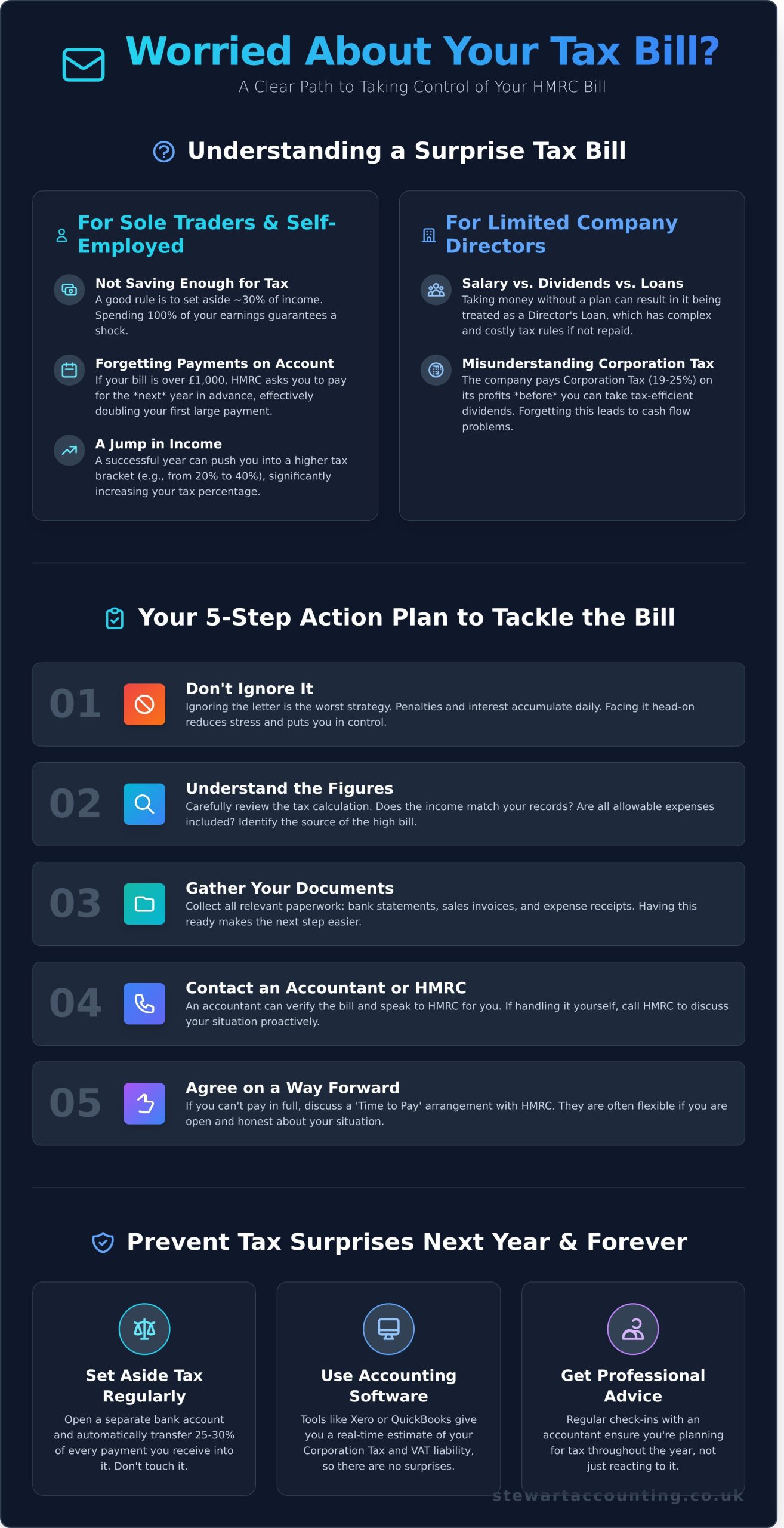
- Not saving enough for tax: A good rule of thumb is to set aside around 30% of your income in a separate account for tax and National Insurance. If you’ve been spending 100% of your earnings, the final bill will always be a shock.
- Forgetting Payments on Account: This is a major tripwire. If your Self Assessment bill is over £1,000, HMRC requires you to pay for the next tax year in advance, effectively doubling your first significant payment.
- A jump in income: A successful year is great news, but it can easily push you into a higher tax bracket (from 20% to 40%, for example), meaning a much larger percentage of your earnings goes to the taxman.
For Limited Company Directors
Running a limited company creates a legal separation between you and the business, but how you take money out has specific tax consequences. Confusion here is a primary cause of high tax liabilities.
- Salary vs. Dividends vs. Loans: Taking money from the business isn’t as simple as transferring it to your personal account. An unplanned withdrawal might be treated as a Director’s Loan, which has complex tax rules if not repaid quickly. A proper structure of a small salary and dividends is usually more tax-efficient.
- Misunderstanding Corporation Tax: Your company must pay Corporation Tax on its profits before you can take any dividends. Forgetting to account for this 19-25% tax can lead to a cash flow crisis when the deadline arrives.
Other Common Triggers for a High Tax Bill
Sometimes, the surprise isn’t from your main business at all. Other financial activities throughout the year also attract tax, and it’s easy to overlook them until your Self Assessment is due.
- Additional income: Did you earn money from a rental property or sell some shares? This income needs to be declared and tax paid on it.
- An incorrect tax code: If you are also employed (PAYE), your employer may have been using the wrong tax code, meaning you haven’t paid enough tax on your salary throughout the year.
- Capital Gains Tax (CGT): Selling a significant asset, like a second home or other investments, can trigger a large, one-off CGT bill that must be planned for.
Your 5-Step Action Plan to Tackle the Tax Bill Head-On
That feeling of “I’m worried about my tax bill” can be paralysing, but the key to moving forward is to transform that worry into action. By breaking the problem down into small, manageable steps, you can regain control and find a clear path forward. This isn’t about solving everything at once; it’s about taking the first step and knowing you don’t have to do it alone.
Step 1: Gather Your Paperwork
Start by simply collecting the essential documents you have to hand. Don’t aim for perfection-just begin. This includes things like:
- Bank statements for your business account
- Sales invoices you’ve issued
- Receipts and invoices for business expenses
Modern accounting software like Xero can make this process much smoother by keeping everything organised in one place, but for now, just gather what you can find.
Step 2: Get an Accurate Figure
Often, the figure you’re imagining is far worse than the reality. An uncertain number is always scarier than a concrete one. This is where professional help is invaluable. A qualified accountant will not only calculate the precise figure but will also ensure you claim every single allowable expense, which can significantly reduce the final amount you owe.
Step 3: Communicate Before They Do
It is always better to contact HMRC before they have to contact you. Being proactive shows you are taking responsibility, which can make discussions about payment more straightforward. If the thought of this is daunting, we can take it completely off your hands. As your agent, we can manage all correspondence on your behalf. Let us handle the difficult conversations with HMRC for you.
Step 4: Understand the Payment Options
Many business owners don’t realise that a tax bill doesn’t always have to be paid in one lump sum. HMRC offers arrangements for those struggling to pay, known as a ‘Time to Pay’ plan. This allows you to spread the cost over a series of manageable monthly instalments. Simply knowing that options exist can provide immediate relief from the pressure.
Step 5: Create a Plan for Next Year
Once you have a handle on this year’s bill, the final step is to look ahead. We can help you set up a simple system to put money aside for tax throughout the year, so there are no surprises next time. A little forward planning turns a source of annual stress into a routine business task, giving you back your peace of mind.
Can’t Pay Your Tax Bill All At Once? Your Options with HMRC
Staring at a large tax bill can be incredibly stressful. The thought, “I’m worried about my tax bill and can’t afford to pay it,” is a common fear for many business owners and self-employed individuals. The good news is that HMRC understands this. Their primary goal is to collect the tax owed, and they can be surprisingly flexible if you communicate with them proactively. You are not the first person to be in this situation, and there are established solutions to help you manage the debt without undue panic.
What is a ‘Time to Pay’ Arrangement?
A ‘Time to Pay’ (TTP) arrangement is a formal agreement with HMRC that allows you to pay your tax debt in manageable monthly instalments. It’s designed to give you breathing room. Generally, you may be eligible to set one up online if you owe less than £30,000 from your Self Assessment, have no other tax debts, and your tax returns are up to date. These plans typically last for 12 months or less, but this can be a vital lifeline for your cash flow.
How to Apply for a Time to Pay Plan
For Self Assessment debts under the £30,000 threshold, you can often apply for a payment plan directly through your Government Gateway account. For larger debts or more complex situations (like VAT or Corporation Tax arrears), you or your accountant will need to call HMRC’s Payment Support Service. Before you call, make sure you have the following information ready:
- Your Unique Taxpayer Reference (UTR) or other tax reference number.
- Details of the tax bill you are unable to pay in full.
- A clear reason why you are currently unable to pay.
- A realistic assessment of what you can afford to pay upfront and each month.
- Your bank account details for setting up the Direct Debit.
What an Accountant Can Do to Help
If the thought of negotiating with HMRC fills you with dread, you don’t have to do it alone. This is where an experienced accountant can be invaluable. We can contact HMRC on your behalf, take the stress of the conversation completely off your hands, and use our expertise to propose a realistic payment plan based on your actual business cash flow. Getting professional support ensures you get the best possible outcome and lets you focus on running your business. Let us help you find a solution that gives you peace of mind; contact our team today to see how we can assist.
How to Prevent Tax Bill Worries Next Year (and Forever)
Dealing with a large, unexpected tax bill is stressful. While the steps above can help you manage the immediate situation, the real solution is to shift from a reactive cure to a proactive strategy. If the thought “I’m worried about my tax bill” is a familiar one, building a system for financial clarity is the key to ensuring it doesn’t happen again. Good financial habits are the foundation for less stress and more peace of mind.
The Habit of ‘Tax Potting’
One of the most effective habits you can adopt is ‘tax potting’. The concept is simple: open a separate, easy-access savings account dedicated solely to your tax savings. Every time an invoice is paid, immediately transfer a set percentage-typically 25-30%-into this pot. This simple discipline ring-fences the money owed to HMRC, ensuring it isn’t accidentally spent. When your tax payment is due, the funds are already there, waiting.
Embrace Modern Bookkeeping
The days of a year-end scramble with a shoebox full of receipts are over. Using modern cloud accounting software like Xero provides a real-time, accurate view of your income and expenses. Keeping your books up-to-date throughout the year means no nasty surprises. This clarity not only removes stress but also allows for accurate tax forecasting, so you always have a clear idea of what you will owe long before the bill arrives.
The Value of Proactive Tax Planning
An accountant shouldn’t just be someone you speak to once a year. Think of us as a year-round partner, here to help you make smarter financial decisions. Proactive tax planning is about looking forward, not just back. Regular check-ins mean your tax bill is never a surprise, and the annual cycle of thinking “I’m worried about my tax bill” becomes a thing of the past.
With ongoing support, we can help you:
- Structure your business in the most tax-efficient way.
- Plan for major expenses and investments to maximise tax relief.
- Understand the tax implications of your decisions before you make them.
Let us take the stress of tax planning off your hands so you can focus on what you do best. Work with us to make tax stress a thing of the past.
Swap Your Tax Bill Worries for a Clear Plan
Receiving an unexpected tax bill can be daunting, but it’s a challenge you can overcome. The key is to face it with a clear strategy. By understanding your bill, exploring all your payment options with HMRC, and putting a proactive plan in place for next year, you can move from anxiety to action. A surprise bill doesn’t have to derail your financial peace of mind.
Ultimately, the feeling of “I’m worried about my tax bill” doesn’t have to be your reality. If you’d rather hand the problem over to an expert, our team is here to help. As Fully Qualified Chartered Accountants with local offices in Alloa, Stirling, and Falkirk, we specialise in taking the complexity off your hands. We are dedicated to giving our clients what they value most: more time, more money, and less stress.
Feeling overwhelmed? Let us take the worry off your hands. Get in touch for a chat. You’ve already taken the first step by seeking information-now let’s get it sorted for good.
Frequently Asked Questions
What are the penalties for filing or paying a tax return late in the UK?
HMRC applies strict penalties for lateness. For late filing, there’s an immediate £100 penalty, even if you don’t owe any tax. After three months, daily penalties of £10 can be added, and penalties increase further at six and twelve months. For late payment, you will be charged interest on the outstanding amount. If the tax is still unpaid after 30 days, a penalty of 5% of the tax due is applied, with further penalties later.
Will HMRC really send me to prison for not paying my tax bill?
It is extremely rare for someone to go to prison for not paying a tax bill. This is a last resort reserved for cases of deliberate and serious tax fraud, not for individuals who are struggling to pay. HMRC’s primary goal is to recover the tax owed. They would much rather work with you to establish a payment plan, known as a ‘Time to Pay’ arrangement, to help you clear your debt in a manageable way. It’s always best to communicate with them.
I haven’t told HMRC I’m self-employed. What should I do?
The most important thing is not to panic, but to act promptly. You should register for Self Assessment with HMRC as soon as possible. By coming forward voluntarily, you demonstrate an intention to get your affairs in order, which HMRC looks upon much more favourably than if they discover your status themselves. We can help you with this process to ensure everything is handled correctly and efficiently, taking the stress and worry off your hands.
How much does it cost to hire an accountant to sort out my tax problems?
The cost to resolve tax issues can vary significantly depending on the complexity of your situation. A simple, one-year tax return will cost much less than untangling several years of unfiled accounts or dealing with a tax investigation. Most accountants, including us, offer a free initial consultation to understand your circumstances. This allows us to provide a clear, fixed-fee quote so you know the exact cost before any work begins, ensuring there are no surprises.
Can an accountant help me reduce the tax bill I already have?
While an accountant cannot illegally reduce a correctly calculated tax bill, we can thoroughly review your past tax returns for errors or missed opportunities. We often find that individuals have not claimed all the allowable expenses or tax reliefs they are entitled to. If we find any such discrepancies, we can submit an amendment to HMRC on your behalf, which could result in a lower tax liability or even a rebate. The focus is on ensuring you only pay what you legally owe.
Is it better to call HMRC myself or have an accountant do it?
If you’re thinking, “I’m worried about my tax bill and dread calling HMRC,” letting an expert handle it can provide immense peace of mind. An experienced accountant speaks HMRC’s language and can communicate your situation clearly and unemotionally. We know what information is needed and can negotiate a ‘Time to Pay’ arrangement more effectively. This removes the stress from you and ensures the conversation is productive, leading to a much better outcome.