

Understanding the IR35 rules can feel overwhelming for contractors. The terminology is complex, and the stakes are high. But it doesn’t have to be a source of stress. This guide will help you understand the IR35 rules, determine if you are ‘inside’ or ‘outside’, and learn how to manage your tax obligations with confidence.
What is IR35? A Plain English Explanation
In simple terms, IR35 is a set of tax rules designed by HMRC to combat tax avoidance by ‘disguised employees’. These are workers who provide their services through their own limited company, often called a Personal Service Company (PSC), but whose working relationship with their client is much the same as a permanent employee. The main goal of the legislation is to ensure that these contractors pay broadly the same Income Tax and National Insurance as an employee would.
Key Terms You Need to Know
- PSC (Personal Service Company): This is typically your own limited company through which you provide your services to clients.
- Client/Engager: This is the business or organisation that you are carrying out the work for.
- Deemed Employee: If HMRC determines that your contract falls ‘inside’ IR35, you are considered an employee for tax purposes, even though you are working through your own company.
Inside IR35 vs. Outside IR35: What It Means for Your Pay
The most critical question for any contractor is whether their contract falls ‘inside’ or ‘outside’ IR35. This determination directly impacts how you are taxed and, consequently, your take-home pay. It is vital to assess your status for every single contract you undertake, as your status can change from one project to the next.
What ‘Inside IR35’ Means for You
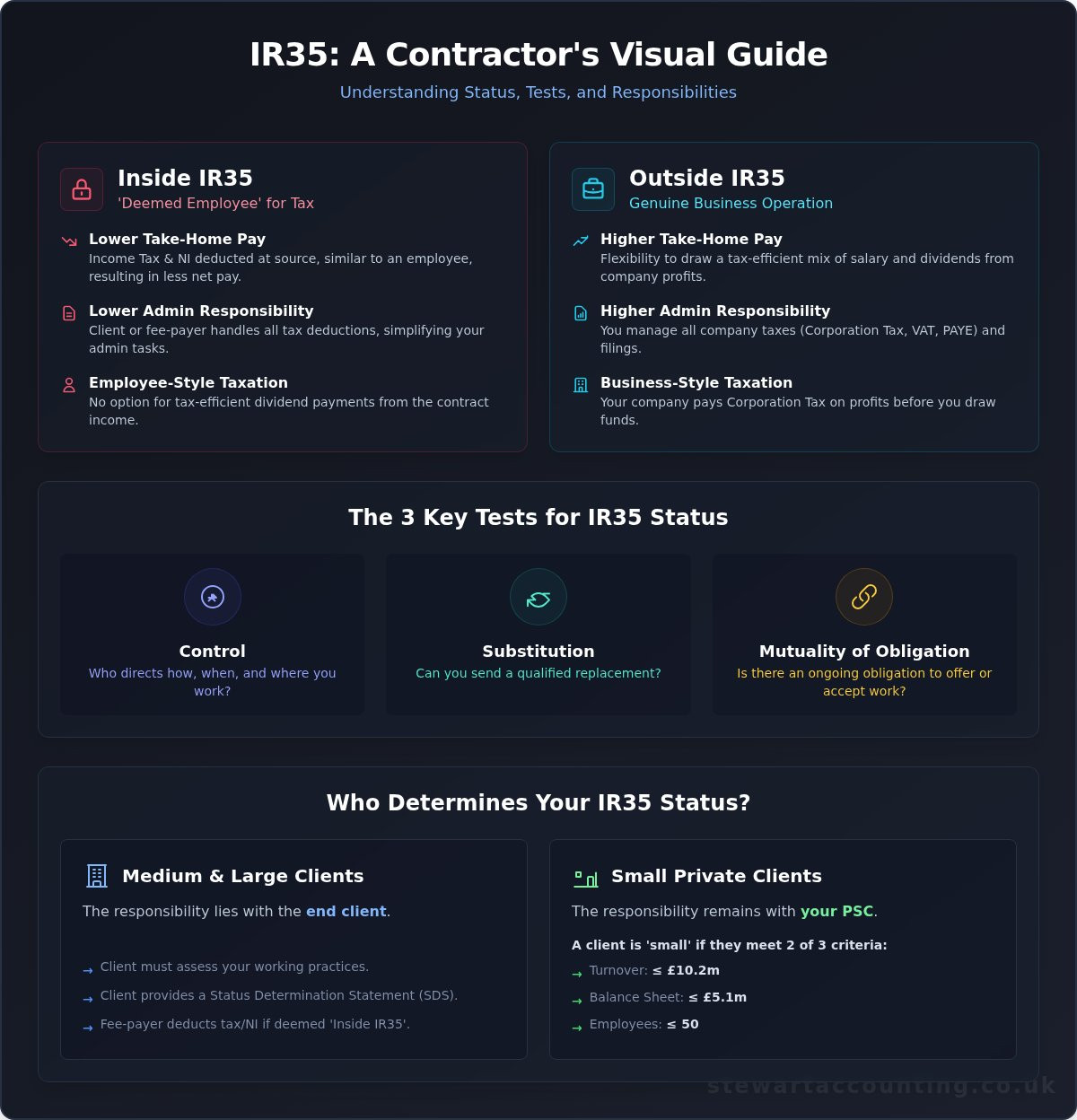
If your contract is deemed to be inside IR35, you are treated as an employee for tax purposes. Your client (or the fee-paying agency) will deduct Income Tax and National Insurance contributions directly from your earnings before you receive them. While this often results in lower take-home pay, it does simplify your tax administration as the deductions are handled for you at source.
What ‘Outside IR35’ Means for You
Being outside IR35 means you are operating as a genuine business. You have the flexibility to pay yourself a combination of salary and dividends, which is usually more tax-efficient and can lead to higher take-home pay. However, with this flexibility comes the responsibility of managing all your own company’s tax and National Insurance obligations.
Quick Comparison: Inside vs. Outside IR35
| Feature | Inside IR35 | Outside IR35 |
|---|---|---|
| Tax Treatment | Treated as an employee. Tax and NI deducted at source. | Treated as a business. Pay Corporation Tax, salary, and dividends. |
| Take-Home Pay | Generally lower due to employee-style tax deductions. | Generally higher due to tax-efficient payment structure. |
| Admin Responsibility | Lower. The client or fee-payer handles deductions. | Higher. You are responsible for all company taxes and filings. |
How is IR35 Status Determined? The 3 Key Tests
HMRC looks beyond the written contract to the reality of your day-to-day working practices. To determine your employment status for tax, they use three main principles that have been established through years of employment law cases. It’s crucial to understand that the actual nature of your working relationship is more important than what your contract says.
1. Control: Who directs how, when, and where you work?
A key indicator of employment is the level of control a client has over the worker. If your client has significant control over how, when, and where you complete your work, you look more like an employee. Genuine self-employed contractors typically have a high degree of autonomy and are hired for their expertise to deliver a result, not to be managed.
2. Substitution: Can you send a replacement to do the job?
A genuine business should be able to send a suitably qualified substitute to perform the work in their place. If you have an unfettered right to send a replacement (and you are responsible for paying them), this is a strong indicator that you are outside IR35. If the client is hiring you for your personal service and no one else can do the job, this points towards an employment relationship.
3. Mutuality of Obligation (MOO): Does the client have to offer work?
Mutuality of Obligation refers to whether the client is obliged to offer you more work and whether you are obliged to accept it. In a typical self-employed arrangement, there is no such obligation; the contract is for a specific project, and once it’s finished, the relationship ends. If there’s an expectation of continuous work, it suggests an employment-like arrangement.
Who Decides Your Status? The Off-Payroll Working Rules
The responsibility for determining a contractor’s IR35 status has shifted in recent years. The rules now depend on the size of the end client you are working for.
Working for Medium or Large Private Sector Clients
If you are working for a medium or large-sized business in the private sector, the responsibility for determining your IR35 status lies with the client. They must assess your working relationship and provide you with a ‘Status Determination Statement’ (SDS) outlining their decision. If they decide the contract is inside IR35, they (or the agency paying you) are responsible for deducting the correct tax and NI from your fees.
Working for Small Private Sector Clients
When you work for a client that qualifies as ‘small’, the responsibility remains with you and your PSC. You must assess your own contract and working practices to determine your IR35 status and ensure you are paying the correct tax. According to HMRC rules, a client is considered small if it meets at least two of the following criteria: an annual turnover of no more than £10.2 million, a balance sheet total of no more than £5.1 million, or no more than 50 employees.
Worried About IR35? We Can Take the Stress Away
Navigating the complexities of IR35 can be a significant source of stress for contractors. The rules are nuanced, and the financial consequences of getting it wrong can be severe, potentially leading to costly HMRC investigations and back-dated tax bills. This is where seeking professional advice from a specialist accountant can provide invaluable peace of mind.
How Stewart Accounting Services Can Help
Our team of qualified experts understands the intricacies of IR35. We can help you navigate this complex area with confidence. We offer a range of services designed to support contractors:
- We review your contracts and working practices to provide a clear assessment of your IR35 status.
- We advise on the most tax-efficient way to manage your finances if you have contracts that fall inside IR35.
- We handle all the complex calculations and ensure your company remains fully compliant with HMRC regulations.
- Ultimately, we give you the freedom to focus on your work, knowing your tax affairs are in safe hands. Get professional IR35 advice today. Let us take it off your hands.
Frequently Asked Questions
Is it bad to be inside IR35?
Not necessarily. While it usually means a lower take-home pay for that specific contract, it also simplifies your tax administration. Many contractors work on a mix of inside and outside IR35 contracts. The key is to understand the implications and plan accordingly.
How can I prove I am outside IR35?
Ensure your contract and working practices clearly reflect a business-to-business relationship. This includes having a genuine right of substitution, maintaining control over your work, and demonstrating that you are not treated like an employee of the client company.
Can my IR35 status be different for different contracts?
Yes, absolutely. IR35 status is determined on a contract-by-contract basis. You could have one project that is clearly outside IR35 and another that is inside. Each one must be assessed on its own merits.
What is a Status Determination Statement (SDS)?
An SDS is a document that your medium or large-sized client must provide, stating their decision on your IR35 status for a particular contract and the reasons for that decision. You have the right to challenge the determination if you disagree with it.
Does IR35 apply to sole traders?
No. IR35 rules only apply to individuals who are working through their own intermediary, which is typically a limited company (PSC).
What happens if HMRC disagrees with my IR35 status?
If HMRC investigates and concludes that you have incorrectly classified a contract as outside IR35, you could be liable for back-dated tax, National Insurance, interest, and potential penalties. This is why professional advice is so important.
Don’t let the complexity of IR35 cause you unnecessary worry. As fully qualified Chartered Accountants and local experts helping contractors across Scotland, we are here to take the worry out of tax compliance. Confused about IR35? Talk to our experts for a free, no-stress consultation.