

When you run a limited company, one of the most powerful tools you have for managing your finances is understanding your business expenses. Think of it this way: every legitimate cost your business incurs can reduce its taxable profit, which in turn lowers your Corporation Tax bill.
The secret lies in a simple but strict rule from HMRC.
What Actually Counts as a Business Expense?

At the heart of it all is one core principle: an expense must be "wholly and exclusively" for the purpose of your trade. This is the ultimate test that HMRC applies. It's the filter through which every purchase must pass to be considered a legitimate business cost.
Let's say you're a web developer. Your monthly Adobe Creative Cloud subscription? That's a textbook business expense. You need it to do your job. But what about your personal gym membership, even if you argue it helps you stay sharp for work? That's a personal cost, and HMRC won't allow it. The line is drawn between what the business needs versus what you need personally.
This distinction is crucial. Every single pound you correctly claim as an expense shrinks your company's profit on paper. Since you only pay Corporation Tax on profits, this simple act of good housekeeping directly saves your company money.
Why You Need to Get This Right
Mastering this concept isn't just a "nice-to-have"—it's fundamental for two big reasons: financial health and legal compliance. By diligently tracking and claiming every allowable cost, you make your company as tax-efficient as it can be. This means more cash in the bank for you to reinvest, hire new talent, or build a financial cushion.
On the flip side, getting it wrong can be painful. You could end up overpaying tax, or worse, face an HMRC investigation with penalties for incorrect returns. Building a solid understanding of these rules from day one is the foundation of a sound financial strategy. For instance, companies managing property have a whole specific set of rental property tax deductions that can make a huge difference to their tax bill.
To really nail this down, it helps to think of HMRC's rules as a simple set of principles.
The Golden Rules of Claiming Expenses
This table breaks down the core HMRC principles into plain English, helping you apply them to your own business decisions.
| Principle | What It Really Means | Practical Example |
|---|---|---|
| Wholly and Exclusively | The cost must be 100% for business purposes. Any personal benefit usually disqualifies the entire expense. | Buying a new laptop solely for work is allowable. Buying one for the family that you occasionally use for work is not. |
| Necessary for Business | The expense must be genuinely required for your company to operate and generate revenue. | A plumber can claim for their tools and van, as they are essential for the job. A designer claiming for a sports car would be a hard sell. |
| Not a Capital Asset | Day-to-day running costs are expenses. Large, one-off purchases that provide long-term value (like property) are 'capital assets' and treated differently. | Office stationery is a running cost. Buying the office building itself is a capital asset. |
| No Dual Purpose | If a cost serves both a business and a personal purpose simultaneously, HMRC will typically disallow it. | Your daily commute from home to your permanent office is considered a personal journey, not a business expense. |
Ultimately, these rules are your guide. They aren't there to catch you out, but to ensure fairness and prevent personal costs from being subsidised by the taxpayer. Keep them in mind with every purchase, and you'll be on solid ground.
Claiming Your Initial Startup and Pre-Trading Costs
Long before you send that first invoice, your business is already spending money. These essential early outlays are what get your company off the ground, and they're known as pre-trading expenses. A lot of new directors think this money is just a sunk cost, but HMRC actually lets you claim it back. It’s a welcome financial boost right when you need it most.
Think of it like getting a car ready for a long road trip. You don't just jump in and drive. You have to buy the car, get it insured, maybe even get a new set of tyres. In the same way, before your limited company officially "starts the engine" and begins trading, you'll be paying for things like company formation, legal advice, or maybe a new laptop. These are all legitimate limited company expenses.
These initial costs can pile up fast. What you spend will vary massively depending on your industry – a freelance writer's setup is a world away from the investment needed for a new recruitment agency. According to data from anna.money, just the basic act of registering your company online with Companies House will set you back about £50, plus extra for certificates. That's just one of many small costs you absolutely should be reclaiming. You can see more examples of how these costs differ across sectors in their guide.
Understanding the 7-Year Rule
Here’s one of the most generous—and often missed—rules from HMRC. You can claim for allowable business expenses from up to seven years before your company even started trading. That's a huge window that can cover a lot of the groundwork you might have laid long before you officially incorporated.
There's one simple condition: the expense has to be something your company would have claimed if it had been trading at the time. Let's say you bought a domain name two years before you formed the company. HMRC treats that cost as if your company bought it on its very first day of trading. This means you can offset it against your first year's profits.
Key Takeaway: Any legitimate business cost you paid for within seven years of your trading start date is likely claimable. This covers everything from professional fees to essential equipment and other setup costs that were vital to getting you launched.
What Pre-Trading Expenses Can You Claim?
This is why keeping meticulous records from day one is non-negotiable. Every receipt, every invoice, no matter how small, is potential tax relief you don't want to miss. Some of the most common pre-incorporation expenses we see are:
- Professional Fees: Paying an accountant to advise on your company structure or a solicitor to draft initial contracts.
- Equipment: The laptop you bought specifically for the business, office furniture, or any specialist machinery.
- Marketing and Research: The cost of building your first website, printing business cards, or commissioning market analysis.
- Formation Costs: The fee you paid to Companies House to officially register your limited company.
For a more detailed breakdown of what qualifies, our guide on what pre-incorporation expenses you can claim gives you plenty more clarity and examples. Getting a firm grip on these rules means you start your business on the strongest possible financial footing, reclaiming every single pound you're entitled to.
The A-Z of Everyday Business Running Costs
Once your company is up and running, the focus naturally shifts from those initial setup costs to the day-to-day expenses that keep the business ticking over. These are what accountants often call revenue expenses or simply running costs, and they’ll make up the vast majority of your limited company expenses over the year.
Think of it like owning a car. Buying the car is a big, one-off cost (that’s your pre-trading expenses). But to actually use it every day, you need fuel, oil, insurance, and regular maintenance. These ongoing necessities are your business's running costs.
This infographic gives you a quick visual rundown of the most common costs you'll encounter in your daily operations.
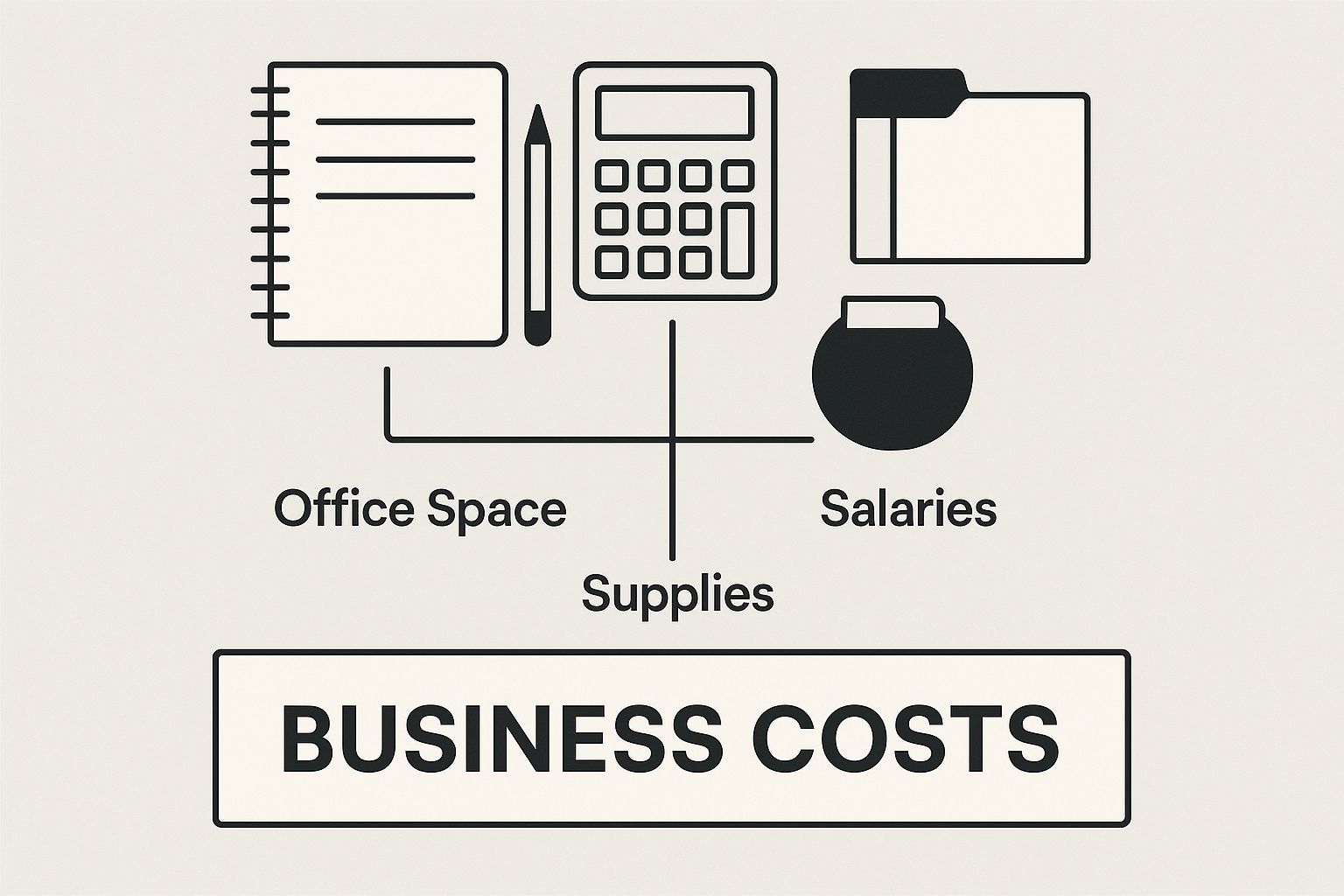
As you can see, everything from the big-ticket items like rent down to the small but essential office supplies all add up to your total business expenditure.
Office and Premises Costs
Whether you’re renting a slick city-centre office, using a flexible co-working space, or have converted the spare room at home, the costs tied to your business premises are almost always allowable. After all, you need a place to work.
Common examples you can claim include:
- Rent for your business premises: A classic, straightforward claim for the monthly or quarterly rent on your office, workshop, or shop.
- Business rates: The tax you pay to the local council for your non-domestic property is fully claimable.
- Utility bills: This covers the electricity, gas, water, and business internet needed to keep your commercial space operational.
- Repairs and maintenance: The cost of getting that leaky tap fixed or servicing the office boiler is an allowable repair, not a property improvement.
Key Consideration: HMRC draws a clear line between repairs (which are allowable day-to-day costs) and improvements (which are treated as capital costs). Giving the office a fresh coat of paint is a repair. Building an extension is an improvement, and the tax treatment is completely different.
Staff Salaries and Associated Costs
If you employ anyone—and that includes paying yourself as a company director—their salary and the related costs are some of the most significant allowable expenses you'll have. Paying your team is a fundamental cost of doing business.
This category goes well beyond just the monthly paycheque. It also covers:
- Gross salaries: The full salary amount paid to employees before any tax or National Insurance is deducted.
- Employer's National Insurance Contributions (NICs): The Class 1 NICs you, as the employer, have to pay for each staff member.
- Pension contributions: Any payments your company makes into an employee's workplace pension scheme.
- Staff benefits: The cost of providing benefits in kind, such as private health insurance or life assurance.
- Allowable staff training: You can claim for courses that are directly relevant to an employee's job and will benefit the company.
For example, sending your new marketing assistant on an advanced social media course is a perfectly valid business expense. Paying for them to get a degree in ancient history, however, probably wouldn’t fly with HMRC as it lacks a direct business purpose.
Marketing, Advertising, and Professional Fees
You need to spend money to make money, and you also need to spend money to stay on the right side of the law. The costs for getting your name out there and keeping your company compliant are essential for growth and stability.
Marketing and advertising costs are fully deductible, as long as they are genuinely for promoting your business. This is a broad category that can include:
- Website hosting and domain renewal fees.
- Digital ad campaigns on platforms like Google Ads or social media.
- The design and printing costs for flyers, brochures, and business cards.
- Sponsoring a local football team to get your brand seen in the community.
In the same vein, the professional fees you pay for expert help are also allowable. These typically include:
- Accountancy fees for sorting your year-end accounts and tax returns.
- Legal fees for help with contracts or other business matters.
- Fees for specialist consultants or freelancers you bring in for a specific project.
Think of these costs not just as expenses, but as crucial investments in your company's public profile and its operational health.
The Special Case of Working From Home
For thousands of company directors, the "office" is just a short walk down the hallway. Working from home is incredibly common, but this is where the lines between business and personal costs can blur. You have to be careful to only claim for the business portion of your home expenses.
HMRC gives you two main ways to do this.
1. The Simplified Flat Rate Method
This is by far the easiest route. HMRC lets you claim a flat rate of £6 per week (£26 per month) to cover the extra costs of working from home, like a bit more electricity and gas. The best part? You don't need to show any receipts or do any complicated sums.
This method is ideal if you only work from home part-time or you simply can't be bothered with the administrative headache of calculating actual costs. You just claim the allowable amount for the year and you're done.
2. The Actual Costs Method
If you have a dedicated home office and believe your actual additional costs are much higher than the flat rate, you can calculate and claim a proportion of your real household bills. It takes more effort, but it can lead to a much larger tax deduction.
Here’s a rough idea of how it works:
- Round up the relevant bills: You can include a portion of your council tax, mortgage interest (not the capital repayment), or rent, plus electricity, heating, and home insurance.
- Calculate the business use: You need a fair and reasonable way to split the costs. A common method is to work out what percentage of your home is used for business (e.g., if one room out of eight is your office, that's 12.5%).
- Factor in time: You then need to adjust for how much time that space is actually used for business versus personal activities. You can't claim for the weekend if you only work Monday to Friday.
For instance, if your relevant household bills come to £400 a month and your office takes up 15% of your home's space, your starting point is £60 per month (£400 x 15%). From there, you'd adjust for any personal use of the room. It’s a more involved process, but for anyone with a permanent home office, it's often the most financially savvy approach.
How Do I Claim for Big-Ticket Purchases?
Buying a new van for the business, a powerful computer for design work, or specialised machinery for your workshop isn’t like buying a pack of pens. These are significant investments—assets that you expect to use for years to help your business run and grow. Because of this, HMRC treats them differently from your day-to-day running costs. The system they use is called capital allowances.
Think of it this way. A regular expense, like printer paper, is like your morning coffee – you use it, and it's gone. A major asset, however, is like buying the entire coffee machine. It’s a tool that’s going to serve you for years to come.
So, instead of claiming the full cost against your profits in one go, capital allowances let you claim a portion of its value each year. This reflects its gradual depreciation and spreads the tax relief over the asset's working life. Getting this right is a crucial part of managing your limited company expenses, and it can make a real difference to your corporation tax bill, especially in years when you're investing heavily.
The Annual Investment Allowance: Your Best Friend for Asset Purchases
To make life easier for businesses, HMRC introduced the Annual Investment Allowance (AIA). This is an incredibly useful tax relief that lets you deduct 100% of the cost of most new equipment from your profits in the same year you buy it, right up to a very generous limit.
Let’s say you're a freelance photographer and you splash out on a new professional camera and lens kit for £5,000. Normally, that’s a big hit. But with the AIA, you can deduct that entire £5,000 from your company's profit for the year. If your profit before buying the camera was £40,000, the AIA instantly drops your taxable profit down to £35,000. Simple as that.
This immediate tax relief is a massive incentive for businesses to invest in the tools they need to grow. If you want to get into the nitty-gritty of how it works, check out our detailed guide on the Annual Investment Allowance.
Just to give you an idea of how much this matters, UK limited companies claimed for a staggering £175.7 billion in capital allowances in the 2023 to 2024 tax year. That’s a huge jump from the previous year and shows just how vital these reliefs are for encouraging investment across the country, as highlighted in the latest HMRC corporation tax statistics.
What Counts as "Plant and Machinery"?
The phrase "plant and machinery" might bring to mind factories and heavy industry, but in the eyes of HMRC, it covers a massive range of assets that most businesses rely on every day. Essentially, it includes the items you need to actually carry out your trade.
Here are a few common examples of what qualifies:
- Office Equipment: Think computers, printers, desks, office chairs, and other essential furniture.
- Business Vehicles: This covers vans, lorries, and sometimes cars (though the rules for cars can get a bit tricky).
- Tools and Machinery: From a builder's power tools to complex manufacturing equipment, it all falls under this category.
- Certain Fixtures: Things like air conditioning units or fitted kitchens that you install in your commercial property can also qualify.
It’s worth remembering that the building itself and the land it sits on don't count. Neither do things that are considered part of the very fabric of the building, like doors and windows. The key is that the asset is a piece of equipment you use within the business. Getting this classification right is the first step to making sure you claim every penny of tax relief you're entitled to.
Building a Bulletproof Record-Keeping System
Figuring out what you can claim is only half the story. The other, and arguably more important, part is being able to prove every single expense. This is where a solid, HMRC-compliant record-keeping system becomes your best friend. It’s not just about ticking a box; it's your primary line of defence if HMRC ever comes knocking and the very bedrock of smart financial management.
Think of it this way: every receipt, invoice, and bank statement is a piece of evidence justifying a business cost. Without that proof, your expense claims are just stories—and they won't stand up to scrutiny. A robust system means you're always ready for an audit.
At the heart of great expense management is meticulous record keeping, a discipline that goes beyond simple compliance to give you powerful insights into where your money is actually going.
Your Essential Document Checklist
HMRC needs to see a clear, detailed trail of your company's income and outgoings. Vague descriptions or missing paperwork are red flags that can lead to disallowed expenses and, potentially, penalties.
Your core record-keeping file should always contain:
- Copies of all sales invoices you've sent out, alongside a clear record of all business income.
- All purchase invoices and receipts for absolutely everything the company has bought.
- Bank statements for every business account, including any company credit cards.
- A log of any personal money used for the business by directors or staff (i.e., expenses you've reimbursed).
- Your VAT records if you’re VAT registered, which includes your VAT account and all the calculations behind your returns.
It might seem like a mountain of paperwork, but together, these documents create the complete financial puzzle of your company's year.
The Six-Year Rule Explained
One of the most common questions we get is, "How long do I actually have to keep all this stuff?" HMRC’s rule on this is crystal clear.
You must keep your business records for at least six years from the end of the last company financial year they relate to. For example, if your company's year-end is 31st March 2024, you need to hang onto those records until at least the end of March 2030.
This long-term requirement is precisely why digital systems are now the norm. Trying to store six years of paper receipts in dusty filing cabinets is not only a hassle but also a huge risk. Digital copies are secure, easily searchable, and far simpler to manage. For a deeper dive, our guide explains exactly what records to keep for your limited company and breaks down the retention rules.
Spreadsheets vs. Accounting Software
So, how should you actually track everything? You really have two main camps to choose from. The right tool for you will depend on how complex your business is and what you feel comfortable with.
1. Using Spreadsheets
This is the classic DIY approach. Spreadsheets are cheap (often free) and you can set them up however you like, which makes them a go-to for many new businesses just starting out.
- Pros: No upfront cost, and you have total control over the layout.
- Cons: It's incredibly easy to make a typo or formula error. Data entry is a manual slog, and as your business grows, the spreadsheet can quickly become a monster.
2. Using Accounting Software
Modern cloud platforms like Xero or QuickBooks are built for this. They take the manual labour out of the process, which cuts down on errors and saves a massive amount of time.
- Pros: They can link directly to your business bank account, pulling in transactions automatically. You get real-time reports, and they make VAT returns infinitely easier.
- Cons: There’s a monthly subscription fee.
While a simple spreadsheet might do the job when you're tiny, dedicated software gives you the accuracy and efficiency to build a truly bulletproof system that will grow with your business.
Common Expense Mistakes and How to Avoid Them
Running a limited company comes with its own set of rules, and navigating the world of expenses can feel like a minefield. But once you know where the common tripwires are, it’s much easier to stay on the straight and narrow with HMRC.
Let's walk through the most frequent blunders I see business owners make, so you can sidestep them entirely.
Mixing Business and Personal Finances
This is, without a doubt, the number one mistake. It’s so tempting to just use your personal debit card for a business purchase when you're in a hurry, but it creates a massive headache down the line.
When your morning coffee receipt is sitting next to a new software subscription on the same bank statement, how can you prove to HMRC that the software was "wholly and exclusively" for the business? It muddies the waters instantly.
More than just a bookkeeping nightmare, this habit can get you into serious legal trouble. It can lead to what’s known as "piercing the corporate veil," a situation where the courts decide the line between you and your company is so blurred that your personal assets are no longer protected. Suddenly, your house and savings could be on the line for company debts. It's a risk that's just not worth taking.
Misunderstanding Key HMRC Rules
Beyond messy bank accounts, many directors simply get tripped up by specific HMRC rules that have tricky nuances. Getting these wrong means your claims will be disallowed, leaving you with an unexpected and unwelcome tax bill.
Here are a couple of classic examples that catch people out all the time.
-
Claiming for Client Entertainment: You take a potential client out for a great lunch, seal the deal, and naturally, you think, "That's a business expense." Well, yes and no. The company can absolutely pay for it, but HMRC is crystal clear: you cannot deduct the cost of client entertainment to reduce your Corporation Tax bill.
-
Ignoring the 'Duality of Purpose' Rule: This is a big one. If something has both a business and a personal benefit, it’s almost always disallowed. Think about your daily commute to your main office. You're going there to work, but HMRC views this as an ordinary personal journey that everyone has to make. The purpose isn't solely for the business.
The acid test for any expense is this: is it genuinely necessary for the business to operate, or is it just making your life as the director a bit easier? That distinction is everything.
The Dangers of Disorganised Records
Finally, we have the simplest and yet most damaging mistake of all: poor record-keeping. You can have a mountain of perfectly legitimate expenses, but if you don't have the receipts to prove it, your claims are worthless in the eyes of HMRC.
A lost receipt or a missing invoice means you have zero evidence.
Without a solid system in place, you’re not just risking penalties if HMRC decides to investigate. You're practically guaranteeing that you'll miss out on claiming expenses you’re entitled to, which means you're voluntarily paying more tax than you need to.
To steer clear of all these pitfalls, build these three simple habits into your routine:
- Open a separate business bank account the day you form your company. No excuses, no exceptions.
- Ask yourself "Is this wholly and exclusively for the business?" before spending a single penny. If you hesitate, get advice.
- Use accounting software like Xero or FreeAgent to snap a photo of every receipt the moment you get it. Don’t let them pile up.
Make these practices second nature, and you'll turn expense management from a source of anxiety into a simple, compliant, and stress-free part of running your business.
Your Questions About Company Expenses Answered
Even when you've got a good handle on the basics of business expenses, there are always a few tricky situations that pop up. It's completely normal. Let's tackle some of the most common questions we hear from company directors to give you a bit more clarity and confidence.
What’s the Deal with the Annual Staff Party?
Good news – you can absolutely throw an annual bash for your team and claim it as a business expense. Think of the classic Christmas party or a summer barbecue.
But, as with most things tax-related, there are a few rules to follow. The event needs to be an annual affair and, importantly, open to all of your employees. To keep it tax-free for everyone, the total cost can't go over £150 per person (and that includes the VAT).
Here’s the catch: the £150 isn't an allowance. If you spend £151 per head, the whole amount becomes a taxable benefit, not just the £1 you went over. So, keep a close eye on that budget!
Can I Claim for a Company Car?
You can, but this is one area where you need to tread carefully. While the company can claim the cost of the car, providing it to a director or employee creates a hefty "benefit in kind" tax charge for that person. The amount of tax you’ll pay is usually tied to the car's list price and its CO2 emissions.
Honestly, for most small business owners, it’s far more tax-efficient to own the car personally. You can then claim mileage from the company for any business-related trips. HMRC's approved rate is a straightforward 45p per mile for the first 10,000 miles in a tax year, and 25p for every mile after that. This handy rate is designed to cover your fuel, insurance, and general wear and tear.
Key Insight: A shiny new company car feels like a fantastic perk, but the personal tax bill can be a nasty surprise. Before you commit, always work out the benefit in kind tax. Nine times out of ten, claiming mileage on your personal car is the simpler and cheaper option.
Are Mobile Phone Contracts an Expense?
Yes, a mobile phone is a perfectly valid expense, but how you claim it really matters. It all comes down to whose name is on the contract.
- Contract in the company’s name: This is the best-case scenario. The entire bill – line rental, calls, data, the lot – is an allowable expense. Even better, there's no taxable benefit for any personal use.
- Contract in your personal name: Things get a bit fiddlier here. You can only claim for the exact cost of your business calls and data. You can't claim for any portion of the line rental, because HMRC’s view is that you'd be paying for that anyway.
To keep things simple and get the most tax relief, always get the mobile phone contract in your limited company's name from day one.
At Stewart Accounting Services, we help directors across the UK get to grips with their business finances, making sure every single allowable expense is claimed correctly. If you could use some expert help to lower your tax bill and get some time back, find out more at https://stewartaccounting.co.uk.