
When you're starting out, the choice between setting up as a sole trader or a limited company often boils down to a classic trade-off: simplicity versus protection. Going the sole trader route is definitely the simpler, cheaper path to get started. The catch? Your personal assets are on the line if things go wrong.
On the other hand, forming a limited company wraps a protective legal blanket around your personal finances, but it comes with a heavier load of paperwork and running costs.
An Overview of Your Business Structure Options
Deciding how to structure your business is one of the first, and most important, decisions you'll make. It’s a choice that has a real impact on everything from your personal liability and tax bill to the amount of admin on your plate. It can even shape how clients, banks, and investors see you. Getting your head around these differences before you start trading is crucial.
The UK is teeming with entrepreneurs, with around 5.5 million businesses currently operating. The sole trader model is by far the most popular, accounting for roughly 56% of all businesses. Private limited companies aren't far behind, making up nearly 37.5%. The popularity of the sole trader setup just goes to show it’s a fantastic, straightforward option for countless freelancers and small business owners. You can dive deeper into these figures with these UK business statistics at vatcalculators.co.uk.
Sole Trader vs Limited Company At a Glance
Before we get into the nitty-gritty, this table gives you a quick snapshot of the main differences. Think of it as a cheat sheet for comparing the two structures side-by-side.
| Feature | Sole Trader | Limited Company |
|---|---|---|
| Legal Status | You and the business are one and the same. | The company is a separate legal person in its own right. |
| Personal Liability | Unlimited – your personal assets are at risk. | Limited – your personal assets are protected. |
| Taxation | Income Tax & Class 2/4 National Insurance on profits. | Corporation Tax on profits; personal tax on salary/dividends. |
| Administration | Much simpler; file one Self Assessment tax return a year. | More involved; annual accounts and a confirmation statement are required. |
| Public Record | Your business details are kept private. | Director and company financial details are public information. |
| Credibility | Often seen as a smaller, one-person operation. | Can be perceived as more professional and established. |
| Setup Cost | Free to register with HMRC. | A small fee to register with Companies House. |
This gives you the lay of the land, but the right choice for you will really depend on your specific situation—what industry you’re in, how much you expect to earn, and where you see your business heading in the future.
The real game-changer here is liability. As a sole trader, you are the business. As a limited company director, you work for the business. Grasping that single distinction is the key to understanding all the other differences in tax, admin, and risk.
Liability and Legal Protection: Where Does the Buck Stop?
When you’re weighing up whether to be a sole trader or a limited company, the single most critical point to get your head around is personal liability. This isn't just a bit of legal jargon; it’s the line in the sand that separates your business risks from your personal life. Getting this right is fundamental to protecting your personal assets.
As a sole trader, you and your business are legally one and the same. There's no distinction. This means you have unlimited liability, a term with some pretty serious implications. If your business runs up debts it can't cover, your personal assets—your home, your car, your savings—could all be on the line to settle those debts.
This direct financial link is often a source of real anxiety, especially as a business starts to grow and take on bigger financial commitments.
The Reality for a Sole Trader
Let's put this into context. Imagine you’re a freelance graphic designer set up as a sole trader. You take out a £10,000 business loan for some top-of-the-range new equipment. Then, disaster strikes. A major client goes bust without paying you, and new work dries up, leaving you unable to meet the loan repayments.
Because you have unlimited liability, the bank can come after you personally for that money. They aren't restricted to seizing your business assets; they could legally pursue a charge against your house to get their money back. That’s the stark reality of being a sole trader: your business’s financial health is directly chained to your personal financial security.
The bottom line for a sole trader is that there's no legal separation. Every debt, every contract, and every potential lawsuit is ultimately your personal responsibility.
The Limited Company: A Corporate Shield
A limited company, on the other hand, is a completely different beast. It is a separate legal entity. When you register a company at Companies House, you’re creating a new legal 'person' that is entirely distinct from you, its owner (the shareholder) and manager (the director). This is the whole basis of limited liability.
This legal wall means the company itself enters into contracts, racks up debts, and owns assets. The difference this makes is profound. The company’s debts belong to the company, not to you personally. This is why choosing between a limited company and a sole trader has such huge consequences for your financial safety in the UK. You can find more detail on the pros and cons of a UK limited company at anna.money.
Of course, this protection isn't a get-out-of-jail-free card. Directors have legal duties under the Companies Act and can be made personally liable if they engage in wrongful or fraudulent trading. But for legitimate business debts, your personal finances are kept safely out of reach.
How Limited Liability Works in Practice
Let’s go back to our graphic designer, but this time they operate as "Designer Designs Ltd". The company takes out the exact same £10,000 loan. If the business fails and can't repay the debt, the lender can only go after assets owned by Designer Designs Ltd.
The director’s personal home, car, and savings are legally separate and protected. Their liability is 'limited' to the value of their shares in the business, which is often just a nominal amount. This corporate shield is precisely why entrepreneurs who are dealing with larger contracts, taking on debt, or employing staff almost always choose to incorporate.
Making this decision is a crucial step, and it's something our team at Stewart Accounting Services helps business owners with all the time. You can get a feel for how we work by reviewing our accounting services and seeing how we support businesses with their structure.

A Detailed Comparison of Tax Implications
How you're taxed is probably the biggest difference between operating as a sole trader or a limited company. The two systems are worlds apart, and getting your head around the details is crucial for keeping your finances healthy and staying on the right side of HMRC.
This infographic gives you a quick visual rundown of the main tax differences.
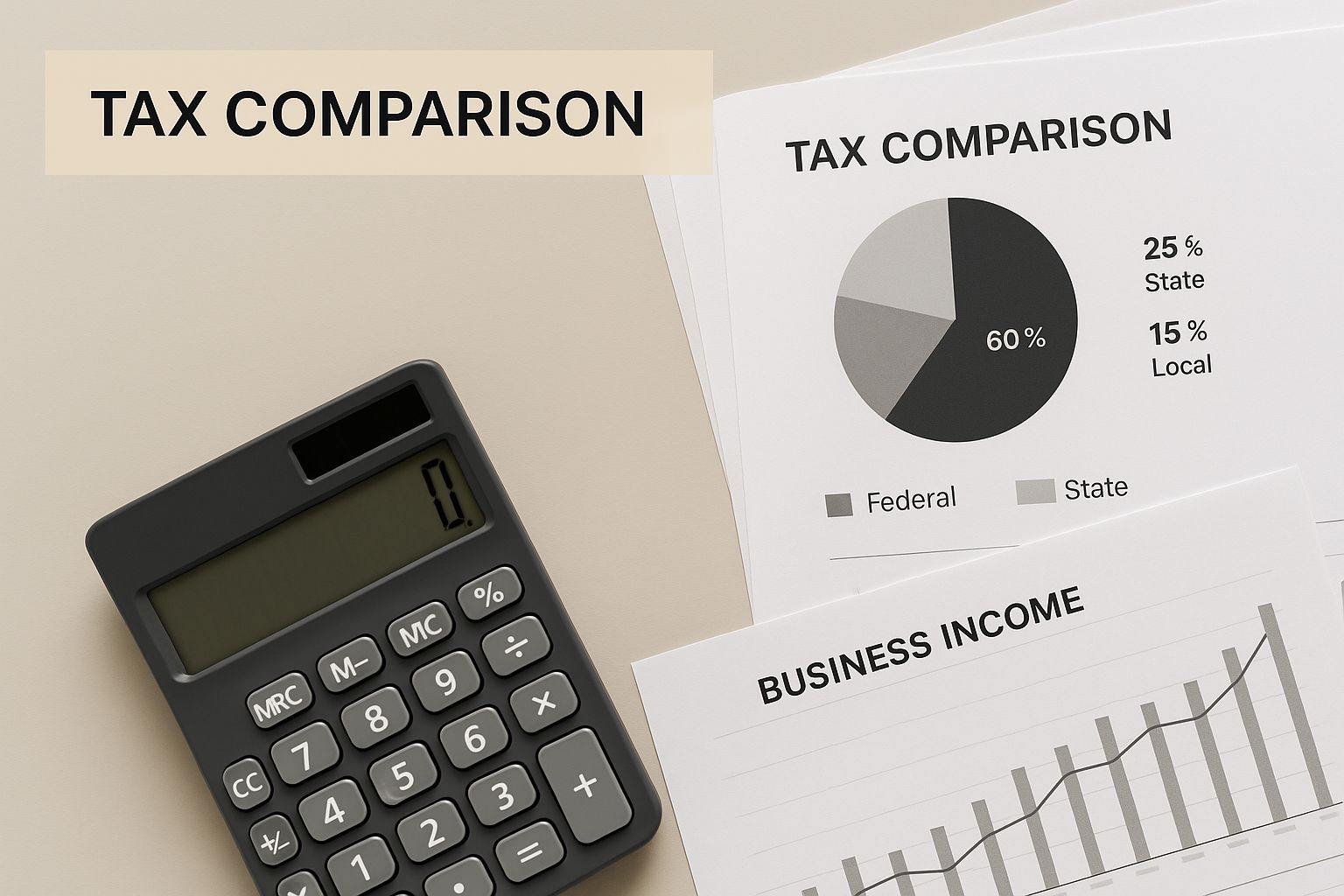
As you can see, the core idea is simple: sole traders pay Income Tax on everything they make, while limited companies pay Corporation Tax on profits, and then you personally pay tax only on what you take out.
How Sole Traders Are Taxed
When you're a sole trader, you and your business are one and the same in the eyes of the taxman. Your business profits are simply your personal income. It's a straightforward setup where you declare all your earnings on your annual Self Assessment tax return.
Your final tax bill is worked out based on your profits (your total income minus all your allowable business expenses). It's made up of two key parts:
- Income Tax: You'll pay this at the standard personal tax rates (basic, higher, and additional) on any profits that fall above your Personal Allowance.
- National Insurance: You usually pay two types. There’s Class 2 (a small, flat weekly rate if your profits are over the threshold) and Class 4 (a percentage of your profits above a certain annual limit).
While this is easy to manage, it can start to feel a bit inefficient once your profits climb and you start tipping into the higher tax brackets. Every pound of profit gets taxed, whether you leave it in the business bank account or spend it on yourself.
How Limited Companies Are Taxed
Things get a little more involved with a limited company, but that complexity brings some real flexibility. The company is taxed on its profits first, and then you're taxed separately on any money you draw out of it.
Here’s how that works in practice:
- Corporation Tax: The company pays Corporation Tax on its yearly profits. The main rate is currently 25%, but if your company's profits are £50,000 or less, you'll benefit from the smaller profits rate of 19%.
- Taking Your Income: As a director, you get to decide how to pay yourself from the profits that are left. The go-to strategy for most is to take a small salary combined with dividends.
This two-step approach is where the real tax planning opportunities lie. By paying yourself a low salary—often set just right to be efficient for National Insurance—and taking the rest of your income as dividends, you can often significantly lower your overall tax bill. This is the main reason business owners start seriously weighing up the limited company or sole trader debate as they grow. To see how our team helps businesses navigate this, you can check out https://stewartaccounting.co.uk/wp-content/uploads/2021/11/Stewart-accounts-1536×315-min-768×158.png.

A Real-World Tax Scenario
To make this clearer, let's look at a simplified example comparing the two structures on a business profit of £50,000. The table below breaks down the approximate tax you'd pay in each scenario.
Tax Breakdown Example at £50,000 Profit
| Tax Component | Sole Trader Calculation | Limited Company Calculation |
|---|---|---|
| Business Profit | £50,000 | £50,000 |
| Corporation Tax | N/A | £9,500 (at 19%) |
| Income Tax | £7,486 | £1,937 (on dividends) |
| National Insurance | £2,851 | £0 (on salary below threshold) |
| Total Tax Paid | £10,337 | £11,437 |
| Take-Home Pay | £39,663 | £38,563 |
Note: Figures are illustrative for the 2024/25 tax year and depend on individual circumstances. The limited company calculation assumes a salary of £12,570 and the rest taken as dividends.
As this example shows, at the £50,000 profit level, the total tax burden is actually slightly higher for a limited company, leading to less take-home pay. This is because the benefits of the salary/dividend structure really start to kick in at higher profit levels, where they outweigh the impact of Corporation Tax.
Key Insight: The tipping point where a limited company often becomes more tax-efficient is typically when annual profits get into the £30,000 to £40,000 range. Around this mark, the savings from the salary and dividend model usually start to overtake the added admin costs and complexity of running a company.
Of course, general tax rules are one thing, but your specific industry might have its own quirks. For example, people in the hospitality sector need to get to grips with Navigating short-term rental tax obligations to stay compliant. It’s vital to choose a structure that works not just for general tax purposes, but for the unique demands of your field.
Managing Administration and Running Costs
Beyond the big-ticket items like tax and liability, the day-to-day reality of running your business will feel very different depending on your chosen structure. The amount of paperwork and the costs involved are practical considerations that can really sway your decision.
For many people starting out, the sheer simplicity of the sole trader route is its biggest draw. The paperwork is genuinely minimal, which frees you up to focus on your actual work rather than getting tangled in compliance. This straightforward approach is a huge advantage when you just want to get going.
The Sole Trader Experience: Simplicity and Low Overheads
As a sole trader, your main admin job is to keep a clear record of your income and business expenses. You’ll need this information to fill out your annual Self Assessment tax return, which is your one major filing obligation with HMRC each year.
The running costs are refreshingly low, too. There’s no fee to get started, and because the accounting is far less complex, accountancy fees are much more manageable. Most sole traders can expect to pay somewhere between £250 and £400 a year for an accountant to prepare and file their Self Assessment.
This low-friction setup makes being a sole trader an incredibly attractive way to start earning from your skills without a major financial or time commitment to admin.
A key advantage for sole traders is privacy. Unlike a limited company, your business details and earnings are not published on a public register, offering a level of confidentiality that many freelancers and small business owners appreciate.
The Limited Company: A More Formal Framework
Choosing to operate as a limited company brings a far more formal and structured set of responsibilities. Your company is a separate legal entity, and that status comes with a higher level of regulatory oversight from both Companies House and HMRC.
The administrative workload is considerably heavier, with several mandatory annual filings. It’s vital to stay organised because missing these deadlines can lead to automatic penalties.
Core Limited Company Obligations:
- Annual Accounts: You have to prepare and file statutory accounts with Companies House every year. These become a public record of your company's financial health.
- Company Tax Return (CT600): This is a separate tax return filed with HMRC to declare your profits and work out your Corporation Tax bill.
- Confirmation Statement: An annual check-in with Companies House to confirm that the details they hold about your company (directors, shareholders, etc.) are still correct.
- PAYE Records: If you pay yourself or anyone else a salary, you must run a PAYE (Pay As You Earn) scheme, reporting tax and National Insurance deductions to HMRC.
- Statutory Records: You're legally required to keep internal company records—often called statutory books—which document things like director appointments and shareholder details.
These extra duties mean that running a limited company demands more diligence and a robust organisational system. It’s the trade-off you make for the legal protection and potential tax advantages that the structure provides.
Comparing Ongoing Running Costs
It’s no surprise that the increased complexity of a limited company leads to higher running costs, especially when it comes to professional fees. While you can technically manage the filings yourself, the vast majority of directors hire an accountant to ensure everything is done correctly and on time.
Accountancy fees for a limited company are significantly higher than for a sole trader. A comprehensive package to cover your annual accounts, Corporation Tax return, confirmation statement, and basic payroll will likely cost £70 to £150 per month, which works out to £800 to £1,800+ annually. The final figure will depend on your company’s turnover and the volume of its transactions.
While this is a bigger financial commitment, remember that it's a tax-deductible business expense. If you're considering this path, our team at Stewart Accounting Services provides tailored support; you can learn about our full range of accounting services to see how we help businesses stay compliant.

Ultimately, you need to weigh the simplicity and low cost of being a sole trader against the more demanding but legally robust framework of a limited company.
Planning for Growth and Securing Investment
Picking between a sole trader setup and a limited company isn't just about today's taxes and paperwork. It's a strategic move that lays the groundwork for where you want your business to be in the future. If you have big ambitions—thinking about hiring a team, scaling up, or bringing in outside money—this decision is absolutely critical. It sends a clear signal to the rest of the world about your intent and professionalism.
The sole trader route is a brilliant way to get off the ground quickly. But as soon as growth becomes a serious part of the plan, you might start to feel its limitations. When your business is legally the same thing as you, it can make potential investors, lenders, and even big corporate clients a bit nervous. They often prefer the legal certainty and permanence that comes with a limited company.
Enhancing Credibility and Trust
Let’s be honest: operating as a limited company just looks more professional. Being registered with Companies House, with your details on public record, gives your business a sense of permanence and transparency. This isn't just about appearances; it brings real, tangible benefits.
Banks and lenders, for example, tend to see limited companies as a safer bet for business loans. The formal accounts and the legal separation between you and the business give them a much clearer financial picture, making it easier to approve your application. On a similar note, when you're trying to win larger contracts, you’ll find some organisations have strict policies that mean they will only do business with incorporated entities. It's all about managing their own risk.
The credibility of a limited company isn't just a perception; it's a structural advantage. Investors and lenders are backing a distinct legal entity with formal governance, not just an individual. This separation is often non-negotiable for securing significant funding.
This enhanced trust is a cornerstone of long-term expansion. When you’re thinking about the right structure for your venture, it's vital to understand how to build a scalable business for lasting growth. The limited company model is practically designed to support that journey.
Securing Investment Through Shares
Here’s the single biggest advantage for a growth-hungry business: the ability to issue shares. A limited company is owned by shareholders, and selling shares is the classic way to raise capital without taking on more debt.
As a sole trader, you simply can't sell off a piece of your business like this. If you need cash, you're looking at personal loans or bringing in a partner, which completely changes your legal setup anyway. A limited company, on the other hand, has far more flexibility. You can:
- Issue new shares to angel investors or venture capitalists in return for a cash injection.
- Offer equity to key employees or co-founders to incentivise them and tie their success to the company's.
- Create different classes of shares to manage things like voting rights and dividend payments.
This kind of flexibility is a game-changer for startups and any business with serious growth potential. The whole process is formalised, giving clear legal protection to both you and your investors. It’s how you raise the money you need for new equipment, a bigger marketing budget, or a growing team. Without it, your ambitions could hit a ceiling pretty quickly, which is why a limited company is almost always the default choice for entrepreneurs on the hunt for investment.
Which Business Structure Is Right for You?
Deciding whether to set up as a sole trader or a limited company isn't about finding one "best" answer. It’s about finding the right fit for your specific journey. The best choice really hinges on your industry, your income, your appetite for risk, and where you see yourself in a few years.
To make this a bit more concrete, let's walk through a few common scenarios.
This is a decision millions of people have faced. Self-employment in the UK has seen huge growth over the last two decades, climbing from just 3.2 million in 2000 to a peak of over 5 million in early 2020. You can explore more of the data on UK self-employment trends on Statista.com. This boom just goes to show how many different paths entrepreneurs are taking.
The Freelance Creative
Picture a freelance writer or a graphic designer who’s just starting out. What do they need most? Simplicity and low overheads. They're working directly with clients, they don't have many business debts, and their income is probably going to be a bit up and down at first.
- Top Priorities: Minimal admin, low setup costs, keeping things straightforward.
- Our Recommendation: Kicking off as a sole trader makes the most sense here. It lets them pour their energy into finding clients and doing great work without getting bogged down in company accounts. Since they're not taking on big loans, the risk of unlimited liability is pretty low.
The Ambitious Startup Founder
Now, let's think about an entrepreneur with a big idea, maybe for a new software app. Their roadmap involves bringing in outside investment to hire a team and scale up fast. For them, credibility and a structure that investors can work with are non-negotiable from day one.
- Top Priorities: Securing investment, protecting personal assets, and looking professional.
- Our Recommendation: A limited company is the only real option. You need to be able to issue shares to raise capital, and the limited liability protection is absolutely crucial when you start taking on financial risk and employing people.
Your business structure should be a reflection of your ambition. A sole trader setup is perfect for building a craft; a limited company is designed for building an enterprise.
The Local Tradesperson
What about an experienced plumber or electrician with a solid base of local customers? Their biggest concerns are likely protecting their personal assets, like their family home, from any work-related accidents and coming across as a professional, trustworthy operation.
- Top Priorities: Protection from on-site liabilities and building customer trust.
- Our Recommendation: A limited company can offer invaluable peace of mind. Creating that legal separation between personal and business finances protects their home from business debts or legal claims. In a trade where physical risks are part of the job, that’s a massive advantage.
The E-commerce Entrepreneur
Finally, imagine someone launching an online shop selling handmade crafts. They might be starting small from their kitchen table, but they've got their sights set on growth, managing more stock, and maybe even hiring help as sales pick up.
- Top Priorities: Scalability, managing stock finances, and planning for future growth.
- Our Recommendation: It's often smart to start as a sole trader to keep things simple at the beginning. But have a plan to incorporate as a limited company once profits start to consistently hit the £30,000-£40,000 mark. This hybrid approach lets you stay nimble initially and then switch to a more tax-efficient and scalable structure right when the business needs it.
Still Have Questions? Here Are Some Common Ones
Even with all the facts laid out, a few practical questions almost always pop up when you're on the verge of making a decision. Let's tackle some of the most common queries I hear from people trying to choose the right path.
Can I Switch from a Sole Trader to a Limited Company Later On?
Absolutely. This is a well-trodden path for many successful businesses. As your venture grows, making the switch is often the next logical step.
The process involves registering a new limited company with Companies House and then formally transferring your business assets, like equipment and client contracts, over to the new entity. You'll need to let HMRC know you're no longer a sole trader, and don't forget to update your bank, clients, and suppliers to keep everything running smoothly.
How Does This Choice Affect My Pension?
This is a big one, and the structure you choose has a major impact on how you can save for retirement. As a sole trader, you'll make contributions to a personal pension from your profits after you've paid tax, although you do get tax relief on what you put in.
A limited company, on the other hand, can pay directly into your pension as an 'employer' contribution. This is a really tax-smart move because the payment is treated as an allowable business expense, which lowers your Corporation Tax bill. Plus, you won't pay any personal Income Tax or National Insurance on that money.
Key Insight: The ability for a limited company to make pre-tax 'employer' pension contributions is a significant financial advantage, often leading to much greater tax savings compared to a sole trader's post-tax personal contributions.
When Is It Time to Call in a Professional?
While you can technically set up either structure yourself, there are definite moments when getting an accountant involved isn't just a good idea—it's essential.
You should seriously consider professional advice if:
- You expect your annual profits to climb over the £30,000 mark.
- You're thinking about hiring your first employee or bringing in a business partner.
- You need to attract funding from investors or get a business loan.
- Your business deals with high-value assets or valuable intellectual property.
A good accountant can run the numbers for your specific situation, giving you total clarity on which structure will be the most tax-efficient and secure for where you want to go.
Choosing between a limited company and a sole trader is a foundational decision for your business. If you're looking for clear, personalised advice tailored to your ambitions, the team at Stewart Accounting Services is here to help. Get in touch with our experts and let's figure out the best path forward together.