

Make my Stirling business look professional to investors

What if the most professional thing you can show an investor is not a polished pitch deck, but a clear plan for what their money will help your business achieve? If you want to make your Stirling business look professional to investors, start by explaining the opportunity, the evidence behind it and how investment would support your next stage of growth.
Investors want confidence in both the business and the people leading it. The challenge is to make a clear, credible case without overstating progress or relying on vague forecasts. Your figures and claims should tell a consistent story.
This article explains how to present the problem you solve, demonstrate market traction, build realistic financial forecasts and show why your team can deliver. It also covers how to link your funding request to specific milestones, so investors can see how the money would be used and what progress it is intended to support.
Key Takeaways
- Support your case for market demand with customer research, testing and traction measures that show how the business is performing.
- Explain how your team’s complementary skills and experience equip it to deliver the growth plan.
- Describe the customer problem clearly, then show how your solution addresses it with evidence rather than broad claims.
- Assess the opportunity from an investor’s perspective, including business risks, growth potential and how funding would be put to work.
- Use cash flow, profit-and-loss and balance sheet forecasts to make your financial plans easier to understand and assess.
Demonstrating market demand and commercial traction
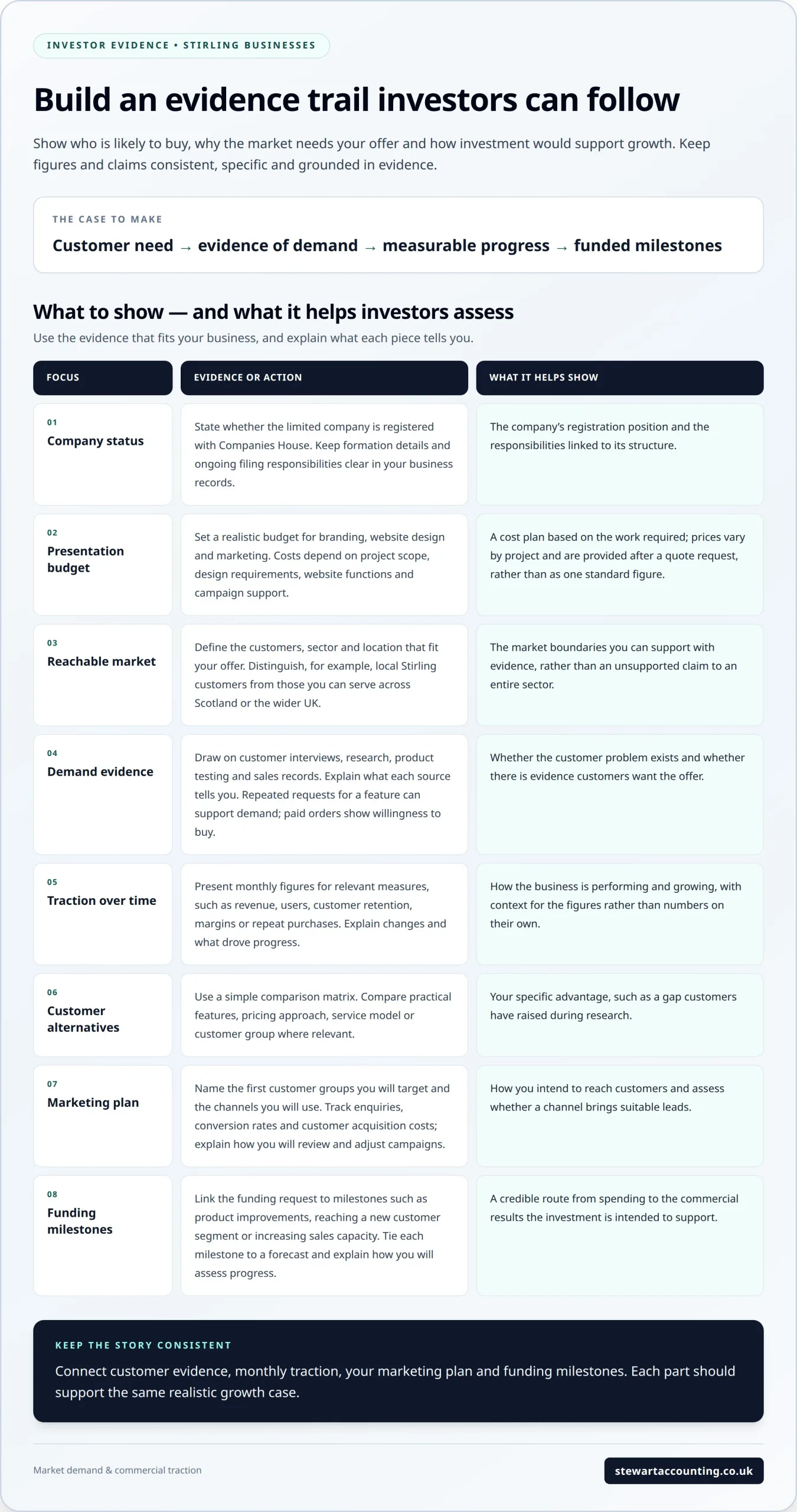
Build a clear evidence trail: show who will buy, why the market needs your offer and how investment would support growth.
- Clarify the company’s registration status. To register a limited company, submit the required formation information to Companies House. After registration, keep up with ongoing company filing requirements. The details and responsibilities depend on the company’s structure, so make them clear in your business records.
- Set a realistic budget for presentation. Costs for professional branding, website design and marketing in Stirling depend on the scope, design requirements, website functions and campaign support involved. Prices vary by project and are provided after a quote request, rather than being a single standard figure.
- Define the market you can actually reach. Describe the customers, sector and location that fit your offer. For example, a Stirling business might distinguish local customers from people it can serve across Scotland or the wider UK. Explain the evidence behind each boundary, rather than claiming an entire sector as its market.
- Gather evidence of demand. Use customer interviews, research, product testing and sales records to demonstrate that the problem exists. Explain what each source tells you. For example, repeated requests for a particular feature can support demand, while paid orders provide evidence of customers’ willingness to buy.
- Track traction consistently. Present monthly figures for relevant measures, such as revenue, users, customer retention, margins or repeat purchases. Choose measures that reflect how your business earns and grows. Add a short explanation of changes, so investors can see what drove progress instead of reading figures without context.
- Show how you compare with alternatives. Use a simple comparison matrix to explain the options customers currently have. Compare practical features, pricing approach, service model or customer group, where relevant. Then identify your specific advantage, such as solving a gap that customers have raised during research.
- Connect market opportunity to a marketing plan. Name the customer groups you will target first and the channels you will use to reach them. Explain how you will track enquiries, conversion rates and customer acquisition costs. Include how you will review results and adjust campaigns when a channel does not bring suitable leads.
- Link future growth to the funding request. Set out the milestones the capital would support, such as product improvements, reaching a new customer segment or increasing sales capacity. Tie each milestone to a forecast and explain how you will assess progress. Investors want to see a credible route from spending to commercial results.
Management team credibility and capacity
Investors assess whether the people leading your business can deliver its plans. Set out clear responsibilities, relevant experience and evidence that your team can manage growth.
-
Set Out Team and Advisor Roles
Introduce each director, manager and advisor by role, then link their responsibilities to business priorities. For example, explain who leads product decisions, sales, operations and financial oversight. Describe an advisor’s specialist contribution without implying they manage daily work. Check that titles, biographies and responsibilities match across your pitch deck and business plan.
-
Present the Team’s Credibility
Choose relevant examples to show how each person can help deliver the opportunity. A founder might describe experience serving the target sector, while an operations lead could explain how they manage delivery. State what each person has achieved and what they will handle next. Avoid broad claims such as “experienced team” without evidence linked to the business plan.
- Show complementary skills. Compare the skills needed for your next stage with those of the people responsible for delivery. A technology business, for example, may need product development, customer sales and financial control. Explain how the team covers these areas, where responsibilities overlap and which capabilities need strengthening. This helps investors assess whether the team can act on its growth plans.
- Demonstrate capacity, not just expertise. Explain how the team will manage its current workload alongside new activities funded by investment. If a director handles both sales and operations, show how they will organise priorities. Link proposed hires or external support to specific tasks in the plan. Investors can then judge whether the named people have the capacity to deliver.
- Make advisor contributions specific. Describe the relevant guidance an advisor provides, such as sector insight, technical knowledge or introductions. Explain how that input supports decisions without presenting occasional advice as a full-time management role. If an advisor has no defined contribution to the business plan, leave them out of the core management case.
- Match team strengths to the investor. Tailor your presentation to the investor’s focus. An angel investor may weigh the founders’ skills and experience heavily, while a strategic investor may also assess how the product fits their business. Explain the connection plainly, then show how the team can act on it.
- Keep the presentation consistent. Use concise biographies, clear role descriptions and examples that support the same growth plan. Make sure spoken answers match the pitch deck. If you need to align financial reporting with management responsibilities, you can discuss your reporting needs.
Defining the business problem and solution
Investors need to understand the customer problem before they can assess your solution. Build a concise case with customer evidence, clear examples and a direct explanation of what you sell.
- Describe the customer and the problem. Identify who experiences the issue, when it arises and what makes it difficult. For example, a small retailer might struggle to reconcile online and in-store stock, causing avoidable delays. Focus on a recognisable customer group instead of claiming everyone has the same need.
- Support the problem with evidence. Use customer interviews, survey responses, support requests or observed behaviour to show that the issue exists. Explain what you learned from each source. For instance, several customers might describe the same obstacle when trying to complete an order. Separate direct findings from assumptions, and don’t present one conversation as proof of the whole market.
- Show the effect on customers. Explain what happens if the problem remains unresolved. A delivery delay could cost a retailer repeat orders; a complicated booking process could lead customers to abandon a service. Use an example that reflects your customers’ experience and link the consequence to their time, money or ability to complete a task.
- Explain your solution in plain language. State what the product or service does, who uses it and how it addresses the problem. Avoid technical language that obscures an everyday benefit. If your solution is a booking platform, for example, explain how customers use it to find an available appointment and confirm a booking.
- Make the solution easy to picture. Use a product demonstration, prototype, diagram or screen image to show the customer experience. A booking platform might show the steps from choosing a service to receiving confirmation. Label each stage clearly, and make sure the visual supports your explanation rather than suggesting features you haven’t built.
- Explain why customers would choose it. Set out the practical difference between your offer and the alternatives customers use now. For example, your service might combine appointment booking and reminders in one process. Link each claimed advantage to customer feedback, product testing or observed use. Don’t call an idea unique unless you can explain the specific difference.
- Connect the problem to selling and delivery. Show how a customer moves from discovering your offer to buying and using it. A clear route might include a referral, a demonstration, an order and follow-up support. Explain how partners contribute, where relevant, such as helping deliver the service or reach a customer group. Keep the route practical and consistent with current operations.
Assessing a business from an investor’s perspective
Assess your business through five lenses: Momentum, Market, Machine, Management and Money. This helps explain the opportunity, risks and planned use of investment.
- Find suitable Stirling support and funding routes. Start with Scottish Enterprise and Business Gateway Stirling when mapping local business support. Prepare a short summary of your business, funding need and intended use of capital, then consider whether each route fits your stage and needs. Grants and investment serve different purposes, so distinguish repayable or equity funding from grant support in your plan.
- Understand what each support organisation can contribute. Scottish Enterprise and Business Gateway Stirling can be starting points for exploring business support and investment preparation. Set out the specific help you need, such as guidance on funding options, readiness or next steps in your plan. Focus on how that support addresses a practical gap, rather than treating either organisation as a guaranteed source of investment.
- Assess the business using the five Ms. Momentum covers progress; Market considers customer demand; Machine looks at how the business operates; Management examines the team; Money covers financial performance and funding needs. For example, link rising customer numbers to delivery capacity and the cash required to serve them. This joined-up view explains both the opportunity and what investment could change.
-
Prepare for Due Diligence
Organise records investors may examine, including company ownership, key contracts, accounts, cash flow, debt and tax information. Make sure figures agree across financial reports and pitch materials. Investors may test forecast assumptions against past performance, so explain unusual changes and keep supporting documents together. Clear records help surface questions early, without presenting due diligence as a legal checklist.
- Map risks and explain your response. List technical, commercial and market risks, then describe actions that could reduce each one. A business dependent on one large customer, for example, should explain how it would manage the impact of losing that account. Link each risk to an owner, decision or practical mitigation instead of hiding uncertainty behind optimistic forecasts.
-
Address Unprofessional Presentation Mistakes
Remove conflicting figures, unexplained jargon and claims without evidence. Avoid a generic pitch that overlooks the investor’s focus, or a funding request with no link to planned spending. State whether capital would support product development, sales capacity or a new market, then connect that use to a measurable business objective.
- Match your approach to the investor. An angel investor may suit an early-stage business, while private equity generally fits established, profitable businesses with consistent growth. Strategic investors may value industry alignment; expansion capital investors may look for scalability and a long-term vision. Research each investor’s portfolio, investment stage and criteria before presenting your case.
What financial documents and forecasts do UK investors expect from a small business?
Give investors a financial picture they can follow: past performance, forecast assumptions, cash needs and planned spending should agree.
- Prepare a clear record of past performance. Present recent accounts and management figures in a consistent format. Separate one-off costs from regular operating expenses and explain unusual changes. Investors may use past performance to assess future revenue, so link each major movement to a practical cause, such as a new contract or higher staffing costs.
- Build a month-by-month cash flow forecast. Show when customer receipts are expected and when wages, suppliers, tax and other payments fall due. A business can report sales and still face a cash shortfall if customers pay later. Explain the assumptions behind payment timing and identify periods when available cash may tighten.
- Forecast profit and loss. Set out expected sales, direct costs, overheads and when the business may become profitable. Explain the main drivers behind each estimate, such as customer numbers, average order value or staff costs. Keep projected growth consistent with delivery capacity and the sales evidence already presented.
- Include a forecast balance sheet. Show what the business expects to own and owe at a future point. This helps investors assess its financial position alongside profit and cash flow. Explain material changes, such as equipment purchases, borrowing or stock levels, so the figures tell a connected story instead of appearing as separate tables.
- Model different outcomes. Prepare low, mid and high cases to show how results change when key assumptions shift. For example, test slower customer growth or higher supplier costs against the same plan. Explain what decisions each scenario would prompt, including how you might control spending or adjust hiring.
- Show cash burn and runway together. Cash burn describes how quickly cash is being spent; runway estimates how long available funds can support operations at that rate. State the assumptions behind both measures and show how planned investment affects them. This helps investors understand the timing and purpose of your funding request.
- Connect forecasts to the investment plan. Show how capital is expected to be employed over the next 18 months, then provide wider projections for the next 3-5 years. Include month-by-month projections of key measures, such as customers or users, for the next 24 months. Make sure each forecast aligns with the proposed use of funds.
- Keep supporting documents organised. Match forecasts to the underlying records and label each version clearly. If you need help preparing a cash flow forecast or aligning figures with a business plan, discuss your financial forecasts.
Stewart Accounting Services
Stewart Accounting Services can take the financial records behind your investor presentation off your hands. Bookkeeping services help you maintain accurate, organised records, while Year-End Accounts provide a structured view of business results. Self-Assessment Tax Returns can also help keep personal tax reporting in order.
Turn to Stewart Accounting Services when you’re preparing to explain your financial position and want support with the records behind your figures. With less time spent on financial admin, you can focus on your business and its next steps, with more time, more money, more mind.
If you’d like support preparing your financial records, contact Stewart Accounting Services.
Prepare for your next investor conversation
If your goal is making your Stirling business look professional to investors, treat preparation as an ongoing part of running the business, not a last-minute pitch exercise. Keep your records and plans aligned as the business changes, so you can explain decisions clearly and respond confidently when an investor asks how you reached a figure or forecast.
Stewart Accounting Services can support the financial groundwork through Bookkeeping, Year-End Accounts and Self-Assessment Tax Returns. Clear, organised records can help you focus on the opportunity ahead and make more time for decisions that move your business forward.
Take the next step at a pace that suits you. Contact Stewart Accounting Services to discuss support with your business finances and investor preparation. With a clearer foundation, you can approach your next conversation with greater confidence.
Frequently Asked Questions
How will any investment I put into this business be used?
Investment should fund specific activities linked to the business’s next milestones. Break the request into clear uses, such as developing a product, expanding sales capacity or entering a new customer segment. Explain why each cost is needed, who will oversee it and how progress will be assessed. For example, link funding for new equipment to increased production capacity instead of presenting it as a general growth budget.
What Is a Pitch Deck for Investors?
A pitch deck is a short presentation that introduces your business and explains why it may interest an investor. A small-business deck is typically 10 to 15 slides long. It can outline the customer problem, product or service, market, business model, team, financial outlook and funding request. Keep each slide focused on one point, use clear visuals where helpful, and make sure the figures match your supporting documents.
What should be included in the plan?
Your plan should explain how the business will operate and turn its opportunity into progress. Include objectives, target customers, route to market, management responsibilities, key risks and financial assumptions. Add supporting documents in an appendix, such as evidence behind important claims. Explain how you will monitor marketing results and adjust your approach, so the plan shows how decisions will be made as conditions change.
What do investors look for in a professional business in Stirling, Scotland?
Investors look for a credible opportunity, clear records and a team that can explain its decisions. To make your Stirling business look professional to investors, show how its customer base relates to the local area and whether it can also serve customers elsewhere. Be ready to explain what you sell, how you earn revenue and what could affect future performance. A professional presentation keeps these points consistent across conversations and documents.
How should a Stirling business prepare a pitch deck for investors?
Build the deck around one clear investment case, then tailor it to the investor’s interests and stage. Making your Stirling business look professional to investors also means explaining specialist technology in plain language, since an investor may not know your sector. Use charts only when they clarify a point, and label the period and measure shown. Practise concise answers about assumptions, risks and the proposed funding.
How can a business in Stirling demonstrate market demand and competitive advantage to investors?
Use evidence from real customer behaviour, not just expressions of interest. For example, explain what a completed pilot revealed about repeat use, customer objections or willingness to pay. Compare your offer with alternatives using factors customers value, such as ease of use or delivery. Show which advantages customers recognise and how the business can maintain them. Keep the evidence relevant to the specific market you plan to serve.
Recent Posts
25 Nov, 2026