

Your Guide to Monthly Management Accounts

If you've ever felt like you're running your business with one eye on the rearview mirror, you're not alone. Many business owners rely solely on their year-end statutory accounts, which are a bit like a yearly MOT—essential for compliance, but they only tell you how things looked on one specific day in the past.
Monthly management accounts, on the other hand, are your live dashboard. They give you a real-time view of your business's performance, helping you navigate the road ahead.
Your Business Dashboard for Smarter Decisions

Imagine trying to drive down a busy motorway. Your statutory accounts show you where you’ve been, but offer no insight into the traffic jams or clear stretches of road just around the bend. That's a risky way to travel.
Monthly management accounts are the forward-looking GPS every business owner needs. They show your current speed (revenue), your fuel level (cash flow), and your engine’s health (profitability). And because they are for internal use, you can customise them to track the numbers that truly matter to your business, not just what HMRC wants to see. This allows you to be proactive instead of constantly reacting to old news.
By turning raw financial data into a clear monthly story, you gain the power to spot trends, correct your course quickly, and make decisions based on solid evidence, not just gut feeling. This regular financial discipline is the bedrock of a resilient, scalable business.
This kind of agility is vital for UK businesses. For example, recent Bank of England data revealed that non-financial businesses withdrew a staggering £13.6 billion from banks in a single month. That’s the sort of economic shift that monthly accounts would immediately bring to your attention, giving you the chance to adapt.
What’s the Real Difference?
It’s easy to get statutory and management accounts confused, but they serve very different purposes. Statutory accounts are for outsiders like HMRC and Companies House. Management accounts are for you—the person in the driver's seat.
Here’s a quick comparison to make the distinction crystal clear:
Management Accounts vs Statutory Accounts at a Glance
| Feature | Monthly Management Accounts | Annual Statutory Accounts |
|---|---|---|
| Purpose | Internal decision-making and strategic planning. | External reporting for legal and tax compliance. |
| Audience | Business owners, directors, and managers. | HMRC, Companies House, shareholders, lenders. |
| Frequency | Monthly (or sometimes quarterly). | Annually. |
| Format | Flexible and customised to the business's needs. | Strict format required by law (GAAP or IFRS). |
| Focus | Forward-looking; helps with future performance. | Backward-looking; a historical record of the past year. |
As you can see, one is about compliance, while the other is all about control and strategy.
The Core Purpose of Management Accounts
So, what do you actually do with them? At their core, monthly management accounts help you:
- Track performance in real-time. Keep an eye on Key Performance Indicators (KPIs) like your gross profit margin or how long it takes customers to pay, while you can still do something about them.
- Make informed decisions. Wondering if you can afford to hire a new team member or invest in equipment? Your monthly figures will give you the answer.
- Get a grip on cash flow. Spot potential cash shortages weeks or months in advance, giving you time to arrange an overdraft or chase late payments.
- Plan for the future. Use accurate, up-to-date data to build realistic forecasts and budgets that you can actually stick to.
This steady reporting rhythm builds a rich, detailed financial picture over time. It’s the key to steering your company with confidence towards sustainable growth, and you can learn more by checking out our other resources.
https://stewartaccounting.co.uk/wp-content/uploads/2021/11/Stewart-accounts-1536×315-min-300×62.png

Right, let's open up that management accounts pack and see what we're working with.
When you first get your hands on a set of monthly management accounts, it can feel a bit like you’ve been handed a pilot's pre-flight checklist. It’s packed with crucial information, but it's only really useful once you know what each dial and gauge is telling you. Think of these reports as your business’s own diagnostic toolkit—every document is a specific instrument designed to give you a clear reading on your company's health.
The trick is to get to know the purpose behind each of the core reports. They aren’t just standalone documents; they work together to build a complete financial picture, turning raw numbers into a story about how your business performed last month.
The Profit and Loss Statement
You'll often hear this called the P&L or Income Statement. It’s probably the most familiar report in the pack and it gets straight to the point, answering one simple question: Is your business making a profit?
The P&L does this by lining up all of your income (your sales and revenue) and subtracting everything you spent to earn it (your costs and expenses) over a specific period, usually the past month. It shows you precisely where your money came from and where it went, all leading down to the famous "bottom line"—your net profit or loss. It’s your number one tool for judging monthly profitability.
The Balance Sheet
If your P&L is a video of last month's financial action, then the Balance Sheet is a high-resolution snapshot. It captures your business's financial position on a single day—typically the last day of the month—and shows you exactly what the company owns (assets) and what it owes (liabilities).
Everything on this report is held together by one core equation: Assets = Liabilities + Equity. It’s a powerful snapshot of your company’s financial stability and overall net worth. It helps you answer big questions like, "How much debt are we actually carrying?" or "What's the total value of our business right now?"
A healthy Balance Sheet shows that your business is built on a solid foundation. It gives banks, investors, and—most importantly—you the confidence that the company is financially sound and not dangerously reliant on debt.
The Cash Flow Statement
Cash is the lifeblood of any business, which makes the Cash Flow Statement your company’s heart-rate monitor. This report is all about the real-world movement of money. It tracks the cash coming in and the cash going out, which is a very different thing from profit. It’s entirely possible to be profitable on paper but run out of cash because a few big customers haven't paid their invoices yet.
The Cash Flow Statement usually breaks activity down into three key areas:
- Operating Activities: The cash generated from your core, day-to-day business.
- Investing Activities: Cash spent on or received from selling long-term assets, like a new van or office equipment.
- Financing Activities: Cash from taking out loans or from investors, or cash used to pay back debt.
Variance Analysis
This is where the real magic happens. Variance analysis takes your actual results (from the P&L) and puts them side-by-side with what you'd planned to achieve in your budget or forecast. It’s a powerful comparison that instantly highlights where you're on track, where you’re overspending, and where you’re knocking it out of the park.
For example, this kind of detailed analysis within monthly management accounts is essential for UK businesses trying to get a grip on complex operational costs. You could be tracking labour performance by comparing the actual hours worked (say, 2,300 hours) against the standard hours you’d budgeted for (2,400), or looking at how different inventory valuation methods affect your profit margins. If you want to go deeper, you can explore more about these detailed accounting practices to see how they give you a much finer level of financial control.
The Strategic Value of Monthly Reporting

Your annual accounts are a legal necessity, of course, but their real value is historical—they tell you where you’ve been. The real strategic power for shaping your future comes from timely, consistent monthly management accounts. These reports are so much more than paperwork; think of them as your sharpest tool for navigating the day-to-day realities of running a business.
They act as an early-warning system. A good set of management accounts gives you the foresight to spot a potential cash flow gap weeks before it becomes a full-blown crisis. They can flag that your profit margins are getting squeezed while you still have plenty of time to do something about it. This is what shifts you from being a reactive owner, constantly putting out fires, to a strategic leader who sees challenges coming and prepares for them.
Building Trust and Securing Growth
Getting your financial reporting in order doesn’t just help you make better decisions internally. It sends a powerful signal of stability and competence to the outside world, from banks to potential investors. When you need to secure a loan or find investment to fund your next big move, a solid history of detailed monthly reports shows you’re in control and know what you’re doing.
This kind of evidence makes securing funding so much easier. Lenders and investors gain confidence when they see a business that understands its numbers inside and out. Instead of basing your pitch on gut feelings, you can present a clear, data-driven case for your company’s potential, backed up by months of credible financial history.
Your monthly management accounts are the foundation of your business's financial story. They empower you to make bold, calculated decisions that drive growth, secure in the knowledge that every move is backed by hard evidence, not guesswork.
An Essential Tool in Uncertain Times
This regular financial check-in becomes even more critical when the economy gets choppy. In a challenging climate, truly understanding your company's financial health isn't just good practice—it's essential for survival.
For example, recent UK government statistics revealed a 9% year-on-year increase in company insolvencies, with administrations jumping by a staggering 30%. These aren't just numbers; they represent the harsh reality many firms are facing. By systematically reviewing monthly management accounts, UK businesses can catch the early warning signs of distress—like consistent budget overruns or dwindling cash reserves—and take corrective action before it’s too late.
This regular analysis provides the clarity and control you need to not only survive but find opportunities to thrive. It’s about steering your business forward with confidence, no matter what the economic forecast says.

How to Create Your Monthly Reporting System
Knowing you need monthly management accounts is one thing. Actually producing them can feel like a completely different challenge. But here’s the secret: creating a solid monthly reporting system isn't about being a financial genius. It's about building a clear, repeatable process that you can stick to.
Get the right tools and habits in place, and what seems daunting now will soon become a powerful and manageable routine. It all starts with a foundation of clean, consistent data.
Choose and Configure Your Software
Your first move is to pick the right accounting software for your business. You've got great cloud-based options like Xero, QuickBooks, and Sage, all designed with SMEs in mind. They take the drudgery out of data entry and are built to produce the core reports you need for your management accounts with just a few clicks.
Once you’ve made your choice, proper setup is everything. This means:
- Connecting your business bank accounts so transactions are pulled in automatically.
- Customising your chart of accounts to match your specific income streams and costs.
- Setting up rules to automatically categorise those recurring transactions.
A well-configured system doesn't just save you hours of work; it drastically cuts down the risk of human error. This ensures your reports are built on solid, accurate data from the very beginning.
Maintain Consistent Bookkeeping
Let's be clear: your monthly reports are only as good as the data you feed them. This is why disciplined, ongoing bookkeeping isn't optional—it's essential. This isn't a task you can cram into the last day of the month; it needs to become a regular habit.
This means reconciling bank transactions frequently, sending out invoices on time, and logging expenses as they occur. Think of it like tidying the kitchen as you cook instead of leaving a mountain of washing up for later. If you want a great framework for structuring your reports and making sure they lead to growth, a good monthly business review template can be a huge help.
The Month-End Closing Process
At the close of each month, it's time for the "month-end close." This is essentially a checklist you run through to finalise the period's accounts and lock in their accuracy before generating your reports. This is the process that turns your everyday bookkeeping data into genuine monthly management accounts.
The month-end close isn’t just about ticking boxes. It’s the critical step where you adjust your raw data to reflect the true financial performance of the month, accounting for timing differences between when money is earned or owed and when it actually moves.
This involves making a few key adjustments, most commonly:
- Accruals: Recording expenses you've incurred but haven't been invoiced for yet. For example, you used a contractor’s services in March, but their invoice won't land until April.
- Prepayments: Spreading out a cost you've paid for upfront. Think of an annual insurance policy—you pay it once, but the cost applies to all 12 months.
Getting this right ensures your Profit & Loss statement gives you a true picture of the month's performance. The infographic below shows how this data flows from collection right through to action.
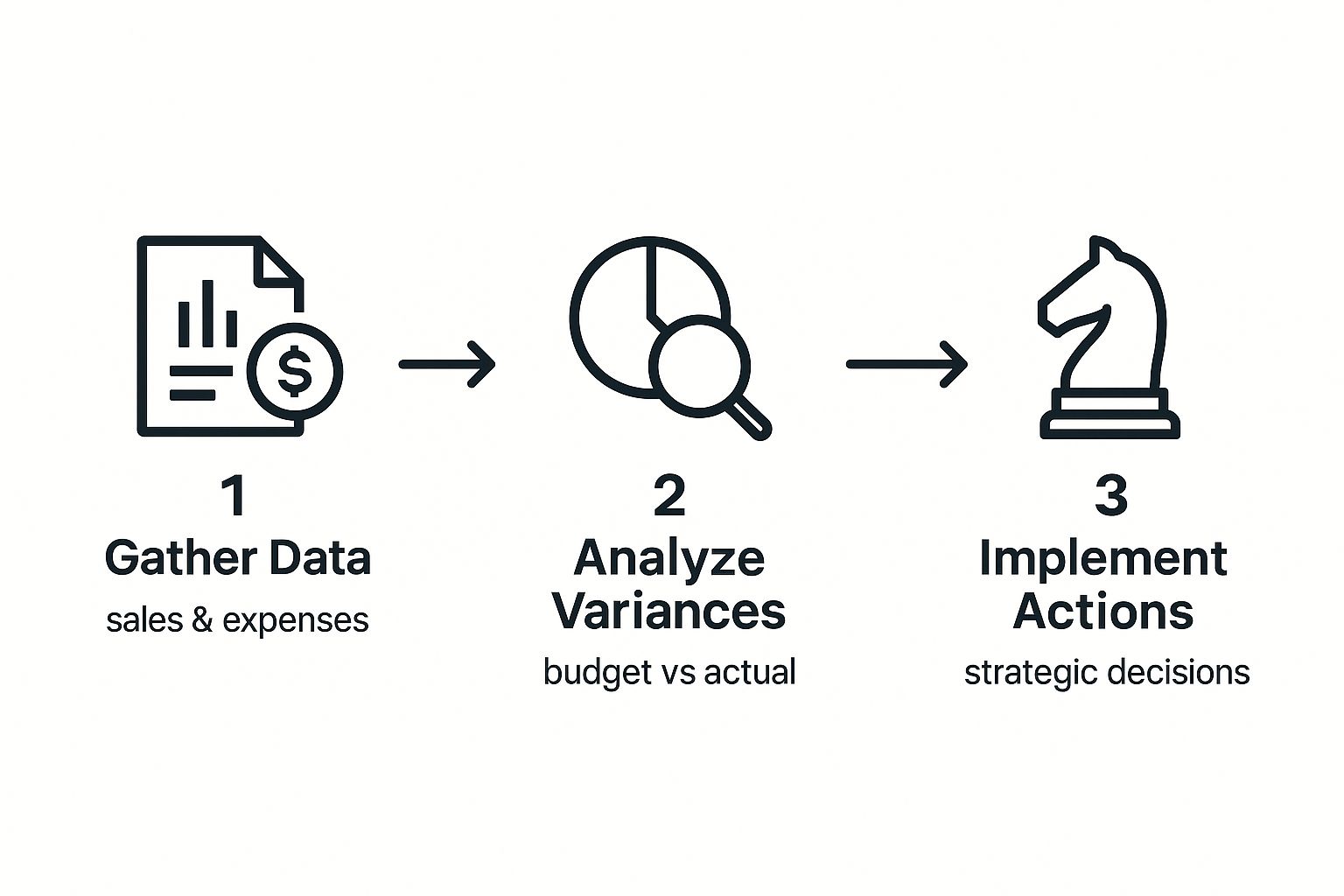
This straightforward flow—from gathering clean data to analysing performance and making smart decisions—is the engine that will drive your business forward.
Turning Financial Data Into Actionable Insights

Getting a fresh set of monthly management accounts on your desk is a great start, but let's be honest—the reports themselves don't make you any money. Their real value comes to life when you translate those numbers into smart, timely business decisions. Without context, figures are just figures; you need to understand the story they're telling.
This is where you shift from being a scorekeeper to a strategist. Imagine you run a growing digital agency. Your latest P&L statement shows revenue is up, which on the surface feels like a clear win. But a quick glance at your Net Profit Margin reveals it has actually slipped from 15% to 12%. That’s a critical insight raw revenue figures would completely mask.
This one piece of data should immediately spark a crucial question: why? This is the moment you begin turning information into action.
Analysing Key Performance Indicators
To get to the 'why', you need to zoom in on specific Key Performance Indicators (KPIs). Think of these as the vital signs of your business's health. You don’t need to track dozens of them; focusing on a handful of core metrics will tell you most of what you need to know.
For almost any business, a great starting point includes:
- Gross Profit Margin: This tells you how much profit you’re making on your products or services before factoring in overheads. If this margin is shrinking, it could mean your direct costs are creeping up.
- Net Profit Margin: This is your true "bottom line" profitability after every single cost is deducted. A drop here, like in our agency example, is a red flag that your operational expenses are out-pacing your revenue growth.
- Debtor Days: This measures how long it takes, on average, for your customers to pay their invoices. If this number is getting bigger, it can put a serious strain on your cash flow, even if your P&L shows a healthy profit.
To make sense of these metrics, it helps to have a quick reference. The table below breaks down some of the most common financial ratios you'll want to keep an eye on.
Key Financial Ratios and What They Tell You
| Ratio | Formula | What It Measures |
|---|---|---|
| Gross Profit Margin | (Revenue – Cost of Goods Sold) / Revenue | The core profitability of what you sell. |
| Net Profit Margin | (Net Profit / Revenue) | Overall profitability after all expenses. |
| Debtor Days | (Trade Debtors / Revenue) x 365 | How quickly customers are paying you. |
| Current Ratio | Current Assets / Current Liabilities | Your ability to cover your short-term debts. |
Understanding these formulas is the first step, but applying them to solve real problems is where the magic happens.
From Insight To Intelligent Action
Let's return to our digital agency. By digging into the variance analysis report within their monthly management accounts, the owner uncovers the root cause of the profit drop. While software subscription costs have held steady, spending on freelance contractors has shot up by 40% against the budget. Now that is an actionable insight.
The next step is to make strategic adjustments. Instead of a knee-jerk reaction like banning all freelancers, the owner can now make an informed choice. The data gives them the power to ask much better questions:
- Are we pricing our projects correctly to cover these higher freelance costs?
- Could we bring some of this work in-house more cost-effectively?
- Are we using our permanent team members to their full potential before we outsource work?
The goal isn't just to spot a problem, but to use the clarity provided by your management accounts to find the right solution. This transforms financial reporting from a backward-looking chore into a forward-looking strategic tool.
To make this process even smoother, many businesses now automate data extraction, pulling figures directly from invoices and receipts into their accounting software. This cuts down on manual entry and helps ensure the data you’re analysing is as accurate as it can be.
For a clearer picture of how you might structure your own reports, you can see an example of how Stewart Accounting visualises key data. This cycle of analysis and adjustment, repeated every month, is what builds a resilient, adaptable, and ultimately more profitable business.
Common Questions About Management Accounts
Getting to grips with financial reporting can feel a bit like learning a new language. It’s completely natural for questions to pop up, and for many UK SME owners, the idea of producing monthly management accounts can seem like a lot of extra work.
Let's walk through some of the most common questions we hear. My goal here is to clear up any confusion and help you feel more confident about this powerful business tool.
My Business Is Small. Do I Really Need These?
This is easily the most frequent question we get, and the answer is a firm yes. In fact, you could argue that monthly accounts are even more crucial for a small business. Think about it: big corporations often have massive cash reserves to absorb a bad quarter. For an SME, though, tight financial control isn't just a nice-to-have; it's your lifeline.
Just looking at your bank balance to gauge your business's health is like judging a car's performance by how clean it is. It tells you nothing about what’s actually happening under the bonnet. These reports give you the real story, helping you to:
- Get a handle on your cash flow before it becomes a problem.
- See your true profitability, month by month.
- Make sharp, informed decisions on everything from pricing and hiring to new investments.
Building this financial discipline early on establishes a solid foundation for growth. It helps you avoid nasty surprises and lets you run your business based on facts, not just gut feelings.
Think of it this way: monthly management accounts are your business's regular health check. They spot the small issues before they have a chance to become serious illnesses, keeping your company financially fit and ready for whatever comes next.
Can I Do This Myself or Do I Need an Accountant?
This is a great question. With modern cloud software like Xero or QuickBooks, you can absolutely generate the basic reports yourself, especially if your bookkeeping is already in good shape.
However, the real magic of monthly management accounts isn't just in producing them—it's in understanding what they're telling you. An experienced accountant does more than just run the reports. They help you read between the lines, pointing out risks you might not see or opportunities hidden in the data. They can translate the numbers into practical advice for improving your margins or managing your cash more effectively.
For many businesses, a hybrid approach offers the perfect balance. You manage the day-to-day bookkeeping in-house, and your accountant comes in each month to finalise the reports, provide analysis, and act as a strategic sounding board. It’s the best of both worlds: you maintain control while benefiting from expert insight.
How Are These Different from a Cash Flow Forecast?
It’s easy to mix these two up, but they serve very different purposes. The distinction is simple but really important.
- Management Accounts are retrospective. They look backward, giving you a factual record of what actually happened in your business last month—your real income, what you spent, and the profit you made.
- A Cash Flow Forecast is prospective. It looks forward, serving as your best guess of the cash you expect to flow in and out of your business over the next few weeks and months.
The two work hand-in-hand. You use the solid, historical data from your management accounts to make your future cash flow forecast much more accurate and reliable. One informs the other.
Understanding and creating a regular reporting rhythm is one of the most powerful things you can do to unlock your business's potential. At Stewart Accounting Services, we specialise in turning financial data into clear, actionable insights for SMEs across the UK. We want to help you go beyond simply meeting compliance deadlines and give you the support you need to build a more profitable and resilient business.
Recent Posts
12 Oct, 2026
12 Oct, 2026
10 Oct, 2026