

Rent and VAT: Who Charges It and When to Register

Residential rent is generally VAT-exempt, commercial rent stays exempt unless the landlord opts to tax, and holiday accommodation is usually standard-rated at 20% where the business is VAT-registered. That split decides whether VAT is added to the rent and whether VAT on repairs stays stuck in your costs.
So why do landlords still treat an option to tax as an automatic reclaim? The usual line, opt in and get the VAT back, looks only at the landlord's return. It ignores the tenant who has to fund the extra charge. If that tenant can't recover it, you've raised the rent, and a higher occupancy cost is a vacancy risk, not a tax win. I would start with the property and the tenant's VAT position, not with the reclaim. Rent and VAT only works in your favour when both sides of the lease can live with the answer.
Which Rent Carries VAT at a Glance
Match the property and the way it is used to one row. The last column is the test that can flip the answer.
| Rent type | VAT charged on rent? | Landlord recovers VAT on costs? | Condition that changes it |
|---|---|---|---|
| Residential rent, dwelling let as a home | No, exempt | Generally no | Property used as a dwelling |
| Commercial rent, no option to tax | No, exempt | Generally no | Default position for most commercial land |
| Commercial rent, option to tax in force | Yes, 20% standard-rated | Yes, on attributable costs | Effective election covering the property |
| Furnished holiday or short-term holiday accommodation | Yes, 20% where VAT applies | Yes, if VAT-registered | Holiday accommodation rules apply, not the residential exemption |
| Garages and parking spaces | No if let with a dwelling; standard-rated if let on their own and you are registered | No on an exempt letting; yes on a taxable letting | Whether let with a dwelling or separately |
| Shop with a flat above | Shop part standard-rated if opted; flat exempt | Partly | Apportioned on a fair and reasonable basis |
Read the row that matches use, not the name on the advert. A flat let as someone's home sits in the first row even if the lease says "licence" or "room rental". An office with no election sits in the second row, so you neither charge VAT nor reclaim it on that building's costs. The third row is the one people jump to too quickly: 20% on the rent, and recovery only on costs that belong to that taxable letting.
Holiday lets don't borrow the dwelling exemption. A lock-up or parking space follows the dwelling only when it is let with the home. Let it to someone else, and it can become a taxable supply in its own right. A shop with a flat above is never one answer. You split the rent.
Practical rule: If a property is not clearly a home, read the lease and check who occupies it, and for what, before you treat the rent as exempt.
Why Residential Rent Is Usually VAT-Free
Think of an exempt business as a shop that doesn't add tax to its prices and also can't claim back the tax on its stock and services. That tax stays inside the business as a cost. A buy-to-let landlord is in the same position.
HMRC's VAT Notice 742 on land and property treats the grant of a tenancy or licence to occupy residential property as exempt. You don't charge VAT on the rent. You also generally can't recover VAT on related costs, including repairs, professional fees and management expenses. That VAT belongs in the yield and the cash-flow forecast, not in a reclaim column.
What an irrecoverable bill does to the numbers
Say a plumber invoices £1,200 plus £240 VAT. A VAT-registered trader making taxable supplies would reclaim the £240 and carry a net cost of £1,200. A residential landlord can't. The job costs £1,440. Letting-agent commission, a surveyor's report, boiler cover and a managing agent's monthly fee follow the same pattern. If you budget from the net line on the invoice, every job is understated by the VAT.
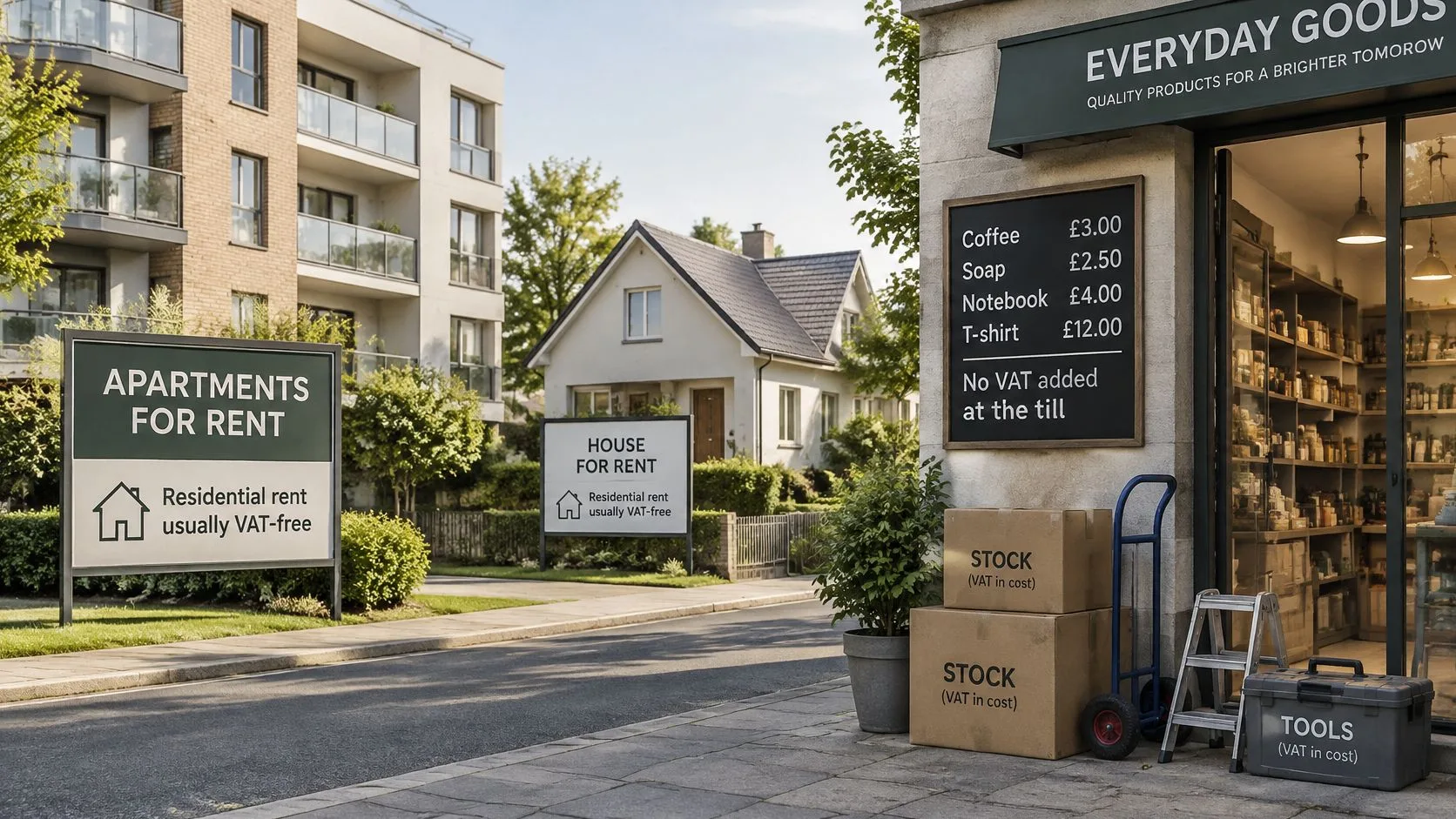
Build the gross figure into the model before you compare yields. On a small portfolio the unrecovered VAT on annual repairs can wipe out the gap you thought you had over a savings account.
The exemption follows use as a dwelling, not the word "rent" on the paperwork. Holiday accommodation, some garages and parking, and certain new-build transactions sit outside it. A lease headed "residential" doesn't fix the treatment if the occupier is running short stays with hotel-style services.
- Budget the gross cost. Put the VAT-inclusive figure into repairs, fees and insurance comparisons.
- Separate the exempt activity. Don't expect those costs to prop up a reclaim on a different, taxable trade without a proper partial-exemption method.
- Recheck unusual use. A dwelling that becomes holiday accommodation, or a garage let on its own, needs a fresh look before the next invoice.
Add VAT to the cost side of every residential budget, and review mixed or unusual use before you assume the exemption still applies.
Commercial Rent and the Option to Tax
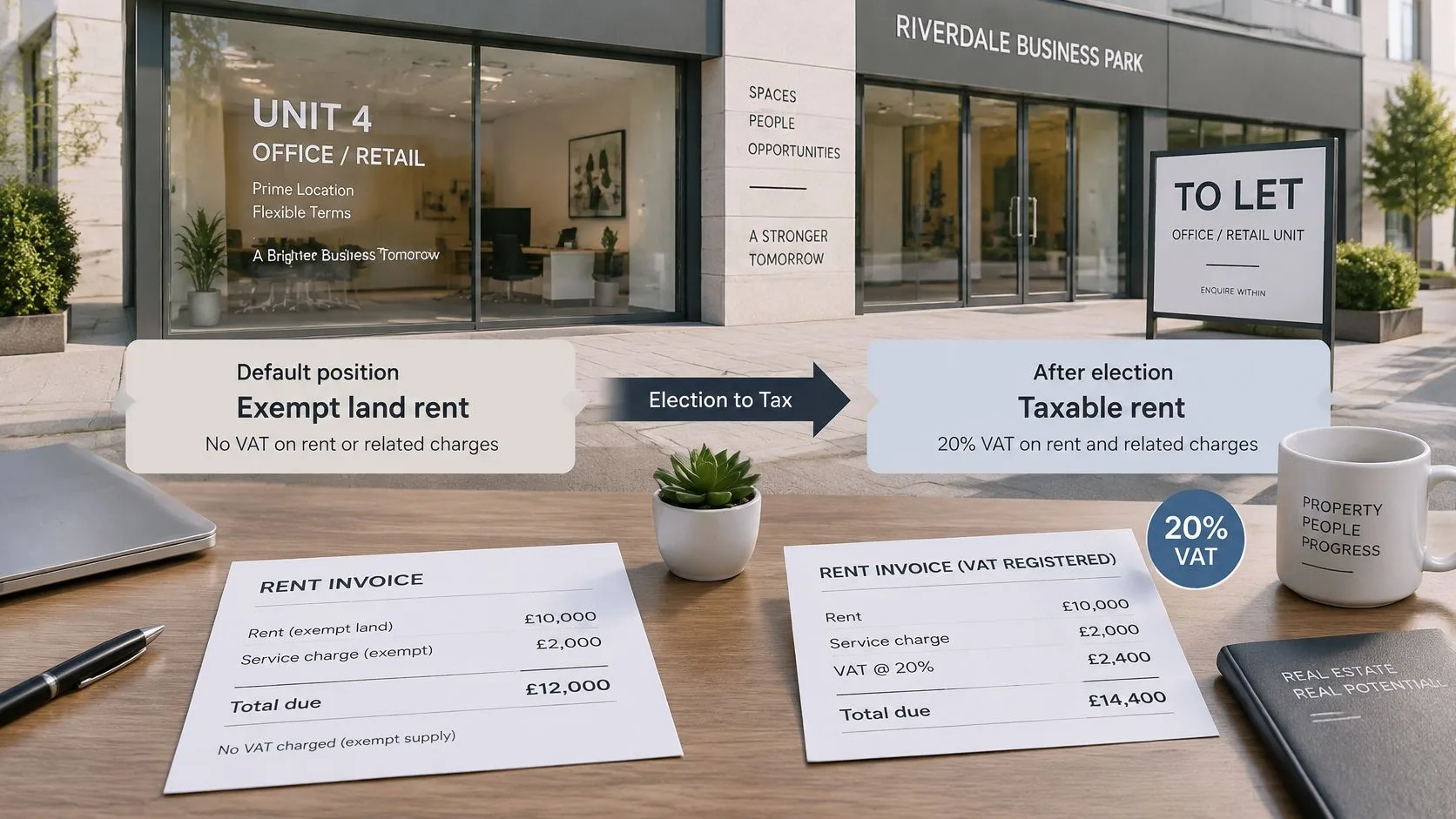
Commercial land is normally exempt as well. The difference is that the owner can usually elect to tax that property. Once an effective option to tax applies, HMRC's Notice 742A says rents and other qualifying supplies tied to the property are generally standard-rated, and the landlord can normally recover VAT on costs of making those taxable supplies. The same notice is clear that a fully taxable tenant may recover the VAT as input tax, while a partly exempt or non-business occupier may bear some or all of it.
An invoice comparison makes the cash difference obvious before you change the lease.
When the reclaim is real
Say you spend £100,000 plus £20,000 VAT refurbishing an office before you let it. With no election, the £20,000 is a cost you don't get back. With an effective election, that VAT is generally recoverable because the onward rent is taxable. That can change whether the works stack up. It doesn't change the fact that the tenant's rent invoice is now 20% higher on the face of it.
The election is property-specific. It generally covers the relevant land and buildings, not "all my commercial units" as a vague intention. Anti-avoidance rules can disapply it in some cases, including where the occupier's use blocks the election. Check those rules, and read how an option to tax on property takes effect, before you tell a tenant the rent will carry VAT.
- Confirm the building is commercial and isn't used as a dwelling. A flat in the same block stays exempt and must be kept out of the taxable rent.
- List the tenants and their VAT status. A firm that sells only taxable goods is a different commercial prospect from a clinic, a school or an unregistered trader.
- Model the VAT you could recover on works, professional fees and running costs, and set that against any rent you may have to cut so the tenant's net cost still works.
- Notify HMRC on form VAT1614A and get the timing right so the election is effective before you rely on it. Don't raise a VAT invoice for a period the election doesn't cover.
- Update the lease, the invoice and the next VAT return. Show VAT separately, quote your VAT number, and state that rent is exclusive of VAT from the effective date.
Opt to tax only when the recoverable costs and the tenant's ability to recover VAT both support it. A reclaim that empties the building hasn't paid off.
Tenant VAT Recovery Decides the Real Cost
Take an office at £40,000 a year with an option to tax in force. VAT at 20% adds £8,000. You still collect £40,000 of rent and you account for the £8,000 to HMRC. The tenant's real cost is a separate question, and HMRC's land, buildings and construction VAT rules are the reason the slogan "opt so you can reclaim" is incomplete. A tenant with exempt or partly exempt supplies can bear some or all of that 20% as a genuine occupancy cost.
| Tenant position | Recovers 20% VAT on rent? | Real cost of opted rent | Usual effect on negotiation |
|---|---|---|---|
| VAT-registered, fully taxable supplies | Yes, as input tax | Close to neutral | Little pressure; cash-flow timing only |
| VAT-registered, partially exempt (for example some healthcare, finance or education) | Partly, under partial exemption | Part of the 20% is lost | Pressure for a lower rent or a rent-free period |
| Fully exempt supplies (for example most insurance and finance) | No | Full 20% added to occupancy cost | Often declines opted premises or demands a discount |
| Not VAT-registered (for example a small trader or an individual occupier) | No | Full 20% added to occupancy cost | Often declines opted premises |
What each row does to the negotiation
A fully taxable tenant, a retailer or a builder selling standard-rated work, reclaims the £8,000. Their real rent stays near £40,000. They care about cash-flow timing, because they pay you and recover later through the VAT return, not about a permanent extra cost. You can hold the headline rent.
A partially exempt tenant recovers only a fraction. A clinic, a financial adviser or a school with a mix of taxable and exempt income will lose part of the £8,000 every year. They will ask for a lower rent or a rent-free period so their net cost matches an exempt building down the road. How businesses reclaim input VAT depends on that mix, and the recovery rate can move year to year.
A fully exempt tenant, and a tenant who isn't registered at all, loses the whole £8,000. Their occupancy cost is £48,000. Many will walk away, or they will only sign if you discount the rent enough to absorb the VAT. You then fund their irrecoverable tax out of your own yield, which can cancel the refurbishment reclaim that tempted you to opt.
A landlord who prices every commercial tenant as if they reclaim VAT in full will mis-price the lease.
Where the building itself is mixed, commercial below and a flat above, the rent and the costs have to be split on a fair and reasonable method. You can't treat the whole building as taxable because the shop has an election, and you can't treat the shop's costs as exempt because a flat sits upstairs.
Before you opt, test two versions of the same lease. One assumes the likely tenant recovers the VAT. The other assumes they don't. Put four pressures next to each version: how far the headline rent can fall before the deal fails, how long a void would last if opted space is harder to let, what mix of tenants you can attract, and what a future buyer inherits if the election is still in force. The version that still works when the tenant recovers nothing is the only one I would sign without a further conversation.
Furnished Holiday Lets and Short-Term Stays
Does a furnished holiday let avoid VAT? No. Furnished holiday let status is an income-tax label that affects how profit is taxed and losses are used. VAT depends on whether the property is supplied as holiday accommodation rather than let as a home. If it is holiday accommodation and you are VAT-registered, the supply is standard-rated. Treating “FHL” on an income-tax return as a VAT exemption can lead to under-declared VAT.
Price VAT out of the guest rate, not on top of it
For a cottage listed at a VAT-inclusive £900 a week, the net income is £750 and the VAT due to HMRC is £150. If you treat £900 as the net price and add 20%, the guest sees a price of £1,080. That can make the listing less competitive, while the VAT remains due if you are registered.
Display the VAT-inclusive price. Check how the booking platform presents the total, including cleaning fees, so the figure shown to guests matches the amount recorded for VAT. Set the rate with VAT taken out of the advertised total, rather than adding VAT to your intended net price.
Confirm each stay's length and letting pattern against HMRC's holiday-accommodation guidance. If the property returns to long-term residential use, its VAT treatment may change. Extra services do not determine by themselves whether the accommodation is a holiday let. Keep evidence of the letting pattern, rather than relying on the wording or photographs in the advert.
- Furnished holiday status doesn't remove VAT. Income-tax status and VAT liability are separate.
- Holiday use alone doesn't require registration. A small holiday let remains outside VAT until its taxable turnover crosses the registration threshold.
- The type of letting doesn't replace the turnover test. Registration depends on taxable turnover, not on guests staying for a week.
Record the VAT treatment of each booking from the first night in the system that raises the guest invoice. That keeps the booking ledger aligned with the VAT account when you prepare the return, without having to reconstruct the figures later. A guest searching for choosing temporary accommodation for work does not change the VAT treatment of the stay.
Registration Thresholds and Mixed-Use Buildings
Does your rental income count towards VAT registration? The answer depends on whether it is taxable, not on the size of your portfolio. Exempt residential rent is excluded from the rolling twelve-month taxable-turnover test, so a large residential portfolio can remain below the threshold while a smaller holiday-let or opted commercial business exceeds it.
| Item | Figure or rule | What it means for a landlord |
|---|---|---|
| Compulsory registration threshold (rolling 12 months) | £90,000 | Taxable turnover above this requires registration |
| Deregistration threshold | £88,000 | You may request deregistration when taxable turnover falls below this level |
| Notification deadline after exceeding threshold | 30 days from the end of the month in which it was exceeded | Late notice can lead to penalties and VAT due on rent |
| Exempt residential rent counted towards threshold? | No | Exempt supplies do not count towards taxable turnover |
| Voluntary registration | Available at any turnover | Allows input VAT recovery, but you must charge VAT on taxable supplies |
| Standard VAT rate | 20% since 4 January 2011 | Applies to taxable rent, holiday lets and related supplies |
The HMRC VAT guide sets the compulsory registration threshold at £90,000 and the deregistration threshold at £88,000. It also confirms the standard rate is 20%. For standard-rated periodic rent, the tax point is the date you receive payment or issue a VAT invoice, whichever comes first. That date determines when the rent belongs on your VAT return.
Why twenty exempt flats still don't register you
In July 2025, average monthly private rent was £1,398 in England and £807 in Wales, according to the Office for National Statistics. At the English average, one home brings in about £16,776 a year. Twenty such flats produce roughly £335,000 of rent, yet none counts towards taxable turnover if every letting is an exempt dwelling and you make no taxable supplies. Add opted commercial rent, holiday lets or other taxable charges, and those amounts count towards the threshold.
You can register voluntarily below the threshold. The VAT registration requirements include having taxable supplies on which to charge VAT and input tax worth recovering. Voluntary registration does not create a right to reclaim VAT on a purely exempt residential portfolio. It does, however, mean you must submit VAT returns.
A shop and a flat are two supplies
Suppose the shop rent is £12,000 a year and the flat rent is £9,600. If you have opted to tax the commercial part, the shop rent is standard-rated while the flat rent remains exempt. You cannot invoice the combined £21,600 plus VAT, and you cannot treat every builder's invoice as fully recoverable.
Use a fair and reasonable method to apportion shared costs, and apply it consistently for each period. Floor area is often a starting point. Rental value may be more appropriate when the shop and flat command very different rents per square metre. Keep the calculation with the lease plan, use the same basis for income and costs, and revisit it if the building changes. Shifting the method between periods to increase a reclaim risks an adjustment if HMRC reviews the figures.
Notify HMRC within 30 days of the end of the month in which taxable turnover passes the threshold. If you notify late, you may owe penalties and VAT on rent you have already charged without VAT. That cost can fall on you if the lease does not let you recover it from the tenant.
Confirm Your VAT Position Before Your Next Lease
Work through the portfolio in this order. Skipping to the election is how landlords lock in a 20% problem they can't easily undo.
- Classify each property as residential, commercial, holiday or mixed. Use the actual occupation, not the portal listing.
- Read the lease. Check that the rent clause matches that classification and that any VAT wording is either absent, on an exempt letting, or explicit where you charge VAT.
- Check each tenant's VAT status and how much of the VAT on rent they can recover. Ask. Don't guess from the shopfront.
- Add up taxable turnover for the last twelve months and a forward twelve months, and set it against HMRC's registration threshold. Leave exempt residential rent out of that total.
- Decide on the option to tax using the cost-and-tenant test, and notify HMRC before the election takes effect. Don't raise VAT on rent for a date the election doesn't cover.
- Record the treatment on every invoice and in the VAT return, with the tax point taken from the earlier of payment and the VAT invoice.
Step 5 carries the most risk. An election is difficult to reverse once tenants are in place and lease wording assumes VAT. Changing it after signature means reopening rent, sometimes funding a discount, and explaining to a buyer why the building is locked into a treatment that shrinks the pool of occupiers. Steps 1 to 4 are paperwork. Step 5 changes the economics of the asset.
A practice such as Stewart Accounting Services can review the option to tax, the registration position and VAT return preparation for landlords and small businesses, alongside your own solicitor on the lease drafting. I would get that review before the election, not after the first VAT invoice has gone out.
This week, list every property, its use and its tenant's VAT status on one sheet. That sheet is the decision record. Everything else hangs off it.
Before the next rent invoice or renewal goes out, mark each line on that sheet as exempt or standard-rated, and note whether the tenant can recover the VAT. Where a line is unclear, get the lease and the VAT position checked before the tax point, so you aren't funding an irrecoverable 20% out of rent you have already agreed.