

What if your next pay rise actually results in a smaller boost to your lifestyle than you planned? With Scotland’s 6-band tax system diverging further from the rest of the UK, many professionals in places like Alloa and Stirling find their net pay surprisingly low. You’ve likely noticed that your gross salary doesn’t tell the full story, especially with the 2026/27 thresholds looming. Using a reliable Scotland salary calculator after tax is the first step to understanding why your take-home pay might feel stretched against rising household costs.
It’s completely normal to feel confused by the jump from the 19% starter rate to the 48% top rate. We believe you deserve more time, more money, and less stress when it comes to your finances. This guide breaks down exactly how the unique Scottish tax bands will impact your monthly budget for the upcoming year. You’ll learn how to verify your tax code and apply expert accounting insights to optimize your earnings, giving you the peace of mind that you’re only paying what you truly owe and not a penny more to HMRC.
Key Takeaways
- Understand how the 2026/27 Scottish tax bands differ from the rest of the UK and what these specific rates mean for your monthly household budget.
- Learn how to use a Scotland salary calculator after tax to accurately forecast your earnings while accounting for the latest Advanced and Top rate thresholds.
- Identify the impact of National Insurance and Plan 4 Student Loan repayments to ensure your take-home pay calculations are precise and HMRC-compliant.
- Discover actionable steps to increase your net income, from verifying your “S” tax code prefix to utilizing tax-efficient salary sacrifice options for pensions or electric vehicles.
- Find out how expert accounting guidance in Alloa, Stirling, and Falkirk helps you achieve “more money” and “less stress” by taking complex tax burdens off your hands.
How Scottish Income Tax Differs from the Rest of the UK in 2026
Understanding your payslip shouldn’t feel like solving a puzzle. Since the Scotland Act 2016, the gap between what you pay in Stirling and what a colleague pays in London has grown. The Scottish Parliament holds the power to set the rates and bands for non-savings and non-dividend income. While the UK government in Westminster still controls National Insurance and the Personal Allowance, Holyrood decides how much of your earnings go to the Scottish Government. This distinction is why a generic UK tax tool won’t give you an accurate figure. You need a specific Scotland salary calculator after tax to see your true disposable income.
The 2026/27 Scottish Tax Landscape
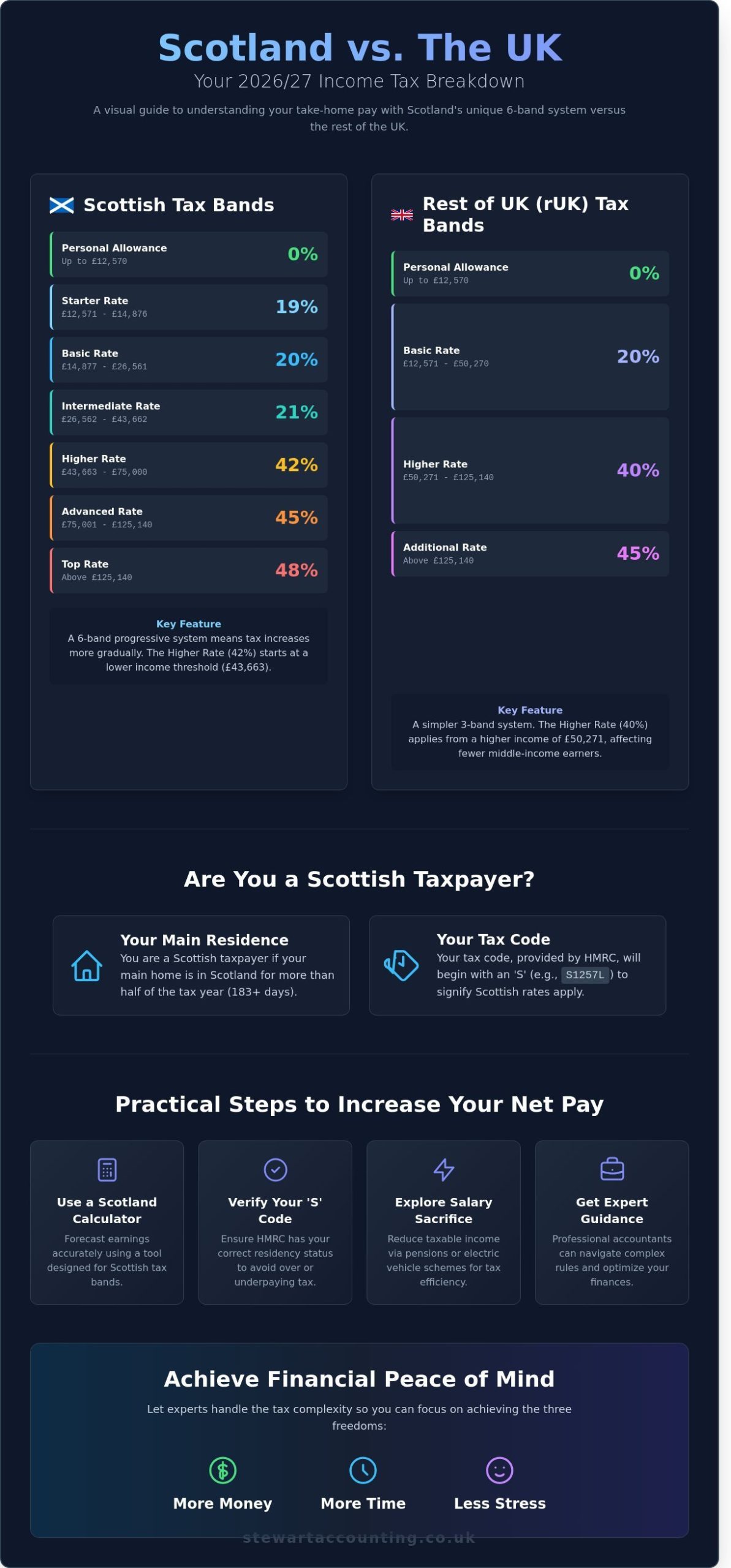
The history of Scottish income tax shows a steady move away from the rest of the UK’s simpler three-band system. By April 2026, Scotland maintains a more complex six-band structure, ranging from the 19% Starter rate to the 48% Top rate. This progressive system aims to ensure those with the broadest shoulders contribute more, but it also means middle-income earners in places like Falkirk often face higher tax bills than those across the border.
To be classed as a Scottish Taxpayer in 2026, your main residence must be in Scotland for more than half of the tax year. Whether you’re commuting from Alloa to Glasgow or working remotely from a home office in Stirling, your physical location determines your tax status. For the 2026/27 tax year, you’re classed as a Scottish Taxpayer if your main residence is located in Scotland for at least 183 days of the year.
One thing that hasn’t changed is the Personal Allowance. This remains a UK-wide figure, frozen at £12,570 since 2021. Even though your tax rates are devolved, the first chunk of your income stays tax-free regardless of where you live in the UK. At Stewart Accounting Services, we find that clarifying this helps take the stress off clients who worry about conflicting rules between two governments.
HMRC vs. Revenue Scotland: Who Collects What?
It’s a common misconception that you pay your taxes directly to a different body. HMRC still collects the money through the PAYE system or Self Assessment. However, they apply the specific rates set by Holyrood. Your employer in Central Scotland processes your payroll by looking at your tax code. If you’re a resident, your code will start with an “S” prefix, such as S1257L. This single letter tells the software to apply Scottish tax bands instead of English ones.
The impact on your monthly take-home pay can be significant. For example, the Advanced rate, introduced at 45% for earnings between £75,000 and £125,140, creates a notably different net pay compared to the rest of the UK. When you use a Scotland salary calculator after tax, you’ll see that these differences add up over the year. Our goal is to give you “more mind” by ensuring you aren’t surprised by these figures when your January Self Assessment or monthly payslip arrives. We take the complexity off your hands so you can focus on your business goals in Alloa, Stirling, or Falkirk.
- Starter Rate (19%): Applies to the first slice of taxable income.
- Intermediate Rate (21%): A band that doesn’t exist in the English system.
- Higher Rate (42%): Hits at a lower threshold than in the rest of the UK.
- Advanced Rate (45%): Targeted at those earning above £75,000.
Breaking Down the 2026/27 Scottish Salary Tax Bands
Understanding how much you actually keep from your paycheck shouldn’t be a source of stress. For the 2026/27 tax year, the Scottish Government continues to use a distinct six-band system that differs significantly from the rest of the UK. When you use a Scotland salary calculator after tax, it’s these specific thresholds that determine your monthly take-home pay. The system is designed to be progressive, but the gaps between the bands can sometimes lead to unexpected “shocks” in your net income as your salary grows.
The Six-Band System Explained
The Scottish tax system is more granular than the English equivalent. It starts with the Starter Rate of 19%, which applies to earnings between £12,571 and £14,876. This specific band helps lower earners keep a few extra pounds every month compared to those in London or Cardiff. However, the divergence grows as you move up the ladder. The Intermediate Rate of 21% and the Advanced Rate of 45% represent the points of maximum difference from the rest of the UK. By the time you reach the Top Rate of 48% for earnings over £125,140, the tax burden for high earners in Scotland is the highest in the British Isles.
- Starter Rate (19%): £12,571 to £14,876
- Basic Rate (20%): £14,877 to £26,561
- Intermediate Rate (21%): £26,562 to £43,662
- Higher Rate (42%): £43,663 to £75,000
- Advanced Rate (45%): £75,001 to £125,140
- Top Rate (48%): Over £125,140
Calculating Your Personal Allowance
Most workers in Scotland benefit from a standard Personal Allowance of £12,570. This is the amount you can earn before you pay a single penny of income tax. This figure has remained frozen for several years and continues to stay at this level for the 2026/27 period. While income tax is a devolved matter, National Insurance contributions are still set by the UK government and are deducted alongside your tax. If you’re married or in a civil partnership and one of you earns less than the allowance, you might be able to use the Marriage Allowance to transfer £1,260 of that tax-free limit, potentially saving your household up to £252 a year.
The “Personal Allowance trap” is a critical hurdle for anyone earning over £100,000. For every £2 you earn above this threshold, you lose £1 of your tax-free allowance. This means that once you hit £125,140, your entire Personal Allowance is gone. This creates an effective tax rate of 60% in that specific income bracket, which is often a shock for successful professionals. If these numbers feel overwhelming, we can take the complexity off your hands to ensure you’re planning your finances as efficiently as possible.
It’s helpful to distinguish between your “headline tax rate” and your “effective tax rate.” Your headline rate is the highest bracket you fall into, such as 42%. Your effective rate is the actual percentage of your total income that goes to HMRC. Because of the £12,570 tax-free cushion, your effective rate is always lower than the headline figure. For example, a person earning £35,000 is in the 21% Intermediate band, but their effective income tax rate is actually closer to 13% because the first portion of their salary isn’t taxed at all. Using a Scotland salary calculator after tax helps visualize this reality, giving you more mind and less worry about your monthly budget.
Beyond Income Tax: National Insurance and Scottish Deductions
While the official Scottish Income Tax rates dictate a large portion of your payslip, they aren’t the only figures that matter. Calculating your true take-home pay requires a look at National Insurance and specific Scottish student loan repayments. We want to give you more time and less stress by breaking these down clearly, so you aren’t surprised when your bank balance updates on payday.
National Insurance Contributions (NICs) in 2026
National Insurance is a UK-wide tax. It doesn’t change just because you live in Stirling, Falkirk, or Alloa. For the 2026 tax year, most employees pay Class 1 NI at a rate of 8% on earnings between the primary threshold and the upper earnings limit. This tax funds state benefits and the NHS, but unlike income tax, the Scottish Parliament has no power to change these rates. For the 2026 tax year, monthly earners will see a primary threshold of £1,048 before any National Insurance is deducted from their gross pay. This consistency across the UK helps balance the slightly higher income tax rates found in the Scottish intermediate and higher bands. Using a Scotland salary calculator after tax helps you see how these two different tax systems interact on your final payslip.
Scottish Student Loans and Workplace Pensions
If you studied at a Scottish university, you’re likely repaying a Plan 4 student loan. This is a specific financial commitment for Scottish graduates that differs from the plans used in England and Wales. You’ll pay 9% of your income above the repayment threshold, which is £31,395 for the current cycle. If you earn £35,000, you’ll pay 9% on the £3,605 difference. This deduction happens automatically through the PAYE system, taking the administrative burden off your hands. It’s a significant factor when you use a Scotland salary calculator after tax to plan your monthly budget.
Pension contributions offer a unique “bonus” for many people in Scotland. Most workplace pensions use a “Relief at Source” mechanism. Since Scottish taxpayers often pay higher marginal rates, such as the 21% intermediate rate or the 42% higher rate, the standard 20% tax relief claimed by pension providers isn’t enough. You can often claim back the extra 1% or 22% through your tax return or by asking HMRC to adjust your tax code. This effectively gives you more money for your future while reducing your current tax bill.
Voluntary deductions also play a role in your final figure. Many employers in Central Scotland offer schemes that can reduce your taxable income, including:
- Cycle to Work: A salary sacrifice scheme that saves you roughly 30% to 42% on the cost of a new bike.
- Pension Salary Sacrifice: This reduces your gross pay before NI is calculated, saving you an extra 8% compared to standard contributions.
- Gym Memberships and Healthcare: These are often deducted directly from your net or gross pay depending on the specific benefit structure.
Managing these moving parts can feel complicated. Our goal is to help you achieve the “three freedoms”: more time, more money, and less stress. By understanding how NI, Plan 4 loans, and pension relief work together, you can make informed decisions about your salary sacrifice options and ensure your financial planning is based on accurate, real-world numbers.
Practical Steps to Increase Your Take-Home Pay in Scotland
Managing your finances effectively in Scotland requires more than just checking a Scotland salary calculator after tax; it involves proactive planning to ensure you keep more of what you earn. The Scottish tax system has diverged significantly from the rest of the UK, with six different tax bands ranging from the 19% starter rate to the 48% top rate. This complexity means there are several legitimate ways to optimize your position and reduce the amount of money leaving your payslip every month.
Your first step should always be a thorough review of your tax code. If you’re a Scottish resident, your code must have an “S” prefix, such as S1257L. This prefix tells HMRC to apply Scottish tax rates rather than English ones. We’ve seen cases where employees moving to Stirling or Falkirk from south of the border remain on the wrong code for months, leading to unexpected tax bills later. You should also check your P60 and P11D forms by May 2026 to ensure any company benefits, like health insurance or car allowances, are recorded accurately. Mistakes here often lead to overpayments that stay with HMRC until you claim them back.
Salary sacrifice is one of the most powerful tools at your disposal. By agreeing to give up a portion of your gross salary in exchange for non-cash benefits, you reduce the total income subject to tax and National Insurance. Common examples include:
- Pension Contributions: Increasing your workplace pension contribution is the most effective way to lower your taxable income.
- Electric Vehicles (EVs): Taking a car through a salary sacrifice scheme can be incredibly tax-efficient, as the benefit-in-kind rates for EVs remain low at 3% for the 2025/26 tax year.
- Cycle to Work Schemes: These allow you to buy a bike and equipment out of your gross pay, saving you up to 42% depending on your tax bracket.
Tax Planning for Scottish Employees
You need to be particularly careful if your income falls between £100,000 and £125,140. In this bracket, you face a 60% “effective” tax rate because your £12,570 personal allowance is withdrawn by £1 for every £2 you earn over the £100,000 threshold. By using a Scotland salary calculator after tax, you’ll see how quickly your take-home pay plateaus in this zone. Making a strategic pension contribution to bring your adjusted net income back down to £100,000 can effectively “earn” you a 60% return on that contribution. It’s a simple way to achieve our “three freedoms” promise: more time, more money, and less stress.
Don’t forget to claim professional expenses. If you pay professional fees to bodies like the NMC, SSSC, or various trade unions, these are often tax-deductible. While the flat-rate working-from-home relief has become stricter since 2022, you can still claim it if your employer requires you to work remotely and doesn’t provide an office. Additionally, higher-rate payers should always record charitable gifts made via Gift Aid. This extends your basic rate tax band, meaning more of your income is taxed at 20% instead of 42% or 45%.
Advice for Small Business Owners in Central Scotland
For Limited Company directors in Alloa, Stirling, and Falkirk, the 2026 strategy often involves a careful balance of salary and dividends. With the dividend allowance currently at £500, it’s vital to structure your withdrawals to stay within the most efficient bands. We often recommend a lower salary to cover your National Insurance credits while taking the remainder of your income as dividends to avoid the higher Scottish income tax rates on earned income. Managing payroll for a growing team across Central Scotland can be complicated, but we can take it off your hands to ensure compliance. If you’re looking to optimize your company’s performance, our team can assist with Year End Accounts Preparation to identify every available saving.
Achieving the Three Freedoms: Why Professional Accounting Matters
At Stewart Accounting Services, we believe your finances should serve your life, not dominate it. We’ve built our reputation on helping clients achieve the “three freedoms”: more time, more money, and more mind. While using a Scotland salary calculator after tax gives you a useful estimate, it’s just the beginning of the conversation. True financial freedom comes from professional oversight that ensures every pound is accounted for and every tax advantage is utilized.
Achieving “More Money” isn’t about magic; it’s about precision. Scotland currently operates with six distinct income tax bands, ranging from the 19% Starter rate to the 48% Top rate. If you’re earning over £43,663, you’ve entered the 42% Intermediate rate, which is a significant jump from the 20% Basic rate used elsewhere in the UK. We analyze your specific circumstances to ensure you aren’t overpaying. Whether it’s through pension contributions, gift aid, or professional expenses, we find the legal avenues to keep more of your hard-earned cash in your pocket.
The “More Mind” aspect focuses on removing the burden of financial stress. HMRC compliance is a minefield. A single mistake on a Self Assessment or a missed deadline can result in an immediate £100 penalty, with daily interest added thereafter. We take the burden off your hands by managing your filings with meticulous accuracy. You won’t have to worry about changing legislation or whether you’ve ticked the right boxes; we’ve got it covered.
Finally, we give you “More Time.” The average business owner spends over 10 hours a month on bookkeeping and tax administration. By letting our team in Alloa, Stirling, or Falkirk handle these complex tasks, you reclaim those hours. You can spend that time growing your business, being with your family, or simply enjoying the peace of mind that comes with professional management.
More Than Just Numbers
An online tool is a great starting point, but it’s often too simplified for real-world scenarios. If you have multiple jobs, receive rental income from a property in Clackmannanshire, or collect dividends from a limited company, a generic Scotland salary calculator after tax won’t provide the full picture. Our approach is tailored to your unique situation. We don’t just look at what you owe; we look at your goals. Our expert accountants provide a level of analysis that software simply can’t match, ensuring your tax strategy supports your long-term ambitions.
Get Started with Stewart Accounting Services
We’re more than just a CA firm; we’re your partners in success. We’ve helped hundreds of ambitious business owners across Central Scotland navigate the complexities of Scottish tax legislation since our founding. If you’re ready to stop worrying about HMRC and start focusing on your future, we’re here to help. We invite you to book a free consultation at our Alloa, Stirling, or Falkirk offices to discuss your specific needs. It’s time to take the weight off your shoulders and let experts handle the heavy lifting. Contact us today for a tailored tax review and discover how the three freedoms can transform your business and your life.
Secure Your Financial Future for the 2026/27 Tax Year
Understanding your net income involves more than a quick search for a Scotland salary calculator after tax. With the 2026/27 Scottish tax bands creating a distinct gap between the North and South of the border, proactive planning is essential. You now know that the 6-band system and specific Scottish thresholds can significantly alter your monthly take-home pay compared to the rest of the UK. Our team of Fully Qualified Chartered Accountants is ready to help you navigate these rules from our local offices in Alloa, Stirling, and Falkirk. We focus on delivering the “Three Freedoms”: more time, more money, and more mind; which means less stress for you. By optimizing your pension contributions or reviewing your benefits, we’ll take the burden of tax planning off your hands. It’s time to stop worrying about complex HMRC regulations and start focusing on your personal goals. You’ve worked hard for your salary; let’s make sure it works hard for you.
Book a free consultation to optimize your 2026 take-home pay with Stewart Accounting Services. We’re here to ensure you keep more of what you earn while staying fully compliant with the latest Scottish regulations.
Frequently Asked Questions
Is tax higher in Scotland than in England for 2026?
Yes, income tax is generally higher in Scotland than in England for anyone earning over £29,000 in the 2026/27 tax year. While the 19% Starter Rate helps low earners, the 21% Intermediate Rate and 45% Higher Rate mean a worker on £50,000 pays roughly £1,500 more than their English counterpart. We help you understand these gaps to ensure your financial planning stays on track.
What is the Scottish tax code for 2026/27?
Your Scottish tax code for 2026/27 will almost certainly begin with the letter ‘S’, such as S1257L. This ‘S’ prefix tells HMRC to apply Scottish tax rates rather than UK ones. If your code is S1257L, it means you have the standard £12,570 tax-free allowance. We can check your coding notice to ensure you aren’t overpaying or missing out on vital tax reliefs.
How much can I earn before I pay tax in Scotland?
You can earn £12,570 before you pay any income tax in Scotland during the 2026/27 period. This Personal Allowance is shared across the UK and is currently frozen at this level until April 2028. If you earn less than this amount, you won’t pay tax, though National Insurance might still apply if your weekly earnings exceed £242. Our team can help you maximize your take-home pay.
Does a Scotland salary calculator include National Insurance?
A reliable Scotland salary calculator after tax includes National Insurance contributions alongside income tax to give you an accurate take-home figure. For the 2026/27 tax year, most employees pay 8% on earnings between £12,570 and £50,270. Our goal is to take the stress out of these calculations so you know exactly what lands in your bank account every month without any surprises.
What happens to my take-home pay if I earn over £100,000 in Scotland?
If your earnings exceed £100,000 in Scotland, your tax-free Personal Allowance is reduced by £1 for every £2 you earn over that limit. This creates a “60% tax trap” because your effective rate jumps significantly when combined with the 45% Higher Rate. By the time you reach £125,140, your entire tax-free allowance is gone. We can help you find tax-efficient ways to manage this situation.
Can Stewart Accounting Services help me if I live in Stirling but work in London?
Yes, Stewart Accounting Services can support you if you live in Stirling but work for a London-based company. Because you reside in Scotland, you’ll still pay Scottish income tax regardless of where your employer is located. We regularly assist clients in Stirling, Alloa, and Falkirk who work remotely, ensuring their “S” tax code is applied correctly to their payroll to avoid unnecessary stress.
How do Scottish student loan repayments (Plan 4) affect my monthly pay?
Plan 4 student loan repayments reduce your monthly take-home pay by 9% of everything you earn above the £31,395 threshold. For example, if you earn £40,000, you’ll pay 9% on the £8,605 difference, which is roughly £64.50 per month. These deductions happen automatically through PAYE. We can help you factor these costs into your overall household budget to give you more peace of mind.
What are the 2026 Scottish tax bands for a £50,000 salary?
For a £50,000 salary in 2026, your income is split across four Scottish tax bands: Starter (19%), Basic (20%), Intermediate (21%), and Higher (45%). The Higher Rate in Scotland starts at £43,663, which is much lower than the £50,270 threshold used in England. Using a Scotland salary calculator after tax helps you see how these specific bands impact your final monthly earnings and pension contributions.