

What if your hard-earned pay rise in 2026 actually results in a smaller boost to your bank balance than you expected? With Scotland now managing six distinct tax bands, including the specific Advanced rate for those earning over £75,000, it’s natural to feel anxious about where your money is going. You likely feel that calculating your true take-home pay shouldn’t require a degree in mathematics, yet the complex gap between salary and dividend rules adds another layer of frustration to your financial planning.
We’re here to take that weight off your shoulders. This guide explains how to use a Scottish tax calculator 2026 to get a crystal-clear estimate of your earnings while highlighting professional ways to optimize your position. You’ll learn exactly how the 2026 thresholds affect your pocket and discover tailored strategies to legally keep more of what you earn. We’ll walk through the latest regulations and show you how a local expert in Alloa, Stirling, or Falkirk can simplify your filing. By the end of this article, you’ll have the tools to reclaim your three freedoms: more time, more money, and significantly less stress.
Key Takeaways
- Gain clarity on the 2026/27 Scottish income tax bands to understand exactly how much of your hard-earned money stays in your pocket.
- Learn the logic behind a Scottish tax calculator 2026 to accurately factor in National Insurance contributions and your specific tax code.
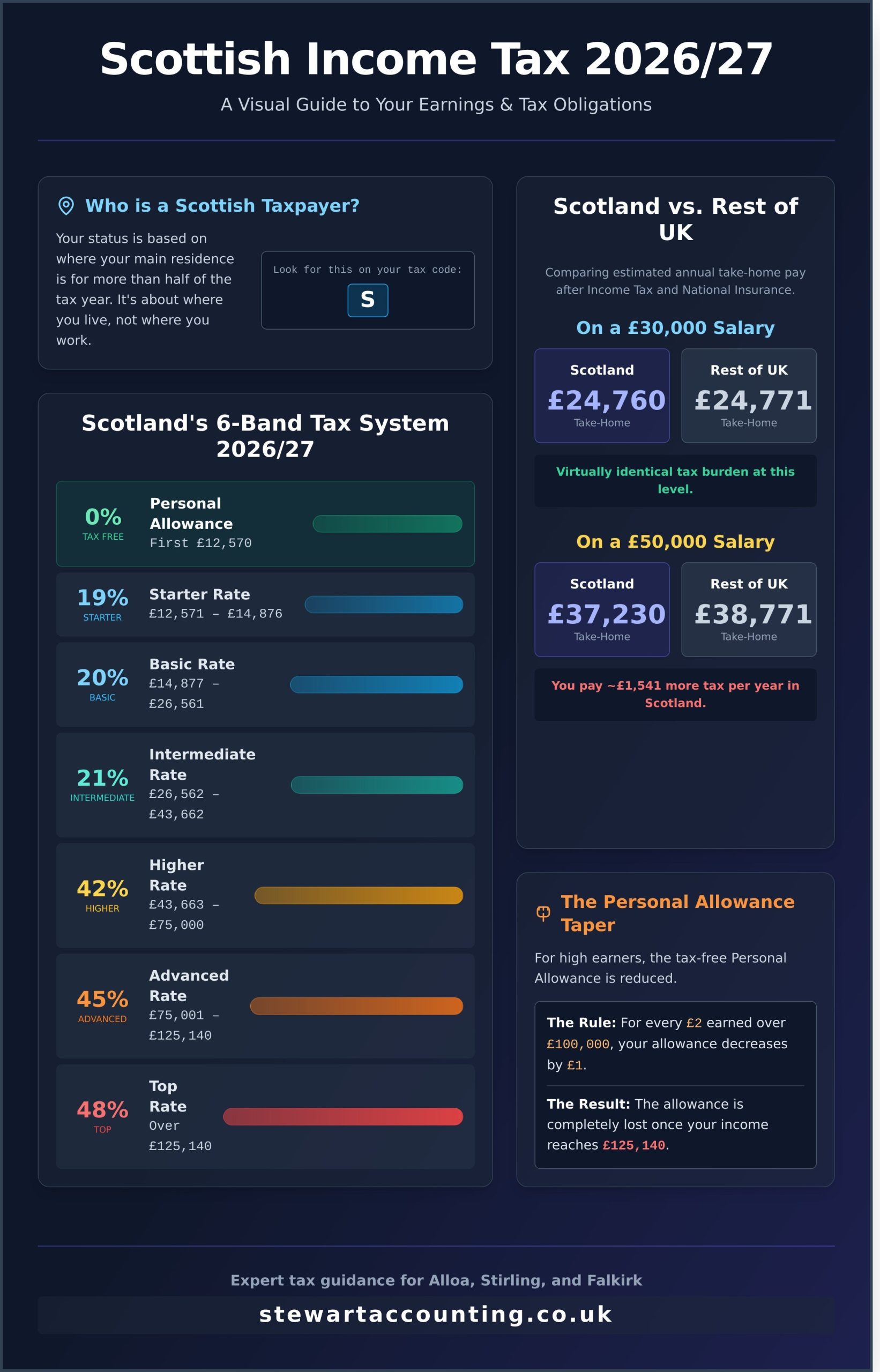
- Compare the tax differences between Scotland and the rest of the UK on common salaries like £30,000 and £50,000 to visualize your unique tax burden.
- Identify strategic moves for limited company directors, including the most tax-efficient salary and dividend splits for the 2026 tax year.
- Discover how expert accounting support can take the stress off your hands, providing you with more time, more money, and total peace of mind.
Understanding the 2026 Scottish Income Tax Rates and Bands
Scottish Income Tax is the tax you pay on your wages, pension, and most other non-savings income if you live in Scotland. While the UK government sets the Personal Allowance, the Scottish Parliament has the power to set the rates and tax bands for its residents. This devolved power means your tax bill can look quite different from someone earning the same salary in London or Cardiff. HMRC continues to collect the tax on behalf of the Scottish Government, so you still deal with the same tax office, but the calculations follow Holyrood’s specific legislation.
The 2026/27 tax year represents a continuation of Scotland’s unique approach to progressive taxation. Since the 2018/19 tax year, Scotland has moved away from the three-band system used in the rest of the UK. By using six distinct bands, the government aims to ensure that lower earners pay slightly less than they would elsewhere in Britain, while higher earners contribute more to fund public services. Using a Scottish tax calculator 2026 is the most efficient way to see how these tiers affect your take-home pay without getting bogged down in the math.
You can learn more about how these powers evolved by looking at the History of Scottish Income Tax, which details the transition from the 2012 and 2016 Scotland Acts. At Stewart Accounting Services, we believe that understanding these numbers shouldn’t be a source of stress. Our goal is to give you “more mind” by taking the complexity out of your financial planning.
Who Qualifies as a Scottish Taxpayer?
Your status as a Scottish taxpayer depends on where you live, not where you work. If your main place of residence is in Scotland for more than half of the tax year, you’re a Scottish taxpayer. It doesn’t matter if your employer’s head office is in England. If you move between Scotland and another part of the UK during the year, HMRC looks at where you spent the most time. You’ll know you’re being taxed correctly if your tax code starts with the letter ‘S’. If you don’t see that ‘S’ on your payslip but live in Stirling or Alloa, you should contact HMRC to avoid an unexpected bill later.
The 2026 Scottish Tax Band Breakdown
The Scottish system creates a more gradual climb in tax rates. The Personal Allowance remains at £12,570 for the 2026/27 period. This means the first £12,570 you earn is tax-free. Beyond that, the tiers begin. The Starter rate is 19% for income up to £14,876, followed by the Basic rate of 20% and the Intermediate rate of 21%. These lower-tier bands ensure that many Scottish residents pay less than the 20% flat basic rate found in England.
- Starter Rate (19%): £12,571 to £14,876
- Basic Rate (20%): £14,877 to £26,561
- Intermediate Rate (21%): £26,562 to £43,662
- Higher Rate (42%): £43,663 to £75,000
- Advanced Rate (45%): £75,001 to £125,140
- Top Rate (48%): Over £125,140
The divergence becomes most visible at the Higher, Advanced, and Top rates. For example, the Higher rate of 42% is 2% higher than the equivalent rate in the rest of the UK. Additionally, for those earning over £100,000, the Personal Allowance starts to taper away at a rate of £1 for every £2 earned. This creates a high effective tax rate in that specific bracket. Using a Scottish tax calculator 2026 helps you visualize exactly where your income falls and how much of your hard-earned money stays in your pocket.
How to Calculate Your Scottish Take-Home Pay in 2026
Understanding your pay slip doesn’t have to be a headache. While using a Scottish tax calculator 2026 is the fastest way to get an estimate, knowing the logic behind the numbers gives you more mind (less stress !!!!!!). It ensures you aren’t overpaying and helps you plan for those big life goals. The calculation starts with your gross pay, but the figure the taxman sees is often different. You must first account for pension contributions. If your employer uses a “net pay arrangement,” your pension comes out before tax is calculated, which lower your taxable income and saves you money instantly.
You also need to consider Benefits in Kind (BIK). These are non-cash perks like a company car or private medical insurance. Even though you don’t see this money in your bank account, the tax office treats it as “notional income.” This increases your taxable total, meaning you might pay more tax than someone on the same salary without those perks. Determining Who Pays Scottish Income Tax is the vital first step, as residency in Scotland dictates that you follow the specific six-band system rather than the three-band system used in England and Northern Ireland.
Step-by-Step Calculation for Employees
To get a clear picture of your 2026 earnings, follow these three stages:
- Step 1: Identify your gross annual salary. This is your total pay before any deductions like tax, NI, or student loans.
- Step 2: Subtract your Personal Allowance. For the 2026/27 tax year, the standard UK Personal Allowance is £12,570. If you earn over £100,000, keep in mind that this allowance reduces by £1 for every £2 you earn above that threshold.
- Step 3: Apply the Scottish tax bands sequentially. You’ll pay 19% on the first slice of income above £12,570, then 20%, 21%, 42%, 45%, and finally 48% on earnings in the Top Rate band.
Adjusting for Student Loans and NICs
National Insurance (NI) is another deduction that impacts your take-home pay. For 2026, employees pay Class 1 NI at a rate of 8% on earnings between the Primary Threshold and the Upper Earnings Limit of £50,270. The Primary Threshold for NI in 2026 is the specific earnings level where employees start paying contributions, currently aligned with the Personal Allowance at £12,570 per year. If your earnings exceed the Upper Earnings Limit, the rate on that top portion drops to 2%.
Student loan repayments also depend on your specific plan. If you’re on Plan 1, you’ll pay 9% on income over £24,990. Plan 2 graduates pay 9% on income over £27,295. Most Scottish students are on Plan 4, which requires a 9% repayment on everything earned over the £31,395 threshold. These deductions are calculated on your gross pay before tax is taken out, which can feel like a lot to track at once. If you’d like to simplify your finances, our team can take it off your hands to ensure your payroll and tax planning are 100% accurate. Using a reliable Scottish tax calculator 2026 helps you stay ahead of these changes so you can focus on growing your business or career.
Scotland vs. Rest of UK: Comparing the 2026 Tax Burden
Living and working in Scotland means your take-home pay follows a different set of rules than the rest of the UK. For the 2026/27 tax year, the gap between Scottish taxpayers and those in England, Wales, or Northern Ireland continues to widen, particularly for those earning above the median wage. At Stewart Accounting Services, we want to give you back “more mind” by clarifying exactly how these differences impact your pocket.
The divergence is most visible when you look at the actual cash staying in your bank account. If you earn £30,000, the difference is minimal; you’ll pay roughly £22 more in Scotland than you would south of the border. However, once you cross the £50,000 mark, the gap becomes a chasm. A professional in Stirling earning £50,000 pays approximately £1,542 more in annual income tax than someone in Newcastle on the same salary. For high earners at £150,000, the Scottish tax bill is over £6,000 higher. Using a Scottish tax calculator 2026 is the fastest way to see how these specific percentages affect your unique situation.
- £30,000 Salary: Scotland tax is ~£3,490 vs rUK tax of ~£3,468.
- £50,000 Salary: Scotland tax is ~£10,980 vs rUK tax of ~£9,438.
- £150,000 Salary: Scotland tax is ~£59,800 vs rUK tax of ~£53,400.
Middle earners often face the highest effective tax rates because of the interaction between Scottish rates and UK-wide National Insurance. When you earn between £43,663 and £50,270, you’re paying 42% Scottish Higher Rate tax plus 8% National Insurance (based on current projections), creating a 50% marginal tax rate on every extra pound earned. This “tax trap” is a significant hurdle for growing businesses in Alloa and Falkirk trying to reward their staff with meaningful raises.
The Divergence in Higher Rate Thresholds
The most striking difference remains the Higher Rate threshold. In Scotland, the 42% rate kicks in at £43,662, whereas the UK-wide threshold sits at £50,270. This £6,608 gap means Scottish professionals lose a larger chunk of their “middle” income to the Treasury. This creates a “fiscal drag” effect; as wages rise to keep pace with inflation, more workers are pulled into the 42% bracket earlier. For local businesses, this makes recruitment and retention harder, as candidates often compare net pay across the whole UK.
Dividend Tax: The UK-Wide Constant
It’s vital to remember that dividend tax rates remain a UK-wide matter set by Westminster. Whether you’re in Falkirk or London, you’ll pay 8.75% for basic rate, 33.75% for higher rate, and 39.35% for additional rate dividends. However, your Scottish Income Tax bands still dictate which dividend rate you pay. Because the Scottish Higher Rate starts at £43,662, you might find your dividends being taxed at 33.75% much sooner than a shareholder in England. Using a Scottish tax calculator 2026 allows you to input both salary and dividends to see the combined impact on your “three freedoms.”
The introduction of the 45% Advanced Rate for those earning over £75,000 further separates the Scottish system. This band ensures that high earners contribute more, but it also requires careful tax planning to ensure you aren’t overpaying. We’re here to take that stress off your hands and help you keep more of what you earn.
Tax Planning Strategies for Scottish Small Business Owners
Using a Scottish tax calculator 2026 provides a helpful snapshot of your liabilities, but a calculator alone won’t build a long-term strategy for your business. For limited company directors in Central Scotland, the real goal is achieving the three freedoms: more time, more money, and less stress. We focus on moving beyond basic compliance to ensure you aren’t overpaying simply because you’re following generic UK advice that ignores Holyrood’s specific tax bands. Our team in Alloa and Stirling works to take the burden of complex calculations off your hands, allowing you to focus on growth.
Optimising Salary and Dividends in Scotland
Scottish directors often find that a lower salary is more tax-efficient than it is for their counterparts in England. While the £12,570 Personal Allowance remains the standard baseline to avoid National Insurance, the 19% Starter Rate and 20% Basic Rate in Scotland apply to much narrower brackets. The “sweet spot” for 2026 involves balancing a low salary with dividend drawings to stay below the £43,662 Higher Rate threshold. This approach requires careful timing, which we integrate into your Year End Accounts to ensure no tax is wasted.
The 60% effective tax rate trap is the most dangerous zone for your personal finances. This occurs between £100,000 and £125,140 because your Personal Allowance is withdrawn by £1 for every £2 you earn above the £100k mark. When you combine this loss with the Scottish Advanced Rate of 45%, your effective tax rate actually hits 67.5%. If you earn £110,000, that extra £10,000 results in only £3,250 reaching your pocket. We help clients avoid this by using strategic business expenses or timing dividend distributions to keep “Adjusted Net Income” safely under the £100,000 ceiling.
The Power of Pension Planning
Pensions are the most effective tool for Scottish taxpayers to reclaim their income from the higher brackets. Contributions to a SIPP or SSAS reduce your taxable income pound-for-pound, which is essential when you’re trying to drop below a specific tax threshold. Advanced rate taxpayers receive full relief at their highest marginal rate, meaning the government effectively pays nearly half of your retirement savings through tax relief. It’s a pragmatic way to move money from the taxman’s pocket into your own future.
- Scenario A: A director earning £50,000 is firmly in the 42% Higher Rate band. By making a £6,338 gross pension contribution, they drop back into the Basic Rate band, saving £1,331 in immediate tax.
- Scenario B: An owner with £110,000 income makes a £10,000 pension contribution. This move reinstates £5,000 of their Personal Allowance, effectively saving £6,750 in tax and NI.
- Strategy: Using a Scottish tax calculator 2026 helps us identify exactly how much you need to contribute to hit these thresholds.
We don’t just look at the current year; we look at the trajectory of your business. By managing your drawings and pension contributions methodically, we ensure your tax bill is as low as legally possible. If you want to stop worrying about the 60% trap and start keeping more of what you earn, let us handle the technicalities for you.
Why Professional Accounting Beats an Online Tax Calculator
A Scottish tax calculator 2026 offers a quick glimpse into your potential liabilities, but it can’t replace the nuanced advice of a Fully Qualified Chartered Accountant. These digital tools are built on static formulas. They don’t account for the 1,000 plus pages of UK tax legislation or the specific quirks of the Scottish tax bands. While a calculator might show you a basic figure, it won’t identify that you’ve missed out on a specific relief or that your dividend structure is costing you an extra £1,200 annually. We provide the “Three Freedoms” to our clients: more time, more money, and more mind (less stress!!!!!!). This goes far beyond what any software can offer.
Proactive tax planning is the bridge between simply filing a return and actually building wealth. Most people use a Scottish tax calculator 2026 as a reactive measure at the end of the year. By then, it’s often too late to change your financial outcome. We work with you throughout the year to implement strategies that reduce your bill before the deadline hits. For instance, timing a capital expenditure or adjusting your pension contributions by just 5% can move you into a lower tax bracket, saving you thousands in the long run. Our local presence in Alloa, Stirling, and Falkirk means you aren’t just a number in a database. You can sit down with us face-to-face to discuss your goals in a way an online tool never could.
- Personalised Analysis: We look at your whole financial picture, not just one data point.
- Regulatory Accuracy: We stay updated on every Scottish Government budget change so you don’t have to.
- Strategic Growth: We help you plan for 2027 and beyond, ensuring your business remains scalable.
Taking the Stress Out of Self-Assessment
The burden of compliance is heavy. HMRC’s penalty system is unforgiving; a single day’s delay results in an automatic £100 fine. If you’re six months late, that penalty jumps by another £300 or 5% of the tax due, whichever is higher. We “take it off your hands” to ensure you never face these avoidable costs. Our team handles every detail of your Self Assessment Tax Returns, ensuring 100% compliance and significantly reducing the risk of an HMRC investigation. We handle the complicated paperwork so you can focus on running your business.
Enabling Ambitious Business Owners
We don’t just count the beans; we help you grow them. Our tailored business advisory services are designed to help you achieve your personal and business goals through structured, expert guidance. Having a Fully Qualified Chartered Accountant on your side provides a level of security that software simply can’t replicate. We act as your financial partner, offering pragmatic solutions to real-world challenges in Central Scotland. Whether you’re a sole trader or a limited company, we provide the steady hand needed to navigate the 2026/27 tax year successfully. Contact Stewart Accounting Services for a tailored tax review to see how we can help you gain more time and more money.
Secure Your Financial Future for the 2026 Tax Year
Navigating the 2026 Scottish Income Tax bands requires more than a quick glance at a table. While using a Scottish tax calculator 2026 gives you a baseline for your take-home pay, it can’t account for the complex interactions between your dividends, personal allowance, and business expenses. Small business owners in Scotland face unique rules. These differ significantly from the rest of the UK. Relying on software alone often means missing out on legitimate ways to reduce your £5,000 or £10,000 tax bill.
At Stewart Accounting Services, our Fully Qualified Chartered Accountants in Alloa, Stirling, and Falkirk handle the complicated details so you don’t have to. We apply our deep expertise in Scottish-specific tax legislation to ensure you’re compliant while maximizing your earnings. Let us take the stress off your hands and help you achieve more time, more money, and more peace of mind. Your financial health is our priority; we’re ready to help you thrive in the coming year.
Get your professional tax review and find your ‘Three Freedoms’ today
We look forward to helping your business reach its full potential with a plan tailored just for you.
Frequently Asked Questions
Is income tax higher in Scotland than in the rest of the UK for 2026?
Scottish taxpayers pay more than those in the rest of the UK because of the unique six-band system. For the 2026/27 tax year, any individual earning over £28,850 pays a higher marginal rate than someone on the same salary in England. This tiered structure aims to support local public services, but it creates a higher tax burden for middle earners. We help you manage this to ensure you keep more of your money.
How much tax do I pay on a £50,000 salary in Scotland?
You’ll pay approximately £9,176 in Scottish Income Tax on a £50,000 salary during the 2026/27 tax year. This figure assumes you’re using the standard £12,570 Personal Allowance. Our Scottish tax calculator 2026 breaks this down across the five relevant tax bands, showing exactly how much goes to the government. This clarity helps reduce stress and lets you focus on your personal financial goals.
Does the Scottish tax calculator account for National Insurance?
Yes, our Scottish tax calculator 2026 accounts for Class 1 National Insurance contributions to provide a complete picture of your take-home pay. While the Scottish Parliament sets income tax rates, National Insurance remains a reserved matter for the UK Government. By combining both sets of regulations, we take the guesswork off your hands. You get a reliable estimate of your actual net income for the year.
What is the Scottish tax code for 2026?
The standard Scottish tax code for the 2026/27 tax year is S1257L for most residents with one job. The “S” prefix identifies you as a Scottish taxpayer, ensuring HMRC applies the correct regional rates to your earnings. If your code is different, it might be due to taxable benefits or underpaid tax from previous years. We can review your coding notice to ensure it’s accurate and fair.
Can I avoid the Scottish Higher Rate of tax legally?
You can legally reduce your Scottish Higher Rate tax bill by making smart pension contributions or donating via Gift Aid. For example, putting £5,000 into a private pension can pull your taxable income back below the £43,662 Higher Rate threshold. This strategy effectively gives you more money for retirement while lowering your immediate tax liability. It’s a practical way to achieve more financial freedom with less worry.
How do I claim a tax refund if I’ve overpaid Scottish Income Tax?
You can claim an income tax refund by logging into your HMRC Personal Tax Account or by waiting for a P800 calculation letter. Most overpayments are identified automatically after the tax year ends on 5 April 2027. If you’re a sole trader in Stirling or Falkirk, we’ll reconcile this through your Self Assessment return. This ensures any overpaid tax is returned to your bank account as quickly as possible.
Do I pay Scottish tax if I work in London but live in Stirling?
You pay Scottish tax if your main home is in Stirling, regardless of where your employer’s office is located. HMRC determines your tax status based on where you live for more than 183 days in a tax year. Since you reside in Scotland, your London-based employer must use a Scottish tax code for your payroll. This ensures your contributions correctly fund the Scottish public services you use every day.
What are the 2026 Scottish tax bands for self-employed sole traders?
Self-employed sole traders in 2026/27 pay tax across six bands, starting at 19% and reaching 48% for income over £125,140. The 21% Intermediate rate applies to profits between £26,562 and £43,662. We help business owners in Alloa and Central Scotland navigate these complex layers. Our goal is to handle the complicated paperwork so you have more time to grow your business and achieve your goals.