

A Self Assessment tax return is simply HMRC’s way of collecting tax on income that hasn’t been taxed already. For most people on a regular payroll, tax is handled automatically through the Pay As You Earn (PAYE) system. But for millions of others, Self Assessment is the process they use to declare their earnings and pay the right amount of tax.
Think of it as your annual financial check-in with the taxman. It’s a fundamental part of the UK tax system, and getting it right is crucial.
Figuring Out If You Need to File
So, how do you know if you need to bother with all this? The easiest way to think about it is to see the UK tax system as two main pathways. The first is PAYE, where your employer deducts tax from your salary before you even see it. It’s neat, tidy, and mostly hands-off for you.
The second pathway is Self Assessment. This is designed for everyone whose income doesn't fit neatly into the PAYE box. It's your responsibility to tell HMRC about this other income, work out what you owe, and file a return before the deadline. This is where this self assessment tax return guide comes in.
It’s a system that relies on you to get the figures right and be honest about your earnings.
Quick Guide Who Needs to File a Self Assessment Tax Return
To make things clearer, here’s a quick rundown of the most common situations that mean you'll need to register for and file a Self Assessment tax return.
| Scenario | Description | Typical Example |
|---|---|---|
| Self-Employed / Sole Trader | You run your own business and your gross income was over £1,000 in the tax year. | A freelance graphic designer, a plumber, or an online seller. |
| Partner in a Business | You are a member of a business partnership, regardless of profit levels. | Two individuals running a local café together as partners. |
| Company Director | You have income that wasn't taxed at source through PAYE. | Receiving dividend payments from your limited company. |
| High Earner | Your total taxable income for the year was more than £100,000. | An employee with a large salary and bonus. |
| Landlord / Property Income | You receive income from renting out a property you own. | Letting out a spare room or a buy-to-let property. |
| High-Income Child Benefit | You or your partner claimed Child Benefit and one of you had an income over £50,000. | A household where one parent earns £60,000 while the other claims Child Benefit. |
This isn’t a complete list, of course. You might also need to file if you have income from overseas, significant earnings from savings or investments, or have sold an asset and need to pay Capital Gains Tax.
If you’re just getting started on this journey, you can learn more about what you need to know if you are new to Self Assessment in our dedicated article.
Why Getting Self Assessment Right Matters
This isn't a niche process affecting a handful of people. For the last tax year, over 11.5 million taxpayers had to file a return by the 31 January deadline. The shift to digital is undeniable, with around 97% of people now filing online. These figures, highlighted in the latest government report on tax filing statistics, show just how widespread Self Assessment is.
Filing a tax return is about more than just settling your bill with HMRC. It's about keeping your financial affairs in good order and staying compliant. Getting it wrong, or simply being late, triggers automatic penalties. You’re looking at an instant £100 fine for being just one day late, and those costs can spiral quickly. Understanding your duties is the best way to avoid any nasty surprises.
Getting Registered and Hitting Your Deadlines
Figuring out you need to file a Self Assessment is the first step. The next, equally crucial, part is actually getting registered with HMRC. This isn't optional, and the clock is ticking from the moment you start earning untaxed income. If you miss the registration deadline, it can snowball, making you late for the filing deadline and landing you with penalties before you’ve even started.
Think of it like getting your name on the list for a club – if you're not on it, you can't get in. Registering with HMRC gets you on their list and, more importantly, gives you your Unique Taxpayer Reference (UTR). This ten-digit number is your key to everything Self Assessment, so keep it safe.
The cycle is pretty simple: you earn the income, you calculate the tax, and then you file the return. It’s a rhythm every Self Assessment filer gets used to.
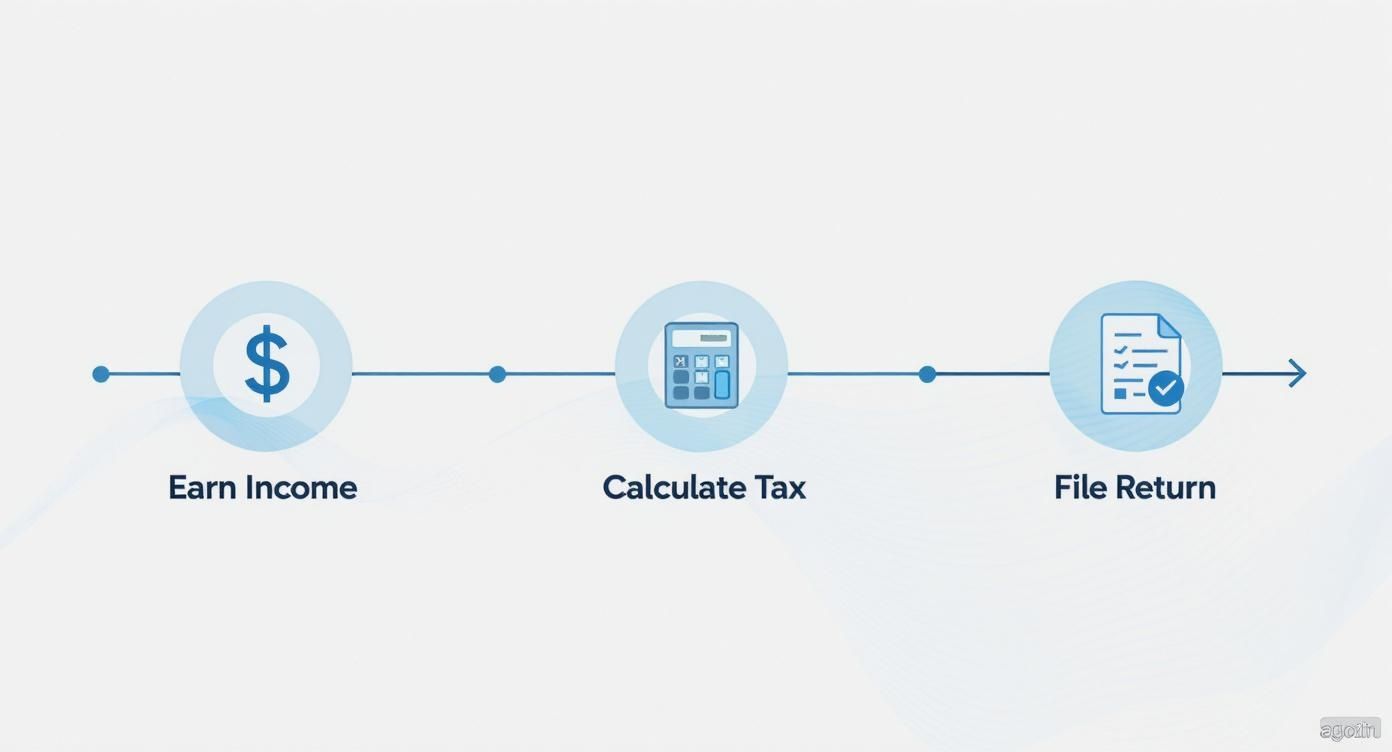
This image really breaks down your core responsibilities. Under the Self Assessment system, the ball is in your court to declare what you’ve earned and pay what you owe.
How to Get Registered
How you register depends entirely on why you need to file. If you’re newly self-employed as a sole trader, you’ll register for Self Assessment and Class 2 National Insurance at the same time.
But if you need to declare other income, like from renting out a property or from foreign investments, you’ll use a different form (the SA1). To make the whole process go smoothly, have these details handy before you start:
- Your National Insurance number
- Your full name and address
- Your date of birth
- A phone number and email address
Once your application is in, HMRC will post your UTR number to you. Be warned, this can take up to 10 working days to show up (sometimes longer), so don't leave it until the last minute.
The Deadlines You Absolutely Cannot Miss
The UK tax year runs from 6th April to 5th April every year. Getting these dates into your calendar is the best way to stay compliant and avoid any last-minute panic.
The biggest mistake anyone can make is simply ignoring the deadlines. HMRC’s penalty system is automated and doesn’t listen to excuses. You’ll get an instant £100 penalty for being just one day late. The best defence is good organisation.
Here are the key dates to burn into your memory:
-
5th October: This is your deadline to tell HMRC you need to file a tax return. It’s on the 5th of October following the end of the tax year you started trading in. So, for the 2023-24 tax year (which ended on 5th April 2024), you must register by 5th October 2024.
-
31st October: This is the deadline for filing a paper tax return. It’s a bit old-fashioned now and most people file online, but if you do send it by post, you have a much earlier cut-off.
-
31st January: This is the big one. It's the final deadline to file your online tax return and pay the tax you owe from the previous tax year. For the 2023-24 tax year, the deadline is 31st January 2025.
Interestingly, you don’t have to wait until the January rush. More and more people are choosing to file their tax returns right at the start of the new tax year on 6th April. According to government figures, a record number of people are now filing early. It gives you peace of mind and, if you're owed a refund, you'll get it that much faster. You can read more on early tax filing trends on GOV.UK.
Choosing Your Best Filing Method
When it comes to filing your Self Assessment, there’s no single “right” way to do it. The best path for you really depends on your own circumstances – how complex your finances are, how confident you feel with the numbers, and frankly, how much time you’re willing to spend on it.
Picking the right method from the start can save you a world of stress and, in many cases, a good bit of money. Let's walk through the three main ways you can tackle your tax return.
Method 1: Filing with HMRC Online
The most straightforward option is to go directly to the source: HMRC's own online portal. It's a free, secure service that takes you through the essential parts of your tax return, covering things like employment income, self-employment, and income from property.
If your tax affairs are pretty simple – say, you’re a sole trader with one main source of income – this can be a perfectly good choice. It’s a no-frills tool designed to get the basic job done.
But it’s important to know what it doesn't do. The HMRC portal is built for compliance, not for tax planning. It won't actively hunt for ways to lower your tax bill or flag up potential mistakes you might be making. If you're juggling multiple income streams, dealing with capital gains, or have a long list of complex expenses, you might find the system a bit rigid.
Method 2: Using Commercial Tax Software
A great middle-ground solution is to use commercial tax software. These are paid tools from companies like Xero, QuickBooks, or FreeAgent, and they're designed to make the whole Self Assessment process much more user-friendly. Think of them as a helpful guide walking you through each step.
Instead of just presenting you with stark tax forms, these programs often ask simple, plain-English questions to gather the information they need. They offer more support than HMRC’s basic service but without the full cost of hiring an accountant.
Here's what you typically get:
- Built-in error checks: The software often spots inconsistencies or potential mistakes before you hit 'submit'.
- Expense reminders: Many will prompt you with common allowable expenses for your line of work, jogging your memory about things you might have missed.
- Direct filing: Just like the HMRC portal, these tools submit your completed return directly to the tax authorities.
This route is ideal if you’re happy to manage your own finances but want a bit of a safety net to make sure you’re doing everything correctly.
Method 3: Hiring a Professional Accountant
The third route is to bring in an expert and hand the whole thing over to a qualified accountant. While it’s the biggest investment upfront, this option often delivers the most value in the long run, especially as your business or personal finances become more complicated.
A good accountant does far more than just fill in the boxes on a form. They offer a strategic service, looking at the bigger picture to make sure you're operating as tax-efficiently as possible. They live and breathe tax law, so they can spot reliefs and allowances that most people would never find on their own.
An accountant’s job is to go beyond simple form-filling. They help with tax planning and business structuring, and they ensure you claim every single expense you're entitled to. The tax they save you can often be more than their fee.
This method is the best fit for:
- Directors of limited companies who have to navigate salary, dividends, and corporation tax.
- High-earning sole traders or landlords with a portfolio of properties.
- Anyone who just feels overwhelmed by it all and would rather spend their time focusing on what they do best – running their business.
It’s natural to weigh up the cost versus the benefit. If you’re on the fence, our guide on if you can do a self assessment tax return without an accountant offers a more detailed look to help you decide.
To make the choice clearer, here’s a quick comparison of the three methods.
Comparing Self Assessment Filing Methods
| Filing Method | Best For | Pros | Cons |
|---|---|---|---|
| HMRC Online | Individuals with very simple tax affairs (e.g., single source of self-employed income). | – Completely free to use. – Direct and secure submission to HMRC. |
– No tax-saving advice. – Limited guidance; easy to make mistakes. – Can be time-consuming to navigate. |
| Tax Software | Sole traders and landlords who are confident with their numbers but want some guidance. | – More intuitive than HMRC's portal. – Built-in error checks and expense prompts. – Cheaper than an accountant. |
– Subscription fees apply. – Can't offer bespoke tax planning advice. – You are still responsible for the final numbers. |
| Accountant | Limited company directors, high earners, or anyone with complex finances. | – Maximises tax efficiency and savings. – Expert advice and strategic planning. – Saves you significant time and stress. |
– Highest upfront cost. – You need to find a reputable and trusted professional. |
Ultimately, the right decision comes down to that balance between cost, the complexity of your finances, and your own peace of mind.
A Practical Guide to Allowable Expenses
Getting to grips with what you can and can’t claim as a business expense is one of the best ways to legally lower your tax bill. Think of allowable expenses as all the legitimate costs you incur simply to run your business. When you deduct these costs from your total income, you reduce your taxable profit, which in turn reduces the amount of tax you have to pay. Simple as that.
The golden rule from HMRC is that any expense must be “wholly and exclusively” for business purposes. This is the bedrock principle you should apply to every single cost you consider claiming. It just means the expense wasn't for your personal benefit or had a dual purpose.
A classic example is travel. Your daily commute to a permanent office? That's a private journey and not claimable. But that train ticket you bought to visit a client for a project? That's 'wholly and exclusively' for business, making it a perfectly allowable expense.
Common Categories of Allowable Expenses
The world of expenses can feel a bit overwhelming at first, but thankfully, most costs fall into a few predictable categories. Let's break down the common areas where you can make legitimate claims and bring some clarity to this vital part of your self assessment tax return guide.
- Office and Premises Costs: This covers everything needed to keep your workspace running, from the rent on your commercial premises and business rates to stationery and phone bills.
- Staff Costs: If you employ people, their salaries are an obvious one, but don't forget employer's National Insurance and pension contributions. Payments to subcontractors also fall under this umbrella.
- Marketing and Advertising: Any cash you spend to get your business noticed is a valid expense. This includes things like website hosting, Google or social media ads, and even printing business cards.
- Financial and Professional Fees: Think business insurance, bank charges, and the fees you pay to your accountant or solicitor for business-related advice. These are all fully deductible.
Working from Home Expenses
With so many of us running businesses from our kitchen tables or spare rooms, understanding these specific rules is more important than ever. You can’t just claim your entire mortgage, but you can claim for a fair proportion of your household costs. This means a share of your heating, electricity, council tax, and even your mortgage interest or rent.
To figure this out, you need to use a reasonable method. A popular approach is to calculate the percentage of your home you use for business (say, one room out of five) and the proportion of time it’s used for work.
For a simpler life, HMRC offers a flat-rate 'simplified expenses' system. If you work from home for more than 25 hours a month, you can claim a set monthly amount. This saves you the headache of digging through utility bills and doing complex sums.
This simplified method can be a real time-saver. Just bear in mind that if you have high running costs, taking the time to calculate the exact figures might result in a larger claim. You have to pick one method and stick with it for the whole tax year.
Travel and Vehicle Costs
Business travel is a huge area for claims, but it’s also where that "wholly and exclusively" rule gets put to the test most often.
Here’s a quick rundown of what you can typically claim:
- Vehicle Costs: This includes fuel, insurance, repairs, and servicing for your business vehicle.
- Public Transport: Train, bus, air, and taxi fares for business journeys are all allowable.
- Accommodation and Subsistence: If you're on an overnight business trip, your hotel room and reasonable meal costs are also deductible.
As an alternative, you can use simplified mileage expenses. This lets you claim a flat rate per business mile driven (currently 45p for the first 10,000 miles). If you go this route, you can't also claim for fuel, insurance, or repairs, as the flat rate is designed to cover all these running costs.
What You Cannot Claim
Knowing what not to claim is just as important. Getting this wrong can raise a red flag with HMRC and lead to questions you’d rather avoid.
Here are a few common costs that are not allowable:
- Entertaining Clients: Taking a client out for lunch or to a rugby match might be great for business, but it's classed as 'business entertaining' and is not tax-deductible.
- Everyday Clothing: The cost of your business suit isn't claimable, even if you only ever wear it for work. The only exceptions are for specific, branded uniforms or essential protective clothing.
- Legal Costs for Buying Property: The legal fees involved in buying your business premises are considered a capital expense, not a day-to-day running cost, so they can't be claimed in the same way.
For landlords with rental income, keeping a watertight record of expenses is non-negotiable; using tools like property management apps can make this process far less painful. Mastering your allowable expenses really is a key skill. It transforms your Self Assessment from a chore into a smart way to manage your business finances.
Avoiding Common Mistakes and Penalties
Getting your Self Assessment filed on time is a great feeling, but the real peace of mind comes from knowing you've sidestepped the common traps that trigger penalties. The best way to have a stress-free tax season is to understand HMRC’s rules of the game.
Ignoring those rules, on the other hand, can get expensive. The penalty system is largely automated, which means fines can stack up quickly if you’re not on the ball. This part of our self assessment tax return guide is all about keeping you compliant and out of trouble.
Understanding the Penalty System
HMRC issues penalties for two main slip-ups: filing your tax return late and paying your tax bill late. It's important to realise these are treated as separate issues, so you can actually be penalised for both at the same time. The costs can really mount up, turning a simple oversight into a major financial headache.
For late filing, the penalties kick in immediately:
- One day late: You’re hit with an instant £100 fixed penalty. This applies even if you don't owe any tax or have already paid what you owe.
- Three months late: Daily penalties of £10 start adding up for the next 90 days, which can mean an extra £900.
- Six months late: A further penalty of 5% of the tax due or £300 is applied—whichever amount is greater.
- Twelve months late: Another 5% charge or £300 (again, whichever is greater) is added on top of everything else.
Late payment penalties follow a similar pattern, with charges of 5% of the unpaid tax at the 30-day, six-month, and twelve-month marks. You can get the full breakdown in our deep dive on the penalties for late tax payments.
The Importance of Effective Record Keeping
If there’s one golden rule to avoiding mistakes and penalties, it’s keeping meticulous records. Think of your records as your evidence—they’re there to back up every single figure on your tax return if HMRC ever decides to take a closer look. In fact, failing to keep adequate records can lead to a penalty in its own right.
Good record-keeping isn't just about staying compliant; it's about taking control. When your finances are organised, you can make smarter business decisions, claim every expense you're entitled to, and file your return with total confidence.
Your system doesn't need to be fancy, but it absolutely must be consistent. You’re legally required to keep your records for at least five years after the 31st January submission deadline for that tax year.
Here’s a quick checklist of what you must keep:
- Proof of income: All your sales invoices, bank statements showing customer payments, and any records of cash takings.
- Proof of expenses: Every receipt for things you've bought for the business, supplier invoices, plus bank and credit card statements.
- Other financial records: Details of any personal money you've put into the business, loan agreements, and your P60 if you also have a job.
Preparing for Making Tax Digital
The world of Self Assessment is changing, and the biggest shift on the horizon is Making Tax Digital (MTD). This is HMRC’s plan to bring the tax system into the 21st century, and it’s not some far-off idea—it's a real change that will affect how you manage your tax.
Soon, platforms like Amazon, Airbnb, and Deliveroo will have to report their sellers' incomes directly to HMRC. And from April 2026, the MTD for Income Tax rules will kick in for self-employed people and landlords with income over £50,000. This will require you to keep digital records and send quarterly updates to HMRC.
This means the days of shoeboxes full of receipts and basic spreadsheets are numbered. You'll need to move to MTD-compatible software. Getting ahead of this now will make the switch much smoother and ensure you stay on the right side of the rules for years to come.
Still Got Questions? Let's Tackle Some Common Self Assessment Head-scratchers
Even the most detailed guide can leave you with a few lingering questions when it's time to actually sit down and do your tax return. That's perfectly normal. We've pulled together some of the most common queries we hear from clients to give you clear, straightforward answers.
What If I've Missed the Registration Deadline?
First off, don't panic, but do act quickly. If the 5th of October deadline has passed, you should get registered with HMRC as soon as you possibly can.
While there isn't a specific penalty just for late registration, the real danger is that it can delay you getting your UTR number. Without it, you can't file your return, and missing the 31st January filing deadline definitely comes with an automatic penalty. The sooner you register, the more time you have to get everything sorted.
Can I Still Claim for Costs If I'm Using Simplified Expenses?
This is a great question, and the answer is a classic "it depends". If you're using the simplified expenses flat rate for your business vehicle (claiming a set amount per mile), then no, you cannot claim for other running costs like fuel, repairs, or insurance on top of that. The mileage rate is designed to cover all of those things.
However, you can absolutely still claim for other distinct travel costs, like train fares to a client meeting or parking fees for a business trip.
A Quick Note on Record Keeping: For the 2023-24 tax year, HMRC expects you to hold onto your records until at least the end of January 2030. That's a minimum of 5 years after the filing deadline for that tax year, so make sure you have a solid system in place.
Do I Need to File a Return for My Side Hustle?
It all comes down to how much you're earning from it. If your total gross income (that's before any expenses are deducted) from all your self-employed ventures is under £1,000 for the tax year, you're covered by the 'trading allowance'. This means you don't have to declare it or register for Self Assessment.
But the moment your gross income from that side business tips over £1,000, you are legally required to register and file a tax return. This is true even if you have a full-time job where you're already paying tax through PAYE. Knowing this threshold is a vital part of any good self assessment tax return guide.
Navigating the ins and outs of Self Assessment can feel like a maze, but you don't have to find your way through it alone. Stewart Accounting Services is here to make tax simple and stress-free for sole traders, landlords, and small businesses across the UK. Let us handle your tax return so you can focus on what you do best.