Getting your self-employed record keeping right is the absolute bedrock of a healthy business. It’s what turns tax time from a frantic, stressful scramble into a calm, organised process. Honestly, it’s about far more than just keeping HMRC happy; it gives you a crystal-clear picture of your financial health, which helps you make smarter business decisions and claim every single expense you're entitled to.
Building Your Foundation for Simple Record Keeping
Taking the leap into self-employment is thrilling, but it's easy to get bogged down by the admin. This is where solid record keeping becomes your best friend, helping you maintain financial clarity and stay compliant from the get-go.
Don't think of it as a chore. See it as the essential framework that supports your business's success. I've seen it time and time again: a messy system leads to missed deductions, huge anxiety around the tax deadline, and a very fuzzy idea of whether you're actually making a profit.
Create a Clear Financial Divide
If there's one piece of advice I give every new freelancer or sole trader, it's this: open a separate business bank account on day one. It's the single most effective thing you can do.
Mixing your business and personal finances is a classic mistake, and it turns preparing your Self Assessment into a complete nightmare. You'll end up spending hours poring over bank statements, trying to recall if that Amazon purchase was for office supplies or a birthday present.
A dedicated business account gives you an immediate, clean record of all your income and expenses. This simple act of separation makes everything easier:
- Simplified Expense Tracking: Every transaction in that account is for the business. No more guesswork.
- A More Professional Look: It just looks better when clients are paying into a business account rather than your personal one.
- A Clear Audit Trail: If HMRC ever queries anything, your business bank statements provide a straightforward and easily defensible record.
Know Your Record Keeping Obligations
Once your systems are in place, you need to be crystal clear on what the law requires. The GOV.UK website is your definitive source here, laying out exactly what records you must keep.
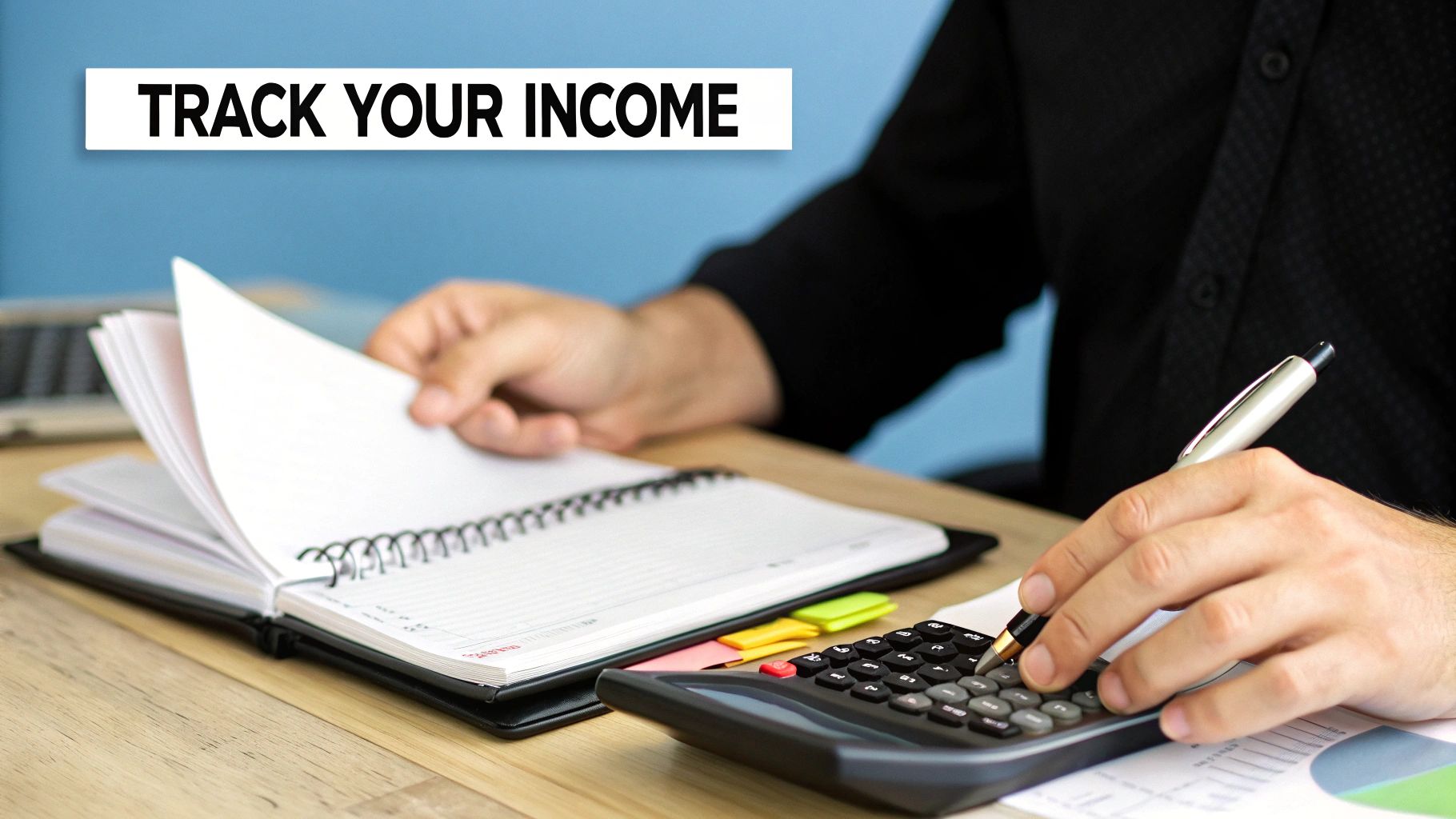
As you can see, your core responsibility is to track all your sales and income, all your business expenses, and any other personal income you might have. This data forms the foundation for your tax return. A crucial part of this is knowing how long you need to hang onto everything.
HMRC is very clear on this: you must keep your business records for at least five years after the 31st January submission deadline for that tax year. So, for the 2022-2023 tax year (which you'd file by 31st January 2024), you need to keep those records safe until at least January 2029. It's worth reading up on exactly how long you should keep your financial records as a self-employed professional.
Choosing the Right Record-Keeping Tools for You
Let's be honest, the best tool for your self-employed records is the one you’ll actually use. It’s all too easy to get swayed by software with endless features, but the real aim is to find a system that slots neatly into your daily routine, fits your budget, and doesn't feel like a chore. The ideal setup for a freelance writer is worlds away from what a busy tradesperson needs.
For many just starting out, a well-organised spreadsheet does the job perfectly. It costs nothing and you have total control. The catch? As your business picks up, the manual data entry can start to feel like a real time-sink, and the risk of a typo throwing your numbers off balance grows with every line you add.
Digital vs. Paper: What's the Real Cost?
Choosing between digital tools and a trusty paper ledger often boils down to a classic trade-off: time versus money. While paper records might seem like the "free" option, their hidden cost is the time you pour into filing, finding, and manually calculating everything. This is precisely where modern solutions begin to look very attractive.
This graphic really highlights the difference in time, error rates, and overall cost between digital and paper-based systems.
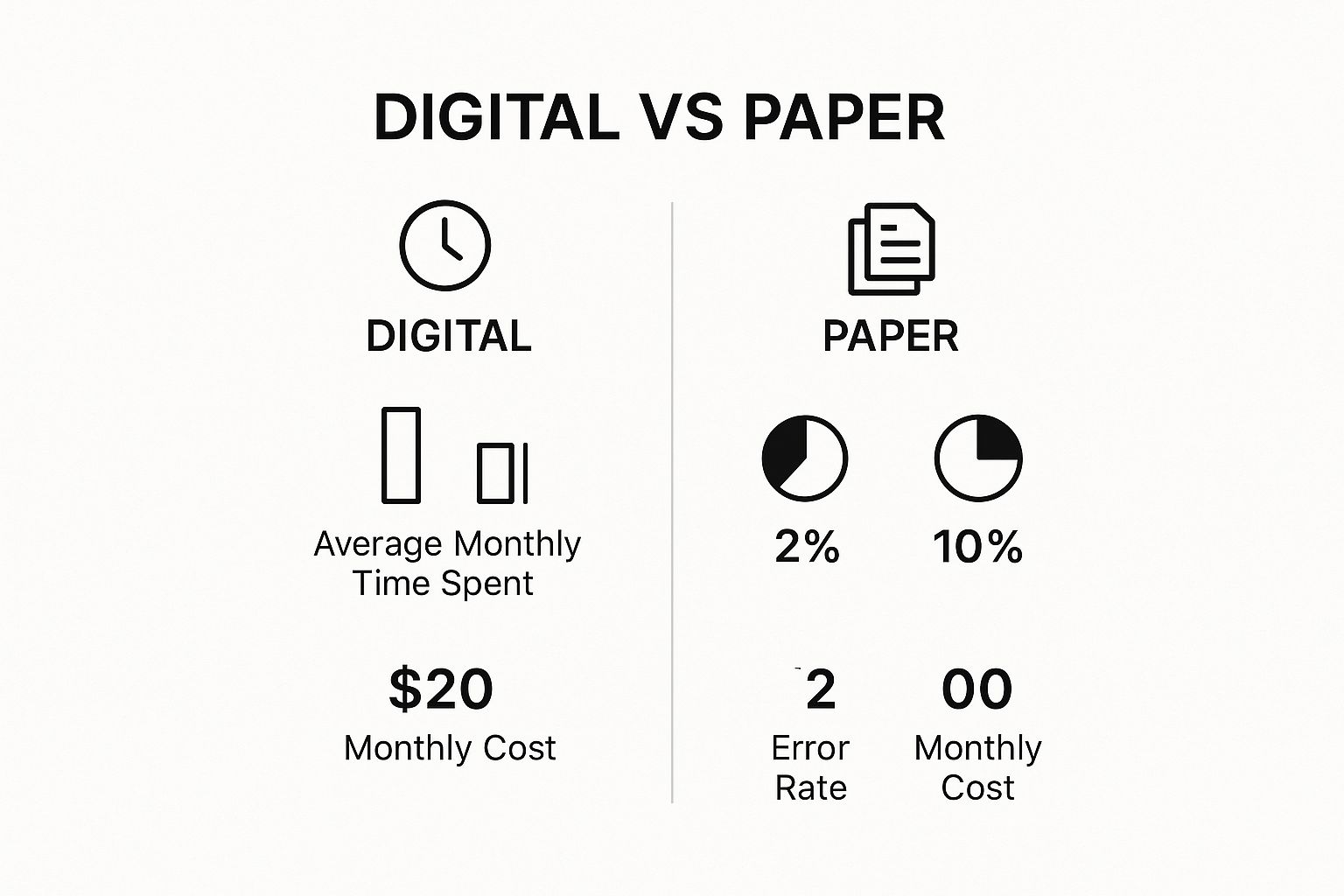
The numbers make it clear: while digital tools come with a subscription fee, the hours they save and the costly mistakes they prevent often mean the software pays for itself several times over.
Comparing Record Keeping Methods for UK Freelancers
To help you decide, here’s a practical comparison of the most common methods. Think about your business, your budget, and how comfortable you are with technology to find your best fit.
| Method | Best For | Pros | Cons |
|---|---|---|---|
| Spreadsheets | New freelancers, those with very few transactions, or anyone on a tight budget. | – Completely free to use. – Highly customisable. – Gives you full control over your data. |
– Prone to human error. – Can become very time-consuming. – No automation or bank feeds. |
| Receipt Scanners | Anyone who makes frequent physical purchases and needs to track expense receipts on the go. | – Saves huge amounts of time on data entry. – Creates a digital, searchable archive of receipts. – Often integrates with accounting software. |
– Only handles the expense side of things. – Subscription fees apply. – Still requires some manual review. |
| Accounting Software | Established freelancers, limited companies, or anyone who wants a complete, automated view of their finances. | – Automates invoicing, expenses, and bank reconciliation. – Provides real-time financial reports. – Makes tax returns much simpler (MTD compliant). |
– The most expensive option. – Can have a steeper learning curve. – Might be overkill for very simple businesses. |
Ultimately, there’s no single "correct" answer. The key is to be realistic about what you need and what you will consistently maintain throughout the year, not just in a panic before the tax deadline.
Exploring Your Software Options
When you feel you've outgrown your spreadsheet, you'll find a fantastic range of tools designed to make your financial admin easier. They generally fall into two main camps:
- Receipt Scanning Apps: Tools like Dext or AutoEntry are lifesavers for capturing expenses as they happen. You just snap a photo of a receipt with your phone, and the app cleverly pulls out the important information, saving you from a pile of paper and tedious typing.
- Dedicated Accounting Software: This is the all-in-one solution. Platforms like FreeAgent, Xero, or QuickBooks are purpose-built for comprehensive self-employed record keeping. They can link to your business bank account, automatically categorise your spending, create and send professional invoices, and generate the reports you need for your tax return.
The true advantage of accounting software is the live, accurate picture it gives you of your business's financial health. You’re not just logging what's already happened; you're getting the insights you need to make smarter decisions for the future.
Making the Right Choice for Your Business
Think about how you work day-to-day. Are you constantly out buying materials or grabbing coffees with clients? A good receipt-scanning app is practically essential. Do you juggle multiple invoices every month? Accounting software with automated payment reminders will save you the awkward job of chasing late payers.
As you look at different software, it's also worth seeing how you could use accounting document automation solutions to cut down on even more manual work. The goal is always to build a system that supports your business, not one that adds to your to-do list.
For instance, a freelance copywriter with just a few clients might get by perfectly with a simple spreadsheet and a free receipt app. On the other hand, a buy-to-let landlord managing several properties, tenants, and maintenance costs would find full accounting software invaluable from the very beginning.
By picking a tool that matches your real-world needs, you’ll set yourself up for stress-free financial admin and a much, much smoother tax season.
What Records You Actually Need to Keep for HMRC
Knowing exactly what information to save is half the battle. When it comes to self-employed record keeping, it’s not about hoarding every scrap of paper you can find. It’s about methodically documenting the right details for HMRC, giving you a clear, defensible file for your Self Assessment.
Think of it as two sides of a coin: the money coming in and the money going out. HMRC needs to see a full picture of both. Let’s break down exactly what you should be tracking.
Documenting All Your Income
Every single penny you earn through your business has to be on the record. This goes beyond just the invoices you send out. Your income records need to paint a complete picture of all your sales and earnings.
This means you’ll need to hold on to:
- All your sales invoices: A copy of every single invoice you issue to a client is a must.
- Bank statements: Your business bank statements provide a clear trail of payments received.
- Records of any cash sales: If you’re paid in cash, you need a log. A market trader, for instance, should have a daily takings sheet.
- Online marketplace reports: Selling on platforms like Etsy or Shopify? Make sure you download and save their sales reports.
It's absolutely crucial to report all your self-employment income, no matter how small an individual job might seem. It's the combined total from all your business activities that HMRC is interested in.
Tracking Your Business Expenses
This is where meticulous record-keeping really starts to pay off. Every "allowable expense" you claim directly reduces your profit, which in turn lowers your tax bill. To claim it, you need proof.
For every single business expense, you should keep:
- Receipts for all goods and services.
- Purchase invoices from your suppliers.
- Bank and credit card statements that show the transactions.
- Records of any personal money you’ve used for business purchases.
Remember, the burden of proof is on you. You must be able to prove an expense was for your business. A simple line on a bank statement might not be enough on its own—that corresponding receipt or invoice provides the essential context that HMRC requires.
What Counts as an Allowable Expense?
So, what costs can you actually claim against your income? The golden rule is that the expense must be "wholly and exclusively" for the purpose of your trade.
Here are some of the most common categories you'll likely encounter:
Common Allowable Expenses
| Category | Real-World Example |
|---|---|
| Office Costs | Rent for your workshop, stationery like printer paper and pens, and your business phone bill. |
| Travel Costs | Fuel and parking for client visits, train tickets to a conference, or bus fares for local jobs. |
| Staff Costs | Salaries paid to employees and any employer's National Insurance contributions you make. |
| Marketing | The cost of running Google Ads, printing flyers for a local event, or your website hosting fees. |
| Financial Costs | Monthly bank charges on your business account or the fees for an accountant like us. |
| Subscriptions | Your annual membership to a professional body or a subscription to a trade journal relevant to your industry. |
A common point of confusion is the home office deduction. If you work from home, you can claim a portion of your household bills like electricity, heating, and council tax. You can either work out the precise proportion based on usage or simply use HMRC’s simplified flat rate.
Good self-employed record keeping makes either method straightforward. Keeping these records organised is your best defence against tax-time stress and ensures you pay the right amount of tax—no more, no less.
How to Organise Your Financial Documents
We’ve all seen it: the shoebox overflowing with crumpled receipts. It's the classic image of freelancer dread, a surefire recipe for a panic-filled tax season. But trust me, smart organisation is the secret to stress-free self employed record keeping. It turns what feels like a monumental chore into a simple, manageable routine.
When you have a solid system, finding that one specific invoice or receipt from six months ago takes seconds, not hours. This isn't just about keeping HMRC happy—it’s about giving yourself some well-deserved peace of mind. Let’s walk through how to get your financial documents in perfect order, whether you’re all-digital or still love a good ring binder.
Create a Logical Folder System
Your first step is to build a structure that just makes sense to you. This logic applies equally to physical binders on a shelf and digital folders on your computer or cloud drive. Vague labels like "Invoices" are your enemy; specificity is your friend.
Start by creating a main folder for each tax year, like "Tax Year 2024-2025". Within that main folder, break it down further into a few core sub-folders:
- Income: This is where you’ll save a copy of every single sales invoice you send out.
- Expenses: To make life easier, create even more sub-folders inside this one. Think "Office Supplies," "Travel," "Software Subscriptions," "Marketing Costs."
- Bank Statements: Keep a clean, dedicated home for all the monthly statements from your business bank account.
- Self Assessment: Once you've filed, this is where your final tax return and the official calculation summary should live.
This kind of clean separation stops your folders from becoming a digital dumping ground. Getting this structure right is half the battle. Once you know what records to keep, the next crucial step is learning how to organize important documents so they're always easy to find when you need them.
Develop a Naming Convention for Digital Files
If you're managing your records digitally, a consistent file naming system is an absolute game-changer. It transforms a chaotic list of cryptically named files into a beautifully organised and searchable archive. A good, practical format usually includes the date, the name of the client or supplier, and a brief description of the document.
For instance, an invoice you’ve sent to a client could be named something like this:
2024-10-25_ClientName_INV-047.pdf
And a receipt for that software you pay for every month could look like this:
2024-10-15_SoftwareCo_Receipt.pdf
It seems like a small thing, but this simple habit makes searching for a specific transaction incredibly easy. No more clicking open ten different PDF files just to find the one you're looking for.
My Pro Tip: Don't let the paperwork pile up. I block out just 15-20 minutes every Friday afternoon to sort through the week's admin. Scan any paper receipts right away, file them using your naming system, and you're done. This weekly rhythm is far less intimidating than staring down a mountain of paperwork at the end of the month.
Always Back Up Your Data
Finally, whether your records are on paper or a hard drive, you have to protect them from being lost. If you're using a paper system, it’s worth investing in a fire-proof and water-resistant box. You’d be surprised how often accidents happen.
For digital records, a backup strategy is non-negotiable. Please don't make the mistake of relying on your computer's hard drive as the only copy. A single hard drive failure could wipe out years of your financial history in an instant. Use a cloud storage service like Google Drive, Dropbox, or OneDrive. Most of these services can automatically sync your folders, creating a secure, off-site copy of everything without you even having to think about it. Consider it your ultimate safety net for robust self employed record keeping.
Common Record Keeping Mistakes to Avoid
Learning from the mistakes of others is one of the fastest ways to get things right. When it comes to self employed record keeping, I've seen how even tiny oversights can snowball into massive headaches, leading to missed deductions, a frantic tax season, and even a dreaded letter from HMRC.
Let's get real about the most common traps that self-employed people fall into. By knowing what to look out for, you can build a system that’s not just compliant, but helps you claim every single penny you're entitled to.
Mixing Business with Pleasure
This is the absolute classic, number one mistake. Running your business transactions through your personal bank account is a recipe for disaster. It turns your financial records into a tangled web, and when your Self Assessment is due, you'll be stuck trying to remember if that café trip was a client meeting or just grabbing a latte for yourself.
It creates a huge amount of extra work and dramatically increases the chances of making a mistake. HMRC expects a clean, clear divide between your business and personal finances for a reason.
Ignoring Small Cash Purchases
That £3 coffee with a potential client or the £5 parking fee might seem trivial at the moment. It’s easy to think, "Oh, it's only a few quid, I won't bother," but this mindset means you're almost certainly overpaying on your tax bill. These small cash expenses really do add up over the course of a year.
Make it a habit to log every single cash transaction, no matter how small. A simple app on your phone or even a dedicated notebook can work. Just make sure you capture:
- A description of what you bought
- The date of the purchase
- The exact amount you paid
This little bit of discipline ensures you capture every allowable expense, which directly reduces your taxable profit.
Misunderstanding Allowable Expenses
Just because a purchase feels like it’s for your business doesn’t automatically mean HMRC agrees. The official rule is that an expense must be "wholly and exclusively" for business purposes, and this is where many sole traders get tripped up.
For instance, buying a smart suit for client meetings is not an allowable expense, because it has a dual purpose (you could wear it to a wedding). On the other hand, branded workwear with your logo or specific protective gear required for your job is allowable.
It's so important to get your head around these distinctions. Claiming things you shouldn't can flag your account for an enquiry from HMRC. If you are ever in doubt, it’s always better to get professional advice than to make a guess that could cost you later.
Letting Record Keeping Pile Up
Procrastination is the real enemy of good financial hygiene. The "I'll sort it all out at the end of the month" mindset almost always becomes "I'll deal with it just before the tax deadline." This is a one-way ticket to a frantic hunt for faded receipts and a mountain of avoidable stress.
The best approach is to make it a small, regular habit. I always advise my clients to set aside just 20 minutes each week to update their records. This consistent approach to self employed record keeping stops it from becoming a monumental chore and keeps your finances organised and your mind at ease.
Answering Your Record Keeping Questions
Even with the best system in place, you're bound to run into specific questions about self-employed record keeping. That’s completely normal. Getting clear, straightforward answers is what helps you manage your finances confidently and stay on the right side of HMRC.
Let's dive into some of the most common queries we hear from freelancers, sole traders, and contractors all over the UK. This is your go-to guide for those fiddly little details that often cause the biggest headaches.
Do I Really Need a Separate Business Bank Account?
Technically, if you're a sole trader in the UK, the law doesn't force you to have one. But I can tell you from experience, it's one of the best things you can do for your business. In fact, it's highly recommended by both HMRC and any accountant worth their salt.
Having a separate business account creates a clean, undeniable line between your business finances and your personal spending. It just makes life so much easier. You'll find it simpler to spot allowable business expenses and create a clear audit trail. When your Self Assessment is due, that separation makes the whole process smoother and much less likely to contain expensive mistakes. Think of it as a cornerstone of good financial hygiene.
How Long Do I Need to Keep My Business Records?
This is a big one, and it's a rule you absolutely must get right. HMRC insists you keep all your business records for at least five years after the 31st of January submission deadline for that tax year.
Let’s put that into perspective. For the 2023-24 tax year, you need to file your online return by 31 January 2025. This means you must hang onto all the related paperwork—receipts, invoices, bank statements, the lot—until at least 31 January 2030. It doesn't matter if they're digital files or paper copies.
Don't be tempted to have a clear-out the moment you've hit 'submit' on your tax return. That five-year rule is non-negotiable, and you'll be glad you have those documents handy if HMRC ever decides to look into your tax affairs.
What Happens If I Lose a Receipt for a Business Expense?
It's frustrating, I know, but losing a receipt doesn't automatically mean you can't claim for that expense. While the original receipt is always the gold standard, it's not game over if one goes missing. Your goal is to find another way to prove the purchase happened.
Start digging for other forms of proof. This could be:
- A bank or credit card statement that clearly shows the transaction.
- The order confirmation email you got from the supplier.
- A note you made in your own bookkeeping records at the time of the purchase.
Make sure to log the key details: the date, the precise amount, and what you bought and why it was purely for business. HMRC will always prefer an original receipt, but having strong secondary evidence is infinitely better than having no proof and losing out on a perfectly legitimate tax deduction.
Navigating the world of self-assessment and record keeping can feel overwhelming, but you don’t have to go it alone. Stewart Accounting Services specialises in taking the stress out of tax and compliance for sole traders, landlords, and small businesses across the UK. Get in touch to see how we can give you more time, more money, and a clearer mind. You can find out more about our services.