

Mastering Self Employed Record Keeping in the UK
When you're self-employed, keeping track of your income and expenses isn't just a good habit—it's a legal must. You need proof, like invoices and receipts, for every transaction. This is the foundation for getting your Self Assessment tax return right and staying on the right side of the law in the UK.
Why Smart Record-Keeping Is Your Business Superpower
Let's get one thing straight: paperwork isn't just a chore to tick off a list. For a self-employed professional, your records are the single most powerful tool you have for building a business that lasts. Think of them less as a box of receipts for HMRC and more as the financial dashboard for your entire operation.
Good records give you a clear, real-time snapshot of your business's health. Are you actually turning a profit? Which of your services are the real moneymakers? Where are your costs creeping up? These questions are impossible to answer with guesswork but become crystal clear when you have organised data to hand.
This clarity means you can make sharp, informed decisions. For instance, a freelance graphic designer I know started tracking her income by project type. She quickly realised that her branding packages were generating nearly double the profit of one-off social media graphics. That insight allowed her to pivot her marketing, focus on what worked, and significantly boost her income.
Beyond Day-to-Day Operations
The perks of solid financial records go far beyond just managing your daily cash flow. If you ever decide to apply for a business loan to expand or even a personal mortgage, lenders will demand a detailed history of your earnings. A tidy set of accounts shows you're professional, reliable, and that your business is a sound bet.
Organised finances are not just about compliance but about building a resilient, successful business from day one. They are the foundation for growth, enabling you to secure funding, optimise profitability, and operate with confidence.
Staying Compliant with HMRC
And, of course, there's the big one: staying compliant with UK tax law. This is one area where you absolutely cannot afford to be disorganised.
In the UK, you are legally required to keep your business records for at least five years after the 31st January submission deadline for that tax year. This includes everything from invoices and bank statements to every last receipt for business expenses.
Getting this wrong can be costly. HMRC can issue penalties of up to £3,000 if you can't produce adequate records when asked. For a deeper dive into the specific rules, you can find more insights on sites like GoSimpleTax.
To make this crystal clear, here’s a breakdown of the essential records you absolutely must keep.
Essential Records for HMRC Compliance
This table summarises the core records every self-employed professional in the UK needs to maintain for full compliance.
| Record Type | Examples | Why It's Important |
|---|---|---|
| Income | – All your sales invoices – Bank statements showing payments received – Till rolls (if you have a physical shop) – Chequebook stubs |
Provides proof of all money your business has earned. This is the starting point for calculating your profit and tax bill. |
| Expenses | – Receipts for goods or stock – Bank statements showing payments made – Mileage logs for business travel – Invoices from suppliers and subcontractors |
Allows you to claim for allowable business expenses, which reduces your taxable profit and, therefore, your tax bill. |
| VAT | – VAT invoices – Records of VAT paid and charged – VAT returns (if you are VAT registered) |
Essential for accurately completing your VAT Return and reclaiming any VAT you've paid on business purchases. |
| PAYE | – Employee wages and deductions – Records of payments to HMRC – P45s and P60s (if you have staff) |
Crucial for managing payroll correctly and ensuring you meet your legal obligations as an employer. |
Keeping these documents organised isn't just about avoiding penalties; it's about peace of mind.
Ultimately, having a good system for your records removes the dread that so many self-employed people feel, especially when tax season looms. It turns a massive source of anxiety into a source of control, giving you the confidence to run your business effectively and plan for a much brighter future.
Choosing Your Record-Keeping System
Picking a system for your self-employed records can feel like a huge decision, but honestly, it just comes down to what works for you and your business right now. If you're just starting out, you don't need to overcomplicate things. The goal is to find a method that keeps you organised, compliant, and sane.
A good system is your best defence against that mad scramble before the Self Assessment deadline. It helps you keep a finger on the pulse of your business's financial health and makes it a breeze to claim every single allowable expense. Let's walk through the main options to see what fits you best.
At its heart, any solid record-keeping setup is about having a clear, structured way to handle your essential documents.
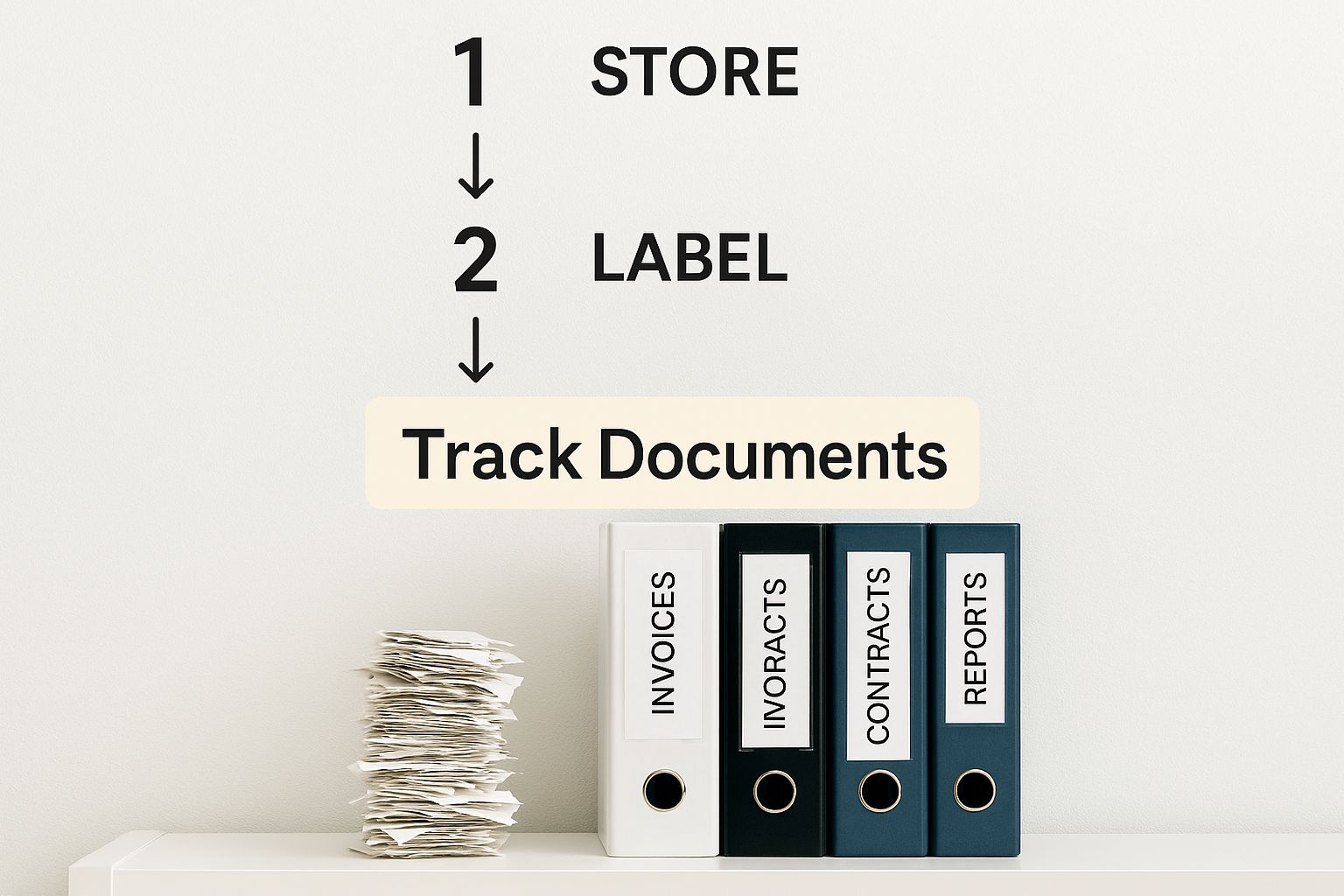
The image above really gets to the core principle: have a designated place for everything, whether it's a folder on your computer or a file in a cabinet.
The Spreadsheet Method
For many new sole traders, a simple spreadsheet is the perfect place to start. It’s practically free, you already know how to use it, and it gives you total control. You can easily set up separate tabs for income and expenses, breaking down each entry to see exactly where your money is coming from and going to.
For instance, a freelance photographer I know started with columns for:
- Date: When the invoice was paid or the receipt was issued.
- Description: A quick note on the job or purchase (e.g., "Headshot session for ABC Corp" or "New camera lens").
- Client/Supplier: Who paid them or where they spent the money.
- Amount (£): The total value of the transaction.
- VAT: A separate column for when they eventually became VAT registered.
While this is a brilliant and lean way to begin, spreadsheets can get clunky as your business picks up steam. They're vulnerable to human error – a single misplaced decimal or formula mistake can throw your entire year's figures out of whack – and they lack the time-saving automation you'll soon crave.
Dedicated Accounting Software
Once you've got a steady stream of invoices and expenses, dedicated accounting software is a complete game-changer. Platforms like Xero, QuickBooks, or FreeAgent are built from the ground up to manage business finances. They take over many of the repetitive, tedious tasks involved in self-employed record keeping.
These tools can connect directly to your business bank account, pulling in transactions automatically and even suggesting how to categorise them. You can also create professional-looking invoices, send automated payment reminders, and see a snapshot of your finances on a dashboard.
The real magic of accounting software is getting a live, accurate picture of your financial position. You shift from just recording the past to actively managing your business's future, allowing you to make smarter decisions based on real-time data.
The Dangers of the 'Shoebox' Method
And then, there's the infamous ‘shoebox’ method. This is exactly what it sounds like: stuffing every paper receipt and invoice into a box to "sort out later." I've seen it firsthand, and it never ends well. While it feels like the easy option day-to-day, it’s the most stressful and riskiest approach you can take.
Trying to organise a year's worth of crumpled paper at the last minute is a nightmare. You’re almost guaranteed to miss out on claiming valuable expenses from lost or faded receipts.
Worse still, it leaves you wide open if you ever face an HMRC enquiry. Showing up with a shoebox is a massive red flag and makes proving your numbers incredibly difficult. My advice? Avoid this method at all costs. It just creates unnecessary stress and will almost certainly cost you money in the long run.
Tracking Your Income and Expenses Like a Pro
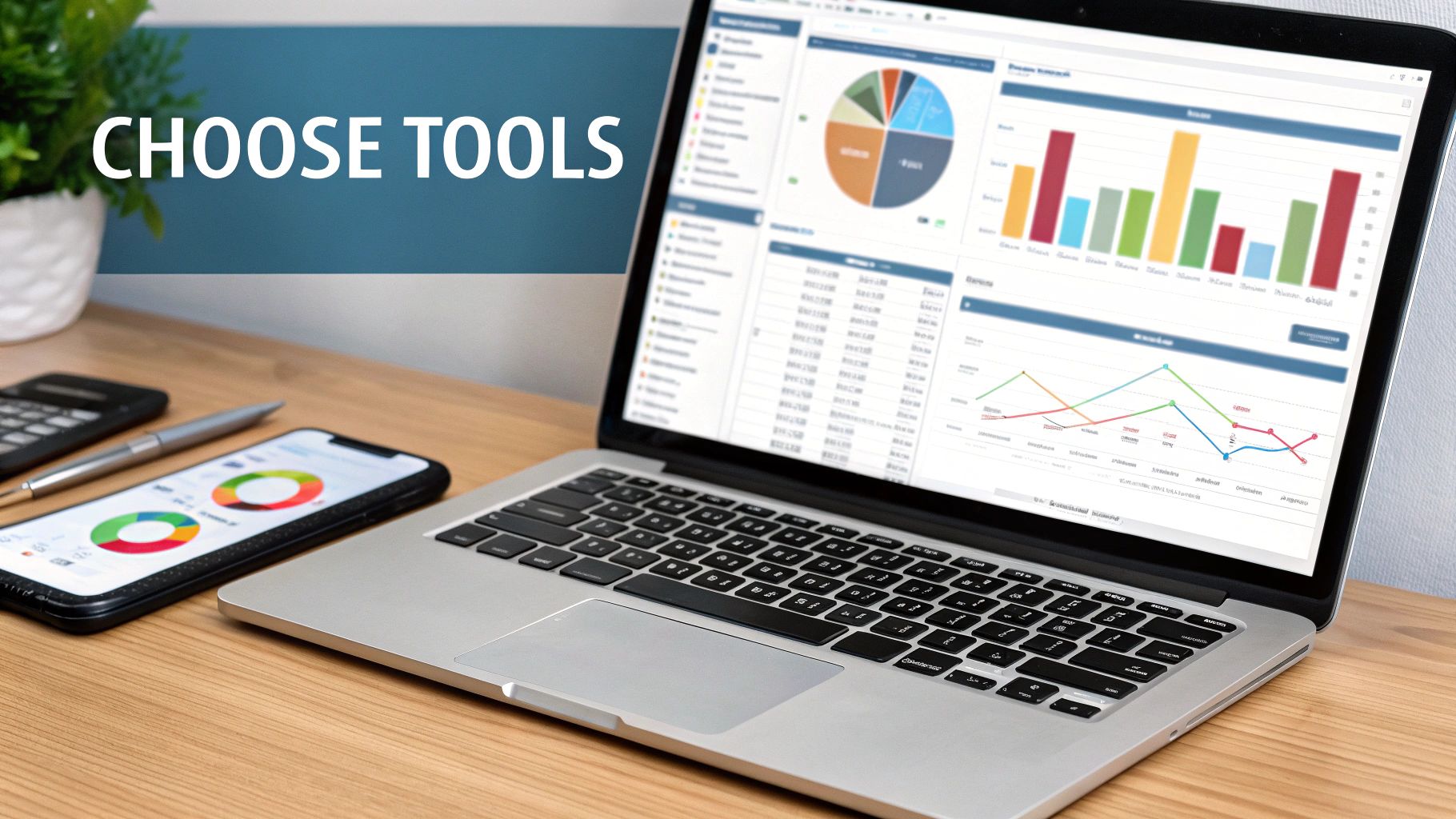
Right, let's get down to the nitty-gritty. This is where the theory of good record-keeping meets the daily reality of running your own business. We’re moving beyond just setting up systems and into the practical details of tracking every pound that comes in and goes out.
Think of it this way: diligent tracking isn't a once-a-year chore for your tax return. It's the lifeblood of your business, giving you a real-time picture of your cash flow and profitability.
One of the biggest, and most common, mistakes I see self-employed people make is mixing their personal and business finances. It’s a recipe for disaster. It creates a chaotic paper trail, risks an inaccurate tax return, and makes it almost impossible to tell if your business is actually making money.
The fix is surprisingly simple. Open a separate business bank account from day one. Have all your client payments go in, and all your business purchases come out. That one small step creates a clean, automatic record that will make your bookkeeping infinitely easier.
Keeping on Top of Your Income
If you’re like most freelancers or contractors, you probably have money coming in from various clients and projects. Staying on top of who has paid and who hasn't is crucial for a healthy cash flow. Your primary tool here? The humble invoice.
A proper, professional invoice is non-negotiable. It needs to include:
- Your business name and address
- The client's details
- A unique invoice number and the date
- A clear breakdown of the services you provided
- The total amount due and your payment terms (e.g., "Due within 14 days")
Creating a sharp, clear invoice doesn't just give you the records you need; it also gets you paid faster. For instance, if you're a freelance graphic designer juggling three projects, using sequential invoice numbers (#001, #002, #003) helps you instantly see if a payment from client #002 is missing.
Claiming Every Allowable Expense
This is where you can make a real difference to your bottom line. Understanding and tracking your expenses is how you lower your taxable profit, which in turn lowers your tax bill. HMRC lets you claim for any costs that are "wholly and exclusively" for your business. It’s a potential goldmine, but only if you have the proof.
The rule of thumb for expenses is quite simple: if you didn't have the business, would you have spent this money? If the answer is no, it's almost certainly a claimable business expense. Your job is to keep meticulous records to back it up.
Common examples of allowable expenses include things like:
- Office Costs: Pens, paper, printer ink, postage.
- Digital Tools: Your accounting software, project management subscriptions, or specialist industry apps.
- Marketing: Website hosting, business cards, or online advertising costs.
- Travel: Train tickets to meet a client or fuel for business-related journeys. For travel, it’s worth understanding tax-efficient mileage tracking to ensure you’re claiming correctly and not leaving money on the table.
A big one that often gets overlooked is working-from-home expenses. If your office is at home, you can claim a portion of your household bills like heating and electricity. HMRC even offers a simplified flat-rate claim based on the hours you work from home, which saves you from doing complicated sums.
The key is consistency. Whether you use a spreadsheet or dedicated software, logging every receipt and invoice as you go creates an undeniable evidence trail for HMRC. No more last-minute panic.
Staying Confident with HMRC Compliance
Let's be honest, the thought of an HMRC enquiry can make even the most experienced sole trader a bit nervous. But most of that anxiety really just comes from a fear of the unknown. When you have meticulous records for your self-employed business, that fear turns into confidence. You know you’re prepared for anything.
It's important to remember that an enquiry doesn't automatically mean you've done something wrong. Sometimes they're triggered by a simple data mismatch, and other times they're just part of a routine, random check. Your best strategy is to be proactive. Have a set of pristine, well-organised records ready to go at a moment's notice.
What an HMRC Enquiry Actually Looks Like
So, what happens if HMRC does get in touch? Typically, they'll send a letter asking for specific documents to check the figures you submitted on your Self Assessment tax return. Being able to hand these over quickly and cleanly shows you’re professional and have nothing to hide, which can often wrap things up fast.
Here’s the kind of information they usually want to see:
- Bank Statements: This includes both your business and personal accounts, so they can verify income and cross-reference your spending.
- Sales Invoices: They’ll want a complete record of every single invoice you sent out during the tax year.
- Expense Receipts: You'll need proof for every allowable expense you've claimed. No receipt, no claim.
- Mileage Logs: If you've claimed for using your vehicle, they'll expect to see detailed logs of your business trips.
This is exactly why keeping on top of your records throughout the year is so crucial. Instead of a mad, panicked scramble through shoeboxes and old emails, it's just a simple task of pulling up your organised files.
The real goal of great record keeping isn't just about ticking boxes for the tax man. It's about building a fortress of proof around your business. When you can back up every single number on your tax return with a clear paper trail, you remove the fear of being questioned.
The Five-Year Rule and Why You Can't Ignore It
Here’s a non-negotiable part of UK tax law: you are legally required to keep your business records for at least five years after the 31st January submission deadline for that tax year. This isn't just a friendly suggestion; it's a legal requirement.
If you don't keep proper records, or you dispose of them too early, you could be facing some hefty penalties. That’s not meant to scare you, but to empower you. Once you know the rules of the game, it's much easier to play and win.
Accurate records are absolutely vital for staying compliant and avoiding costly investigations. HMRC expects your records to paint a clear picture of all your business income and allowable expenses, and they need to be organised enough to be found quickly during an enquiry. For an even deeper dive, it's worth exploring the expert guidance on self-employed record keeping at TaxAid.org.uk.
At the end of the day, compliance is simply a result of good organisation. When you make record-keeping a core part of how you run your business, you're not just getting ready for a potential audit. You’re building a stronger, more transparent, and ultimately more successful business, giving you the peace of mind that if HMRC ever does call, you'll be completely ready.
Using Digital Tools to Simplify Your Finances
When you're first starting out as self-employed, a simple spreadsheet for tracking your income and expenses feels like all you need. It’s straightforward and gets the job done. But as your business grows, that spreadsheet can quickly turn into a time-consuming chore, prone to errors and becoming a real bottleneck.
Thankfully, you don’t have to stay stuck in spreadsheet purgatory. Embracing a bit of modern tech isn't about making your life more complicated—it's about simplifying it. The right digital tools are designed to take the most repetitive tasks off your plate, cut down on human error, and give you a crystal-clear, real-time view of your finances. For any busy sole trader, learning to automate data entry is a genuine game-changer.
Moving Beyond Spreadsheets
The real leap forward comes from using a cloud accounting platform. Think of it as a dedicated financial hub for your business, built to handle everything from invoicing and expense tracking right through to getting your tax figures ready.
The benefits are immediate and tangible:
- Live Bank Feeds: These platforms securely link to your business bank account and automatically pull in every transaction. Suddenly, the tedious task of manually typing in every single purchase is gone.
- Receipt Scanning: Most come with a slick mobile app. You just snap a photo of a receipt, and the software instantly reads the data, categorises it, and attaches the image. It's the perfect audit-proof record.
- Real-Time Dashboards: At a glance, you can see your cash flow, profit and loss, and who owes you money. This isn't just about bookkeeping; it's about having the insights you need to make smarter business decisions on the fly.
- Making Tax Digital (MTD) Compliance: Crucially, these platforms are designed to be fully compliant with HMRC’s upcoming MTD for Income Tax Self Assessment (ITSA) rules. This means you'll be ready long before the deadlines hit.
Here in the UK, popular choices like Xero, QuickBooks, and FreeAgent all offer plans specifically for sole traders, each with its own strengths.
This is a typical dashboard from Xero. That immediate, visual snapshot of your business's financial health is something a spreadsheet just can't deliver.
The magic of these tools is how they shift record-keeping from a backwards-looking chore into a forward-looking management tool. You’re no longer just documenting the past; you’re actively shaping your financial future.
Choosing the Right Software
So, which platform is for you? The honest answer is: it depends entirely on your business. A freelance copywriter with a handful of monthly invoices has very different needs to an e-commerce seller managing inventory and various payment processors.
To help you decide, here’s a quick comparison of the big players for UK sole traders.
Comparison of Popular Accounting Software for the Self-Employed
| Software | Best For | Key Features | Price Point |
|---|---|---|---|
| Xero | Growing businesses and those wanting extensive app integrations. | Powerful invoicing, a huge third-party app marketplace, and brilliant reporting tools. | Mid-to-high |
| QuickBooks | Sole traders needing solid mileage tracking and reliable tax estimates. | Fully MTD-ready, a very intuitive mobile app, and great all-round features for the self-employed. | Mid-range |
| FreeAgent | UK freelancers and contractors who value simplicity and direct Self Assessment filing. | A wonderfully user-friendly interface, project and time-tracking features, and direct tax filing to HMRC. | Often free with certain business bank accounts. |
Ultimately, the best software is the one you’ll consistently use. Most of these platforms offer free trials, so my advice is to take two of them for a proper test drive. See which one feels more natural and fits your workflow.
That small investment of time upfront will pay you back tenfold in the hours you save—and the headaches you avoid—down the road.
Your Top Record-Keeping Questions Answered
Even with the best system in place, some specific questions about self-employed record-keeping always seem to pop up. Think of this as your go-to guide for clear, straightforward answers to those common—and often tricky—situations you're likely to face.
How long should I actually keep my business records?
This is a big one, and HMRC has a very firm rule here. You need to keep your business records for at least five years after the 31st January submission deadline for the relevant tax year.
Let’s put that into practice. For the 2023-2024 tax year (which ends on 5th April 2024), your online filing deadline is 31st January 2025. That means you must hang onto all your records for that year until at least 31st January 2030. Honestly, keeping digital copies is the smartest move—it completely sidesteps the problem of lost or faded paper receipts down the line.
I've lost a receipt. Can I still claim the expense?
It’s a headache we’ve all faced, but the official answer is, unfortunately, no. Without a receipt or some other concrete proof of purchase (like a crystal-clear bank statement entry), you can't claim an expense on your tax return.
HMRC is strict about this; you need evidence for every single expense you claim. If they ever opened an enquiry into your accounts and you couldn't produce the proof, that expense would be disallowed. You'd then be on the hook for the extra tax. This is exactly why those receipt-scanning apps are so brilliant—they create an instant digital backup, so you're always covered.
When do I need to register as a sole trader?
You should get registered with HMRC as a sole trader as soon as you start trading. While the official deadline isn't until the 5th of October in your business's second tax year, leaving it that late is a recipe for unnecessary stress.
Registering early gets you into the system and ensures you receive all the important information from HMRC well before your first Self Assessment is due. It just makes life easier.
A common myth is that you only need to report your self-employed income once you earn over a certain amount. The truth is, you have to report all of it, no matter how small. The £1,000 trading allowance just means you don't pay tax on income below that figure, but you still might need to declare it.
What happens if my business makes a loss?
Making a loss is a perfectly normal part of the business journey, especially in the early days. You must still complete a Self Assessment tax return and declare that loss.
This isn't bad news at all. In fact, you can often use that loss to reduce your overall tax bill. You can either set it against other income you have in the same tax year or carry it forward to reduce the profits you make in future years. To do this, though, your records need to be watertight to prove the loss is genuine.
Managing your finances shouldn’t be a source of constant stress. The team at Stewart Accounting Services specialises in helping sole traders and small businesses across the UK take control of their records, stay compliant, and get back to focusing on growth. If you're ready for more time, more money, and a clearer head, visit the Stewart Accounting Services website to see how we can help.
Recent Posts
09 Sep, 2026