
One of the very first, and most significant, decisions you'll make when starting a business in the UK is choosing between setting up as a sole trader or a limited company. This isn't just about paperwork; it's a fundamental choice that impacts your growth potential, your attitude to risk, and how much time you're willing to spend on admin.
If you're after simplicity and minimal setup costs, the sole trader path is often the most straightforward. However, if your priorities are protecting your personal assets, achieving greater tax efficiency, and building a business that can scale, then forming a limited company is usually the better move.
Choosing Your UK Business Structure
Picking your legal structure lays the groundwork for your entire business journey. It dictates everything from how you're taxed to the level of personal liability you face if things go wrong. Think of it less as a compliance task and more as a strategic decision that shapes how you operate, grow, and safeguard your personal finances.
This choice directly influences several key areas:
- The degree of your personal financial risk.
- The amount of tax you'll ultimately pay.
- Your capacity to secure investment from others.
- The ongoing administrative burden you'll need to manage.

It’s easy to get bogged down in the details, but getting this right from the start saves a lot of headaches later on. For a deeper dive into the specifics, these expert-backed tips for choosing the right legal structure can provide some excellent context.
This guide is designed to cut through the jargon and explore the real-world differences, helping you make a confident choice that's right for your unique situation.
Here’s the rewritten section, crafted to sound like it was written by an experienced human expert.
How Does the Law See You? A Look at Liability and Asset Protection
When you’re weighing up being a sole trader against setting up a limited company, one of the biggest questions you need to ask yourself is: how much personal risk am I willing to take on? The answer to this really gets to the heart of the legal difference between these two structures.
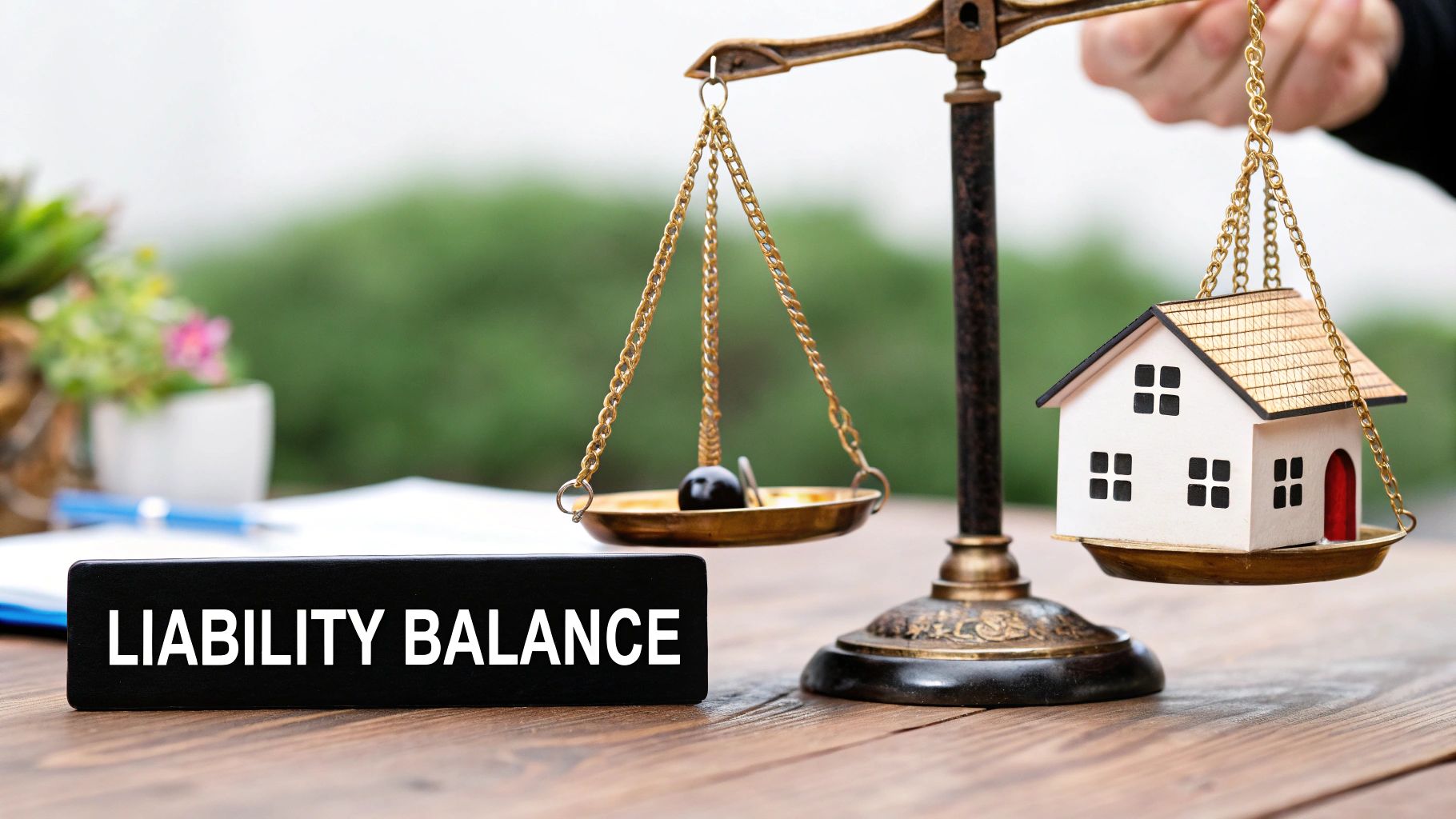
If you go down the sole trader route, the law doesn't distinguish between you and your business. You’re one and the same. This means you have unlimited personal liability. Should the business run into debt or face a lawsuit, your personal assets – everything from your house to your car and personal savings – could be on the line to cover it. It's a straightforward way to start, but that simplicity comes with significant personal exposure.
On the other hand, forming a limited company creates a separate legal person in the eyes of the law. Think of it as building a legal wall, often called a "corporate veil," between your business finances and your personal finances. Your liability is then 'limited' to the value of your investment or any shares you hold in the company. This is a game-changer for many entrepreneurs, offering peace of mind and a more formal, credible business image. If you want to dig deeper into UK business structures, you can find more insights about liability and choosing the right setup on fundingpool.co.uk.
The Bottom Line: As a sole trader, there's no legal barrier protecting your personal wealth from business troubles. With a limited company, that barrier is exactly what you get—your personal assets are shielded.
2. Tax Efficiency and Your Take-Home Pay
Let’s talk about the big one: tax. How you’re taxed is often the single most important factor when weighing up being a sole trader against setting up a limited company. The difference isn't just a few percentage points here and there; it's a fundamental split in how HMRC treats your business profits.
As a sole trader, it’s simple but can be costly. You pay Income Tax and National Insurance on all your profits, whether you leave the money in the business or take it out. A limited company, on the other hand, is a separate legal entity and pays Corporation Tax on its profits.
The Core Difference in Tax Treatment
This separation is where the real planning opportunities lie. For the 2025/26 tax year, the main rate of Corporation Tax is 19% for companies with profits under £50,000. In contrast, a sole trader starts paying Income Tax at 20%, plus National Insurance contributions on top. You can see the full breakdown of current tax rates and allowances to get a feel for the numbers.
Company directors can then pay themselves through a tax-efficient blend of a small salary (often set just high enough to qualify for National Insurance credits but low enough to avoid paying much tax) and dividends, which are taxed at a lower rate than salary income.
This image gives a great at-a-glance view of the basic rates.
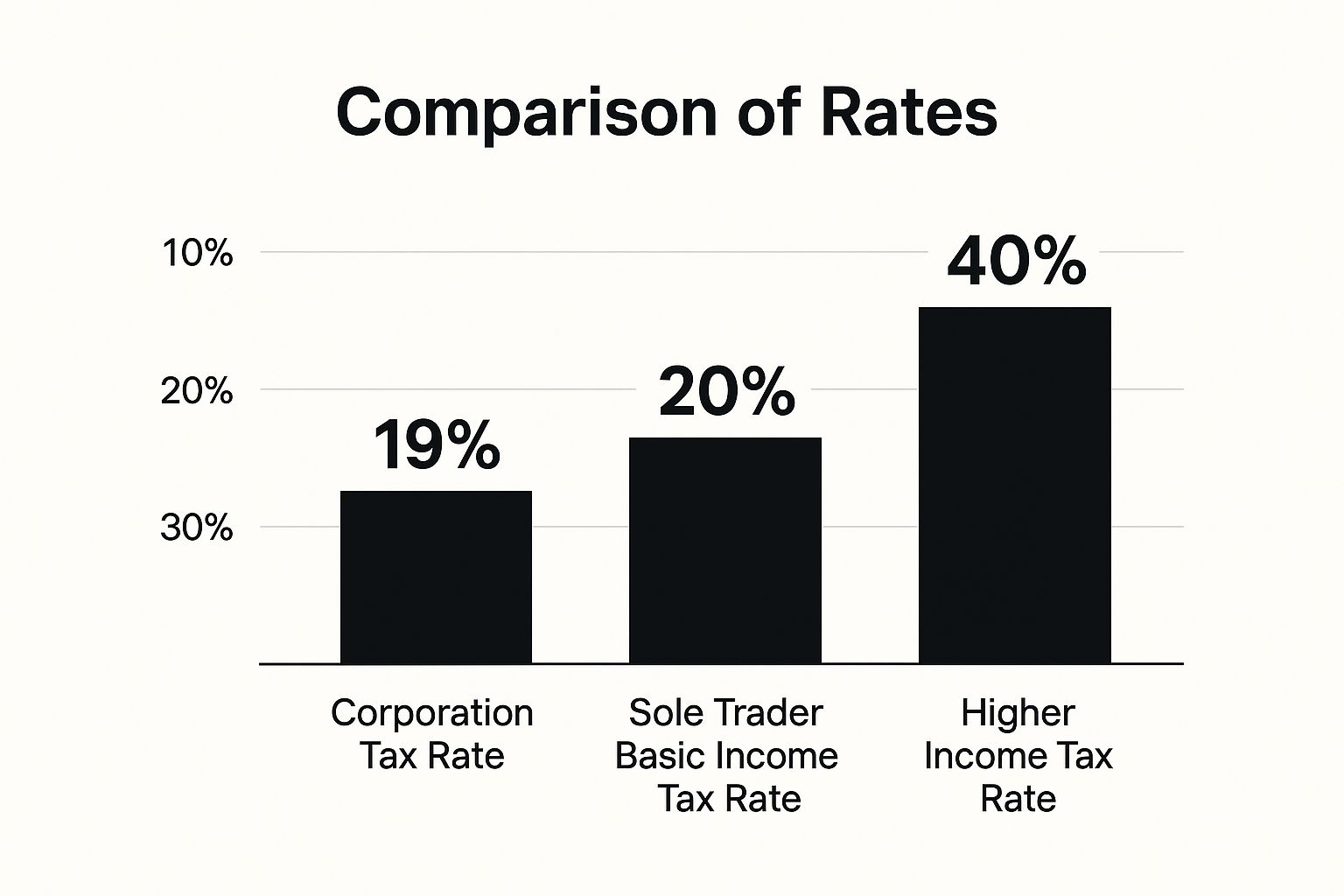
As your income climbs, the maths becomes even more compelling. Once your profits push you into the 40% higher rate tax bracket as a sole trader, the fixed Corporation Tax rate of a limited company suddenly looks incredibly attractive.
Tax Efficiency at Different Profit Levels Sole Trader vs Limited Company
To really see how this plays out in the real world, let's look at some numbers. The table below shows the approximate total tax bill for each structure at different profit levels. These are estimates for the 2025/26 tax year and assume a director is extracting all post-tax profit efficiently.
| Annual Profit | Approx. Total Tax as Sole Trader | Approx. Total Tax as Limited Company Director | Structure with Lower Tax Bill |
|---|---|---|---|
| £30,000 | £6,140 | £6,020 | Limited Company (marginally) |
| £60,000 | £16,140 | £13,100 | Limited Company |
| £100,000 | £34,140 | £26,500 | Limited Company |
Note: Figures are illustrative and depend on individual circumstances. They include Income Tax, National Insurance, Corporation Tax, and Dividend Tax where applicable.
As you can see, even at modest profit levels, the limited company structure starts to pull ahead. But once profits exceed the higher-rate threshold (around £50,271), the savings become significant, often amounting to thousands of pounds each year. This is the tipping point where many successful sole traders decide it's time to incorporate.
What Does It Take to Run Your Business Day-to-Day?
When you're weighing up whether to be a sole trader or form a limited company, it's easy to get fixated on tax and liability. But what often gets overlooked is what your life will actually look like on a Tuesday afternoon. The day-to-day admin and running costs are vastly different for each, and this can be a deciding factor.
If simplicity is what you're after, the sole trader route is hard to beat. Your main obligation is to register for Self Assessment with HMRC and keep a straightforward record of your income and outgoings. That's pretty much it.
A limited company, on the other hand, comes with a much heavier administrative load. You’re not just registering with HMRC; you first need to incorporate the company with Companies House. This involves appointing at least one director and then committing to a yearly cycle of filing official documents. This includes annual accounts, a confirmation statement to verify your company's details, and a separate Corporation Tax return. All this extra work often translates into higher accountancy fees.
The core trade-off is clear: the time and money saved on admin as a sole trader directly corresponds to greater personal financial risk. This is a crucial balance you must consider.
How Your Choice Impacts Business Growth and Credibility
The business structure you choose isn't just a legal formality; it sends a powerful signal to clients, partners, and investors. Rightly or wrongly, a limited company often projects an image of being more established and permanent. This perception can be a real advantage when you're trying to win larger corporate clients or secure government contracts, as some organisations have procurement policies that favour incorporated businesses.
Crucially, if you ever plan to seek equity investment, a limited company is your only viable path. The ability to issue shares to investors is fundamental to this type of funding, and it's a feature exclusive to incorporated entities.
But that doesn't mean being a sole trader puts you at a disadvantage. In fact, it's the most popular business structure in the country for a reason. In 2024, an incredible 56% of all UK private sector businesses were sole proprietorships, a figure that speaks volumes about its credibility and widespread acceptance. You can dig deeper into these UK business statistics at money.co.uk. For many freelancers and small businesses, the greater privacy—keeping your financial details off the public record at Companies House—is a significant benefit.
Ultimately, thinking about your long-term goals is key. If your ambition includes raising capital or building a business with a significant saleable value, you'll need to understand how your structure affects that. Using a business valuation estimator can provide some early insights into how these decisions might play out financially down the line.
Making the Right Call for Your Business
So, which path is right for you? Honestly, the choice between operating as a sole trader or a limited company isn't just a theoretical exercise. It's a very practical decision that hinges on your specific business, your appetite for risk, and where you see yourself in the future.

For many people starting out—think freelancers, consultants, or anyone running a low-risk venture with modest profits—the sole trader route is often the perfect fit. It's simple, quick, and keeps the paperwork to a minimum. But, if your plans are a bit bigger, perhaps involving hiring employees, raising investment capital, or simply shielding your personal assets from business debts, then a limited company really is the only way to go.
Remember, the decision you make today isn't permanent. It's quite common to start as a sole trader and later convert to a limited company. The process is well-trodden and allows your business structure to evolve right alongside your success.
Frequently Asked Questions
When you're weighing up whether to be a sole trader or form a limited company, a lot of practical questions naturally come to mind. Here are some straightforward answers to the queries we hear most often from business owners in the UK.
Can I Use a Business Name as a Sole Trader?
Yes, absolutely. As a sole trader, you don't have to trade under your own name. You can pick a different "trading as" name for your business, which is a great way to build a brand that feels separate from you personally.
Just keep a few important rules in mind:
- Your chosen name can't be offensive or contain sensitive words unless you have official permission.
- It's crucial to check it's not the same as an existing trademark.
- You must not use terms like "Limited," "Ltd," "LLP," or "PLC" in your name. These are legally reserved for specific company structures.
What Happens if I Make a Mistake on My Company Accounts?
It happens, but it’s something you need to fix promptly. If you spot an error in the annual accounts you've filed with Companies House, you can submit an amended version to correct the record. Acting quickly is key to staying compliant.
This is precisely why so many directors decide to work with an accountant. As a director, you're legally on the hook for the accuracy of your company's filings. Getting professional support isn't just about saving time; it's about peace of mind.
How Difficult Is It to Switch From a Sole Trader to a Limited Company?
It's a well-trodden path for many growing businesses and is probably more straightforward than you think. You don't "convert" your business in a technical sense. Instead, you register a brand new limited company with Companies House and then simply transfer your existing business name, assets, and operations over to it.
Once your new company is officially registered, you’ll need to let HMRC know. This means you'll stop being registered for Self Assessment as a sole trader and get your new company set up for Corporation Tax and PAYE. An accountant can handle this entire transition for you, making sure everything is done correctly and smoothly.
Trying to get your head around business structures, tax rules, and financial reporting can feel overwhelming. At Stewart Accounting Services, we specialise in taking that weight off your shoulders. We help sole traders and limited companies across the UK manage their finances properly, giving them more time, more money, and a clearer mind. Whether you need a hand with self-assessment or you're ready to grow as a limited company, get in touch with our team of chartered accountants today.