

The UK CGT Allowance for 2026/26 Explained

Understanding Capital Gains Tax (CGT) can feel complicated, especially when the rules and allowances change. If you’ve sold a valuable asset like shares, property, or cryptocurrency, you might be wondering if you owe tax on the profit. This guide will help you understand the current Capital Gains Tax allowance for the 2025/26 tax year, see how it has changed, and learn how you can use it to legally reduce your tax bill.
What is the CGT Allowance for the 2025/26 Tax Year?
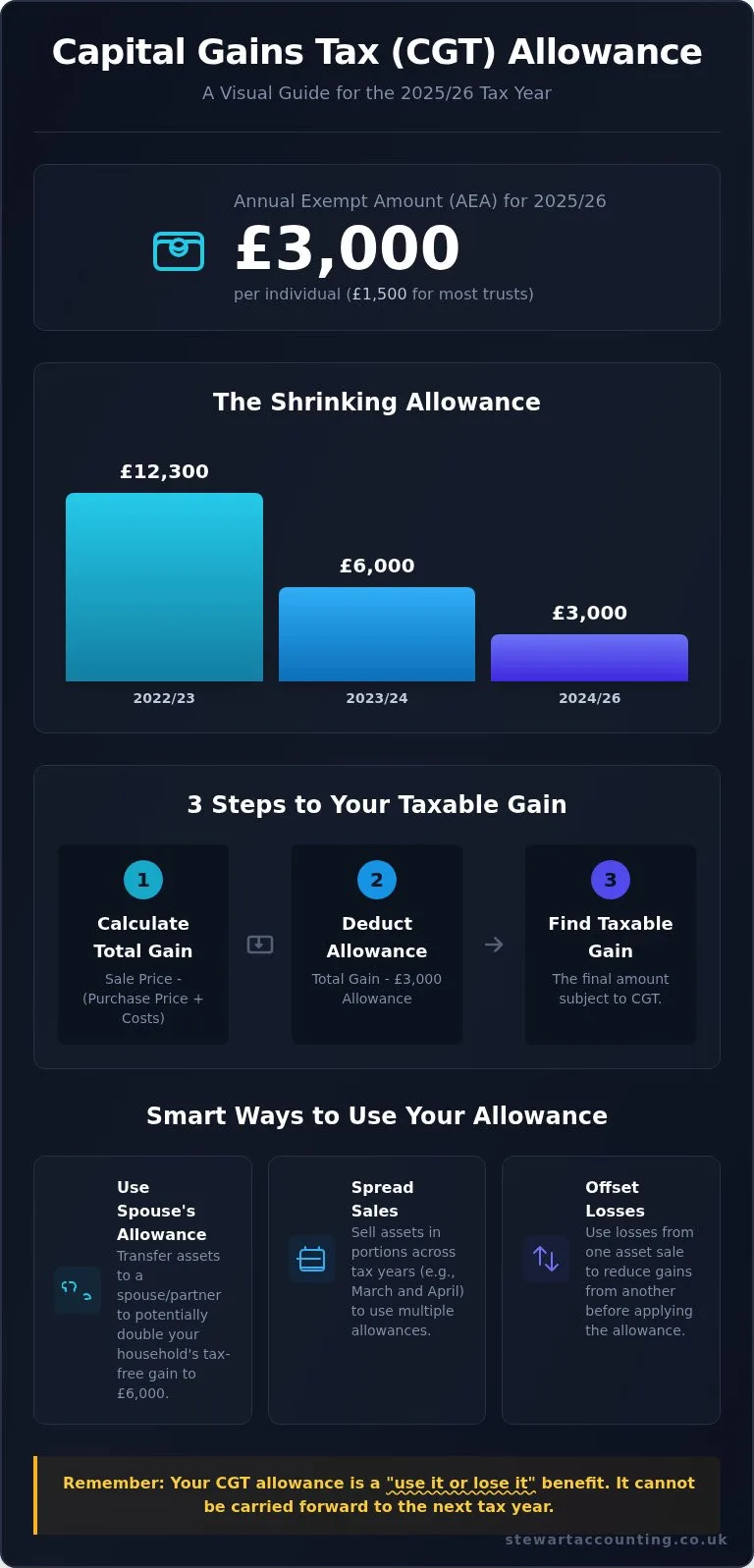
For the tax year running from 6th April 2025 to 5th April 2026, the Capital Gains Tax allowance is £3,000 for individuals. This allowance is officially known as the Annual Exempt Amount (AEA). In simple terms, it’s the amount of profit you can make from selling assets in a tax year before any tax is due. For most trusts, the allowance is set at half this amount, which is £1,500.
It’s crucial to remember that your annual allowance is a “use it or lose it” benefit. You cannot carry any unused portion of your £3,000 allowance forward into the next tax year. This makes planning the timing of your asset sales very important.
How the CGT Allowance Has Changed Recently
The CGT allowance has been significantly reduced over the past few years, which means that many more people who sell assets now find themselves needing to pay this tax. The sharp decrease means that even modest gains are now potentially subject to tax.
Here’s a quick look at the recent changes:
- 2022/23 Tax Year: The allowance was £12,300.
- 2023/24 Tax Year: The allowance was cut to £6,000.
- 2024/25 & 2025/26 Tax Years: The allowance was reduced again to just £3,000.
This dramatic reduction means that a profit from an asset sale that would have resulted in no tax bill just a few years ago might now require you to file a report and pay tax to HMRC.
How to Calculate Your Taxable Gain Using the Allowance
Working out whether you owe CGT doesn’t have to be stressful. By following a simple three-step process, you can get a clear picture of your position. This calculation shows exactly how the allowance works to protect your initial profit from tax.
Step 1: Work Out Your Total Capital Gain
First, you need to calculate your overall profit, or ‘gain’. Start with the amount you sold the asset for. From this figure, you should subtract the original price you paid for it. You can also subtract certain allowable costs associated with buying and selling the asset, such as solicitor’s fees, stamp duty, or stockbroker fees. The final figure is your total capital gain.
Step 2: Deduct the Annual CGT Allowance
Once you have your total gain from Step 1, you can subtract the tax-free allowance. For the 2025/26 tax year, this is £3,000. If your total gain is less than £3,000, your result will be zero or a negative number. In this case, you typically have no Capital Gains Tax to pay and may not need to report the gain to HMRC.
Step 3: Understand Your Taxable Gain
If you have an amount remaining after subtracting the allowance in Step 2, this is your ‘taxable gain’. This is the final figure on which you will pay Capital Gains Tax. The rate of tax you pay on this amount depends on the type of asset you sold and your personal Income Tax band. Tax calculations can be complex, but you don’t have to figure them out on your own. Let us handle the calculations and take the worry away.
Smart Ways to Use Your CGT Allowance
With the allowance now much lower, strategic planning is more important than ever. By thinking ahead before you sell your assets, you can make full use of the rules available to legally reduce your final tax bill. Here are a few common strategies to consider.
Use Your Spouse’s Allowance
You can transfer assets to your spouse or civil partner without creating a Capital Gains Tax charge. This is a useful planning tool because they can then sell the asset and use their own £3,000 tax-free allowance. This effectively doubles the tax-free gain a couple can make to £6,000 in a tax year.
Spread Sales Across Tax Years
If you are planning to sell a large asset or a portfolio of shares, it might be beneficial to sell them in smaller portions across different tax years. For example, selling a portion in March (before the tax year ends on April 5th) and the rest in April (at the start of the new tax year) allows you to use the allowance from two separate years against the gain.
Offset Losses Against Gains
If you’ve sold an asset at a loss in the same tax year, you can use that loss to reduce your total gains. You must use your losses to reduce your total gain before you apply your tax-free allowance. If your losses are greater than your gains, you can carry the net loss forward to use in a future tax year. You must report these losses to HMRC, usually on your Self Assessment tax return, within four years.
Frequently Asked Questions
What was the CGT allowance for the 2024/25 tax year?
The CGT allowance for the 2024/25 tax year (6 April 2024 – 5 April 2025) was also £3,000 for individuals and £1,500 for most trusts.
Do I get a CGT allowance for property sales?
Yes, the £3,000 Annual Exempt Amount applies to gains from selling residential property that is not your main home (e.g., a buy-to-let or a holiday home). However, be aware that the tax rates for property gains are higher than for other assets.
Can I carry forward my unused CGT allowance?
No, the Capital Gains Tax allowance cannot be carried forward. If you do not use your £3,000 allowance within a tax year, it is lost.
Do I have to pay CGT on crypto or shares?
Yes, cryptocurrencies and shares are treated as assets for Capital Gains Tax purposes. If your profit from selling them in a tax year exceeds the £3,000 allowance, you will need to report it and pay tax.
What happens if my gain is less than the £3,000 allowance?
If your total capital gains in a tax year are under the £3,000 allowance, you generally do not have to pay any CGT. You also may not need to report the gain to HMRC, unless you are already required to file a Self Assessment tax return for other reasons.
Navigating tax rules can be a source of stress, but understanding your allowances is the first step toward managing your finances with confidence. If you are based in Scotland, it’s also worth understanding how Scotland’s distinct income tax bands affect the rate you pay — our complete guide to Capital Gains Tax in Scotland explains exactly how this works for the 2025/26 tax year. As fully qualified Chartered Accountants, we provide expert tax advice for clients across Central Scotland, helping you save time, money, and stress. Need help managing your Capital Gains Tax? Contact our friendly team.
Recent Posts
12 Oct, 2026
12 Oct, 2026
10 Oct, 2026