

Last April, a small business owner in Stirling spent three sleepless nights hunting for a single £450 utility invoice to avoid a potential HMRC fine. If you’ve ever felt that same heavy dread while staring at a mountain of digital folders or mismatched paper receipts, you’re certainly not alone. Most UK entrepreneurs find the year-end process to be the single biggest drain on their mental health. It’s exhausting when you want to focus on your business goals but feel trapped by administrative clutter. Using a professional accounts preparation checklist is the most effective way to take this burden off your hands and restore your peace of mind.
At Stewart Accounting Services, we’re committed to giving you more time, more money, and more mind. This guide simplifies your 2026 filing requirements so you can stop worrying about missing deadlines and start focusing on your growth. We’ll walk you through exactly which records to gather, how to reconcile your bank statements, and the specific steps to reduce your tax liability through better organization. This article provides a clear, step by step breakdown of everything you need to prepare your accounts with total confidence.
Key Takeaways
- Learn the critical difference between daily bookkeeping and annual statutory accounts to ensure your business stays compliant with the latest HMRC standards.
- Follow our structured accounts preparation checklist to accurately reconcile income and categorise expenses, eliminating the stress of the traditional “shoebox” method.
- Identify common year-end pitfalls and discover how digital tools like Xero or QuickBooks can safeguard your records against the fear of missing receipts.
- Unlock tax-saving opportunities by reviewing capital allowances on equipment and strategically timing dividends to improve your overall financial position.
- See how letting a local Chartered Accountant take the workload off your hands can provide the “Three Freedoms”: more time, more money, and total peace of mind.
What is Accounts Preparation and Why Does it Matter?
Accounts preparation is the systematic process of gathering, verifying, and reconciling every financial transaction your business made over the last 12 months. It’s the bridge between your daily records and the final figures submitted to the authorities. This process ensures your financial statements comply with the UK Generally Accepted Accounting Practice (UK GAAP), which is the regulatory framework governing how UK business accounts must be structured. Without this vital step, your raw data remains just a list of numbers rather than a legal document that reflects your true performance.
There’s a clear distinction between bookkeeping and accounts preparation. Bookkeeping is the daily or weekly task of recording invoices, expenses, and bank entries. It’s the “what” and “when” of your spending. Accounts preparation is the annual “why” and “how.” It involves adjusting for accruals, prepayments, and depreciation to show a “true and fair” view of your business. Using a robust accounts preparation checklist ensures that these complex adjustments are handled correctly before you file. We often see business owners confuse the two, but bookkeeping provides the ingredients while accounts preparation creates the finished meal.
Accuracy at this stage is your best defense against HMRC. In the 2023/24 tax year, HMRC conducted over 250,000 compliance checks to ensure businesses paid the correct amount of tax. If your accounts are messy, you’re more likely to face an enquiry or pay too much Corporation Tax. Currently, the main rate of Corporation Tax is 25% for profits over £250,000, while the small profits rate sits at 19%. Precise preparation ensures you claim every allowable expense, keeping more of your hard-earned money in your bank account.
At Stewart Accounting Services, we believe this process should provide you with the “Three Freedoms.” First, you get more time because we take the complex reconciliations off your hands. Second, you get more money by identifying tax efficiencies. Third, you get more mind, or peace of mind, by removing the stress of potential penalties. Whether you’re based in Alloa, Stirling, or Falkirk, having a professional handle your accounts preparation checklist means you can sleep soundly knowing your compliance is in expert hands.
Your Statutory Obligations for 2026
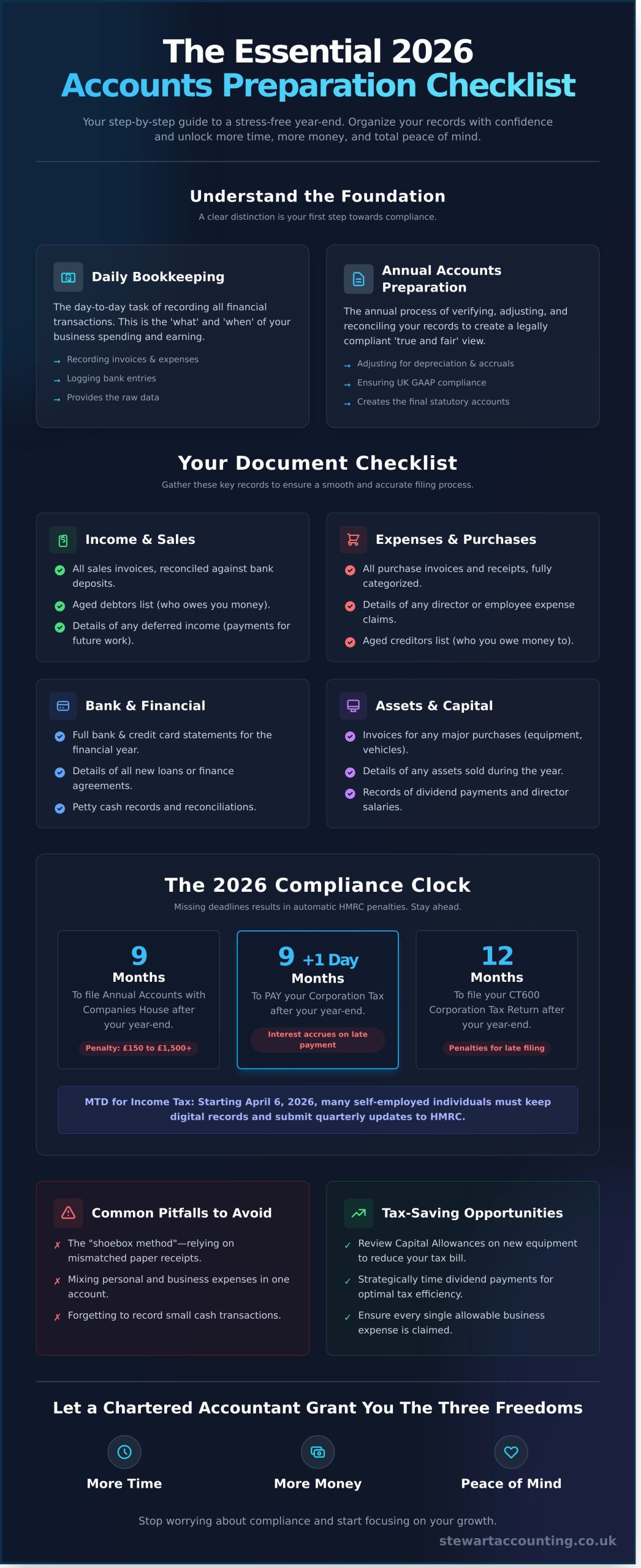
For the 2026 filing season, deadlines remain unforgiving. You must file your annual accounts with Companies House within 9 months of your financial year-end. Missing this by even one day results in an automatic £150 penalty, rising to £1,500 if you’re more than six months late. Your CT600 Corporation Tax return is due 12 months after your year-end, but remember that the tax payment itself is usually due 9 months and 1 day after the period ends. Additionally, the April 6, 2026, deadline for Making Tax Digital (MTD) for Income Tax will require many self-employed individuals to maintain digital records and submit quarterly updates to HMRC.
The Business Value of Prepared Accounts
Prepared accounts offer much more than just tax compliance. They provide the data needed for accurate cashflow forecasting, helping you identify “cash gaps” months before they become a crisis. If you’re looking to grow, organized accounts are essential for securing business grants through Scottish Enterprise or bank funding. Most lenders in Central Scotland require at least two years of professionally prepared statutory accounts before approving a loan. By treating your year-end as a strategic review rather than a chore, you turn your data into a roadmap for future success.
The Essential 2026 Accounts Preparation Checklist
Preparing for your year-end doesn’t have to be a source of anxiety. At Stewart Accounting Services, we believe in giving you three freedoms: more time, more money, and less stress. This accounts preparation checklist helps you organize your records so we can take the heavy lifting off your hands. Following these steps ensures your 2026 filings are accurate and submitted well before the deadline, leaving you free to focus on growing your business.
Income and Sales Documentation
Your first task involves reconciling every sales invoice against your bank deposits. Every penny must be accounted for to ensure your turnover is stated correctly. You should check that all invoices are dated within the correct financial year; for many businesses in Central Scotland, this means verifying everything up to 31st March 2026. If you’ve received payment for a project that doesn’t finish until June 2026, we’ll need to treat this as deferred income. You should also review your aged debtors list. If a client owes you £500 and hasn’t communicated in six months, it’s likely a bad debt that needs writing off. This process ensures you follow the official government guidance on filing annual accounts regarding the true and fair view of your company’s financial position.
Expenses and Purchase Ledger
Keeping business and personal spending separate is vital for a smooth tax season. If you accidentally used the business card for a £45 grocery shop, tell us early to avoid unnecessary tax complications. Accuracy here protects your profit margins and ensures you aren’t paying more tax than required.
- Gather all valid VAT receipts; a bank statement alone isn’t enough for a 20% VAT reclaim.
- Log your mileage claims at the HMRC rate of 45p per mile for the first 10,000 miles.
- Total your home-office hours if you work from a spare room in Stirling, Alloa, or Falkirk.
- Categorize recurring direct debits to ensure utilities and software subscriptions are mapped to the correct nominal codes.
Year-End Adjustments and Accruals
We need to look at timing differences to get an accurate picture of your performance. If you paid a £1,200 annual insurance premium in January 2026, nine months of that cover actually belong in the next financial year. This is a “prepayment.” Conversely, if you used £300 of electricity in March but the bill won’t arrive until April, we must “accrue” that cost. If your business holds physical inventory, perform a full stock take on your balance sheet date. Knowing you have exactly £5,400 of inventory on the shelf ensures your cost of sales is 100% accurate for the period.
Finally, don’t forget the “people” side of your records. We’ll need your final P11D forms for employee benefits and confirmation of all pension contributions made before your year-end date. If you’ve purchased new equipment, like a £2,000 server or office furniture, keep those specific invoices separate for capital allowance claims. Listing your liabilities is just as important; provide statements for any business loans or hire purchase agreements so we can verify interest payments. If this feels like a lot to manage, our team can help you streamline your bookkeeping throughout the year. Using this accounts preparation checklist early gives you the peace of mind you deserve.
Avoiding Common Year-End Pitfalls and Stress
Year-end shouldn’t feel like a financial crisis. The old “shoebox method,” where business owners hand over a pile of faded thermal receipts at the last minute, is a recipe for anxiety and missed tax savings. By April 2026, Making Tax Digital (MTD) for Income Tax will become a reality for many self-employed individuals and landlords, making digital bookkeeping a necessity rather than an option. Transitioning to platforms like Xero or QuickBooks now ensures you aren’t scrambling when the deadline hits. These tools provide a real-time view of your finances, which is a vital component of any modern accounts preparation checklist.
One of the biggest fears we hear from clients in Central Scotland is the dread of missing a single receipt. While accuracy is paramount, don’t let the fear of a lost £15 parking ticket stall your entire process. Modern software allows you to snap photos of invoices on the go, ensuring you comply with the official government guidance on accounting records. This guidance mandates that UK limited companies keep records for at least six years. If you’ve missed something small, we can often help you find alternative evidence, such as bank statements, to satisfy HMRC requirements.
Director Loan Accounts represent another significant pitfall. If you’ve withdrawn more money from the company than you’ve put in, you might have an overdrawn loan account. If this isn’t settled within nine months and one day of your year-end, your company faces a Section 455 tax charge. This is currently set at 33.75% of the outstanding amount. It’s a heavy financial hit that’s easily avoided with proactive planning. Similarly, “Control Account” mismatches occur when your internal software doesn’t align with HMRC’s records for VAT, PAYE, or Pensions. A £500 discrepancy in your PAYE account can trigger automated penalties that take hours of administrative time to resolve.
Digital Record Keeping and MTD
Cloud accounting is the most effective way for us to “take it off your hands.” By using automated bank feeds, we’ve seen local firms reduce manual data entry errors by 85%. This automation ensures that every penny is accounted for without you needing to spend your weekends staring at spreadsheets. Stewart Accounting provides tailored Xero training and ongoing support for firms across Alloa, Stirling, and Falkirk. We’ve helped over 200 Central Scotland business owners find their “three freedoms” by simplifying their digital workflows since 2021.
Common Reconciliation Errors to Check
Even with great software, errors happen. Duplicate entries are a frequent culprit, often occurring when a user manually enters a £120 invoice that the bank feed has already captured. Timing differences also create confusion. A payment made on 31st March might not appear on your bank statement until 2nd April, creating a temporary gap in your accounts preparation checklist. Finally, watch your international purchases. Many businesses forget to apply the 20% reverse charge VAT on digital services from overseas, which can lead to an unexpected bill during an HMRC inspection.
Optimising Your Position: Tax Efficiency at Year-End
Tax efficiency isn’t just about paying less. It’s about timing your actions to keep more money in your business. When you use your accounts preparation checklist, you should look specifically at your capital expenditure. If you’re planning to buy a new £25,000 electric van or £5,000 of office hardware, doing so before your accounting year-end allows you to claim the full cost against your profits immediately through the Annual Investment Allowance. This £1 million allowance remains a powerful tool for reducing your Corporation Tax bill, which currently sits at 25% for profits over £250,000 and 19% for those under £50,000.
Timing your income is just as vital. For the 2024/25 and 2025/26 tax years, the tax-free dividend allowance is £500. If you haven’t used this yet, it’s a “use it or lose it” opportunity. We often help clients balance a low salary of £12,570 with dividends to stay within the basic rate band. This strategy helps you avoid the 40% or 45% tax brackets while ensuring you still qualify for state pension credits. It’s a simple way to gain more money and less stress.
Don’t forget about your pension. Making an employer pension contribution is one of the most efficient ways to reduce your tax. These payments are usually treated as a business expense, meaning they reduce your taxable profit. If your company pays £10,000 into your pension, it could save you up to £2,500 in Corporation Tax. Plus, it moves money from your business into your personal wealth without triggering a personal tax charge. If you’re disposing of assets, remember the Capital Gains Tax (CGT) allowance for 2025/26 is £3,000. Planning disposals around the 6 April 2025 deadline can save you thousands, especially as Business Asset Disposal Relief rates are set to rise from 10% to 14% on that date.
Smart Planning for Limited Company Directors
Deciding on bonuses before the year-end is a smart move. You can accrue a bonus in your current accounts to reduce Corporation Tax, provided you pay it within nine months. We also look for R&D tax credit opportunities. HMRC data from 2023 shows the average SME claim is roughly £46,000. If you’re solving technical problems in Stirling or Falkirk, you might be eligible. Finally, keeping a healthy balance sheet by managing director loan accounts ensures credit agencies see your business as a safe bet for future lending.
Scottish Specific Considerations
Operating in Central Scotland means navigating different tax waters. Scottish Income Tax bands differ from the rest of the UK. For example, the 42% higher rate starts at £43,663 in Scotland, compared to £50,270 in England. We’ll help you structure your salary to account for these nuances. We also monitor local business rates. In Stirling and Falkirk, the Small Business Bonus Scheme can provide 100% relief if your property’s rateable value is £12,000 or less. We also check for Scottish Enterprise grants that could provide 30% to 50% funding for innovation projects.
Ready to keep more of what you earn? Let our team take the tax burden off your hands so you can focus on growing your business.
Let Stewart Accounting Take it Off Your Hands
Managing your own business finances often feels like a second full-time job. While using an accounts preparation checklist helps you stay organized, simply ticking off boxes doesn’t eliminate the underlying stress of HMRC penalties or missed tax reliefs. At Stewart Accounting Services, we take these complex tasks off your hands so you can focus on your core operations. Our team serves clients across Alloa, Stirling, and Falkirk, ensuring that compliance isn’t just a hurdle you clear, but a foundation for your future growth.
We built our firm around a specific “Three Freedoms” promise designed to support ambitious business owners. First, we give you more time. Research suggests the average UK small business owner spends over 120 hours a year on administrative accounting; we reclaim that time for you. Second, we aim for more money. By reviewing your 2024 records with a professional eye, we often identify tax-saving opportunities that standard software or non-specialists miss. Third, we provide more mind. This translates to less stress and zero anxiety when an HMRC envelope arrives in the post.
Our approach avoids the one-size-fits-all model used by many large, faceless firms. A retail shop in Falkirk has vastly different VAT requirements than a specialist consultant in Stirling. We provide a tailored service that adapts to your specific industry codes and turnover levels. Whether you need monthly management accounts or just a robust year-end service, we scale our support to fit your exact requirements. We don’t just process numbers; we interpret them to help you reach your personal and business goals.
Why Choose a Chartered Accountant (CA)?
Hiring a Chartered Accountant provides a level of security that a basic bookkeeping service cannot match. We are “Fully Qualified,” meaning we adhere to the rigorous professional standards and ethics of ICAS. We act as your authorized agent with HMRC and Companies House, handling all correspondence directly on your behalf. This moves our relationship beyond simple data entry. We use proactive tax planning to look ahead at your 2025 projections. For example, we might suggest optimal salary-versus-dividend splits that can save a director over £3,000 annually in National Insurance contributions.
Your Local Partners in Central Scotland
You can visit our team at the Alloa Business Centre or our Stirling office to discuss your financial goals in person. We’ve supported the Central Scotland business community for over a decade, helping firms in Falkirk and the surrounding areas navigate complex year-end cycles. We don’t believe in hidden fees or complicated jargon. Instead, we offer clear, pragmatic advice that helps you stay in control of your cash flow.
Don’t wait until the deadline to start thinking about your 2026 accounts. Contact us today to book a free consultation. We’ll review your current accounts preparation checklist and show you how our professional team can streamline your entire process. Let’s work together to ensure your next year-end is the smoothest, most profitable one yet.
Take Control of Your 2026 Financial Future Today
Your business deserves more than a last-minute scramble to meet HMRC deadlines. Following this accounts preparation checklist ensures you stay ahead of the curve and keep your records accurate throughout the year. By organizing your digital receipts and reconciling accounts monthly, you’ll avoid the common pitfalls that lead to year-end stress. Accurate data doesn’t just satisfy the taxman; it provides the clarity you need to boost your profitability and make informed growth decisions for the year ahead.
As Fully Qualified Chartered Accountants with offices in Alloa, Stirling, and Falkirk, we’ve helped over 500 local business owners find their “Three Freedoms.” Our mission is simple. We give you more time, more money, and total peace of mind by handling the complex numbers for you. You don’t have to navigate the 2026 tax landscape alone when expert support is just a conversation away.
Let us take your 2026 accounts off your hands-Book a Free Consultation
You’ve built something great, and we’re here to make sure your finances reflect that success while you focus on what you do best.
Frequently Asked Questions
What is the deadline for filing small business accounts in the UK for 2026?
Your deadline for filing accounts with Companies House is exactly 9 months after your financial year ends. For example, if your year ends on 31 March 2026, you must file by 31 December 2026. Missing this date results in an immediate £150 penalty. We recommend completing your accounts preparation checklist at least three months early to avoid any last-minute stress or avoidable fines.
Do I need to keep physical receipts if I use accounting software like Xero?
You don’t need to keep physical paper receipts if you use software like Xero or QuickBooks to store digital copies. HMRC has accepted digital records as valid proof since 2019, provided they’re legible and show all transaction details. Using a mobile app to snap photos of receipts means you can recycle the paper immediately. This approach keeps your records organized and reduces the physical clutter in your office.
What happens if I miss the Companies House filing deadline?
You’ll face an automatic financial penalty starting at £150 for being just one day late. This fine increases to £375 if you’re over one month late and reaches £1,500 if you delay by more than six months. If you miss the deadline two years in a row, these penalties double. Our team helps clients in Stirling and Alloa avoid these costs by managing their filing schedules proactively and taking the burden off your hands.
Can I change my financial year-end date to make preparation easier?
You can change your financial year-end date by applying to Companies House online or via form AA01. Shortening your accounting period is allowed as often as you like; however, you can only lengthen it once every 5 years to a maximum of 18 months. Many business owners align their year-end with the tax year on 5 April to simplify their personal and business tax calculations and reduce year-end pressure.
What are the most common tax-deductible expenses for UK limited companies?
Common deductible expenses include staff salaries, business insurance, and office rent. You can also claim for smaller items like professional subscriptions, business travel at 45p per mile for the first 10,000 miles, and marketing costs. Every £1,000 of legitimate business expenses saves a limited company between £190 and £250 in Corporation Tax. Keeping an accurate accounts preparation checklist ensures you never miss these vital deductions and keep more of your money.
How much does it cost to have an accountant prepare my year-end accounts?
Fees for year-end accounts typically range from £600 to £2,500 depending on your business size and the quality of your bookkeeping. A small limited company with clean records might pay around £1,200 annually for full compliance. At Stewart Accounting Services, we provide fixed-fee quotes so you know exactly what you’re paying. This investment usually pays for itself through tax savings and the peace of mind that your filings are correct.
What is the difference between a Profit & Loss report and a Balance Sheet?
A Profit & Loss report shows your income and expenses over a specific period, such as 12 months. It tells you if you’ve made a profit or a loss during that time. In contrast, a Balance Sheet is a snapshot of your company’s financial health on a single day. It lists everything you own, like cash and equipment, against everything you owe, such as loans, VAT, and trade creditors.
How does Making Tax Digital (MTD) affect my 2026 accounts preparation?
From 6 April 2026, self-employed individuals and landlords with income over £50,000 must follow Making Tax Digital rules for Income Tax. This requires you to keep digital records and send quarterly updates to HMRC instead of one annual return. If your turnover is between £30,000 and £50,000, you’ll join the scheme in April 2027. Moving to digital software now will make this transition smooth, easy, and entirely stress-free.