

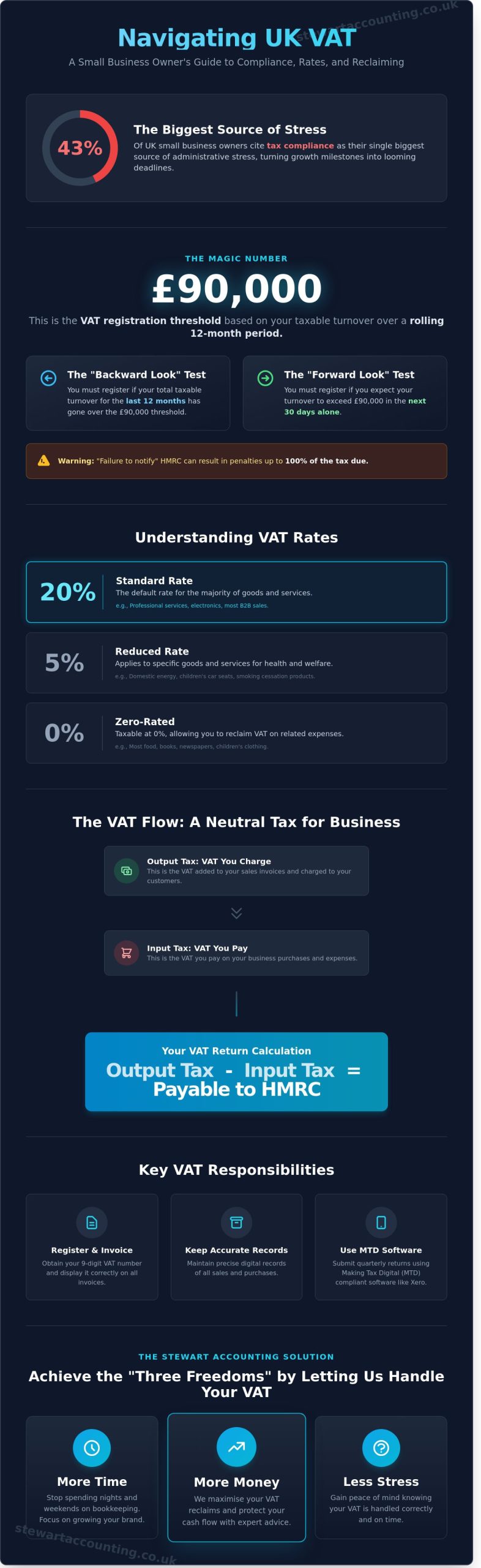
Did you know that 43% of small business owners in the UK cite tax compliance as their single biggest source of administrative stress? For many, reaching the £90,000 turnover threshold feels less like a celebration and more like a looming deadline for HMRC penalties. Managing your Value Added Tax (VAT) obligations shouldn’t feel like a second job that keeps you awake at night. You’ve built your business to achieve more freedom, not to get buried under a mountain of quarterly bookkeeping and confusing rate codes.
At Stewart Accounting Services, we agree that your time is better spent growing your brand than worrying about whether an invoice is zero-rated or exempt. We want to help you achieve the “three freedoms” by taking the tax burden off your hands and providing clear, actionable advice. This guide provides the answers you need to understand your registration obligations and reclaim tax efficiently to protect your business cash flow.
We’ll walk you through the 2026 registration rules, explain exactly what expenses can be reclaimed, and simplify the process for your quarterly returns.
Key Takeaways
- Understand how value added tax england operates as a UK-wide consumption tax and why it is essential for your small business to remain compliant.
- Identify the current £90,000 registration threshold and learn how to monitor your rolling 12-month turnover to avoid potential HMRC penalties.
- Streamline your VAT responsibilities by using Making Tax Digital (MTD) compliant software like Xero to keep your records accurate and stress-free.
- Master the “golden rule” for reclaiming VAT on legitimate business expenses to protect your cash flow and maximise your annual savings.
- Discover how Stewart Accounting can “take it off your hands” to provide the three freedoms of more time, more money, and less stress.
What is Value Added Tax (VAT) and How Does it Work in England?
Value Added Tax, commonly known as VAT, is a consumption tax charged on the majority of goods and services. When you search for value added tax england, it’s helpful to understand that while your business may be based in London, Manchester, or Birmingham, VAT is actually a UK-wide tax. It’s governed by national legislation rather than regional rules. This means the same rates and regulations apply whether you’re trading in England, Scotland, Wales, or Northern Ireland. HM Revenue and Customs (HMRC) manages the entire system, ensuring that tax is collected at each stage of the supply chain.
The mechanism of VAT relies on two core pillars: Input Tax and Output Tax. Output Tax is the VAT you charge your customers on your sales. Input Tax is the VAT you pay on your own business expenses, such as equipment or stock. For most businesses, VAT is a neutral tax. You don’t keep the VAT you charge; instead, you pay the difference between your Output Tax and Input Tax to HMRC. The final consumer, who cannot reclaim the tax, is the one who ultimately carries the cost. You can explore the History of UK Value-Added Tax to see how this system has developed since its introduction in 1973.
The Role of HMRC in VAT Collection
HMRC acts as the central authority for all tax matters in the UK. Once your turnover exceeds the current £90,000 threshold, you must register for a unique nine-digit VAT registration number. This number serves as your legal identifier and must appear on every invoice you issue. The Value Added Tax Act 1994 remains the primary piece of legislation that dictates how these rules are applied. Our team often finds that having a clear understanding of these statutory requirements helps business owners feel more in control of their finances.
Why VAT Matters to Your Small Business
Registering for VAT has a direct impact on your pricing strategy. If your customers are regular consumers, adding 20% to your prices might make you appear more expensive than non-registered competitors. However, for many ambitious business owners, being VAT-registered is a badge of credibility. It signals to larger clients that your business has reached a significant size and is professionally managed. VAT is a 20% levy on most UK transactions as of 2026. This tax status can also help you recover costs on major purchases, which supports your overall cash flow and business growth.
Understanding VAT Rates and Thresholds for 2026
Staying on top of value added tax england rules is vital for any growing business. The current VAT registration threshold sits at £90,000. It’s important to remember this isn’t based on your fixed tax year or a standard calendar year. Instead, HMRC looks at a rolling 12-month period. If your taxable turnover hits this limit at any point, you’ve got a legal obligation to step up and register.
When Must You Register for VAT?
You need to monitor your turnover every single month. The “backward look” test requires registration if your total taxable turnover for the previous 12 months exceeds £90,000. There’s also a “forward look” test. This applies if you expect your turnover to go over that £90,000 mark in the next 30 days alone. If you miss these deadlines, HMRC applies a “failure to notify” penalty. These charges vary but can reach 100% of the tax due if the delay is deemed deliberate. Checking the official VAT registration requirements helps you avoid these costly surprises.
Some business owners choose to register before they’re legally forced to. This voluntary registration allows you to reclaim the VAT you pay on business expenses and stock. If your customers are mostly other VAT-registered businesses, they won’t mind the extra 20% on your invoices, and you’ll likely improve your cash flow by claiming back what you’ve spent. We often help clients decide if this move makes sense for their specific growth plans.
Breakdown of Current VAT Rates
Most goods and services in the UK fall under the standard rate. However, knowing the exceptions helps you price your services correctly and ensures you aren’t overpaying the taxman. Here is how the rates currently look:
- Standard Rate (20%): The default for most items, including professional services, electronics, and most business-to-business sales.
- Reduced Rate (5%): This applies to specific goods like domestic energy, smoking cessation products, and children’s car seats.
- Zero-rated (0%): These items are technically taxable but at 0%. This includes most supermarket food, books, newspapers, and children’s clothing.
It’s easy to confuse zero-rated items with “exempt” items, but the difference is massive for your bottom line. If your sales are exempt (like many health services or insurance), you can’t reclaim any VAT on your business purchases. With zero-rated sales, you’re still part of the VAT system, meaning you can still claim back the tax on your costs. If these categories feel a bit overwhelming, we can take the VAT paperwork off your hands to give you more time and less stress.
Your VAT Responsibilities: Registration, Records, and MTD
Staying compliant with value added tax england involves a clear sequence of actions. Our team at Stewart Accounting Services aims to take these tasks off your hands so you can focus on growing your business in Alloa, Stirling, or Falkirk. Following these five steps ensures you avoid HMRC penalties and maintain your peace of mind.
- Step 1: Register through the HMRC digital portal once your taxable turnover exceeds the £90,000 threshold (effective from 1 April 2024).
- Step 2: Implement MTD-compliant software like Xero to automate your financial data flow.
- Step 3: Issue valid VAT invoices for every taxable sale to ensure your customers can reclaim their tax.
- Step 4: Maintain digital records of all business transactions for at least six years.
- Step 5: Submit your return every three months and pay any liability by the deadline, usually one month and seven days after the period ends.
Making Tax Digital (MTD) in 2026
HMRC’s transition to a fully digital tax system reached a major milestone in April 2022 when all VAT-registered businesses were required to follow MTD rules. By April 2026, this digital requirement expands to Income Tax for those with qualifying income over £50,000. Paper ledgers and manual spreadsheets are no longer sufficient because they lack the digital links HMRC requires. Cloud accounting provides real-time visibility into your tax liabilities, reducing the risk of a surprise bill. We provide tailored Xero training to ensure your transition is smooth and stress-free.
What Makes a Valid VAT Invoice?
Every invoice you issue must contain specific data to remain legal under the rules for value added tax england. You must include your 9-digit VAT registration number, a unique invoice number, and the tax point. You also need to show a clear breakdown of the current VAT rates applied to each item. For sales under £250, you can use a simplified invoice which requires less detail. If you trade internationally, you’ll need to account for the “Place of Supply” rules to determine if UK VAT applies. We help you configure your software to handle these international complexities automatically, ensuring you stay on the right side of the law.
Reclaiming VAT: Maximising Your Business Cash Flow
Managing value added tax england effectively is one of the quickest ways to improve your bottom line. The golden rule is straightforward: you can only reclaim VAT on purchases used exclusively for your business. If an item has a dual purpose, such as a mobile phone used for both work and home life, you must calculate the business percentage and only claim that portion.
You can typically reclaim VAT on a wide range of essential costs, including:
- Equipment and Stock: Computers, tools, and items bought for resale.
- Professional Fees: Costs for solicitors or your chartered accountant.
- Premises: Commercial rent, heating, and lighting for your office or shop.
Many business owners don’t realise they can look back at past spending. The “Pre-registration” rule allows you to reclaim VAT on goods bought up to 4 years before you registered, provided they are still in use by the business. For services, the window is shorter, allowing you to go back 6 months from your registration date. However, HMRC strictly prohibits reclaims on business entertainment for clients and most cars, unless the vehicle is used 100% for business purposes like a taxi or driving school car.
Choosing the Right VAT Scheme
The scheme you choose can significantly impact your “three freedoms”: more time, more money, and less stress. Standard Accounting requires you to pay VAT based on invoice dates, which can hurt your cash flow if clients are slow to pay. The Cash Accounting Scheme solves this by ensuring you only pay VAT to HMRC once your customer has actually paid you. For smaller businesses with low expenses, the Flat Rate Scheme simplifies things by letting you pay a fixed percentage of your turnover, though you won’t reclaim VAT on most individual purchases.
Common VAT Pitfalls to Avoid
Missing the filing deadline is a costly mistake. You generally have exactly 1 month and 7 days after the end of your VAT period to submit your return and pay. Poor record-keeping is another trigger for HMRC investigations. If you fail to distinguish between business and private use of assets, you risk penalties and interest charges. Staying organised ensures your VAT returns are smooth and stress-free.
We help ambitious business owners achieve their goals by making tax simple. Let us take the VAT burden off your hands so you can focus on what matters most.
How Stewart Accounting Simplifies VAT for Your Business
Managing value added tax england doesn’t have to be a source of constant anxiety. At Stewart Accounting Services, we deliver the “Three Freedoms”: more time, more money, and more mind. Recent surveys indicate that 25% of small business owners spend over 10 hours every month on manual admin. We want to give that time back to you. Our team takes the entire process off your hands, ensuring every HMRC deadline is met without a last-minute rush or the threat of late submission penalties.
We provide tailored support for a variety of business structures, including:
- Sole Traders: Simple, effective VAT management to keep your personal and business finances clear.
- Contractors: Expert guidance on the best VAT schemes for your specific industry.
- Limited Companies: Comprehensive oversight of complex inputs and outputs to ensure full compliance.
Our expertise isn’t limited by geography. While we are proud local experts in Central Scotland, serving businesses in Alloa, Stirling, and Falkirk, we support clients across the wider UK. We combine local, approachable service with the technical depth required to handle national tax regulations.
Professional Reassurance from Chartered Accountants
Being a “Fully Qualified” firm means you get a level of protection that uncertified bookkeepers simply can’t match. If HMRC opens a tax investigation into your value added tax england filings, we handle the correspondence and provide the technical defence you need. We focus on proactive tax planning rather than just ticking boxes. Last year, we helped a local client identify £3,450 in unclaimed input tax by reviewing their historical records. We explain everything in plain English, avoiding the confusing jargon that often makes tax feel like a burden.
Take the Next Step Toward Financial Freedom
It’s time to stop worrying about spreadsheets and start focusing on your business growth. Our bookkeeping and VAT services integrate seamlessly. This means your records stay up to date throughout the quarter, making the final submission a non-event. We offer a free consultation to discuss your current VAT position and identify where we can streamline your processes. Join the 200+ businesses we currently support and reclaim your peace of mind. Contact our team today to see how we can take the weight of VAT off your hands.
Master Your Business Finances for 2026
Navigating the complexities of value added tax england in 2026 doesn’t have to be a burden for your small business. By staying ahead of the £90,000 registration threshold and ensuring your digital records meet the latest Making Tax Digital requirements, you protect your company from avoidable HMRC penalties. Effective VAT management serves as a strategic tool to reclaim essential costs and improve your monthly cash flow. Our team ensures every eligible penny is accounted for, which keeps your business lean and resilient.
At Stewart Accounting Services, our Fully Qualified Chartered Accountants provide the expertise you need to thrive. With local offices in Alloa, Stirling, and Falkirk serving the entire UK, we’re dedicated to our Three Freedoms guarantee: providing you with more time, more money, and far less stress. We’ll handle the technical submissions and intricate calculations so you can focus on what you do best. It’s time to stop worrying about shifting tax regulations and start enjoying the rewards of your hard work.
Book a free consultation to take VAT off your hands and discover how simple your accounting can be. We look forward to helping your business reach its full potential this year.
Frequently Asked Questions
What is the VAT threshold in England for 2026?
The VAT registration threshold in England is currently set at £90,000 following the increase on 1 April 2024. This level is expected to remain frozen through 2026 based on the government’s current fiscal plans. You must register if your total taxable turnover for the last 12 months goes over this limit or if you expect it to go over in the next 30 days.
Can I register for VAT if my turnover is below £90,000?
You can choose to register voluntarily for VAT even if your turnover is well below the £90,000 limit. This is often a smart move if you sell primarily to other VAT-registered businesses, as it allows you to reclaim the tax on your own business purchases. It also helps project a more professional image to your clients. We can help you weigh up the benefits to see if it puts more money back in your pocket.
How often do I need to submit a VAT return to HMRC?
Most businesses must submit a VAT return to HMRC every three months, which is known as your accounting period. You typically have one calendar month and seven days after the end of the quarter to file your digital return and pay any tax due. There are alternative options, such as the Annual Accounting Scheme, which only requires one return per year. Staying on top of these deadlines is essential for your peace of mind.
What happens if I forget to register for VAT on time?
If you fail to register for value added tax england when your turnover hits the threshold, HMRC will charge a “failure to notify” penalty. This fine is calculated as a percentage of the VAT due from the date you should have registered, ranging from 5% to 100% depending on the delay. You’ll also be liable for all the unpaid VAT on sales made during that period. We take this worry off your hands by monitoring your limits for you.
Can I reclaim VAT on a car used for my business?
You can usually only reclaim the full VAT on a new car if you can prove it’s used 100% for business and is not available for private use. HMRC rules are incredibly strict; even a commute from home to work counts as private use. However, if you lease a car for business, you can usually reclaim 50% of the VAT. We ensure you claim exactly what you’re entitled to without triggering an investigation.
Is food subject to VAT in the UK?
Most basic food items for human consumption are zero-rated, meaning you don’t pay any VAT on them. However, standard 20% VAT applies to “luxury” items like potato crisps, chocolate biscuits, and alcoholic drinks. Catering and hot takeaway food also attract the full 20% rate. Navigating these rules can be complicated for shop owners, but we can help clarify exactly which rate applies to your specific products.
What is Making Tax Digital (MTD) and does it apply to me?
Making Tax Digital is an HMRC requirement that forces businesses to keep digital records and submit returns using compatible software. It has applied to every VAT-registered business since April 2022, regardless of whether your turnover is above or below the £90,000 threshold. We specialise in setting up systems like Xero to make this process smooth. This technology gives you more time to focus on running your business rather than chasing paperwork.
How much does it cost to have an accountant handle my VAT?
Professional fees for VAT services typically range from £30 to £150 per month depending on the complexity of your business and the number of transactions. This investment provides you with our “three freedoms” of more time, more money, and less stress. By letting us take it off your hands, you avoid expensive HMRC penalties and ensure every possible expense is claimed. We offer fixed-price packages tailored to your specific needs in Central Scotland.