

Value Added Tax (VAT) Explained: A Simple Guide for UK Businesses
For many small business owners in the UK, Value Added Tax (VAT) can seem like a complex and daunting topic. With its own set of rules, rates, and responsibilities, it’s easy to feel overwhelmed. But it doesn’t have to be a source of stress. This straightforward guide is here to explain exactly what VAT is, how it affects your business, and how you can manage it with confidence.
What is Value Added Tax (VAT) in the UK?
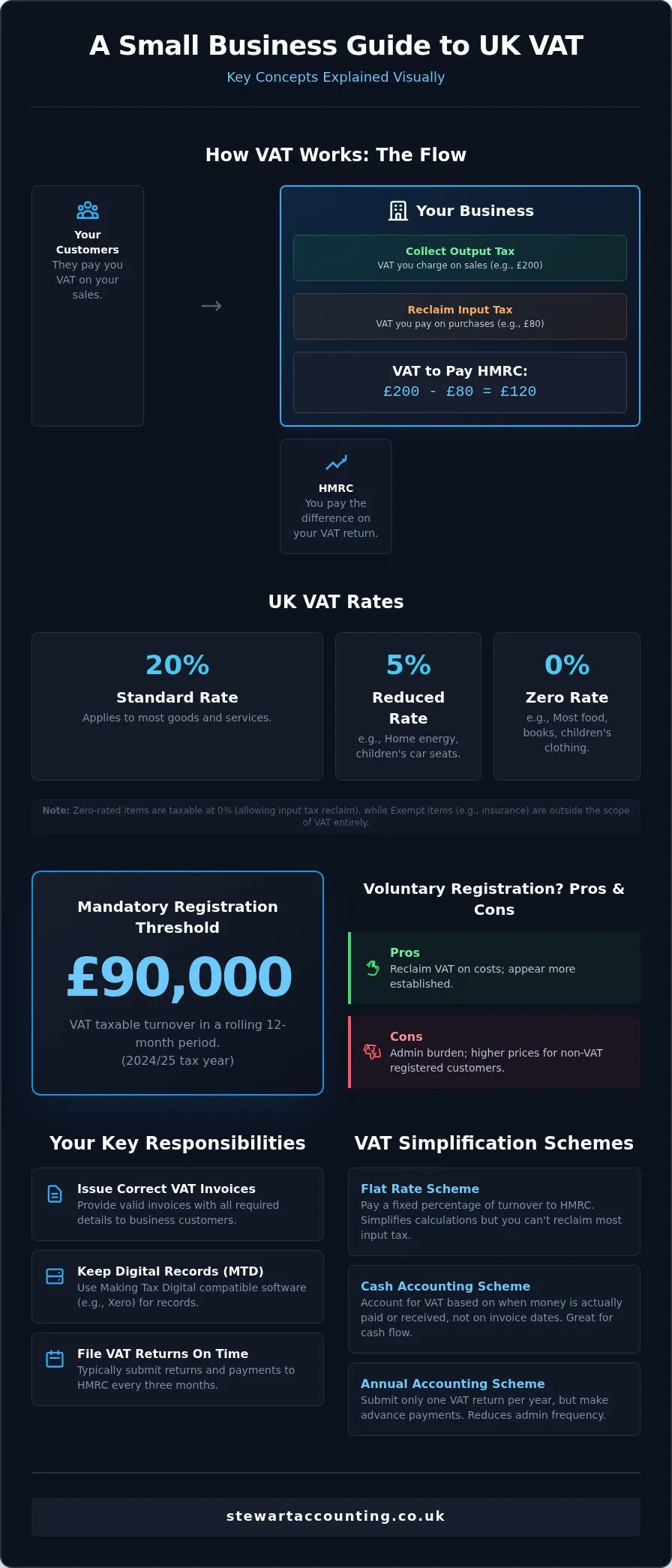
At its core, Value Added Tax is a tax applied to most goods and services sold by VAT-registered businesses in the UK. The simplest way to think about it is that your business acts as a tax collector on behalf of the government (HMRC). You add VAT to your prices, collect it from your customers, and then pay it over to HMRC periodically.
The key principle to grasp is that VAT flows through the business. You charge VAT on your sales, but you can also reclaim the VAT you pay on your own business purchases. This guide will make these concepts simple, helping you take the stress out of tax compliance.
How Does VAT Actually Work for a Business?
To understand the day-to-day reality of VAT, you need to know two key terms: Output Tax and Input Tax.
- Output Tax: This is the VAT you charge on your own sales of goods and services. If you sell a product for £100 and the VAT rate is 20%, you will charge your customer £120. The £20 is your Output Tax.
- Input Tax: This is the VAT you pay when you buy goods or services for your business. If you buy new software for £50 + VAT, the £10 of VAT you pay is your Input Tax.
- The VAT Return: Periodically (usually every quarter), you report these figures to HMRC. You calculate the total Output Tax you’ve collected and subtract the total Input Tax you’ve paid. The difference is what you owe HMRC. If your Input Tax is more than your Output Tax, you can claim a refund.
For example, imagine a graphic designer charges a client £1,000 for a project. They add 20% VAT, so the client pays £1,200. The £200 is Output Tax. During the same period, the designer buys a new monitor for £400 + £80 VAT. The £80 is Input Tax. On their VAT return, they would owe HMRC £200 – £80 = £120.
The Different VAT Rates: Not Everything is 20%
While most people associate VAT with the 20% rate, there are actually several different rates in the UK. It’s crucial to apply the correct one to your sales.
- Standard Rate (20%): This is the default rate and applies to most goods and services.
- Reduced Rate (5%): This lower rate applies to specific items, such as home energy (gas and electricity) and children’s car seats.
- Zero Rate (0%): Some goods and services are zero-rated, meaning you still include them on your VAT return, but you charge 0% VAT. This includes most food, books, newspapers, and children’s clothing.
It’s also important to understand the difference between zero-rated and exempt items. While zero-rated items are taxable at 0%, exempt items (like postage stamps or insurance) are outside the scope of VAT entirely. You cannot reclaim input tax on costs related to exempt sales.
Registering for VAT: Do You Need To?
One of the biggest questions for any growing business is when to register for VAT. The deciding factor is your ‘VAT taxable turnover’-the total value of everything you sell that isn’t VAT exempt. We can help you understand how to calculate this figure correctly. Once your turnover crosses a certain threshold, registration becomes a legal requirement, not a choice.
Mandatory Registration: Crossing the VAT Threshold
You must register for VAT if your VAT taxable turnover for the last 12 months was over the government-set threshold, or if you expect it to go over that threshold in the next 30 days alone. The VAT registration threshold is £90,000 (as of the 2024/25 tax year). It’s vital to monitor your rolling 12-month turnover to avoid registering late, as this can lead to penalties from HMRC.
Voluntary VAT Registration: Why Would You Choose To?
Even if your turnover is below the threshold, you can choose to register voluntarily. Why would you do this? There are several potential benefits:
- Reclaiming Input Tax: The main advantage is that you can reclaim the VAT paid on your business costs and purchases, which can significantly improve your cash flow.
- Business Image: Having a VAT number can make your business appear larger and more established, which can be beneficial when dealing with bigger clients.
However, there are drawbacks to consider, such as the administrative burden of filing regular returns and the fact that your prices will increase for customers who are not VAT registered themselves. Unsure if you should register? Talk to us for clear advice.
Your Responsibilities After Registering for VAT
Once you are VAT registered, you have a set of ongoing responsibilities to HMRC. The key to managing these duties without stress is maintaining excellent bookkeeping from day one. By setting up efficient systems, you can make the entire process smooth and straightforward, and our team is here to help with that.
Issuing VAT Invoices Correctly
You must provide a valid VAT invoice for any standard-rated or reduced-rated sales you make to another VAT-registered business. This invoice must include key information, such as your VAT registration number, the date, a unique invoice number, and a clear breakdown of the VAT being charged. There are different requirements for full and simplified invoices, and getting them right is essential for your clients to reclaim their input tax.
Keeping Digital Records and Filing VAT Returns
Under the Making Tax Digital (MTD) for VAT rules, all VAT-registered businesses must keep digital records and use MTD-compatible software (like Xero or QuickBooks) to file their VAT returns. These returns are typically submitted to HMRC every three months, detailing your output and input tax for the period. Staying organised with your digital records is non-negotiable for compliance.
VAT Schemes to Simplify Your Accounting
To help smaller businesses manage their obligations, HMRC offers several simplified VAT schemes:
- The Flat Rate Scheme: This allows you to pay a fixed percentage of your turnover to HMRC. You can’t reclaim input tax on most purchases, but it simplifies your calculations.
- The Cash Accounting Scheme: You only account for VAT once your customer has paid you, and you only reclaim input tax once you have paid your supplier. This is great for managing cash flow.
- The Annual Accounting Scheme: This allows you to submit just one VAT return per year instead of four, although you still make advance payments towards your bill.
How We Take the Stress Out of VAT
VAT doesn’t have to be a burden that distracts you from running your business. At Stewart Accounting Services, our expert team is here to handle all the complexities for you. We ensure you remain fully compliant with HMRC’s regulations, giving you peace of mind and allowing you to focus on what you do best: growing your business.
Expert VAT Registration and De-registration
We provide clear, practical advice on the right time to register your business for VAT. When the time comes, our team will handle all the necessary paperwork with HMRC, ensuring a smooth and correct registration. We can also manage the de-registration process if your turnover falls below the threshold or you cease trading.
Accurate and On-Time VAT Return Filing
Say goodbye to the quarterly stress of VAT deadlines. Our dedicated team will prepare your VAT returns accurately from your business records, ensuring you reclaim all the input tax you are entitled to. We guarantee that your returns are filed correctly and on time, every time. Never worry about missing an HMRC deadline again. Get your free consultation today.
Frequently Asked Questions
What is the current VAT threshold in the UK?
As of the 2024/25 tax year, the mandatory VAT registration threshold is a taxable turnover of £90,000 in a rolling 12-month period. This figure can change, so it’s always best to check the latest government guidance.
Can I reclaim VAT on all my business expenses?
You can reclaim VAT on most goods and services you buy for your business. However, there are some exceptions, such as business entertainment expenses. You also cannot reclaim VAT if you are using the Flat Rate Scheme or if the expense relates to making VAT-exempt sales.
What happens if I make a mistake on my VAT return?
If you discover a mistake on a past VAT return, you can usually correct it on your next one, provided the error is below a certain limit. For larger errors, you must report them to HMRC directly. It’s always best to seek professional advice to ensure corrections are made properly.
How long do I need to keep my VAT records for?
Under Making Tax Digital rules, you must keep all your VAT records, such as invoices and receipts, for at least six years.
What’s the difference between VAT exempt and zero-rated?
Zero-rated goods are taxable for VAT, but the rate is 0%. This means you don’t charge customers VAT, but you can still reclaim input tax on related costs. VAT-exempt goods are outside the scope of VAT, so you don’t charge VAT, and you cannot reclaim input tax on related costs.
Do I need an accountant to do my VAT return?
While it’s not a legal requirement, using a qualified accountant can save you significant time, reduce stress, and potentially save you money by ensuring you reclaim all eligible VAT and avoid costly errors and penalties. An accountant takes the burden of compliance off your shoulders.
Managing VAT correctly is a crucial part of running a successful business, but you don’t have to do it alone. If you’re looking for expert guidance and a hassle-free way to handle your VAT obligations, our team is here to help. Let us take VAT off your hands. Contact our friendly team today.