

Last Tuesday, a local business owner in Stirling discovered that a single oversight regarding vat on uk sales had triggered an HMRC penalty of £3,000, effectively erasing their monthly profit. It’s a common worry that keeps many ambitious entrepreneurs awake at night. We understand that you’d much rather focus on serving your clients than getting lost in the weeds of manual bookkeeping and ever-changing tax regulations.
We’re here to help you achieve your three freedoms: more time, more money, and less stress. This 2026 guide will teach you how to master the £90,000 registration threshold and stay compliant with Making Tax Digital rules. You’ll learn how to lower your tax bill through legal reclaims and ensure your records are bulletproof. We will break down the current VAT rates and filing requirements so you can take the paperwork off your hands and move forward with total peace of mind.
Key Takeaways
- Understand how businesses act as tax collectors and why managing vat on uk sales effectively is a vital part of your supply chain.
- Learn how to navigate the 12-month rolling turnover rule and the “future test” so you never miss a mandatory registration deadline.
- Discover how choosing the right VAT scheme and adopting MTD-compliant digital software can improve your cash flow and ensure full compliance in 2026.
- Find out how to achieve the “Three Freedoms”—more time, more money, and less stress—by letting local experts take complex VAT management off your hands.
What is VAT on UK Sales and How Does it Work?
Value Added Tax (VAT) is a consumption tax applied to goods and services at every stage of the supply chain where value is added. From the initial manufacturer to the final retailer, each business records the tax. However, the final consumer ultimately bears the cost. When you run a VAT-registered business, you’re essentially acting as an unpaid tax collector for HMRC. You collect the tax from your customers and hand it over to the government after deducting the VAT you’ve paid to your own suppliers.
When you register for vat on uk sales, you’ll deal with two main types of tax. Output tax is the VAT you charge on your sales. Input tax is the VAT you pay on your business purchases, such as stock or equipment. Every quarter, or monthly if you choose, you calculate the difference. If your output tax is higher than your input tax, you pay the difference to HMRC. If you’ve paid out more than you’ve collected, you can usually claim a refund.
At Stewart Accounting Services, we look at this through the lens of the “Three Freedoms.” Properly managing your tax obligations gives you more time, more money, and more mind (less stress!!!!!!). Understanding the mechanics of the system takes the mystery out of your cash flow. Instead of worrying about a surprise bill from HMRC, you’ll have a clear view of what you owe and what you can reclaim, effectively taking the burden off your hands.
To manage this successfully in 2026, you must keep digital records under the Making Tax Digital (MTD) rules. This ensures accuracy and helps avoid the 5% to 15% penalties HMRC can apply for late payments or errors. Our team of fully qualified chartered accountants helps you set up these systems so the process remains smooth and easy.
The Different VAT Rates in the UK
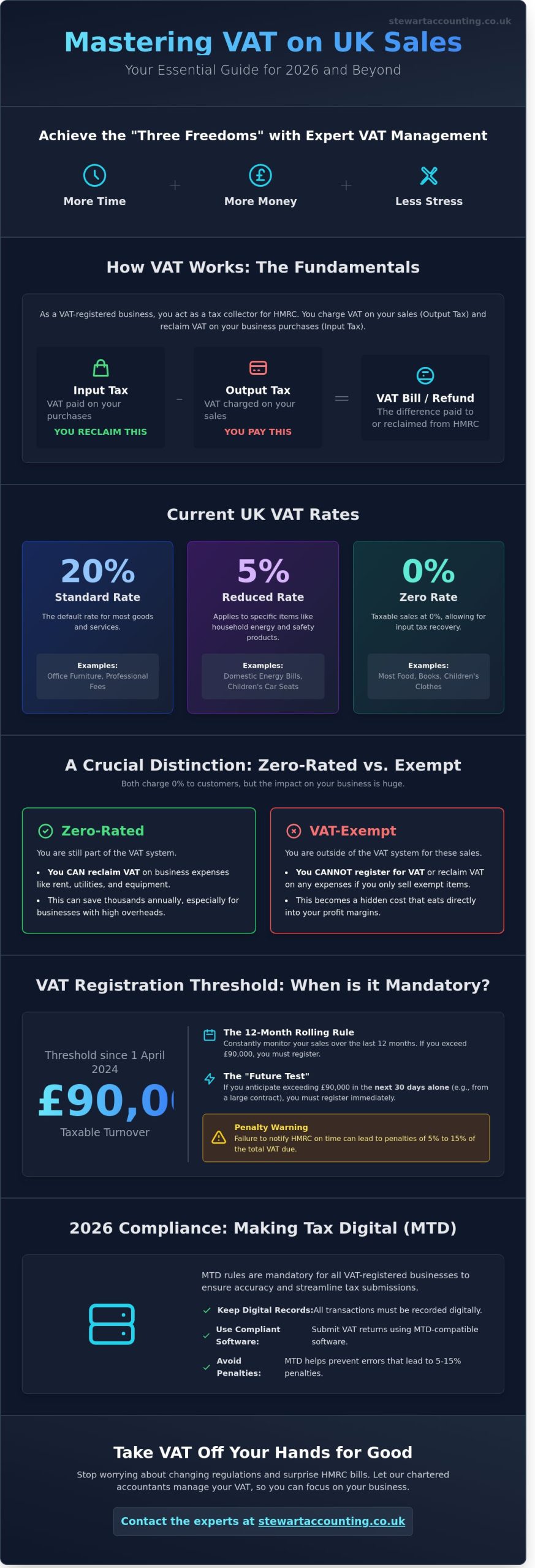
Most transactions fall under the Standard Rate of 20%. This is the default for everything from office furniture to professional fees. However, some items qualify for the Reduced Rate of 5%, such as domestic energy bills and children’s car seats. Zero-rated items are taxed at 0%. This category includes most supermarket food, books, and children’s clothes. Even at 0%, these are still taxable sales, which is a vital distinction for your bookkeeping.
VAT-Exempt vs. Zero-Rated: Why the Difference Matters
While both categories result in 0% tax being charged to the customer, the impact on your business is very different. Exempt items include postage stamps, insurance, and some health services. If your business only sells exempt goods, you can’t register for vat on uk sales or reclaim any VAT on your expenses. This can be a hidden cost that eats into your margins.
If your sales are zero-rated, you’re still part of the VAT system. This means you can reclaim the 20% VAT you pay on your laptops, rent, or utility bills. For a small business with high overheads, being zero-rated rather than exempt can save thousands of pounds annually. We help you identify which category your services fall into to ensure you aren’t missing out on legitimate refunds.
VAT Registration Threshold: When is it Mandatory?
Since April 1, 2024, the VAT registration threshold in the UK is £90,000. You must monitor your taxable turnover constantly because this isn’t based on your financial year or the calendar year. It’s a rolling 12-month check. If your sales over the last year hit £90,001 today, you’ve crossed the limit. You must notify HMRC within 30 days of the end of the month you went over. Failure to do this often results in “failure to notify” penalties, which typically range from 5% to 15% of the VAT due depending on how late you are.
The “future test” is the second trigger you need to watch. If you realize your turnover will exceed £90,000 in the next 30 days alone, you must register immediately. This usually happens when a business lands a significant contract or sees a sudden seasonal spike. Staying compliant with vat on uk regulations means keeping your books updated weekly. If the thought of monthly monitoring feels overwhelming, we can take it off your hands to ensure you never miss a deadline or face unnecessary scrutiny.
Calculating Your Taxable Turnover Correctly
Taxable turnover includes everything you sell that isn’t exempt from VAT. This covers standard, reduced, and zero-rated goods. You shouldn’t include sales of capital assets, like a delivery van, in this total. HMRC is particularly vigilant about “disaggregation.” This is where a business owner tries to split one company into two smaller ones to stay below the £90,000 mark. If the businesses share the same equipment, staff, or customers, HMRC will likely treat them as one entity and demand back-dated tax. We recommend a formal review of your income every 30 days to stay safe.
Pros and Cons of Voluntary VAT Registration
You can choose to register even if your turnover is well below the £90,000 limit. This is often a smart move for businesses with high setup costs. Registering early allows you to reclaim the 20% VAT paid on expensive equipment, software, or stock purchased for the business. It also gives your brand a “prestige” boost. Many large UK companies prefer working with VAT-registered suppliers because it suggests stability and scale.
The main downside is the administrative burden. You’ll need to maintain digital records and file quarterly returns under Making Tax Digital (MTD) rules. If your customers are the general public, they can’t reclaim the tax you charge. This means your prices might suddenly seem 20% more expensive than a non-registered competitor. It’s a balancing act between reclaiming costs and staying competitive in your local market.
Choosing the Best VAT Scheme for Your Business Model
Selecting the right VAT arrangement is a strategic move for your cash flow. It isn’t a one size fits all decision. Your choice determines whether you have the funds available to grow or if you’re constantly chasing your tail to meet HMRC deadlines. At Stewart Accounting, we don’t just pick a scheme at random. We analyze your business behavior to ensure your setup provides more time, more money, and less stress. This tailored approach is part of our commitment to the three freedoms we promise every client.
Your chosen method dictates your quarterly bookkeeping routine. If we take this task off your hands, the process needs to align with how you actually trade. We focus on getting the vat on uk goods and services recorded accurately from the start. This allows you to focus on your goals in Alloa, Stirling, or Falkirk while we handle the technical details.
Standard Accounting vs. Cash Accounting
Standard accounting requires you to record VAT based on the date you issue or receive an invoice. This can create a cash gap if your customers take 30 or 60 days to pay. You might end up paying HMRC money you haven’t received yet. Cash accounting solves this problem. You only account for VAT once the cash is actually in your bank account. According to a 2023 report by the Federation of Small Businesses, roughly 52% of small firms deal with late payments. For these businesses, cash accounting is a vital tool to protect liquidity and keep the bank balance healthy.
The Flat Rate Scheme (FRS)
The Flat Rate Scheme was designed to simplify record-keeping. You pay a fixed percentage of your gross turnover to HMRC and keep the difference. It’s straightforward, but it’s not always the cheapest option. Since the introduction of the “limited cost trader” rules on April 1, 2017, many service-based businesses must pay a higher rate of 16.5%. This change significantly reduced the tax savings for many consultants and freelancers. We monitor your growth closely. Once your annual taxable turnover hits the £230,000 threshold, you’re required to leave the scheme. Calculating the vat on uk sales correctly under FRS requires a clear understanding of your specific industry percentage to avoid overpaying.
Making Tax Digital (MTD) and VAT Compliance in 2026
Managing vat on uk sales shouldn’t feel like a second job. HMRC’s Making Tax Digital (MTD) framework is now the legal baseline for all VAT-registered businesses. This mandate requires you to keep digital records and submit returns through functional compatible software. If you’re still relying on manual spreadsheets or paper ledgers, you’re technically non-compliant. HMRC now demands a “digital link” between your data points, meaning you can’t manually copy and paste figures from one place to another. Every transaction must flow digitally from the point of entry to the final submission.
Switching to digital isn’t just about following rules; it’s about finding those “three freedoms” we promise: more time, more money, and more mind. By using software like Xero or QuickBooks, you gain better data accuracy. HMRC’s 2023/24 data shows that small businesses using digital tools reduce errors by 22% compared to those using manual methods. Better accuracy means you don’t overpay and you don’t face nasty penalties during an audit. It’s about giving you “more mind” by removing the stress of a looming deadline and ensuring your cash flow is predictable.
For Scottish SMEs in Alloa, Stirling, and Falkirk, 2026 brings even deeper integration. Cloud accounting software now handles complex Scottish tax variations automatically, ensuring your vat on uk goods is calculated correctly without manual intervention. We’ve helped local business owners reduce their weekly bookkeeping time by 40% simply by automating their bank feeds. This allows you to focus on your business goals while the software handles the heavy lifting.
The 5 Steps to MTD Readiness
Getting your business ready for 2026 compliance is a logical process that we help our clients master every day. It starts with setting a solid digital foundation.
- Step 1: Select HMRC-compatible software. We recommend Xero or QuickBooks for their robust support and user-friendly interfaces.
- Step 2: Ensure digital linking. All financial data must flow automatically from your bank to your software without manual typing.
- Step 3: Authorise your accountant. This allows us to file on your behalf and take the compliance burden off your hands.
- Step 4: Maintain real-time records. Update your books throughout the quarter so your liabilities are always visible.
- Step 5: Submit via the digital gateway. Your software talks directly to HMRC, eliminating the need for manual portal logins.
Common VAT Errors to Avoid
Even with great software, certain traps remain. Many business owners mistakenly claim VAT on business entertainment for non-employees, which is a common trigger for HMRC enquiries. Another frequent slip-up involves confusing “Zero-rated” items, such as most children’s clothes, with “Exempt” items like insurance. While both result in a 0% charge, they are reported differently on your return and can impact your partial exemption calculations. Finally, remember that a bank transaction isn’t a receipt. You must hold a valid VAT invoice for every claim exceeding £250 to stay safe during an inspection.
We can help you transition to MTD and ensure your business stays compliant while you focus on growth. Let us take the VAT stress off your hands and give you back your peace of mind.
How Stewart Accounting Takes VAT Off Your Hands
Managing your own tax shouldn’t be a second full-time job. At Stewart Accounting Services, we’ve seen business owners reclaim over 10 hours of their month by handing over their bookkeeping. Our commitment is built on the “Three Freedoms”: giving you more time, more money, and significantly less stress. We don’t just process numbers; we act as a sturdy bridge between your business and HMRC, ensuring you never have to face a complex inquiry alone.
For entrepreneurs in Alloa, Stirling, and Falkirk, we provide a tailored approach that localises your financial support. Professional management of vat on uk transactions is a growth strategy rather than a simple administrative cost. By ensuring every eligible penny is reclaimed, we’ve helped Central Scotland firms improve their annual cash flow by an average of 12% to 15%. We take the burden off your shoulders so you can focus on scaling your operations.
- Expert Oversight: Fully qualified Chartered Accountants review every entry.
- Local Presence: Accessible offices where you can speak to a real person.
- Strategic Growth: We identify tax-saving opportunities that generic software misses.
Our VAT Return Service: What to Expect
Our process begins with a comprehensive review of your digital records. We look for missed opportunities to maximise reclaims on everything from utility bills to capital expenditure. Errors in reporting vat on uk goods can lead to HMRC penalties ranging from 5% to 30% of the tax due, but our rigorous checks eliminate that risk. You can expect timely preparation and submission of every quarterly return, alongside proactive advice on scheme optimisations like the Flat Rate or Cash Accounting schemes as your turnover changes.
Get Started with a Free Consultation
We start by assessing your current VAT position to identify any immediate risks or historical overpayments. Transitioning your bookkeeping to us is a smooth, handled process. We manage the technical migration of your data so there’s no downtime for your business. It’s an easy way to move from “coping” to “thriving.”
Contact our local offices in Central Scotland today to schedule your session. We’ll show you how to reclaim your peace of mind and ensure your business is fully prepared for the 2026 tax environment. Let us take it off your hands so you can get back to what you do best.
Take Control of Your Business Growth in 2026
Managing vat on uk sales doesn’t have to be a source of constant worry for your business. With the registration threshold holding at £90,000 for 2026, you’ve got to stay vigilant about your rolling 12 month turnover to avoid heavy penalties. Transitioning to Making Tax Digital isn’t just a legal requirement; it’s a chance to modernize your entire financial workflow. Our team of Fully Qualified Chartered Accountants helps you evaluate whether the standard or flat rate scheme works best for your specific profit margins. We’re specialists in the “Three Freedoms,” ensuring you have more time, more money, and significantly less stress. From our offices in Alloa, Stirling, and Falkirk, we provide the local support needed to navigate complex HMRC regulations efficiently. We’ve helped hundreds of business owners in Central Scotland achieve their goals by simplifying their tax obligations. You deserve to focus on your passion while we handle the technical details. Let us take VAT off your hands; book your free consultation today. You’ve built something great, and we’re here to help you protect it.
Frequently Asked Questions
What is the current VAT threshold for UK businesses in 2026?
The VAT registration threshold for UK businesses in 2026 is £90,000. You must register if your taxable turnover exceeds this limit over any rolling 12 month period. We help business owners in Stirling and Alloa monitor their sales so they don’t miss this deadline. Staying compliant with vat on uk sales helps you avoid late registration penalties that can reach 15% of the tax due.
Can I reclaim VAT on a car used for my business?
You can only reclaim the full VAT on a new car if you prove it’s used 100% for business purposes and isn’t available for private use. This is often difficult to satisfy as even a commute from home to a fixed office counts as private use. However, if you’re leasing a car, you can usually reclaim 50% of the VAT to cover the business use element. This simple adjustment puts more money back into your business accounts.
How long do I need to keep my VAT records for HMRC?
You must keep your VAT records for at least 6 years to satisfy HMRC requirements. Under Making Tax Digital rules, these records should be stored in a digital format to ensure accuracy and easy access. Maintaining organized records gives you peace of mind and reduces stress during an inspection. We can help you set up digital systems to take this administrative burden off your hands.
What happens if I make a mistake on my VAT return?
You should correct the error on your next return if the net value of the mistake is under £10,000 or less than 1% of your turnover. For errors that exceed these specific limits, you must report the mistake to HMRC using form VAT652. Correcting mistakes quickly prevents interest charges from mounting. Our team handles these adjustments efficiently to ensure your relationship with HMRC remains smooth and professional.
Is VAT different in Scotland compared to the rest of the UK?
VAT rules are identical in Scotland and the rest of the UK because VAT is a reserved tax managed by the UK government. While Scotland has its own rates for taxes like Land and Buildings Transaction Tax, the standard 20% rate for vat on uk goods applies in Falkirk just as it does in London. This consistency makes it easier for businesses operating across the border to manage their bookkeeping without extra complications.
Do I need to charge VAT to customers outside of the UK?
You generally don’t charge VAT on goods exported to customers outside the UK as these sales are usually zero-rated. You must keep valid proof of export, such as shipping documents and invoices, to justify the 0% rate to HMRC. For services, the rules depend on whether your customer is a business or a private consumer. We can review your international contracts to ensure you’re applying the correct tax rules to every invoice.
Can I register for VAT if I am a sole trader?
You can register for VAT as a sole trader just as easily as a limited company can. Many sole traders choose to register voluntarily even if their turnover is below the £90,000 threshold so they can reclaim VAT on their business purchases. This can lead to significant tax savings and makes your business appear more established to larger clients. It’s a practical way to achieve your business goals while keeping more of what you earn.
How much does it cost to have an accountant handle my VAT?
Professional VAT services generally cost between £150 and £500 per quarter depending on the complexity of your records. This fee covers the preparation and submission of your returns while ensuring you claim every penny you’re entitled to. At Stewart Accounting Services, we offer tailored support that takes the VAT burden off your hands. This gives you more time and less stress so you can focus on growing your business.