

What if hitting the £90,000 turnover threshold was the moment your business stress actually vanished instead of spiralling? For many entrepreneurs, the prospect of dealing with HMRC feels like a looming shadow over their growth. You likely agree that the complexity of Making Tax Digital (MTD) and the fear of a 15% penalty for late registration are enough to keep any business owner awake at night. It’s natural to worry that adding 20% to your invoices might drive your loyal customers straight to the competition.
This guide offers the professional VAT registration help UK small businesses need to manage the 2026 requirements with total confidence. My goal is to give you back your “three freedoms”: more time, more money, and far less stress. By the end of this article, you’ll have a clear, step by step roadmap for registration that protects your profit margins and ensures you’re fully compliant. We will explore the updated 2026 digital filing rules and show you how to take the administrative burden off your hands so you can focus on what matters most.
Key Takeaways
- Understand the 2026 VAT threshold of £90,000 and the critical difference between the rolling 12-month rule and the 30-day expectation to avoid HMRC penalties.
- Discover how voluntary registration can boost your business’s prestige with corporate clients and whether this strategic move is right for your specific goals.
- Navigate the complexities of the Government Gateway and Making Tax Digital (MTD) by securing expert VAT registration help UK to ensure your setup is error-free.
- Identify the common pitfalls of DIY registration and why professional oversight is vital to protect your business’s time and money from the start.
- Learn how local experts in Alloa, Stirling, and Falkirk can take the entire compliance burden off your hands, providing you with more time, more money, and less stress.
Understanding VAT Registration: Why Professional Help is Vital for UK Businesses
VAT registration isn’t just a tick-box exercise. It’s the formal process of informing HM Revenue & Customs (HMRC) that your business is required to, or chooses to, charge Value Added Tax on its sales. For any growing company, this is a major milestone, but it’s also where the complexity of the Value-added tax in the United Kingdom becomes apparent. The UK tax system is governed by thousands of pages of legislation that change frequently, and a DIY approach often leads to expensive oversights. By seeking expert VAT registration help UK business owners can bypass the technical jargon and focus on their core operations.
At Stewart Accounting Services, we believe in the “Three Freedoms.” We want to give you more time, more money, and more mind (less stress). As we move into 2026, the digital requirements for tax reporting have become even stricter. For the 5.5 million small businesses operating across Britain, the emotional burden of staying compliant is heavy. You shouldn’t have to spend your Sunday evenings decoding HMRC manuals. We’re here to take it off your hands, ensuring your business is set up for success without the mental fatigue of tax management.
The Hidden Risks of ‘Going It Alone’ with HMRC
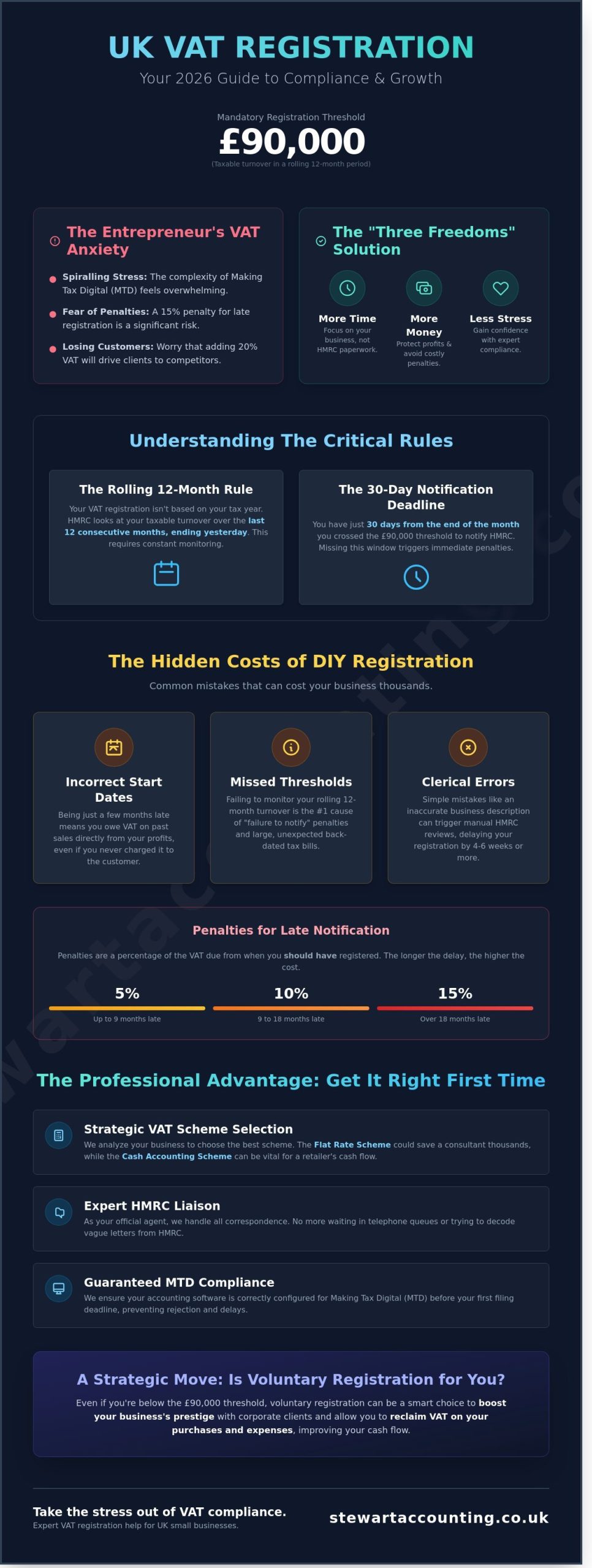
HMRC is incredibly strict about timelines. If your taxable turnover exceeds the £90,000 threshold (the rate set in April 2024), you must notify them within 30 days of the month-end in which you crossed the limit. This isn’t based on your fixed tax year; it’s a rolling 12-month look-back. Missing this window triggers a “failure to notify” penalty. These charges are calculated as a percentage of the VAT due from the date you should’ve been registered. For instance, a delay of 9 to 18 months can result in a 10% penalty on top of the actual tax bill. Common errors we see include:
- Incorrect Start Dates: Choosing a date just three months late means you’ll owe tax on sales where you didn’t charge the customer, eating directly into your profits.
- Missed Thresholds: Failing to monitor the rolling 12-month turnover, leading to back-dated bills that can reach five figures.
- Clerical Errors: Inaccurate business descriptions that trigger manual HMRC reviews and months of delays.
How Professional Guidance Protects Your Business Interests
Choosing the right path involves more than just filling out a form. We analyse your specific industry to identify the most beneficial VAT scheme. For a consultant with low overheads, the Flat Rate Scheme could save thousands of pounds annually compared to standard accounting. Conversely, for a retail business with high stock costs, the Cash Accounting Scheme might be vital for cash flow, as you only pay VAT to HMRC once your customers have actually paid you. Having a Chartered Accountant act as your intermediary means we handle all correspondence. You won’t have to wait in telephone queues or decode vague letters.
The reassurance of knowing your registration is “right first time” is invaluable. When we provide VAT registration help UK clients can expect a smooth transition into the VAT system. We ensure your software is correctly configured for Making Tax Digital before your first deadline. This proactive approach prevents the 4 to 6 week delays often caused by HMRC rejecting incomplete applications. We don’t just register you; we protect your business from future audits by establishing a compliant foundation from day one.
Navigating the 2026 VAT Thresholds and Mandatory Requirements
Staying ahead of tax obligations is the best way to protect your business from unexpected HMRC penalties. As of 1 April 2024, the current VAT registration threshold sits at £90,000. This figure represents the level of domestic taxable turnover a business can reach before registration becomes a legal necessity. We expect this £90,000 limit to remain the benchmark through 2026 unless specific Budget adjustments are announced. For many small business owners in Stirling or Falkirk, reaching this milestone is a sign of success, yet it often brings a wave of administrative anxiety.
One of the most frequent errors we see involves the distinction between turnover and profit. HMRC bases your registration requirement entirely on your gross taxable turnover. This is the total value of everything you sell that isn’t exempt from VAT. It doesn’t matter if your overheads are high or if your actual take-home profit is only £20,000; if your sales hit that £90,000 mark, you must take action. If you feel overwhelmed by these calculations, seeking VAT registration help UK experts can take the weight off your shoulders and ensure you don’t miss a deadline.
Seasonal businesses face unique challenges with these rules. A Christmas-themed retailer or a summer tourism firm might see 80% of their income arrive in a three-month window. Because the test is constant, a single bumper season can push you over the limit even if the rest of your year is quiet. You must monitor your figures monthly to avoid a retrospective tax bill that could wipe out your seasonal gains.
The 12-Month Rolling Turnover Test Explained
The rolling 12-month test is a continuous look-back exercise. It’s not tied to your accounting year or the April tax year. At the end of every month, you must add up your taxable turnover for the previous 12 months. For example, on 31 May, you calculate your sales from 1 June of the previous year. If your total reaches £90,001, you’ve breached the threshold. Your taxable turnover includes standard-rated (20%), reduced-rated (5%), and even zero-rated (0%) goods. It only excludes items that are specifically “exempt,” such as certain financial services or health costs.
The 12-month rolling test requires businesses to evaluate their cumulative taxable turnover at the end of every single month rather than waiting for the end of a traditional tax year.
The 30-Day ‘Future Look’ Rule
The “future look” rule is different because it focuses on what is about to happen rather than what has already passed. You must register for VAT if you expect your total taxable turnover to exceed £90,000 in the next 30 days alone. This scenario often happens when a business lands a significant one-off contract. If a consultant signs a deal on 10 October worth £95,000, they know immediately that they will breach the threshold. In this case, you must notify HMRC by the end of that 30-day period. Your effective date of registration becomes the date you first realised the breach would happen, not the following month. This is where VAT registration help UK specialists become invaluable, as they help you identify these triggers before they become compliance issues.
Managing these dual tests ensures you stay on the right side of the law while keeping your “three freedoms” intact. If you’re unsure where your turnover stands this month, our team can review your books to give you total peace of mind.
Voluntary VAT Registration: Is it the Right Strategic Move for You?
Most business owners in Central Scotland wait until they hit the £90,000 turnover threshold before they even consider tax. This threshold, updated on 1 April 2024, is a legal requirement, but waiting until the last minute isn’t always the smartest path. Choosing to register voluntarily can provide a significant boost to your cash flow and brand image. If you are looking for VAT registration help UK, the first thing we look at is your client base. If you primarily serve other VAT-registered businesses, they won’t feel the impact of your 20% price increase because they will simply reclaim it. It makes the transition financially neutral for them while allowing you to behave like a much larger firm.
There is a distinct prestige factor involved here. Large corporate clients often view VAT registration as a sign of stability and scale. Being non-registered can inadvertently signal that your turnover is low, which might make some procurement departments hesitant. By registering early, you remove that “small business” label. It simplifies your path to winning bigger contracts. Understanding the VAT registration process is the first step in taking control of your business growth and ensuring you don’t miss out on these high-value opportunities.
The Benefits of Reclaiming Input VAT
One of the fastest ways to achieve our “three freedoms” promise of more money and less stress is by reclaiming the VAT you pay on business expenses. When you register, you can recover the 20% tax on items like laptops, office furniture, professional accounting fees, and even some utility bills. For a new startup spending £10,000 on initial equipment and stock, that is a £1,666 cash injection back into the business. You can also look backwards. HMRC allows you to reclaim VAT on goods bought up to 4 years before your registration date, provided you still have them, and on services bought in the last 6 months. This often results in a significant initial refund that we can help you secure.
Potential Drawbacks and Administrative Burdens
Voluntary registration isn’t right for everyone. If you sell directly to the public, like a local cafe or a hair salon, your customers cannot reclaim VAT. Adding 20% to your prices overnight could lead to “sticker shock” and drive your regulars to non-registered competitors. You also need to consider the administrative side. Under Making Tax Digital (MTD) rules, you must keep digital records and submit quarterly returns using compatible software. This adds a layer of complexity to your weekends. We aim to take this off your hands so you can focus on your work, but you must weigh the cost of professional compliance against your potential tax savings. For some, the extra paperwork outweighs the small amount of input tax they would recover.
Deciding whether to register early requires a pragmatic look at your numbers. We help you analyse your specific costs and customer profiles to see if the move puts more money in your pocket. If you need VAT registration help UK services that focus on your long-term goals, getting an expert opinion early can prevent expensive mistakes later. Our goal is to ensure your tax strategy supports your business growth rather than hindering it.
The VAT Registration Process: Avoiding Common HMRC Pitfalls
Starting your journey with HMRC doesn’t have to be a headache. To begin, you must have a Government Gateway user ID and password specifically for your business. If you’ve been using a personal login for Self Assessment, you’ll likely need to set up a new organisational account. This is the first hurdle where many business owners in Alloa and Stirling get stuck. Without the correct credentials, the portal won’t grant you access to the necessary VAT1 forms. Getting professional VAT registration help UK ensures you have the right digital foundations from day one.
HMRC requires specific, verifiable data to process your application. You’ll need your National Insurance number, your Unique Taxpayer Reference (UTR), and your business bank account details ready. If you’re a Limited Company, keep your Certificate of Incorporation and your 10-digit Corporation Tax reference handy. Once you submit the form, the typical timeline for receiving your VAT registration certificate (VAT4) is 30 working days. However, if HMRC identifies any inconsistencies, this can stretch to 40 days or more. We aim to take this burden off your hands so you can focus on your “three freedoms”: more time, more money, and less stress.
Step-by-Step Guide to the Online Application
The VAT1 application form is your primary tool for registration. Accuracy here is vital; a single mistake can trigger a manual review. You must select an “Effective Date of Registration,” which is the date you officially join the scheme. Choosing the wrong date is a frequent pitfall. If you pick a date too far in the past, you’ll owe VAT on all sales made since then, even if you didn’t charge it to your customers. You also need to select a 5-digit SIC code that accurately reflects your business activities. HMRC uses these codes to profile your risk level, so choosing a code that doesn’t match your actual trade can lead to unnecessary enquiries.
Making Tax Digital (MTD) Compliance in 2026
By April 2026, the digital landscape for UK tax will be even stricter. For any business registering now, manual spreadsheets are no longer sufficient for record-keeping. HMRC requires “functional electronic links” between every piece of software you use. This means you cannot simply copy and paste data from a spreadsheet into a filing portal. Using cloud-based software like Xero simplifies this entire process. It automatically creates the digital audit trail HMRC demands, ensuring your quarterly filings are smooth and error-free. We help our clients transition to these tools to ensure they remain compliant without the late-night worry of manual data entry.
Don’t let HMRC paperwork drain your energy. Our team can handle your VAT registration and ensure your business is fully MTD-compliant from the very first day.
How Stewart Accounting Takes the Stress Out of VAT Compliance
VAT doesn’t have to be a source of constant worry. At Stewart Accounting Services, we’ve built our reputation on a simple promise: providing the “Three Freedoms.” We want to give you back more time, more money, and more mind. That last one is vital; it means less stress for you and your family. By offering professional VAT registration help UK business owners can trust, we manage the entire process from the initial application to the final submission. We literally take it off your hands, allowing you to focus on growing your business instead of deciphering HMRC manuals.
Our approach is never one-size-fits-all. A sole trader working from a home office in Clackmannanshire has very different requirements than a limited company in Falkirk with a £2 million turnover and 15 employees. We tailor our service to your specific structure. For contractors, we often analyse whether the Flat Rate Scheme could save you money. For larger limited companies, we focus on robust systems to ensure every penny of input tax is reclaimed accurately. Since our firm’s inception, we’ve helped hundreds of clients avoid the 5% to 15% penalties often associated with late registration or incorrect filings.
Local Expertise for Central Scotland Businesses
While we support businesses remotely across the UK, our physical offices in Alloa, Stirling, and Falkirk provide a base for face-to-face reassurance. You can sit down with a Fully Qualified Chartered Accountant who understands the Central Scotland economy. We know the nuances of Scottish business grants and local industry trends. Our team has guided over 500 local businesses through the complexities of tax, providing a level of personal service that large, faceless online firms can’t match. You aren’t just a number to us; you’re a local partner.
Beyond Registration: Ongoing VAT Management
Registration is only the beginning of your journey. Since 1 April 2022, all VAT-registered businesses must follow Making Tax Digital (MTD) rules, which requires functional compatible software. We don’t leave you to struggle with new technology alone. We provide bespoke Xero training to ensure your bookkeeping is seamless and compliant. Our quarterly VAT return service acts as a final safety net, where we review your figures for accuracy before they reach HMRC. This proactive management prevents the “VAT cliff edge” where businesses face unexpected bills they haven’t budgeted for.
We believe that professional VAT registration help UK should be accessible and transparent. Our goal is to remove the administrative burden that keeps you up at night. By choosing Stewart Accounting Services, you’re investing in a partnership that prioritises your peace of mind. We handle the deadlines, the digital links, and the technical queries so you can get back to what you do best. Don’t let tax compliance stall your momentum or drain your energy. Book a free consultation with our Alloa or Stirling team today and let us take it off your hands.
Take Control of Your VAT Compliance Today
Navigating the 2026 tax landscape requires more than just ticking boxes. You’ve seen how mandatory thresholds and the shift to Making Tax Digital (MTD) make accuracy essential for every small business. Whether you’re nearing the £90,000 limit or choosing voluntary registration to reclaim input tax, getting it right the first time saves you from costly HMRC penalties. Our team of Fully Qualified Chartered Accountants across our Alloa, Stirling, and Falkirk offices specialises in Xero and MTD compliance to ensure your transition is seamless. We focus on the technical details so you can focus on your customers.
Professional VAT registration help UK ensures you don’t just stay compliant; you gain the three freedoms of more time, more money, and less stress. We’ll manage the complex HMRC paperwork and digital setup while you focus on scaling your operations. Let us take the stress of VAT registration off your hands, get in touch today. We’re ready to help you achieve your business goals with confidence and clarity.
Frequently Asked Questions
Do I need VAT registration help if I am a sole trader?
Yes, you should seek professional support if your taxable turnover exceeds £90,000. Getting VAT registration help UK experts provide ensures you don’t miss deadlines or miscalculate your effective date.
We take the paperwork off your hands to give you more “mind” (less stress !!!!!!). This allows you to focus on your trade while we handle the complex HMRC requirements and compliance checks efficiently.
What is the penalty for late VAT registration in 2026?
HMRC applies a “failure to notify” penalty based on a percentage of the VAT due from the date you should’ve registered. If you’re over 12 months late in 2026, the penalty is 15% of the relevant VAT.
For shorter periods, it ranges from 5% to 10%. We help you avoid these unnecessary costs so you keep more of your hard-earned money and stay on the right side of the law.
Can I reclaim VAT on items I bought before registering my business?
You can reclaim VAT on goods bought up to 4 years before registration and services bought up to 6 months before. These items must still be in use by the business or relate to your current taxable supplies.
We’ll review your receipts to ensure you maximise your initial VAT return. This process puts more money back into your business right from the start, helping your cash flow significantly.
How long does it take for HMRC to process a VAT registration application?
HMRC typically processes applications within 30 working days, though complex cases can take longer. You’ll receive your VAT certificate through your online account once approved.
Our team monitors the application process for you. We remove the burden of chasing HMRC so you can focus on growing your business without the administrative headache. This gives you more time to focus on your goals.
Is it worth being VAT registered if my customers are not VAT registered?
It’s often not financially beneficial if your customers are the general public because you must add 20% to your prices without them being able to reclaim it.
However, if your setup costs are high, voluntary registration might save you money on input tax. We provide tailored advice to help you decide if registration will actually give you more money and less stress (more mind).
What is the current VAT threshold for small businesses in the UK?
The current VAT registration threshold is £90,000 as of 1 April 2024. You must register if your total taxable turnover for the last 12 months goes over this limit or if you expect it to go over in the next 30 days.
Professional VAT registration help UK firms offer ensures you monitor these limits accurately every month. This proactive approach prevents any nasty surprises or late notification penalties.
Can an accountant register my business for VAT on my behalf?
Yes, we can act as your authorised agent to handle the entire registration process with HMRC. By appointing Stewart Accounting Services, we take this administrative task off your hands entirely.
We manage the forms and digital links, ensuring your business is compliant while you enjoy more time to spend on what matters most to you and your family. It’s the simplest way to get started.
What happens if my turnover goes above the threshold but then drops back down?
You must still register if you hit the £90,000 limit, unless you apply for a registration “exception” because the increase was temporary. HMRC requires evidence that your turnover will stay below the £88,000 deregistration limit for the next 12 months.
We’ll help you compile the necessary forecasts to support your case and avoid unnecessary compliance work for your business. This keeps your accounting simple and stress-free.