

UK VAT Registration Threshold Demystified

If you’re running a business in the UK, there’s a magic number you need to keep a close eye on: the VAT registration threshold. It's the government's official line in the sand. Once your total sales cross this figure within any 12-month period, you’re legally required to register for Value Added Tax (VAT).
Think of it as a tripwire. As your business grows, you get closer to it, and crossing it triggers your obligation to start dealing with VAT.
What Is the UK VAT Registration Threshold?
So, what's the point of this threshold? It's actually designed to give smaller businesses a break. The government recognises that managing VAT—charging it, keeping records, and making payments to HMRC—is a significant administrative task. By setting a threshold, it allows startups and small enterprises to focus on getting established and growing without getting tangled in tax complexities too early on.
The figure you need to track is your taxable turnover. This is a crucial detail many get wrong. It’s not your profit, nor is it your sales from a fixed financial year (like January to December). Instead, it’s the total value of everything you've sold that isn't exempt from VAT, calculated on a rolling 12-month basis. This means at the end of every single month, you need to look back over the preceding 12 months and add up your sales.
The Current Threshold and Its Impact
As of 1 April 2024, the UK VAT registration threshold was increased from £85,000 to £90,000. This was a pretty big deal, as it was the first increase in seven years and keeps the UK's threshold among the highest in the OECD—more than double the average for both the EU and OECD.
This change is all about easing the burden on small businesses. The government estimates this higher limit will keep around 3.2 million UK businesses out of the VAT system, letting them focus on what they do best. You can find more details in the official government publication about increasing the VAT registration threshold.
By setting a high threshold, the government allows small businesses valuable breathing room. It provides a buffer zone where they can grow their operations before mandatory VAT compliance kicks in.
To help businesses whose turnover hovers around the limit, there's also a deregistration threshold. This is set slightly lower, at £88,000. If your taxable turnover drops below this figure, you have the option to cancel your VAT registration and simplify your bookkeeping again. Keeping a close watch on your turnover against both these numbers is absolutely essential for staying on the right side of HMRC and avoiding penalties.
Current UK VAT Thresholds at a Glance
To make it crystal clear, here’s a quick summary of the key VAT threshold figures every UK business owner should know.
| Threshold Type | Amount | What It Means |
|---|---|---|
| Registration Threshold | £90,000 | If your 12-month rolling taxable turnover exceeds this, you must register for VAT. |
| Deregistration Threshold | £88,000 | If your taxable turnover falls below this, you can apply to cancel your VAT registration. |
These two numbers work in tandem to create a stable system, preventing businesses from having to constantly register and deregister if their income fluctuates slightly.
How to Calculate Your Taxable Turnover
Figuring out your turnover for VAT purposes is one of the most common trip-ups in business finance. It’s not a simple case of looking at your annual sales figures once your financial year ends. A much better way to think of it is like a moving window, not a static photograph.
You need to work out your taxable turnover on a rolling 12-month basis. This means at the end of every single month, you look back over the preceding 12 months and add up your sales. It's this constant check-in that stops you from accidentally sailing past the threshold without noticing.
What to Include in Your Calculation
Your taxable turnover is the grand total of everything you sell that isn't specifically exempt from VAT. Don't get confused here; this applies even if you aren't charging VAT on them yet. It's about whether they could be subject to VAT.
Here’s what you need to tally up:
- Standard-rated goods and services: This is the bulk of what most businesses sell. Think professional fees, items sold in a shop, or meals in a café.
- Zero-rated goods and services: Items like most food, children’s clothing, and books fall into this bracket. The VAT rate is 0%, but their value absolutely counts towards your turnover.
- Reduced-rate goods and services: This includes things like domestic fuel or certain energy-saving materials.
- Goods you hired or loaned to customers: The value of these transactions also gets added to the pot.
This visual guide neatly lays out the simple three-step process for tracking your turnover and getting registered.
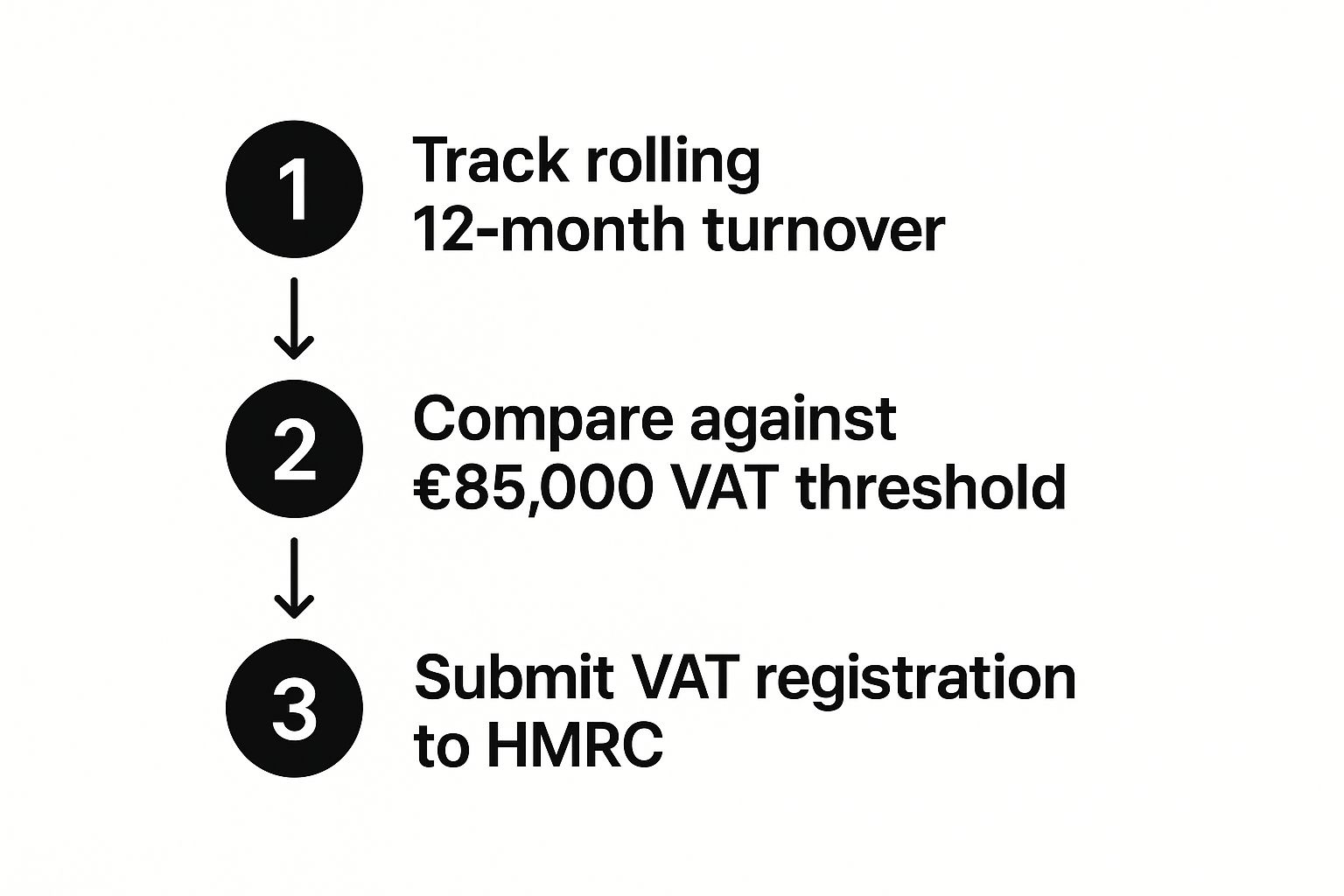
As the infographic shows, it all starts with keeping a continuous, diligent eye on that rolling turnover figure.
What to Exclude from Your Calculation
Knowing what to leave out is just as critical as knowing what to put in. Get this wrong, and you could end up registering too early—creating a pile of admin for no reason—or, worse, registering late and facing penalties from HMRC.
Don't make the common mistake of including income from VAT-exempt supplies. This can artificially inflate your turnover and push you into registering before you legally need to.
Make sure you leave these out of your calculation:
- VAT-exempt sales: This covers specific services like insurance, finance, and some forms of education and training.
- Sales of capital assets: If you sell a company van or an old office computer, that money doesn't count towards your turnover for VAT.
- Income from outside the scope of UK VAT: This includes things like statutory fees or any voluntary donations you receive where you don’t provide anything in return.
To calculate your turnover correctly, you first need clear and accurate records. For some practical tips on how to simplify your invoicing and payment processes, this resource has some great advice for business owners.
Keeping these distinctions straight is fundamental to managing your business's journey towards the VAT threshold. By carefully tracking what counts and what doesn't each month, you can see your registration date coming and prepare properly, avoiding any last-minute panic or costly mistakes. It’s all about staying in control.
Why Does the History of the VAT Threshold Matter?
The VAT registration threshold isn’t some arbitrary figure plucked from thin air. It's a number with a long, often political, history that shapes how small businesses in the UK approach growth. Understanding its past is key to grasping why it's such a sensitive topic and why the recent changes have been so significant.
For years, businesses could rely on a predictable pattern: the threshold would typically see small, steady increases, roughly keeping pace with inflation. This gave business owners a clear runway for growth. But that all changed in 2017.
The Big Freeze and its Fallout
Following a recommendation from the Office of Tax Simplification (OTS), the government took the unprecedented step of freezing the VAT threshold at £85,000. This freeze was locked in place from 2017 right through to 2024, creating a major headache for small and medium-sized enterprises across the UK.
As the cost of doing business and general inflation crept up year after year, more and more businesses found themselves dragged over the threshold, often unintentionally. It was a classic "stealth tax"—while no tax rates were officially raised, inflation effectively did the government's work by pulling a wider pool of businesses into the VAT net.
The most widely felt consequence was the "bunching" phenomenon. This is where a significant number of businesses deliberately hit the brakes on their growth, capping their turnover just shy of the £85,000 mark to avoid the administrative complexities and pricing challenges that come with VAT registration.
This created a very real barrier to growth for thousands of ambitious entrepreneurs. Instead of chasing new contracts, many found themselves strategically treading water, turning down work simply to stay under the limit.
A Tale of Stunted Growth and Heated Debate
The decision to freeze the threshold sparked years of intense debate among economists and business owners. Had the government stuck to its previous policy of raising it with inflation, some analyses suggest the threshold would have hit around £103,000 by 2023. That’s a world away from the £85,000 figure businesses were wrestling with.
This policy has been a thorn in the side of business groups for years. For context, the threshold had climbed from £81,000 to £85,000 between 2014 and 2017 before the long freeze began. This stagnation meant that businesses experiencing even modest growth in real terms were suddenly forced into the VAT system. You can get a deeper sense of this long-running issue by exploring the ups and downs of the VAT registration threshold.
This history is vital. It shows that the threshold is more than just an administrative line in the sand; it's a powerful economic lever that can either fuel or stall small business growth. It's precisely this context that makes the recent increase to £90,000 such a welcome, if long overdue, breath of fresh air for so many.
Should You Register for VAT Voluntarily?
Most businesses simply wait until they cross the VAT registration threshold, and that's perfectly fine. But for some, taking the plunge and registering early isn't just an option—it's a smart strategic move. It might sound like signing up for extra paperwork, but jumping in before you're legally required to can unlock some serious financial and commercial advantages.
The decision really boils down to a single question: will the money you get back from reclaiming VAT outweigh the administrative hassle and the potential need to raise your prices? For a surprising number of businesses, the answer is a firm "yes".
Unlocking Key Advantages of Early Registration
The biggest draw for voluntary registration is the ability to reclaim VAT on your business expenses. Think about it. If you're launching a new café, you're going to spend thousands on coffee machines, furniture, and maybe even some building work. All those purchases have VAT baked into the price. By registering voluntarily from day one, you can claim all that VAT back from HMRC. That's a huge cash flow injection right when you need it the most.
Beyond the purely financial upside, having a VAT number can do wonders for your credibility. It sends a signal that you're an established, serious business. This can be especially important if you're trying to win contracts with larger, corporate clients who are VAT-registered themselves and often prefer working with suppliers who are on the same page.
Weighing the Potential Downsides
Of course, voluntary registration isn’t the right call for everyone. The main drawback is the admin. As soon as you're registered, you have to start charging VAT on your sales. This could make your prices higher than your non-registered competitors, which can be a real problem if your customers are the general public who can't reclaim that VAT.
You’ll also need to get serious about your bookkeeping. Keeping meticulous records and filing regular VAT returns using Making Tax Digital (MTD) compliant software becomes a mandatory, often quarterly, task. It adds another layer of compliance to your to-do list.
Deciding to register voluntarily means taking a hard look at your business model. If your main customers are other VAT-registered businesses and you have high setup or ongoing costs, the benefits will very likely outweigh the drawbacks.
This isn’t just a niche strategy, either. Research shows that around 44% of businesses trading below the threshold still choose to register. This figure alone tells you just how many owners see it as a powerful tool for financial efficiency and professional polish. If you're interested in the economics behind business behaviour and the VAT threshold, you can explore detailed economic analysis from the IMF.
Ultimately, the choice lands squarely on your shoulders. You need to weigh up your customer base, your cost structure, and your ambitions for growth to figure out if taking the VAT plunge early is the right strategic step for your business.
Getting Registered and When to Deregister

Knowing you need to register for VAT is the first step, but getting through the actual process can feel like a separate challenge. It all kicks off when your business hits one of two specific triggers. Getting these right is crucial because they set the clock ticking on your deadline to notify HMRC and help you steer clear of any late registration penalties.
The most common trigger is what’s known as the historical test. This is backward-looking, focusing on your rolling 12-month taxable turnover. The moment it tips over the £90,000 threshold, you have exactly 30 days from the end of that month to get your registration sorted.
So, let's say your turnover went past £90,000 on the 10th of August. The 30-day countdown starts at the end of August, meaning you have until the 30th of September to register. Your official registration date would then kick in from the 1st of October.
Looking Ahead and Stepping Back
The second trigger is a bit different; it requires you to look into the future. The future test comes into play if you expect your taxable turnover to shoot past £90,000 within the next 30 days alone. This isn't about gradual growth – it’s for situations like landing a huge, one-off contract that instantly puts you over the limit. If this happens, you need to register right away.
For either trigger, you'll handle the registration online through the HMRC portal. You'll need to have all your business details, turnover figures, and the exact date you crossed the VAT registration threshold ready to go.
But what if things slow down? This is where deregistration becomes relevant. If you find your taxable turnover is consistently falling below the £88,000 deregistration threshold, you have the option to apply to cancel your VAT registration. For businesses with fluctuating income, this can be a welcome relief from the administrative burden.
Your Path to VAT Compliance
Whether you're jumping into the VAT system or stepping out of it, following a clear set of steps will make the whole process much smoother.
- Keep an Eye on Turnover: Make monitoring your rolling 12-month turnover a regular financial habit.
- Spot the Trigger: Figure out if you've met the historical test or if the future test applies to you.
- Register on Time: Notify HMRC within the deadline. The online registration portal is usually the quickest and easiest way to do this.
- Life After Registration: Once you get your VAT number, you're officially in the system. You must start charging VAT on your sales, keeping digital records that comply with Making Tax Digital (MTD), and filing your VAT returns on time.
- Consider Deregistration: If your turnover drops and stays below £88,000, you can formally ask HMRC to cancel your VAT registration.
This cycle of monitoring, registering, and possibly deregistering is a fundamental part of financial management for any growing business in the UK.
Here is the rewritten section, crafted to sound like an experienced human expert.
What Happens if You Register for VAT Late? Understanding the Penalties
So, you’ve realised you should have registered for VAT a while ago. It’s a sinking feeling, but don’t panic. While missing the deadline can lead to penalties from HMRC, understanding how they work is the first step to resolving the situation without any unnecessary stress.
First things first, HMRC will figure out how much VAT you should have paid. They’ll look at the period from your 'effective date of registration' (the day you officially crossed the threshold) right up to the date you finally submitted your registration. The penalty isn't just a random fine; it’s a specific percentage of that total unpaid VAT.
How HMRC Calculates Late Registration Penalties
The penalty system is tiered, meaning the longer you’ve left it, the higher the percentage becomes. It’s directly tied to how late you are in notifying them.
Here’s a quick breakdown of the standard penalty bands:
- Up to 9 months late: You'll face a penalty of 5% of the VAT due.
- Between 9 and 18 months late: The penalty doubles to 10% of the VAT due.
- Over 18 months late: This jumps again to 15% of the VAT due.
It's also worth remembering that if HMRC suspects you deliberately avoided registering, the penalties can be far more severe. Honesty and prompt action are always your best bet.
Is There a Way to Avoid a Penalty? The 'Reasonable Excuse'
HMRC can be surprisingly understanding. They know that life sometimes throws a curveball that genuinely prevents you from managing your tax affairs. If you have a 'reasonable excuse' for registering late, they might reduce or even waive the penalty entirely.
A reasonable excuse is an unexpected event that was genuinely out of your control. Think serious, unforeseen circumstances like a sudden, debilitating illness or a close family bereavement—not just the usual pressures of running a business.
What doesn't count? Unfortunately, claiming you were too busy, didn’t understand the rules, or found the online portal confusing won’t get you off the hook. This is precisely why keeping a close eye on your turnover is so important. If you do find yourself in a tight spot with a legitimate reason, working with an accountant can be invaluable in helping you present your case to HMRC in the clearest and most effective way.
Common Questions About VAT Registration Answered
Getting to grips with VAT can feel a bit like learning a new language. As your business grows, questions are bound to pop up. Here, we'll tackle some of the most frequent queries we hear about the UK VAT registration threshold, giving you clear, straightforward answers to help you navigate your finances with confidence.
What if I Sell Digital Products to the UK from Abroad?
This is a big one for overseas businesses. When it comes to selling digital services to UK customers, the standard rules go out the window. There’s effectively a £0 threshold.
That’s right—you must register for UK VAT from your very first sale. It doesn’t matter what your total turnover is; the obligation kicks in immediately.
How Far Back Can I Go with My VAT Registration Date?
If you decide to register for VAT voluntarily, HMRC allows you to backdate your registration by up to four years. This can be a smart move if you've paid a lot of VAT on business costs over that time, as it opens the door to reclaiming that input tax.
But it’s a double-edged sword. Backdating also means you’re on the hook for accounting for VAT on all your taxable sales from that earlier date. You'll need watertight records to handle this properly.
It's important to remember that backdating isn't just a strategic choice. If you missed your mandatory registration date because you went over the threshold without realising it, you must backdate your registration to the correct date. This is a crucial step to get compliant and pay any VAT you owe.
What Exactly Is a 'Rolling' 12-Month Period?
This concept trips a lot of people up. A rolling 12-month period isn't tied to the calendar year (January to December) or your financial year. Think of it as a constant, moving window.
At the end of every single month, you need to look back and calculate your total taxable turnover for the preceding 12 months. For instance, at the end of May, you’d tally up your sales from the 1st of June last year all the way through to the 31st of May this year. This regular check-in is the only way to accurately track whether you’re getting close to the VAT registration threshold.
Juggling VAT obligations, from keeping an eye on the vat registration threshold to filing returns, adds a hefty layer of admin to your already busy schedule. The expert team at Stewart Accounting Services can lift that weight from your shoulders. We’ll make sure you stay compliant, reclaim every penny of VAT you’re entitled to, and free you up to focus on what you do best—growing your business.
To see how we can bring clarity and efficiency to your finances, find out more about our services at https://stewartaccounting.co.uk.
Recent Posts
16 Oct, 2026
15 Oct, 2026