
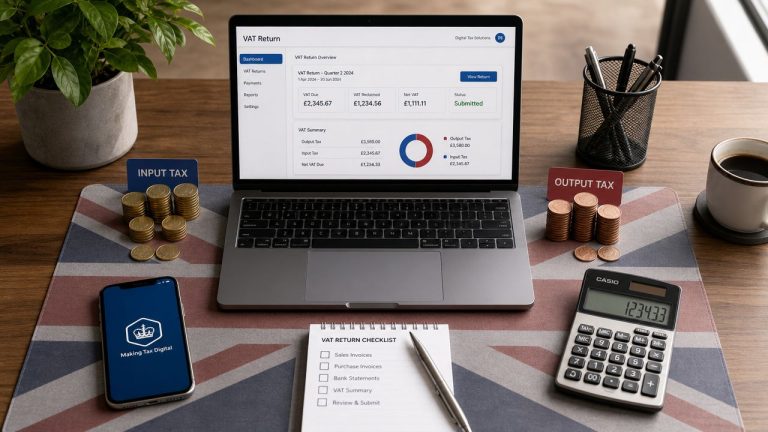
You've probably had the same moment many business owners have. Sales are growing, the bookkeeping is no longer something you can leave until the weekend, and someone says, “You'll need to sort the VAT return.” That's usually when VAT starts to feel less like a tax rule and more like a source of stress.
It doesn't need to be. Once you understand what a VAT return is, how the figures are built, and why cloud bookkeeping matters so much, the process becomes far more manageable. Good VAT compliance isn't just about sending HMRC a form on time. It's about keeping your records clean enough that the return is right before you press submit.
What Is a VAT Return
A VAT return is the periodic report a business submits to HMRC showing the VAT it charged on sales, the VAT it paid on purchases, and the net amount payable or reclaimable. HMRC's guidance says the return must include total sales and purchases, VAT owed, and VAT reclaimed. For most VAT-registered businesses, the filing cycle is quarterly, which means four returns a year, and the standard UK VAT rate remains 20% for most goods and services, as set out in HMRC's VAT return guidance.
The simplest way to think about it is this. Your business collects VAT from customers on behalf of HMRC, then offsets that against the VAT it has paid on business costs where recovery is allowed. The VAT return is the summary that tells HMRC who owes what for that period.
What the return is really doing
For a new business owner, the phrase “VAT return” can sound technical. In practice, it's a reconciliation exercise. You're matching:
- VAT charged on sales that your business has collected
- VAT paid on purchases that may be reclaimable
- The difference that leads to a payment or repayment position
That's why bookkeeping matters so much. If sales invoices are missing, purchase receipts haven't been posted, or transactions have been coded incorrectly, the return won't reflect the actual position.
Practical rule: A VAT return is only as reliable as the records feeding it.
Why it matters beyond compliance
Many owners assume VAT is just another quarterly admin job. It isn't. It affects cash flow directly, because VAT collected from customers isn't business income you can freely spend. If that distinction isn't clear in your accounting system, VAT bills can arrive as an unpleasant surprise.
It also matters because the return creates a regular discipline in the business. When the underlying records are organised, VAT returns become routine. When records are patchy, each quarter turns into a scramble through invoices, receipts and bank transactions.
That difference is often what separates a calm finance function from a stressed one.
VAT Registration and Filing Deadlines
VAT deadlines catch businesses out when growth starts moving faster than admin. One month the turnover looks manageable. A short time later, you're dealing with registration, digital filing, and the pressure of getting things right from the start.

The first point to understand is that VAT isn't a niche issue. The Office for National Statistics says there are about 8 million VAT returns completed each year across roughly 2 million registrations, and it receives fresh turnover and expenditure data from HMRC every month from those returns, as explained in the ONS review of VAT data. That tells you something important. HMRC treats VAT reporting as a core part of the UK compliance system, not a side process.
When registration becomes a live issue
Once your business approaches the registration point, you need proper monitoring of taxable turnover and a clear registration date. In practice, the problem usually isn't understanding that registration exists. It's spotting the trigger in time and knowing what should happen next.
Some businesses also register voluntarily. That can make sense where clients expect to deal with VAT-registered suppliers, or where there is enough input VAT on costs to make registration commercially sensible. The right answer depends on your pricing, customer base, margins and sector.
If you need a practical overview of that decision, Stewart's guide to VAT registration for small business is a useful starting point.
The filing rhythm matters
Most VAT-registered businesses file on a quarterly basis. That sounds simple, but quarterly doesn't mean occasional. A quarterly return is only easy when the records are being kept up throughout the quarter.
A workable rhythm usually looks like this:
- Keep sales current so every invoice is recorded in the right period
- Post purchase invoices promptly so reclaimable VAT isn't missed
- Review bookkeeping regularly instead of waiting until the deadline week
- Check the VAT liability early so there's time to query unusual items
Businesses that leave VAT until the filing week usually aren't solving a VAT problem. They're exposing a bookkeeping problem.
What works and what doesn't
A few habits make a noticeable difference:
| Approach | What usually happens |
|---|---|
| Keep records up to date in cloud software | The VAT return is mostly a review exercise |
| Mix business and personal spending without discipline | The VAT review becomes slower and riskier |
| Reconcile bank and sales records regularly | Errors are spotted before filing |
| Wait until quarter end to sort paperwork | Missing data and rushed judgments become more likely |
For most owners, the key shift is mental. VAT deadlines shouldn't be treated as isolated events. They're the output of an accounting process that needs to run cleanly all quarter.
How to Calculate Your VAT Return
The calculation itself is simpler than many people expect. The difficulty usually comes from the records, not the arithmetic.

Think of the return like a set of scales. On one side is the VAT you've charged customers. On the other is the VAT you're entitled to reclaim on business purchases. The balance between those two sides drives the result on the return.
In the UK VAT return, Box 1 reports output tax due on sales and other outputs, Box 4 reports input tax reclaimable on purchases, and Box 5 is the net settlement figure calculated as Box 1 minus Box 4. That makes Box 5 the cash-flow-critical line because it determines whether the business pays HMRC or receives a repayment, as outlined in this VAT return box explanation video.
The three boxes that matter most
For day-to-day understanding, new owners should focus on three core figures:
Box 1
This is the VAT due on your sales and other taxable outputs.Box 4
This is the VAT you can reclaim on qualifying business purchases.Box 5
This is the net result. If Box 1 is higher than Box 4, you pay HMRC. If Box 4 is higher, you may be due a repayment.
That's the heart of VAT returns explained in practical terms. The return is not mysterious. It is a summary of output tax less input tax.
A simple example
Take a small design agency using Xero. During the VAT period, it raises sales invoices with VAT on its services. It also incurs business costs such as software subscriptions, subcontractor bills, office expenses and accountancy fees, some of which include VAT that may be reclaimable.
The calculation process usually follows this order:
- Review all sales invoices in the period and identify the VAT due.
- Review purchase invoices and receipts that have been posted correctly.
- Exclude anything that isn't recoverable or doesn't belong in the period.
- Confirm the software's VAT report matches the underlying records.
- Read the net figure before filing and sense-check whether it fits the business activity for that quarter.
That final sense-check is often overlooked. If turnover has been quiet but the VAT payable looks unusually high, or costs have been heavy but there is no meaningful input VAT recovery, something may have been coded wrongly.
For businesses building better digital finance processes, it can also help to look at how other regions are adopting cloud systems and automation. This overview of modern accounting for UAE businesses is useful because it shows the same wider shift UK firms are dealing with. Better software only helps when the workflows behind it are disciplined.
Why cloud bookkeeping changes the process
Software such as Xero makes VAT calculation faster, but it doesn't remove judgment. The system can pull figures into a return, yet it still depends on the coding being right at transaction level.
Good practice usually includes:
- Accurate invoice coding so sales and purchases land in the correct VAT treatment
- Regular reconciliations to catch duplicates, omissions and timing errors
- Review of exceptions such as reverse charges, mixed-use costs and unusual supplier invoices
If you want a practical breakdown of the mechanics, this guide on how to calculate VAT gives a straightforward framework. The important point is that software speeds up the maths, but clean data is what makes the return reliable.
Understanding Common VAT Schemes
Not every business has to account for VAT in the same way. That matters because the right scheme can reduce admin strain, improve cash timing, or make the reporting process easier to manage.
Many owners stay on the standard method because it's familiar. Sometimes that's right. Sometimes it means they're carrying extra complexity for no real benefit.
Comparing the main options
Here's a practical side-by-side view of common approaches:
| Scheme | Main idea | Often suits |
|---|---|---|
| Standard VAT accounting | VAT is accounted for under the normal rules | Businesses with straightforward records and regular review processes |
| Flat Rate Scheme | Designed to simplify the calculation method | Smaller businesses with relatively modest input VAT recovery |
| Annual Accounting Scheme | Payments run through the year with a single return cycle | Owners who want fewer formal returns and more predictable administration |
| Cash Accounting Scheme | VAT follows cash received and paid rather than invoice dates | Businesses where payment timing has a strong effect on cash flow |
Where businesses often make the wrong choice
The Flat Rate Scheme can look attractive because it sounds simpler. But simple doesn't always mean cheaper or better. If a business has substantial costs with reclaimable VAT, the scheme may not be the best fit.
Annual Accounting can reduce the feeling of constant filing pressure, but some owners then assume they can pay less attention during the year. That's rarely wise. The records still need to be maintained properly, because the final return only works if the books have been kept in shape.
Cash Accounting is often the most practical conversation for small businesses with slow-paying customers. If clients take time to settle invoices, accounting for VAT based on actual cash movement can be easier on working capital. Stewart's guide to the benefits of the VAT cash accounting scheme explains why many smaller businesses find it useful.
The best VAT scheme is usually the one that fits how your business actually trades, not the one that sounds simplest on paper.
What to ask before choosing a scheme
A sensible decision usually turns on a few questions:
- How quickly do customers pay you
- How much input VAT do you usually reclaim
- How strong are your bookkeeping processes
- Do you want simplicity, cash-flow support, or both
Professional advice proves invaluable here. A scheme choice affects more than the return itself. It influences timing, reporting habits and the way your bookkeeping needs to be maintained across the year.
Filing Your Return and Correcting Errors
Pressing submit feels like the end of the process. In reality, it's the point where all the earlier bookkeeping either holds up or starts to unravel.

Businesses are increasingly dealing with more automated VAT scrutiny and pre-populated return processes, which can increase remediation needs if bookkeeping data is weak. Professional commentary also notes that VAT returns are no longer just a quarterly form-fill exercise. They are becoming a data-quality checkpoint for the wider finance function, as discussed in BDO's VAT returns commentary.
Filing is now a systems issue
This is the part many basic guides miss. Modern VAT compliance isn't just about knowing which box to use. It's about whether your bookkeeping system can support what HMRC expects to see.
If you use Xero or other MTD-compatible software, the submission itself is usually straightforward. The harder question is whether the data inside the software is dependable. Errors tend to come from the same places repeatedly:
- Mis-coded supplier bills
- Sales raised in the wrong period
- Missing purchase evidence
- Incorrect treatment of special cases, such as reverse charge transactions or mixed-use costs
That's why filing should include a review stage, not just a click.
When mistakes happen
Most businesses will make an error at some point. The practical issue is spotting it quickly and deciding the right route to correction.
Some errors can be adjusted through a later return if they're identified in time and the circumstances allow. Others need a more formal disclosure approach to HMRC. The correct treatment depends on the nature of the mistake, how significant it is, and whether it reflects an isolated coding issue or a wider record-keeping problem.
The wrong reaction is panic. The right reaction is to investigate the source of the error, document what happened, and correct it through the appropriate process.
Weak VAT returns rarely start with the return itself. They start with untidy purchase records, inconsistent coding and rushed month-end routines.
Build a repeatable filing process
One of the most useful things a business can do is document the filing workflow. That doesn't need to be bureaucratic. A short internal process note covering who checks invoices, who reviews the draft return, and who approves submission can prevent a lot of confusion. If your team needs a model for that kind of process design, Doczen's workflow playbook offers practical ideas for documenting recurring finance tasks.
A sound filing routine often includes:
- Reconcile bank accounts first.
- Review sales and purchase ledgers for the VAT period.
- Check unusual transactions separately.
- Run the draft VAT report from the software.
- Compare it to expectations based on the quarter's trading.
- Submit only after someone has reviewed the outliers.
That's the shift modern businesses need to make. VAT filing is no longer just compliance admin. It's part of financial control.
Your Pre-Submission VAT Return Checklist
Before any VAT return goes to HMRC, run a short pre-submission check. The check helps catch many avoidable errors.
The checks worth doing every quarter
Confirm all sales are included
Make sure every sales invoice for the VAT period has been entered, dated correctly and given the right VAT treatment.Check purchase invoices and receipts
Review whether all reclaimable business costs have been posted. If your team needs a refresher on supporting documents, this guide to receipts to keep for taxes is a practical reference for keeping evidence organised.Review bank reconciliations
If the bank account isn't up to date, the VAT return probably isn't either. Reconciliations often expose duplicates, omissions and posting errors.Scan for unusual transactions
Large one-off purchases, overseas supplier invoices, credit notes and mixed business/private costs deserve a second look.Sense-check the liability
Ask whether the draft return fits the quarter you've had. A figure that feels out of line often points to missing or mis-coded transactions.
A short approval routine
Use a simple sign-off habit before filing:
| Check | Why it matters |
|---|---|
| Sales ledger reviewed | Prevents under-declared output VAT |
| Purchases reviewed | Reduces missed input VAT or incorrect claims |
| Bank reconciled | Improves accuracy of the source data |
| Exceptions considered | Helps catch items software won't judge properly |
This checklist doesn't replace judgment. It creates space for it. Most VAT stress comes from rushed filing, and rushed filing usually starts with skipping these basics.
Let Stewart Accounting Services Handle Your VAT
Some business owners read a guide like this and feel reassured. Others read it and realise how much of the burden they're currently carrying themselves. Both reactions are reasonable.
VAT returns sit at the point where bookkeeping, deadlines, software and tax judgment all meet. If the records are current, the process is usually manageable. If the records are weak, every quarter becomes disruptive. That's especially true when a business is growing and the owner's time is better spent on sales, staff, delivery and cash flow.
A practical option is to hand the process to people who already work in that cycle every day. Stewart Accounting Services provides VAT return preparation and submission as part of a wider accounting support function, including bookkeeping and cloud accounting workflows. For a business using Xero, that usually means the VAT return is handled as part of an organised digital process rather than a quarter-end scramble.
That changes the experience in a few useful ways:
- Deadlines are tracked so the return doesn't depend on memory
- Bookkeeping is kept cleaner which reduces correction work later
- VAT scheme choices can be reviewed in the context of cash flow and administration
- Questions are dealt with early before they turn into filing issues
For business owners, that often matters more than the submission itself. You're not just outsourcing a form. You're reducing the chance of weak records, late fixes and avoidable disruption.
If your current setup involves chasing receipts, reviewing Xero late at night, and hoping the VAT control account makes sense before the deadline, that's usually a sign the process needs tightening. Good VAT compliance should feel structured and predictable. It shouldn't hijack the final week of every quarter.
VAT returns explained properly always come back to the same point. The return is only the visible part. The underlying work is in the records, the review process and the systems behind it.
If you want a cleaner VAT process, Stewart Accounting Services can take care of the bookkeeping flow, prepare the return, and handle submission through your cloud accounting setup so the quarter-end becomes routine rather than stressful.