

VAT Threshold 2023/24 Your Small Business Guide

For the 2023/24 tax year, the magic number for UK businesses was £85,000. This was the VAT registration threshold – the total taxable turnover your business could reach in a rolling 12-month period before you were legally required to register for Value Added Tax (VAT).
What Was the VAT Threshold for 2023/24?
Getting to grips with the VAT threshold for 2023/24 is crucial if you’re reviewing your past accounts or trying to understand your historical obligations. Set at £85,000, this figure was a firm line in the sand. Once your turnover crossed it, your business had a legal duty to register with HMRC, start charging VAT on your taxable sales, and file regular VAT returns.
Think of it as a moving window, not a fixed calendar year. You had to constantly keep an eye on your turnover for any 12-month stretch. It was this rolling total, not your annual profit, that could trigger the need to register.
A Long Period of Stability
The £85,000 threshold wasn’t just a one-off for 2023/24. In fact, it had been a consistent benchmark in the UK tax system for several years, giving small businesses a predictable target to work with as they planned for growth.
From 2017 right through to the end of the 2023/24 tax year, this figure remained unchanged. This long-standing stability offered a reliable framework for small enterprises before the government announced an increase to £90,000 from 1 April 2024.
To put this in perspective, here’s a quick comparison of the key figures.
VAT Thresholds at a Glance
| Metric | Threshold for 2023/24 Tax Year | Threshold From 1 April 2024 |
|---|---|---|
| Registration Threshold | £85,000 | £90,000 |
| Deregistration Threshold | £83,000 | £88,000 |
This table clearly shows the shift, marking the end of a long period of consistency.
While the threshold is a major focus for smaller businesses, it’s worth noting that the lion’s share of VAT revenue has always come from much larger companies. For instance, in the 2022/23 fiscal year, businesses with turnovers exceeding £10 million accounted for a staggering 75% of the total UK VAT revenue. You can find more insights into small business tax policy on various financial news sites.
Getting Your Taxable Turnover Calculation Right
Figuring out your ‘taxable turnover’ is the single most important part of staying on top of your VAT duties for the 2023/24 tax year. It’s not just your total sales, and it’s certainly not your profit. It’s a specific calculation that dictates whether you need to cross the £85,000 registration threshold. Nail this, and you’re building on solid ground.
Think of your taxable turnover as the total value of everything you sell that isn’t specifically exempt from VAT. This covers a whole host of goods and services, which is where things can sometimes get a bit tricky for business owners.
What Counts Towards the Threshold
When you’re adding up your turnover to see if you’re nearing the VAT threshold, you need to include the value of all sales that are:
- Standard-rated: Most goods and services you can think of, which have the 20% rate applied.
- Reduced-rated: Things like domestic fuel, energy-saving materials, and children’s car seats, which are taxed at 5%.
- Zero-rated: This is the big one people miss. Items like most food, books, and children’s clothes are taxed at 0%. Even though you don’t add any VAT to the sale price, the value of these sales still counts towards your total turnover.
It’s a classic trip-up for businesses to think zero-rated sales don’t matter for the threshold calculation. They absolutely do, so you need to keep a close eye on them month by month.
The key distinction to remember is between items that are zero-rated and those that are exempt. While neither adds VAT to the customer’s bill, only zero-rated sales push you closer to the registration threshold.
What to Leave Out of Your Calculation
Just as important is knowing what to exclude. You must leave out any income from sales of VAT-exempt goods or services. These are things that sit completely outside the VAT system, like postage stamps, insurance, and some financial services.
If you accidentally include these, you’ll inflate your turnover figure and might end up registering for VAT before you legally have to. For businesses that lean on external experts, it’s vital to know their accounting partners have rock-solid systems. This is where things like strategic IT support for accounting firms become so important for maintaining accuracy.
Remember, this calculation isn’t just for UK-based businesses. If you’re based overseas but supply goods or services into the UK, the same registration duties can apply. For a more detailed breakdown, the official government guidance on VAT registration and deregistration thresholds is the best place to go.
Getting to Grips with VAT Registration Triggers
It’s a common misconception that you only need to think about the VAT threshold 2023/24 once a year. The reality is far more fluid. Staying on the right side of HMRC means keeping a constant eye on your turnover, because the rules aren’t just about what you’ve earned in your financial year.
Your trigger for VAT registration isn’t tied to your April-to-March accounts. Instead, it hinges on two very different tests that require ongoing attention. The most common one is the ‘backward look’ test. This means that at the end of every single month, you need to look back and calculate your total VAT-taxable turnover for the previous 12 months.
This rolling calculation is absolutely crucial. Many businesses make the expensive mistake of waiting until their year-end to check their figures, but by then, it’s often too late. The legal requirement to register kicks in the very moment you breach the threshold in any 12-month rolling period.
The Two Critical Registration Tests
Think of the VAT registration triggers as two different kinds of financial alarms. One is a gradual warning that gets louder as you get closer to the limit. The other is a sudden, sharp alert that demands you take action right away.
- The Backward Look Test (Your Rolling 12-Month Total): At the end of each month, add up all your taxable sales from the last 12 months. If that total goes over the £85,000 threshold for 2023/24, you have to register.
- The Forward Look Test (What’s on the Horizon): This one is all about foresight. If you have good reason to believe your taxable turnover will exceed £85,000 in the next 30 days alone, you must register immediately. You can’t wait.
The image below gives a great visual of why it’s so important to track your turnover constantly, not just when the tax year changes in April.
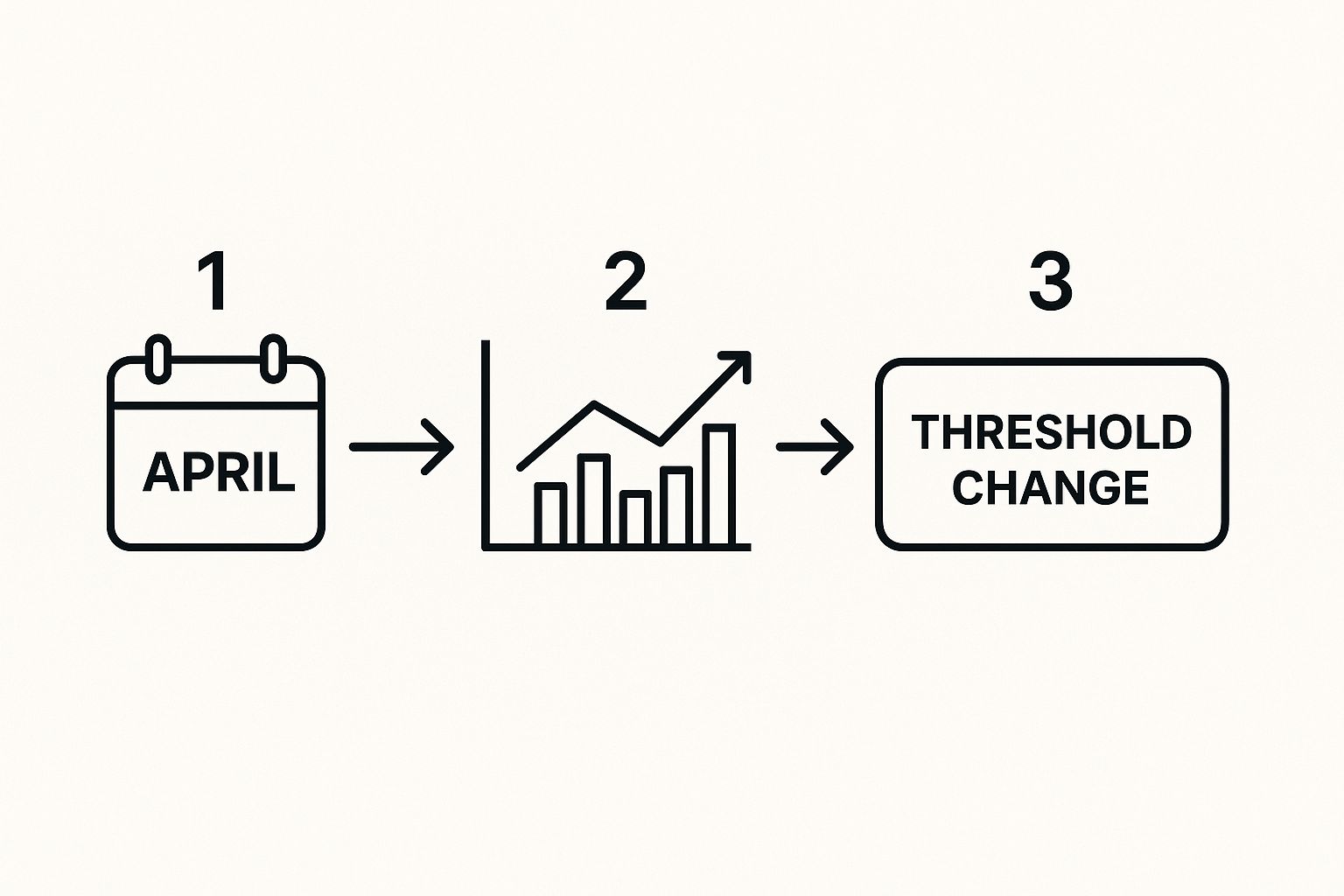
As you can see, VAT compliance is an ongoing job, not a task you can simply tick off at the end of the year.
The forward look test often catches people out when they land a big piece of work. Imagine a freelance web developer signs a £90,000 contract on 15th July. They must register for VAT there and then, regardless of what they earned in the previous 12 months.
At the end of the day, both tests hammer home one simple truth: you have to be proactive about VAT. Waiting until you’ve already crossed the line means you’re behind, and that’s a position no business wants to be in with HMRC.
The New £90,000 VAT Threshold: What It Really Means for Your Business
While looking back at the old VAT threshold for 2023/24 is useful, the real story is what happened next. The government’s move to lift the threshold wasn’t just a routine tweak; it was a deliberate step to tackle some real-world headaches that have plagued small businesses for years.
This change brings some immediate relief. For a start, it cuts down on the admin that comes with VAT. Many entrepreneurs find themselves spending more time on tax paperwork than on actually running their business, so this is a welcome break. It also helps with cash flow, since you’re not having to collect VAT from customers and hold it for HMRC.
Tackling the “Cliff-Edge” Problem
A major reason for the change was to address what’s known as the ‘cliff-edge’ effect. This is a common and frustrating problem where businesses intentionally hold back their growth, making sure their turnover stays just under the VAT limit to avoid the hassle and cost of registering.
For a long time, that £85,000 threshold felt like a glass ceiling for growing businesses. The new, higher limit is designed to give them a bit more runway before they have to step into the world of VAT.
As of 1 April 2024, the VAT registration threshold officially climbed from £85,000 to £90,000. This was the first increase in seven years, and a significant one at that. The government projected that this move alone would take around 28,000 small businesses out of the VAT system.
At the same time, the deregistration threshold was bumped up to £88,000, giving businesses whose turnover might dip slightly a clearer path to deregister. You can find a full breakdown of these updates in the official Spring Budget 2024 VAT changes.
Of course, while the new threshold gives you more breathing room, it doesn’t get rid of the cliff-edge entirely—it just moves it a little further down the road. If your business is getting close to the new £90,000 mark, careful financial planning is just as important as ever to make sure you manage that transition smoothly.
Should You Register for VAT Voluntarily?

Just because your turnover is safely under the £85,000 threshold doesn’t mean you have to stay out of the VAT club. For some businesses, deciding to register voluntarily isn’t just an option; it’s a savvy strategic move.
It can unlock some serious financial perks and even boost your professional reputation. But it’s not a one-size-fits-all solution, and it’s crucial to weigh up the pros and cons for your specific situation.
The Upsides of Voluntary Registration
The biggest carrot on the stick is the ability to reclaim VAT on your business expenses and purchases. This is a game-changer for businesses with high start-up costs or significant ongoing overheads.
Think about it: if you’re launching a new cafe, you’ll be spending a small fortune on everything from espresso machines to ovens and furniture. By registering for VAT, you can claim back the 20% you paid on all those essential items. That’s a significant cash boost right when you need it most.
Beyond the immediate cash flow advantage, having a VAT number can also enhance your business’s image. Many larger B2B companies, for instance, prefer to deal with VAT-registered suppliers. It acts as a signal that your business is established, serious, and operating at a certain scale, which could open the door to bigger and better contracts.
Here are the key benefits in a nutshell:
- Reclaim Input VAT: You get to recover the VAT you pay on goods and services for your business.
- Boost Your Credibility: A VAT registration number can make your business look bigger and more professional to clients and partners.
In essence, registering voluntarily means you join the VAT system, reclaiming tax on your costs while charging it on your sales. If most of your customers are other VAT-registered businesses, this creates a level playing field, as they can simply reclaim the VAT you charge them anyway.
The Potential Downsides to Consider
Of course, it’s not all upside. The main drawback is the extra administrative load. Once you’re in the system, you have to keep meticulous records, submit VAT returns to HMRC (usually every quarter), and make sure your payments are on time. This demands solid bookkeeping, whether you do it yourself or hire someone.
The other major consideration is your customer base. If you primarily sell to the general public or small businesses that aren’t VAT-registered, adding 20% to your prices will make you more expensive than your non-registered competitors. This could easily put you at a competitive disadvantage.
Ultimately, the decision to register voluntarily boils down to who your customers are and the nature of your business costs.
Common VAT Registration Mistakes and How to Avoid Them
Navigating the VAT threshold for 2023/24 can feel a bit like walking a tightrope, and it’s surprisingly easy to stumble. Even the most careful business owners can get caught out, so knowing where the common traps lie is the best way to stay on solid ground with HMRC.
One of the biggest tripwires is simply miscalculating your taxable turnover. This often happens when businesses lump all their income together, forgetting that VAT-exempt sales—like insurance or certain financial services—shouldn’t be included in the calculation. It’s crucial to remember that only your standard, reduced, and zero-rated sales count towards the threshold.
Forgetting to Monitor Turnover Every Month
Another classic mistake is only giving turnover a quick glance at the year-end. That’s not how VAT works. The threshold is based on a rolling 12-month period, which means you need to look back over the last 12 months at the end of every single month.
Thinking you can check your turnover just once a year is like only looking at your car’s fuel gauge before a long holiday. You’re bound to get a nasty surprise somewhere down the road. This simple oversight is a fast track to late registration and the penalties that come with it.
To steer clear of this, get into a simple monthly habit:
- Add It Up: At the end of each month, calculate your total taxable sales for the previous 12 months.
- Check the Limit: See if that 12-month total has gone over the £85,000 threshold.
- Make a Note: Keep a quick record of your check. This gives you peace of mind and creates a clear audit trail if HMRC ever asks.
Finally, don’t put off registering. If you cross the threshold, the clock starts ticking. You have exactly 30 days from the end of that month to get registered with HMRC. Miss that deadline, and you’ll be on the hook for all the VAT you should have collected, even if you never actually charged it to your customers.
Common VAT Threshold Questions Answered
Getting to grips with the VAT threshold for 2023/24 can bring up some very practical, “what if” scenarios. Let’s tackle some of the most common questions business owners ask when trying to stay on the right side of HMRC.
What Happens If I Miss the VAT Registration Deadline?
This is a big one. If you don’t register on time, you could face a ‘Failure to Notify’ penalty from HMRC. The size of the penalty is based on how much VAT you owe and how late you are.
But the bigger sting is that you’ll owe HMRC all the VAT you should have collected from the date you were required to register. This is true even if you never actually added it to your customer invoices, which can create a sudden and significant tax debt for your business.
Can I Deregister from VAT If My Turnover Drops?
Absolutely. If you find your turnover is dipping, you can apply to deregister. For the 2023/24 tax year, you could request to leave the scheme if you expected your VAT-taxable turnover to fall below the deregistration threshold of £83,000.
While this move will certainly lighten your administrative load, keep in mind that you’ll also lose the ability to reclaim VAT on your business purchases and expenses. It’s a trade-off worth considering carefully.
Do Sales to Customers Outside the UK Count Towards the Threshold?
Yes, they usually do. When you’re adding up your turnover, you generally need to include the value of goods and services you export from the UK.
This often surprises people, especially since many of these sales might be zero-rated for VAT. The rules around international services can get particularly tricky, so it’s crucial to factor this revenue into your calculations as you approach the £85,000 threshold.
Navigating the ins and outs of VAT can feel like a full-time job in itself, but you don’t have to figure it all out alone. Stewart Accounting Services offers expert guidance on VAT, tax returns, and strategic business planning to give you more time, more money, and peace of mind. Get in touch with our team to see how we can help.
Recent Posts
06 Oct, 2026
04 Oct, 2026