

Did you know that a property owner in Stirling or Falkirk faces a completely different tax reality than someone renting out a flat in London or Cardiff? With the 2026/27 Scottish tax bands now ranging from a 19% starter rate to a 48% top rate, understanding allowable expenses for landlords scotland is no longer just a “nice to have” skill; it’s a financial necessity. Many landlords we speak with feel overwhelmed by the “wholly and exclusively” rule or fear that a simple misclassification of a repair could trigger a stressful HMRC investigation. It’s a heavy burden to carry when you’re already managing tenants and property maintenance.
We understand that your goal is to protect your investment while securing your personal and professional liberty. You shouldn’t have to sacrifice your weekends to complex tax legislation or worry about the accuracy of your filings. This article promises to help you master the specific rules for Scottish rental deductions so you can legally lower your tax bill and gain total peace of mind. We will explore the essential categories of claimable costs, explain how the latest 2026 regulatory changes affect your bottom line, and show you how to delegate the heavy lifting of compliance to local experts who truly understand the Scottish property market.
Key Takeaways
- Learn how to correctly identify and deduct essential costs from your gross rental income to effectively reduce your taxable profit.
- Discover the specific allowable expenses for landlords scotland that help you stay compliant with HMRC while minimizing your tax liability.
- Master the distinction between revenue repairs and capital improvements to avoid classification errors and protect your long-term investment.
- Prepare for the 2026/27 Scottish tax landscape by understanding how regional tax bands, from the Starter to the Top rate, affect your rental strategy.
- Explore how delegating your tax obligations to local experts can remove the burden of record-keeping and restore your personal freedom.
What Are Allowable Expenses for Landlords in Scotland?
Managing a rental portfolio in Central Scotland involves more than just finding tenants and collecting rent. It requires a sharp eye on your finances to ensure you aren’t paying more tax than necessary. Allowable expenses are the essential costs you incur solely to run your property business. Think of them as the “running costs” of your investment. HMRC lets you deduct these costs from your gross rental income to calculate your taxable profit. Identifying allowable expenses for landlords scotland is vital because our regional tax system, including the 19% starter and 21% intermediate rates, means every pound saved in deductions can significantly protect your net income.
The “Wholly and Exclusively” Rule Explained
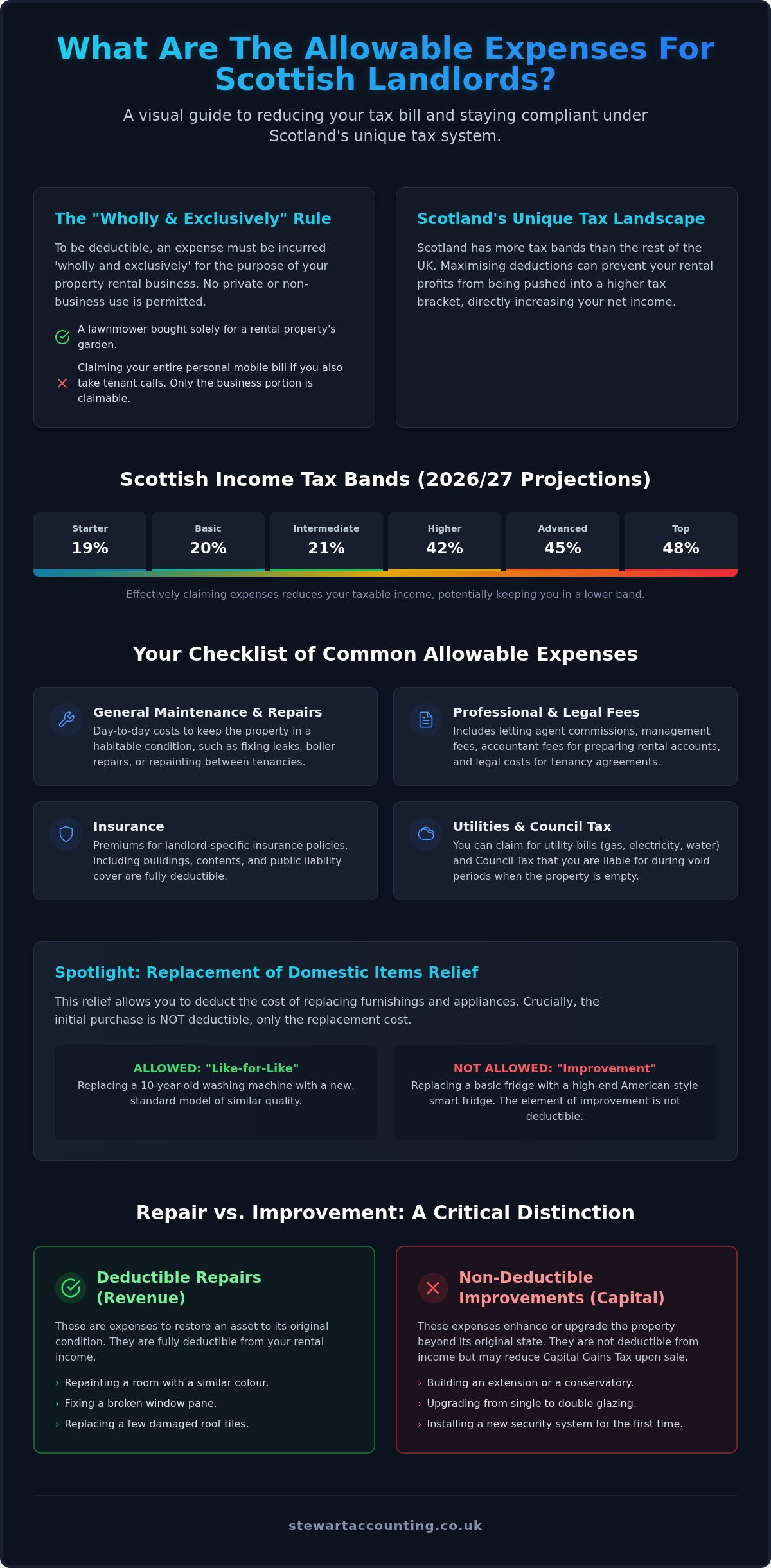
To be deductible, an expense must meet the strict legal threshold of being “wholly and exclusively” for your property business. This means the cost should have no private or non-business purpose. If you buy a new lawnmower specifically for a rental garden in Alloa, that’s a clear deduction. However, many costs are “dual-purpose”. If you use your personal mobile phone to speak with tenants, you can’t claim the entire bill. Instead, you must use a method called apportionment to claim only the business percentage; it’s important to be honest here. You cannot turn a personal family holiday into a deductible business trip just by spending an hour viewing a potential investment property. HMRC views that as a personal expense with an incidental business element, making it ineligible for any deduction.
Why Scottish Landlords Face Different Rules
While the types of costs you can claim are generally consistent across the UK, the financial impact of these deductions is unique here. The Scottish income tax system features six distinct tax bands for the 2026/27 tax year. Because these thresholds differ from the rest of the UK, your strategy for managing deductions directly influences which tax bracket you fall into. For instance, the transition from the 21% intermediate rate to the 42% higher rate happens at £43,663. Using your expenses to stay below a higher threshold, such as that higher rate or the £75,001 advanced rate, is a key part of effective tax planning. Understanding the nuances of allowable expenses for landlords scotland ensures you don’t overpay. For a deeper look at how these figures fit into your yearly obligations, our tax return services provide the professional support you need to stay compliant and stress-free.
A Comprehensive List of Deductible Landlord Expenses
Identifying every legitimate deduction is the most effective way to lower your tax bill. While many property owners focus on obvious costs, there are several allowable expenses for landlords scotland that often go unclaimed. These deductions directly reduce your taxable profit, ensuring you keep more of your hard-earned rental income. Core deductible expenses include:
- General maintenance and repairs: This covers day-to-day costs like fixing a leaking pipe, repairing a broken boiler, or repainting between tenancies. Crucially, these must be repairs rather than improvements.
- Professional fees: You can deduct letting agent fees and commissions for managing the property.
- Insurance: Premiums for buildings, contents, and public liability insurance are fully deductible.
- Utility bills and Council Tax: If you pay these during void periods when the property is empty, they are allowable.
Replacement of Domestic Items Relief
One area that creates significant confusion is the “Replacement of Domestic Items Relief”. This replaced the old 10% Wear and Tear allowance. You can claim for the cost of replacing sofas, beds, carpets, and white goods like fridges or washing machines. However, the replacement must be a “like-for-like” modern equivalent. For example, replacing an old washing machine with a similar new model is fine. Upgrading a basic fridge to a high-end American-style smart fridge would likely be classed as an improvement. It’s also vital to remember that you can’t claim for the initial purchase of these items when you first furnish a rental property.
Legal and Professional Service Costs
Keeping your business compliant often requires expert help. Fees for accountancy services and legal costs for lease renewals or evictions are tax-deductible. Hiring a Chartered Accountant in Scotland ensures your Self Assessment is accurate and helps you identify commonly missed landlord expenses that could be eating into your profits. With HMRC moving toward digital-first reporting, subscriptions for accounting software used for Making Tax Digital (MTD) are also allowable. If you’re feeling overwhelmed by the paperwork, you can reach out to our local team to see how we can simplify your property finances and restore your peace of mind.
Maintenance vs. Improvements: Avoiding the Capital Expenditure Trap
One of the most common mistakes property owners make is confusing a repair with an improvement. This distinction is critical because HMRC treats them very differently. Repairs are classified as revenue expenses, meaning they are allowable expenses for landlords scotland that you can deduct directly from your rental income to reduce your income tax bill. Improvements, however, are considered capital expenditure. You cannot deduct these from your annual rental profits. Instead, they are typically used to reduce your Capital Gains Tax liability when you eventually sell the property.
HMRC scrutinises these claims heavily because misclassifying an improvement as a repair is a frequent trigger for enquiries. A repair simply restores the property to its original state, such as replacing a few broken roof tiles or fixing a faulty light switch. An improvement significantly increases the value or capability of the property, such as adding a conservatory or converting a loft into a bedroom. If your project goes beyond restoration, it’s likely a capital cost.
The “Modern Equivalent” Rule
Technology and building standards change over time, which can complicate the repair vs. improvement debate. HMRC generally accepts the “modern equivalent” rule. For example, replacing old, draughty single-glazed windows with modern double glazing is now often considered a repair. Even though the double glazing is technically “better,” it’s the modern standard for a functional window. If the original materials are no longer available or are prohibitively expensive, using a modern alternative is usually acceptable. The threshold between a modern standard and a luxury upgrade depends on whether the new item performs the same basic function or adds a new, premium feature that wasn’t there before.
Handling Mortgage Interest (Section 24)
It’s vital to remember that mortgage interest is no longer an allowable expense that you can subtract from your gross rental income. Under the Section 24 rules, you now receive a 20% tax credit instead. For many Scottish landlords, especially those in the 42% Higher Rate or 45% Advanced Rate tax bands, this change can lead to a significantly higher tax bill. Because your “profit” is calculated before the interest is deducted, it might even push you into a higher tax bracket than you expect. This complexity makes professional tax planning essential. By delegating your tax strategy to our team, you can ensure you’re using every available relief to protect your finances and restore your mental well-being.
The 2026 Scottish Tax Landscape and Record Keeping
Scottish taxpayers operate under a multi-tiered system that requires careful navigation. For the 2026/27 tax year, the gap between Scottish and UK-wide tax obligations has widened, making it more important than ever to identify every legitimate deduction. When you accurately track allowable expenses for landlords scotland, you aren’t just following rules; you’re actively protecting your profit margins from higher regional rates. Failing to keep precise records doesn’t just invite stress during the January Self Assessment rush. It can lead to expensive errors and missed opportunities to lower your tax bracket.
Current Scottish Income Tax Bands (2026/27)
The Scottish Government utilizes six tax bands, including the Advanced Rate introduced to target higher earners. This structure differs significantly from the rest of the UK, where taxpayers generally face only three bands. If your total income, including rental profits, exceeds £100,000, your personal allowance of £12,570 begins to taper. You lose £1 of allowance for every £2 earned above this threshold. This “60% effective tax trap” makes professional tax planning vital for those in the Higher and Top rates.
| Band | Scottish Rate (2026/27) | Scottish Threshold | Rest of UK Rate |
|---|---|---|---|
| Starter | 19% | £12,571 – £16,537 | 20% (Basic) |
| Basic | 20% | £16,538 – £29,526 | 20% (Basic) |
| Intermediate | 21% | £29,527 – £43,662 | 20% (Basic) |
| Higher | 42% | £43,663 – £75,000 | 40% (Higher) |
| Advanced | 45% | £75,001 – £125,140 | 40% (Higher) |
| Top | 48% | Over £125,140 | 45% (Additional) |
Digital Record-Keeping for Modern Landlords
HMRC’s transition to Making Tax Digital (MTD) for Income Tax in 2026 has fundamentally changed how you must manage your business. Paper receipts in a shoebox are no longer sufficient for compliance. You must now maintain digital records and provide quarterly updates to HMRC. We recommend using cloud-based tools like Xero to snap photos of receipts and log mileage instantly. This digital-first approach ensures you have a clear trail of allowable expenses for landlords scotland for at least five years, as required by law. Our team specializes in helping property owners transition to online accounting services, removing the technical burden from your shoulders. If you want to ensure your records are MTD-compliant before the next deadline, contact our expert team today for a smooth transition.
How Stewart Accounting Liberates Scottish Landlords
The Benefits of Professional Delegation
Many landlords start by trying to manage their own Self Assessment Tax Returns, but the strict “wholly and exclusively” rules and 2026 digital requirements often lead to high levels of anxiety. DIY returns frequently result in missed deductions or, worse, incorrect claims that attract HMRC scrutiny. We provide a total transfer of responsibility. As your authorised agent, we handle all HMRC correspondence, removing the burden of tax season from your desk. Our team makes the difficult “repairs vs. improvements” decisions for you, protecting your business from penalties while maximising your legal deductions. Hiring a professional is a pragmatic investment in the long-term health and profitability of your portfolio.
Next Steps for Your Scottish Property Portfolio
To begin your journey toward financial freedom, start by gathering your digital records for the current tax year. Review any planned maintenance or upgrades for the coming months. Identifying large capital expenditures early allows for better tax planning and cashflow management. If you’re unsure how the new Scottish tax bands or MTD rules affect your bottom line, we’re here to help. You can contact our expert team in Stirling or Alloa for a landlord tax review today. We’ll help you master the rules for allowable expenses for landlords scotland and take the weight of compliance off your shoulders so you can regain your personal and professional liberty.
Securing Your Financial Liberty as a Scottish Landlord
Mastering the specific rules for allowable expenses for landlords scotland is the most effective way to protect your rental profits while staying fully compliant with HMRC. You now have a clear framework for distinguishing between day-to-day repairs and long-term capital improvements. You also understand how the unique 2026/27 Scottish tax bands, from the 19% Starter Rate to the 48% Top Rate, influence your final tax bill. Managing a property portfolio shouldn’t be a source of constant anxiety.
Our team of Chartered Accountants in Alloa, Stirling, and Falkirk specializes in Scottish property tax and SRIT compliance. We’re dedicated to reducing your stress through total delegation, allowing you to reclaim your time and mental well-being. By letting us handle the complex decisions and all HMRC correspondence, you can focus on growing your business or enjoying your personal life. Ready to optimize your tax position? Book a consultation with our Scottish landlord tax specialists today. We look forward to helping you achieve lasting peace of mind.
Frequently Asked Questions
Can I claim for my own time if I do the repairs myself?
No, you cannot claim for the value of your own time or labor when carrying out repairs. HMRC only permits deductions for the actual money you spend, such as the cost of paint or replacement parts. If you hire a professional tradesperson in Alloa to do the work, their entire invoice is deductible; however, your own hours don’t have a tax-deductible cash value.
Are letting agent fees tax-deductible in Scotland?
Yes, letting agent fees are fully tax-deductible. Whether you pay for full management or just a tenant-finding service, these costs are legitimate allowable expenses for landlords scotland. You should include these fees in your annual accounts to ensure your taxable profit is as low as possible. This helps protect your hard-earned rental income from the higher Scottish tax bands.
Can I claim for travel expenses to visit my rental property in Stirling?
You can claim travel expenses if the journey is made “wholly and exclusively” for your property business. This covers trips to Stirling or Falkirk for inspections, maintenance, or meeting new tenants. You should use the HMRC approved mileage rates or keep receipts for public transport. Just remember that if you combine the trip with personal errands, the travel cost cannot be claimed.
What happens if my rental property is empty (void period)?
You can continue to claim expenses during void periods as long as you are actively trying to let the property. Costs such as Council Tax, water rates, and heating bills that you pay while the property is empty are all deductible. It’s important to keep these records organized so you can prove the property was available for rent if HMRC ever asks for clarification.
Is the cost of a landlord safety certificate an allowable expense?
Yes, the cost of obtaining landlord safety certificates is a fully allowable expense. This includes Gas Safety checks, EICRs, and Legionella assessments which are mandatory in the Scottish rental market. Because these are legal obligations rather than property improvements, the full cost of the inspection and the certificate can be deducted from your rental income before you calculate your income tax.
Can I claim for a laptop or phone used for my property business?
You can claim for a laptop or phone, but you must apportion the cost if you also use them personally. HMRC allows you to deduct the percentage of the purchase price and monthly bills that relates specifically to managing your properties. If you buy a laptop solely for digital record-keeping and tenant management, the full cost is typically deductible as a business expense.
How do I claim for “Replacement of Domestic Items” on my tax return?
You claim for these items by deducting the replacement cost from your gross rental income on your tax return. This relief covers the cost of replacing furnishings like sofas, beds, and fridges. It is a vital part of tracking allowable expenses for landlords scotland correctly. Ensure you keep the original purchase receipt and the replacement receipt to prove it was a like-for-like modern equivalent.
What is the difference between Scottish and UK tax for landlords?
The primary difference is the tax rates and thresholds applied to your rental profit. While the rules for deductible expenses are the same across the UK, the Scottish Government sets its own Income Tax bands. For the 2026/27 year, this includes unique rates like the 19% Starter Rate and the 45% Advanced Rate, which don’t apply to landlords in England or Wales.