What if the accountant you’ve been putting off hiring is actually costing you more than their fee? It’s a question worth sitting with, especially if you’re running a limited company in Scotland and quietly dreading every tax deadline that creeps closer on the calendar.
You’re not alone in feeling that way. Managing a limited company comes with a genuine weight of responsibility: Companies House filings, corporation tax, VAT returns, payroll, and the ever-present risk of falling foul of HMRC. Most directors didn’t start their business to spend evenings untangling financial records, yet that’s exactly where many find themselves.
The good news is that working with experienced accountants for limited company Scotland businesses is far less complicated than most people expect, and the returns go well beyond basic compliance. This article breaks down the real, practical benefits of bringing a professional on board, from simplified regulatory obligations and smarter tax planning to stronger financial management that genuinely supports your growth. If you’ve ever wondered whether the cost is worth it, you’re about to find out.
Key Takeaways
- Working with accountants for limited company Scotland businesses goes far beyond basic compliance – it can unlock meaningful tax savings and smarter financial decisions that directly benefit your bottom line.
- Limited companies face a range of legal obligations, from Companies House filings to corporation tax returns, and a qualified accountant ensures none of these deadlines or duties are missed.
- Structuring director pay correctly – balancing salary and dividends – is one of the most effective ways to reduce your overall tax burden, and it’s an area where professional advice pays for itself.
- From VAT returns and year-end accounts to payroll and tax planning, accountants provide a comprehensive suite of services that free you to focus on running and growing your business.
- Local firms like Stewart Accounting Services, with offices in Alloa, Stirling, and Falkirk, bring regional knowledge and a personalised approach that larger, impersonal providers simply cannot match.
What Are Accountants for Limited Companies and Why Are They Important?
Running a limited company in Scotland means accepting a level of financial and legal responsibility that goes well beyond simply earning revenue and paying yourself. The moment you incorporate, a distinct set of obligations kicks in, and keeping on top of them is non-negotiable. That’s where specialist accountants for limited company Scotland businesses come in.
At their core, limited company accountants are qualified professionals who manage the financial and regulatory requirements that come with operating through a company structure. They’re not just number-crunchers. They act as advisers, compliance managers, and strategic partners, helping directors make informed decisions at every stage of the business lifecycle.
While regulatory details vary by country, the need for strategic financial oversight is universal. For those operating in or expanding to Australia, creditte.com.au offers specialized accounting and advisory services that mirror this high level of professional support.
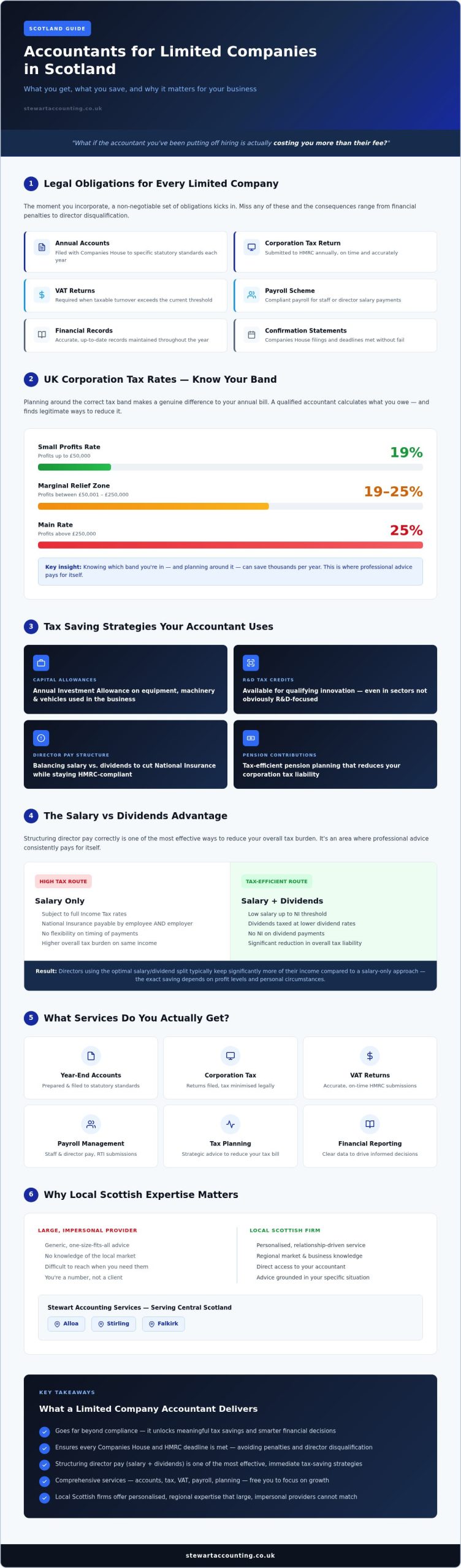
The legal obligations alone are enough to give most directors pause. As a limited company, you’re required to:
- File annual accounts with Companies House, prepared to specific statutory standards
- Submit a corporation tax return to HMRC each year
- Maintain accurate and up-to-date financial records throughout the year
- Register for VAT if your taxable turnover exceeds the current threshold
- Operate a compliant payroll scheme if you employ staff or pay yourself a salary
- Meet Companies House deadlines for confirmation statements and other filings
Miss any of these, and the consequences range from financial penalties to potential director disqualification. The pressure is real, and it compounds quickly when you’re also trying to run a business.
Key Responsibilities of Accountants for Limited Companies
A qualified accountant takes ownership of the tasks that would otherwise consume your evenings and weekends. This includes preparing and filing your year-end accounts, managing payroll and employee tax obligations, handling VAT returns, and ensuring every interaction with HMRC is accurate and on time. They translate complex financial data into clear, actionable information you can actually use.
The Benefits of Having a Professional Accountant
The practical advantages extend well beyond compliance. A professional accountant helps you avoid costly errors that can trigger HMRC investigations or late-filing penalties. They free up your time to focus on the work that actually grows your business—much like how outsourcing specialist property care to Ultimate Clean Solutions protects your premises while you stay focused on operations. And they provide a clearer picture of your financial performance, so decisions about investment, hiring, or expansion are grounded in real data rather than guesswork.
For directors of limited companies across Scotland, that combination of expertise, oversight, and genuine support makes a measurable difference to both the business and the person running it.
How Can Accountants Help Your Limited Company Save Money?
Compliance is the foundation, but it’s rarely where the real financial value lies. The more meaningful question for most directors is this: how much money are you leaving on the table by not having professional advice in your corner? For limited companies across Scotland, the answer is often more than they’d expect.
Tax Planning Strategies for Limited Companies
Corporation tax in the UK currently operates on a tiered basis. Companies with profits up to £50,000 pay at the small profits rate of 19%, while those with profits above £250,000 pay at the main rate of 25%. Between those thresholds, marginal relief applies. Knowing which band you fall into, and planning around it, can make a genuine difference to your annual tax bill.
A qualified accountant doesn’t just calculate what you owe; they look for legitimate ways to reduce it. This includes:
- Capital allowances: Claiming relief on equipment, machinery, and vehicles used in the business through the Annual Investment Allowance
- Research and development (R&D) tax credits: Available to companies investing in qualifying innovation, even in sectors that don’t immediately seem R&D-focused
- Director remuneration structuring: Balancing salary and dividends to reduce National Insurance contributions while staying within HMRC’s rules
- Pension contributions: Making employer pension contributions through the company, which are deductible against corporation tax
- Timing of expenditure: Bringing forward or deferring costs to align with your most tax-efficient accounting period
Each of these strategies is entirely above board. The key is knowing they exist and applying them correctly, which is precisely where accountants for limited company Scotland businesses add value that generic online tools simply can’t replicate.
Cost-Effective Financial Management
Saving money isn’t only about reducing your tax bill. It’s also about running your business more efficiently day to day. Accurate, up-to-date bookkeeping is the bedrock of that efficiency. When your records are clean and current, you’re not paying an accountant to untangle months of disorganised data at year-end; you’re paying for insight, not damage control.
Management accounts take this further. Produced monthly or quarterly, they give you a real-time picture of your cash position, profitability, and trends, so you can make informed decisions about spending, hiring, or investment before problems develop rather than after. That kind of financial visibility is what separates businesses that grow with confidence from those that react to crises.
Cloud accounting software, such as Xero, reduces administrative overhead significantly by automating bank reconciliation, invoicing, and expense tracking. Combined with professional oversight, it keeps your records accurate without consuming hours of your week. Explore our bookkeeping services to see how a structured approach to record-keeping can reduce costs and sharpen your financial clarity throughout the year.
If you’d like to understand where your company currently stands and what tax efficiencies might be available to you, get in touch with the team at Stewart Accounting Services for a straightforward conversation.
What Services Do Accountants Provide for Limited Companies in Scotland?
Understanding what you’re actually getting when you engage an accountant makes it far easier to judge the value. The scope of services available to limited companies goes well beyond filing a tax return once a year. For directors managing everything from client relationships to operational decisions, knowing exactly what can be handed over is genuinely useful.
Essential Accounting Services for Limited Companies
The core obligations of any limited company demand consistent, accurate attention throughout the year. Accountants for limited company Scotland businesses typically cover the full range of statutory requirements, so nothing slips through the cracks.
- Year-end accounts preparation and submission: Your statutory accounts must be prepared in accordance with UK accounting standards and filed with both Companies House and HMRC. A qualified accountant handles the preparation, review, and submission of these documents to the correct deadlines. Explore year-end accounts services to understand what that process looks like in practice.
- Self-assessment tax returns for directors: As a company director, you’re almost certainly required to file a personal self-assessment return each year, separate from the company’s corporation tax return. This covers dividend income, salary, and any other personal income streams. A dedicated tax return service ensures your personal position is handled correctly alongside the company’s obligations.
- VAT registration and filing: If your taxable turnover exceeds the current registration threshold, VAT registration becomes a legal requirement. Even below that threshold, voluntary registration can sometimes be beneficial. Your accountant manages the registration process, selects the most appropriate VAT scheme for your business, and handles each return accurately and on time. Find out more about VAT return services and how the right scheme can simplify your obligations.
Each of these services removes a specific legal obligation from your plate. Taken together, they represent a comprehensive layer of protection against penalties, missed deadlines, and compliance errors.
Advisory Services to Help Your Business Grow
Compliance keeps you out of trouble. Advisory services are what move the business forward. This is where a good accountant shifts from reactive to proactive, helping you plan rather than simply report.
Business planning and financial forecasting give you a structured view of where your company is heading. A well-constructed cashflow forecast, for example, can highlight a potential shortfall months before it becomes a crisis, giving you time to act rather than react. Alongside that, ongoing tax planning advice ensures your structure remains efficient as your revenue grows and your circumstances change.
Local expertise matters here more than many directors realise. A firm with offices in Alloa, Stirling, and Falkirk understands the regional business environment in a way that a remote, generalist provider simply doesn’t. That grounded knowledge informs better advice, whether you’re exploring funding options, planning for growth, or restructuring director remuneration.
Learn more about our Business Advisory Services and how structured planning can support your next stage of growth.
If you’d like to discuss which services would make the most difference to your company right now, get in touch with the team at Stewart Accounting Services for a straightforward, no-pressure conversation.
Why Choose Stewart Accounting Services for Your Limited Company Needs?
There’s a meaningful difference between an accountant who processes your numbers and one who genuinely understands your business. For directors of limited companies across central Scotland, that distinction matters more than most people realise when they’re first searching for support.
Stewart Accounting Services is built around a straightforward idea: that small and medium-sized businesses deserve the same quality of chartered accountancy that larger firms take for granted, delivered by people who know the local area and are genuinely invested in your success. With offices in Alloa, Stirling, and Falkirk, the team works with directors across the region every day, handling the full weight of their financial and compliance obligations so they don’t have to.
That’s not a small thing. Total delegation means exactly what it sounds like. Your year-end accounts, corporation tax, VAT returns, payroll, self-assessment, bookkeeping, and tax planning are all managed by qualified professionals who take ownership of each task and deadline. You stay informed without being buried in paperwork.
What directors consistently find, once they’ve made the switch, is that the relief is immediate. The dread of approaching deadlines fades. The evenings spent staring at spreadsheets stop. And the clarity that comes from having accurate, professionally managed accounts makes business decisions feel far less daunting.
How Our Local Expertise Benefits You
Working with a firm rooted in central Scotland means your accountant understands the financial landscape you’re actually operating in, not a generic national picture. Face-to-face consultations are available at each office, which makes a genuine difference when you’re working through something complex or sensitive. You’re talking to someone who knows your region, not a call centre representative following a script.
For limited company directors who want to understand more about the value of working with qualified professionals, this guide on why your Scottish business needs a chartered accountant sets out the case clearly. It’s a useful read before your first conversation with the team.
Local knowledge also informs better advice. Sector conditions, regional funding opportunities, and the specific pressures facing businesses in Alloa, Stirling, and Falkirk all shape the guidance you receive. That’s something a remote, generalist provider simply can’t replicate, and it’s a core reason why so many directors working with accountants for limited company Scotland needs choose to stay with firms that are genuinely embedded in their community.
Get Started with Stewart Accounting Today
Getting started is straightforward. There’s no complicated onboarding process and no obligation to commit before you’ve had a chance to talk things through. The team at Stewart Accounting Services takes the time to understand your current situation, your obligations, and where you’d like the business to go, before recommending the services that actually fit.
If you’re ready to hand over the financial complexity and focus on what you do best, contact Stewart Accounting Services today and take the first step toward running your limited company with genuine confidence.
Take Control of Your Limited Company’s Financial Future
Running a limited company in Scotland carries real financial and legal weight. As this article has shown, working with accountants for limited company Scotland businesses isn’t just about staying compliant; it’s about making smarter decisions, reducing your tax burden legitimately, and freeing yourself from the administrative pressure that quietly drains your time and energy.
The right accountant brings more than technical knowledge. They bring clarity. Whether it’s structuring your director remuneration efficiently, keeping your VAT returns accurate, or giving you a reliable picture of your company’s financial health, professional support changes how confidently you can run and grow your business.
Stewart Accounting Services combines chartered accountancy expertise with genuine local knowledge, offering personalised support from offices in Alloa, Stirling, and Falkirk. You don’t have to navigate this alone.
Let us simplify your accounting needs so you can focus on growing your business and start moving forward with real confidence.
Frequently Asked Questions About Accountants for Limited Companies in Scotland
What qualifications should I look for in an accountant for my limited company?
Look for an accountant who holds a recognised professional qualification, such as membership of the Institute of Chartered Accountants of Scotland (ICAS), the Institute of Chartered Accountants in England and Wales (ICAEW), or the Association of Chartered Certified Accountants (ACCA). These designations confirm that your accountant meets rigorous professional standards and is subject to ongoing regulatory oversight.
Beyond formal qualifications, relevant experience with limited companies matters considerably. An accountant who regularly works with directors on corporation tax, Companies House filings, and director remuneration structuring will add far more practical value than a generalist with limited company-specific knowledge.
How often do I need to meet with my accountant?
There’s no single right answer, but most limited company directors benefit from at least quarterly contact with their accountant, with more frequent check-ins during periods of growth or significant change. At minimum, you’ll need to engage around key deadlines: your year-end accounts, corporation tax return, and any VAT filing dates.
Many directors find that moving beyond purely deadline-driven contact, and having regular conversations about cashflow, tax planning, and financial performance, is where the relationship becomes genuinely valuable. A good accountant will proactively flag issues and opportunities rather than waiting to be asked.
What documents do I need to provide to my accountant?
Your accountant will typically need bank statements, sales invoices, purchase receipts, payroll records, and details of any director loans or dividends paid during the year. If you’re VAT-registered, your VAT records and reconciliations will also be required. The more organised these are throughout the year, the smoother and more cost-effective the year-end process becomes.
Using cloud accounting software like Xero makes this considerably easier. Rather than gathering paper records at year-end, your transactions are captured and categorised in real time, giving your accountant continuous access to accurate data without the administrative scramble.
Can I use online accounting software with my accountant’s services?
Yes, and it’s actively encouraged. Cloud accounting software like Xero integrates directly with the services provided by accountants for limited company Scotland businesses, allowing both you and your accountant to work from the same live data. This removes duplication, reduces errors, and speeds up everything from bookkeeping reconciliation to VAT return preparation.
Stewart Accounting Services offers Xero training and support to help you get set up correctly from the start. Rather than leaving you to figure out the software alone, the team ensures you’re using it in a way that genuinely reduces your administrative burden and keeps your records in the right shape for compliance purposes.
What are the penalties for not having an accountant for my limited company?
There’s no legal requirement to hire an accountant, but the penalties for getting your obligations wrong can be significant. HMRC charges automatic late-filing penalties for missed corporation tax returns, and Companies House imposes fines for late accounts submissions that increase the longer the delay continues. Persistent non-compliance can, in serious cases, result in director disqualification.
The subtler costs are often just as damaging: overpaying tax through missed reliefs, triggering an HMRC enquiry through inaccurate returns, or making business decisions based on unreliable financial information. An accountant doesn’t just reduce the risk of penalties; they reduce the risk of avoidable financial mistakes throughout the year.
How can I change accountants if I’m not satisfied with my current one?
Changing accountants is straightforward and far less disruptive than most directors expect. You simply notify your current accountant in writing, appoint a new firm, and authorise the new firm to contact your previous accountant for a professional handover of your records. Your new accountant handles the transfer process and will also notify HMRC of the change in agent authorisation.
The best time to switch is shortly after your year-end, so your new accountant can take ownership of a clean accounting period from the start. That said, switching mid-year is entirely possible if your current arrangement isn’t working, and a good firm will manage the transition without disruption to your compliance obligations.
Do accountants help with financial planning for growth?
Yes, and this is one of the most underused aspects of working with a qualified accountant. Beyond compliance, accountants can help you build cashflow forecasts, develop business plans, identify funding and grant opportunities, and structure your finances in a way that supports expansion rather than constraining it. These advisory services turn your accountant from a compliance function into a genuine business partner.
Stewart Accounting Services offers business advisory support, including cashflow forecasting and business plan development, specifically designed to help limited company directors plan their next stage of growth with confidence and clarity.
What is the typical cost of hiring an accountant for a limited company?
Accountancy fees vary depending on the size and complexity of your business, the volume of transactions, and the range of services you require. Rather than quoting a figure that may not reflect your actual situation, the most reliable approach is to request a tailored proposal based on your specific needs. Many firms, including Stewart Accounting Services, offer structured packages that bundle core services together at a predictable monthly cost.
It’s worth framing the cost in context. The tax savings, penalty avoidance, and time recovered through professional support frequently outweigh the fee itself. The more useful question isn’t what an accountant costs, but what not having one is costing you in overpaid tax, missed reliefs, and hours spent on tasks that fall outside your expertise.