

Did you know that roughly 780,000 sole traders and landlords across the UK are about to see their tax reporting frequency quadruple? It’s completely natural to feel a sense of dread when HMRC announces a major overhaul. The upcoming hmrc mtd income tax changes 2026 represent a significant shift from the traditional once-a-year filing to a digital-first, quarterly system. If you’re worried about the administrative burden or the complexity of new software, you aren’t alone. Many of our clients in Alloa, Stirling, and Falkirk are asking exactly how these rules will impact their daily operations and their mental well-being.
We believe that tax compliance should support your professional liberty, not hinder it. This article will help you understand exactly how the Making Tax Digital rollout affects your business or property income and the steps you must take to remain compliant. We’ll break down the £50,000 threshold, provide a roadmap for your software transition, and offer the peace of mind that comes from knowing your affairs are handled correctly. We’ll explore the specific reporting deadlines and digital record-keeping requirements you need to master before the April 2026 deadline arrives.
Key Takeaways
- Understand the transition from annual filing to mandatory digital record-keeping and the new system of quarterly reporting.
- Identify if you’re affected by the hmrc mtd income tax changes 2026 based on the £50,000 gross income threshold for sole traders and landlords.
- Learn why quarterly updates are simpler than full tax returns and how they help you avoid the traditional year-end stress.
- Discover the essential steps for selecting and setting up HMRC-recognised software to keep your business records accurate and accessible.
- Explore how delegating these tasks to a professional firm can restore your personal time and eliminate the anxiety of potential HMRC penalties.
What is Making Tax Digital for Income Tax and how does it work?
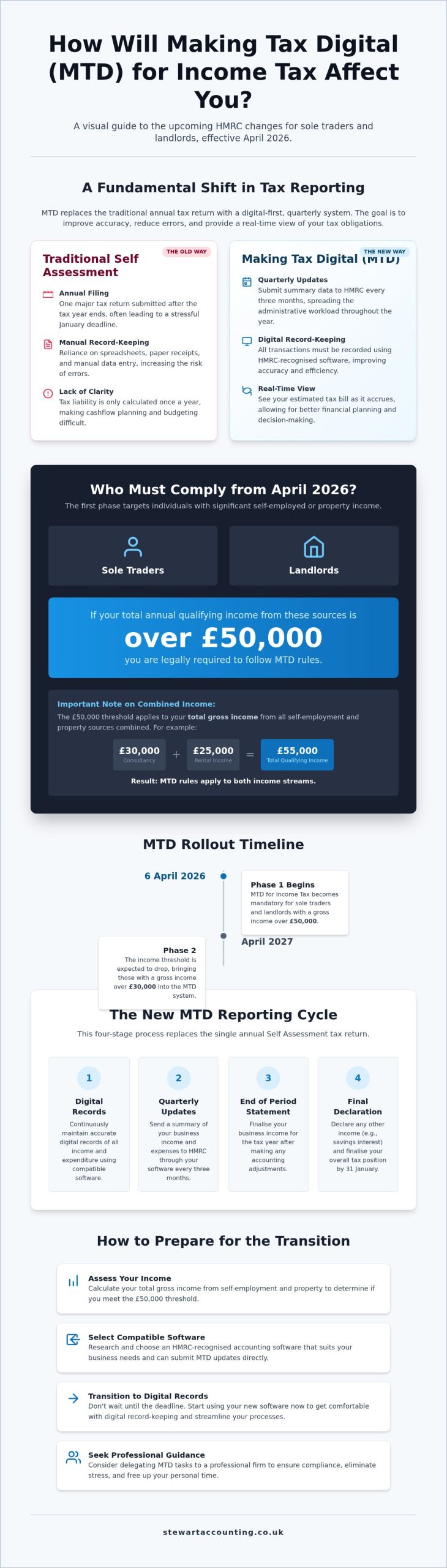
The Making Tax Digital (MTD) initiative is a fundamental shift in how the UK tax system operates. For those affected, it replaces the traditional annual Self Assessment process with a digital-first approach. Starting on April 6, 2026, the first phase of the hmrc mtd income tax changes 2026 will become mandatory for many. Instead of gathering a year’s worth of receipts every January, you’ll maintain digital records of every transaction throughout the year. This change moves us toward a “real-time” reporting mindset. It ensures that tax information is recorded as it happens, rather than being reconstructed months after the fact.
To better understand the technical shift and how digital data flows between your bank and your records, watch this helpful video:
The move away from the annual tax return
The most significant change is the frequency of reporting. You’ll no longer wait until the end of the tax year to tell HMRC about your earnings. Under the new rules, you’ll submit quarterly updates through compatible software. This “admin spread” ensures that your tax records stay up to date, which significantly reduces the stress of the January 31st deadline. While you still need to complete a “Final Declaration” to confirm the accuracy of your total annual figures, the bulk of the work is done in smaller, manageable chunks throughout the year. Adapting to the hmrc mtd income tax changes 2026 requires using online accounting services that can communicate directly with HMRC’s systems. It’s a move from a reactive habit to a proactive business routine.
Why is HMRC making these changes now?
HMRC’s primary motivation is to close the “tax gap” by reducing avoidable errors. Often, manual data entry leads to mistakes that cost both the taxpayer and the government money. Through digital record-keeping, your data is more accurate and easier to verify. This isn’t just about compliance; it’s about providing you with a clearer view of your tax liabilities in real-time. Knowing what you owe as the year progresses allows for better cashflow management and more informed business decisions. For many of our clients in Stirling and Falkirk, this shift aligns perfectly with modern growth strategies. Professional bookkeeping services become a proactive tool for success rather than a reactive chore. By digitalising the process, HMRC aims to create a more efficient and transparent system for everyone involved.
Who must comply with the April 2026 MTD requirements?
The first wave of the hmrc mtd income tax changes 2026 specifically targets individuals who earn the highest levels of self-employed or property income. If you’re a sole trader or a landlord with a qualifying income of more than £50,000, you’re in the Phase 1 group. It’s vital to understand that “income” in this context refers to your gross turnover. This is the total amount of money your business or property receives before you deduct a single penny for expenses, wages, or tax. If your total revenue hits that £50,000 mark, digital reporting becomes a legal requirement for you from April 6, 2026.
Many people find the rules for combined income sources a bit confusing. If you earn £30,000 from a consultancy business and £25,000 from rental properties, your total qualifying income is £55,000. Because this combined total exceeds the threshold, you must comply with the new rules for both income streams. While the 2026 deadline is the immediate priority, the rollout continues for others shortly after. In April 2027, the threshold drops to £30,000. By April 2028, it reaches £20,000. You can find the official HMRC MTD guidance for a deeper dive into these specific timelines and exemptions.
Rules for Sole Traders in Scotland
For business owners in Alloa and Stirling, the hmrc mtd income tax changes 2026 require a clear understanding of how digital reporting interacts with Scottish tax bands. As a Scottish sole trader, your qualifying income is determined by your total self-employment turnover across all your businesses. Contractors and small business owners should be particularly careful. Even if your take-home pay feels lower after significant overheads, it’s that top-line revenue figure that dictates your compliance date. Keeping precise digital records ensures you’re prepared for the transition without the usual year-end panic.
MTD for Landlords: What changes for property income?
HMRC has included landlords in the 2026 mandate to ensure property income is recorded with the same digital precision as business earnings. If you own property jointly, your share of the gross rental income counts toward your personal £50,000 threshold. You’ll need to maintain digital records for every property in your portfolio, rather than just a single summary. This ensures that your quarterly updates provide an accurate snapshot of your total rental position throughout the year. If you’re unsure whether your combined income triggers the 2026 mandate, you might want to speak with our team in Central Scotland for a quick review of your current standing.
The Quarterly Update: Managing the new administrative cycle
The most common concern we hear from business owners about the hmrc mtd income tax changes 2026 is the fear that they’ll have to do four times the accounting work. We want to reassure you that this isn’t the case. You aren’t filing four full tax returns every year. Instead, these quarterly updates are digital summaries of your business income and expenses. Your software gathers this information directly from your digital records and sends it to HMRC. It’s a quick digital check-in designed to ensure your records are accurate as the year progresses, rather than a week-long administrative ordeal every three months.
To keep your affairs in order, you’ll need to follow a specific submission cycle. Each update is due within one month of the quarter’s end. Here are the deadlines you’ll need to mark in your calendar:
- Quarter 1: 6 April to 5 July (Update due by 7 August)
- Quarter 2: 6 July to 5 October (Update due by 7 November)
- Quarter 3: 6 October to 5 January (Update due by 7 February)
- Quarter 4: 6 January to 5 April (Update due by 7 May)
After these four updates, you’ll complete an End of Period Statement (EOPS) for each business or property source. This statement finalises your figures for that specific income stream. While this sounds like more steps, it’s a logical flow that prevents the traditional January panic. By breaking the work into smaller pieces, you maintain a clearer picture of your financial health throughout the year.
Quarterly updates vs. the Final Declaration
It’s vital to distinguish between a quarterly update and the Final Declaration. Quarterly updates are simple data transfers that provide a rolling estimate of the tax you might owe. They don’t usually include complex accounting adjustments, such as capital allowances or specific tax reliefs. You’ll handle those final “tidying up” tasks in the Final Declaration, which is still due by 31 January following the end of the tax year. Because the system relies on regular data, professional bookkeeping services have become a year-round necessity. Keeping your records updated in real-time ensures that your quarterly estimates are as accurate as possible, which helps you manage your cashflow without any nasty surprises.
Penalties for late submissions
HMRC is introducing a new points-based penalty system to coincide with the hmrc mtd income tax changes 2026. Under this system, you’ll receive a point for every late submission. Once you reach a certain threshold of points, you’ll be issued a financial penalty. This is a more proportionate approach than the old flat-rate fines, as it focuses on recurring non-compliance rather than one-off mistakes. HMRC still recognizes “reasonable excuses” for delays, such as serious illness or technical failures, but the digital era leaves less room for simple forgetfulness. Having professional oversight of your digital submissions is the most reliable way to avoid these points and ensure your record stays clean.
How to prepare your business for the 2026 transition
Transitioning to the hmrc mtd income tax changes 2026 isn’t something you should leave until the last minute. The most effective way to reduce anxiety is to follow a clear, methodical roadmap. First, you must calculate your qualifying income based on the 2024/25 tax year. This specific period is the benchmark HMRC uses to determine if you must join the first phase in April 2026. Once you’ve confirmed you’re above the £50,000 threshold, your next priority is selecting HMRC-recognised software. We strongly suggest you begin maintaining digital records for all transactions immediately. Waiting until the mandate starts only increases the risk of errors. Finally, partnering with a Chartered Accountant can make this entire migration feel effortless. We take the technical burden off your shoulders so you can focus on your daily operations.
Choosing the right software for your needs
Finding the right tool is about more than just compliance. The best online accounting services offer remote access, allowing you to check your finances from your phone or laptop anywhere in Central Scotland. While some businesses look for “bridging software” to link old spreadsheets to HMRC, we usually recommend a full cloud accounting solution. We frequently suggest Xero for our sole trader and landlord clients in Stirling and Alloa. It’s intuitive, powerful, and designed to grow with you. A cloud-based system keeps your data secure and ensures that your quarterly updates are sent with a single click, providing a much smoother experience than older, fragmented methods.
Cleaning up your data before April 2026
Accurate reporting depends on clean data. If you’re still using manual ledgers or basic spreadsheets, now is the time to stop. These methods are prone to mistakes and won’t meet the digital record-keeping standards required by the hmrc mtd income tax changes 2026. One of the biggest advantages of modern software is the use of automated bank feeds. These feeds pull your transaction data directly into your accounts, ensuring nothing is missed. To help with this shift, our team provides hands-on Xero training in Alloa and Falkirk. We’ll show you how to categorise expenses and manage your digital records with total confidence. If you want to ensure your business is ready for the transition, contact us today for a software setup review.
Let Stewart Accounting handle the MTD burden for you
We understand that the upcoming hmrc mtd income tax changes 2026 feel like a heavy weight on your shoulders. Our mission is to lift that weight entirely, restoring your time, your finances, and your mental well-being. We don’t just offer advice; we provide a complete delegation service. This means we take over the technical management of your digital records and the direct link to HMRC’s systems. You can focus on running your business or managing your properties while we ensure every quarterly update is precise, compliant, and submitted on time. We physically remove the administrative burden from your desk, allowing you to breathe easier as the 2026 deadline approaches.
Our approach is built on a foundation of professional expertise and local reliability. By transferring the responsibility of MTD compliance to us, you gain more than just an accountant; you gain a dedicated partner. We handle the complexities of:
- Setting up and managing your MTD-compatible digital records.
- Submitting accurate quarterly updates to HMRC.
- Finalising your End of Period Statements and Final Declarations.
- Liaising directly with HMRC on your behalf to resolve any technical queries.
Our Thematic Triad: Time, Finance, and Well-being
Delegating your Self Assessment and MTD requirements is a lifestyle choice as much as a business one. It’s about liberating your weekends from the stress of spreadsheets and receipts. Financial peace of mind comes from knowing that expert tax planning is working in the background to identify reliefs and avoid costly penalties. Most importantly, we aim to reduce the persistent anxiety that often accompanies major regulatory shifts. When you know your tax affairs are in professional hands, your mental well-being improves, allowing you to enjoy the rewards of your hard work without a looming sense of dread.
Your local Scottish MTD experts
The hmrc mtd income tax changes 2026 require an expert who understands the unique nuances of the Scottish business landscape. With offices in Alloa, Stirling, and Falkirk, we’re your accessible, community-based partners. We don’t believe in a cold, corporate approach. Instead, we offer pragmatic, grounded support tailored to your specific goals. If you’re feeling uncertain about your readiness, we offer a free MTD consultation to review your current setup and create a clear roadmap for the transition. We’d love for you to drop by our office at the Alloa Business Centre for a coffee and a chat about how we can support your business. Let us handle the digital transition so you can get back to what you do best.
Secure your business future before the 2026 deadline
Navigating the hmrc mtd income tax changes 2026 doesn’t have to be a solo journey that keeps you awake at night. We’ve explored how the shift to quarterly reporting and digital record-keeping affects those earning over £50,000. By choosing the right software and cleaning up your data today, you can avoid the administrative rush and potential penalties. It’s about moving from annual stress to a streamlined, real-time strategy that gives you back your weekends.
As Chartered Accountants with local offices in Alloa, Stirling, and Falkirk, we’ve been supporting Scottish SMEs and landlords since 2010. Our team are experts in Xero and cloud accounting migration, meaning we can handle the technical transition while you focus on growth. We’re here to ensure your mental well-being and financial health are protected throughout this rollout.
Book your free MTD readiness consultation with our Alloa team today. You’ve worked hard to build your success; let’s ensure your tax affairs are just as robust and ready for the future.
Frequently Asked Questions
What happens if my income drops below £50,000 after I’ve signed up for MTD?
You must continue to follow the MTD rules until your income remains below the threshold for three consecutive tax years. HMRC requires this consistency to prevent businesses from frequently jumping in and out of the digital system. If your turnover stays low for that full three year period, you can then apply to leave the scheme and return to traditional filing.
Can I still use spreadsheets for my business records under the 2026 rules?
Yes, you can still use spreadsheets, but they must be digitally linked to HMRC via bridging software. This setup ensures that your data flows directly from your file to the tax office without any manual copying or pasting. Maintaining these digital links is a mandatory part of the hmrc mtd income tax changes 2026 to ensure data accuracy and reduce entry errors.
Do I need to submit receipts and invoices to HMRC every quarter?
No, you aren’t required to send copies of individual receipts or invoices with your updates. The quarterly submission is simply a summary of your total income and expenditure categories. However, you must keep the original digital records within your software or linked spreadsheets. These records serve as your evidence should HMRC ever need to verify the figures in your final declaration.
Is MTD for Income Tax different from MTD for VAT?
They are distinct systems, though both are part of the same government initiative to digitalise the UK tax system. While MTD for VAT is already active for most VAT registered businesses, MTD for Income Tax is the new requirement starting in April 2026. You’ll likely use the same accounting software for both, but the reporting deadlines and the information you send will be different for each tax type.
What are the specific MTD deadlines for the 2026/27 tax year?
Your first quarterly update for the 2026/27 tax year is due by 7 August 2026. This covers your business activity from 6 April to 5 July. The following updates are due by 7 November, 7 February, and 7 May. Adhering to these dates ensures you stay compliant with the hmrc mtd income tax changes 2026 and avoid the new points based penalty system.
How much does MTD-compliant software typically cost for a sole trader?
Software costs vary significantly depending on the provider and the specific features your business requires. Most major platforms offer tiered monthly subscriptions, ranging from basic starter packages to more advanced versions for larger portfolios. We recommend researching current market rates for HMRC recognised tools like Xero to find a solution that balances your budget with your reporting needs.
Can my accountant submit the quarterly updates on my behalf?
Yes, your accountant can take full responsibility for submitting your quarterly updates to HMRC. At Stewart Accounting, we offer a complete delegation service that removes the technical burden from your shoulders. We manage the software links and ensure your data is accurate before every deadline, which provides total peace of mind that your tax affairs are handled correctly.
Are there any exemptions from MTD for Income Tax based on age or location?
HMRC provides exemptions for individuals who are “digitally excluded” due to age, disability, or a very remote location with no internet access. These exemptions aren’t automatic; you must apply to HMRC and prove that it isn’t practical for you to use digital tools. If they agree that you cannot reasonably use a computer or the internet, you’ll be allowed to continue using alternative filing methods.