

What Do My Year End Limited Company Accounts Need to Include? Find Out Now

Your year-end accounts are the official financial story of your business, and if you run a UK limited company, preparing them is non-negotiable. At their heart, these accounts consist of three core documents: the Balance Sheet, the Profit and Loss Account, and the supporting Notes to the Accounts. Think of it as a mandatory annual report card detailing your business's financial health.
What Your Year End Accounts Must Contain
Tackling your first set of year-end accounts can feel a bit like trying to assemble flat-pack furniture without the instructions. You know you have all the essential pieces, but figuring out how they all fit together is the real puzzle. The good news? The structure is far more logical than it first appears.
In the UK, every private limited company has a legal duty to prepare and file these annual accounts with both Companies House and HM Revenue & Customs (HMRC). This isn’t optional; it's a fundamental part of running a compliant business. It’s worth taking the time to understand the complete requirements for year-end accounts and why they are so crucial.
The Three Core Components
Your accounts are built around three key documents that work in harmony to paint a full financial picture. To make sense of it, let's imagine your company is a ship completing a year-long voyage:
- The Balance Sheet: This is like a photograph of the ship on the final day of its journey. It lists everything the ship owns (its assets, like the hull and valuable cargo) and everything it owes (its liabilities, like unpaid fuel bills). The difference between the two is its net worth.
- The Profit and Loss (P&L) Account: This is the ship's logbook for the entire voyage. It meticulously tracks all the income earned from delivering cargo and every single expense paid out along the way, ultimately showing whether the journey made a profit or a loss.
- Notes to the Accounts: These are the captain’s crucial annotations in the margins of the logbook. They add essential context and explain the numbers in more detail—for instance, clarifying how the cargo's value was calculated or what accounting policies were used.
This trio forms the bedrock of your year-end financial reporting.
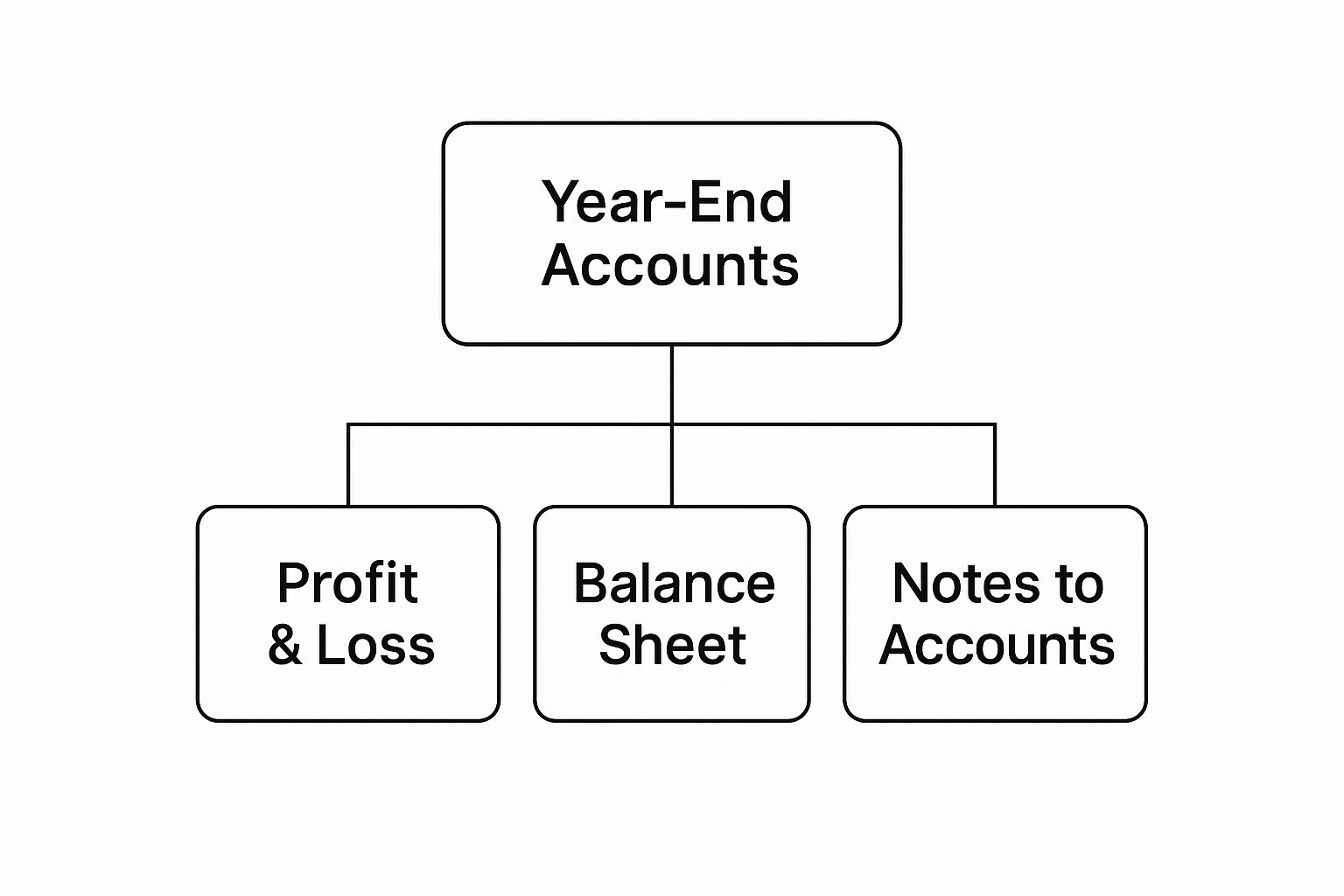
As you can see, each document plays a distinct but interconnected role in telling your company's financial story. Together, they provide the transparent, comprehensive view of performance and financial position that shareholders, lenders, and regulators need to see.
To quickly recap these essential elements before we dive deeper, here's a simple breakdown of what each document does and who it’s for.
Core Documents for Year End Accounts at a Glance
| Document | What It Shows | Who It's For |
|---|---|---|
| Balance Sheet | A snapshot of your company's assets, liabilities, and equity on a single day. | Shareholders, lenders, and potential investors. |
| Profit & Loss Account | Your company's financial performance over the entire accounting period. | Directors, management, and tax authorities (HMRC). |
| Notes to the Accounts | Explanations and extra detail behind the numbers in the main reports. | Anyone needing a deeper understanding of the accounts. |
This table gives you a bird's-eye view, but now let's get into the specifics of what each of these documents involves and what you need to get right.
Reading Your Balance Sheet: A Snapshot of Company Health
Of all the documents in your year-end accounts, the Balance Sheet can feel the most formal and, let's be honest, a bit intimidating. But its job is surprisingly simple. Think of it as a financial photograph of your company, capturing its exact position on one specific day—your Accounting Reference Date.
This isn't a report that tells a story over time; it's a static snapshot of value. It answers one clear question: on this day, what is the net worth of my business? Getting your head around this document is essential when figuring out what your year-end limited company accounts need to include for a complete picture.
The whole thing is built on a single, powerful equation that keeps everything perfectly in check. Once you get this, the rest of the document just clicks into place.
The Fundamental Accounting Equation: Assets = Liabilities + Equity
This formula is the very backbone of every balance sheet. It simply means that everything a company owns (Assets) has been paid for by money it owes to others (Liabilities) or by money from its owners (Equity). The two sides of the equation must always, without fail, balance.
Deconstructing Your Company's Assets
So, what are Assets? They're simply all the valuable resources your business owns. Think of them as everything you could, theoretically, turn into cash. Accountants split them into two main camps based on how quickly they can be converted to money.
1. Current Assets
These are your short-term resources—things you expect to use up or turn into cash within one year. They're the lifeblood of your day-to-day operations.
- Cash in hand and at the bank: The most obvious and most liquid asset you have.
- Trade Debtors (Accounts Receivable): This is the money owed to you by customers for invoices you've sent out.
- Stock (Inventory): The value of any raw materials, unfinished projects, and finished goods you're holding onto.
2. Fixed Assets (Non-Current Assets)
These are your long-term investments. You're not looking to sell them anytime soon; you use them to run the business over many years.
- Tangible Assets: Physical items with value, like your office building, company vehicles, machinery, and computer equipment.
- Intangible Assets: These aren't physical, but they can be incredibly valuable. We're talking about things like patents, trademarks, and brand goodwill.
Understanding Liabilities and What You Owe
If assets are what you own, Liabilities are what you owe. They represent your company's financial obligations to other people and organisations. Just like assets, they're categorised by when they need to be paid.
Current Liabilities are debts you need to settle within the next 12 months. Common examples include:
- Trade Creditors (Accounts Payable): The money your business owes to its suppliers.
- Short-term Loans: Any bank loans or overdrafts that are due within a year.
- Taxes Due: This covers obligations like your VAT bill, PAYE for your staff, and the current year's Corporation Tax.
Long-Term Liabilities, on the other hand, are debts that aren't due for at least another year. This typically includes things like a multi-year business loan or a commercial mortgage on your premises.
Defining Equity: The Shareholders' Stake
So, you take everything your company owns (Assets) and subtract everything it owes (Liabilities). What's left over is the Equity. You'll often see this called 'Shareholders' Funds' because it represents the total value of the business that belongs to its owners.
Equity is generally made of two key parts:
- Share Capital: The original pot of money invested by the founders and shareholders to get the company started, in exchange for their shares.
- Retained Earnings: This is the total, cumulative profit the company has earned over its lifetime that has been ploughed back into the business rather than being paid out to shareholders as dividends.
For a deeper dive into interpreting these figures and understanding what they say about your company's financial position, it's worth learning how to analyze a balance sheet. This skill takes you from just filing a compliance document to truly reading the story it tells about your business's stability and real value.
Telling Your Performance Story with the Profit and Loss Account

While the Balance Sheet gives you a static photograph of your company’s financial health on a single day, the Profit and Loss (P&L) Account is more like the highlight reel of your entire financial year. It tells a dynamic story, tracking your performance from the first day of the accounting period right through to the last. This narrative is a vital part of your year end limited company accounts and something every director needs to get to grips with.
Think of it as the story of a long road trip. You begin with a full tank of fuel, which in business terms is your Revenue or Turnover. This is the total income your company generated from sales before a single penny in costs has been deducted. It’s your top-line figure and the starting point for everything that follows.
From there, the P&L methodically subtracts the costs of the journey, showing just how efficiently your business has been running and exactly where the money went.
Calculating Your Gross Profit
The first deduction from your revenue is the Cost of Sales, often referred to as 'Cost of Goods Sold' or COGS. These are the direct, hands-on costs of producing and delivering whatever you sell. For a coffee shop, it’s the beans, milk, and takeaway cups. For a builder, it’s the bricks, cement, and the wages of the team on site.
When you subtract the Cost of Sales from your Revenue, you get your first key performance indicator: Gross Profit.
Gross Profit = Total Revenue – Cost of Sales
This number is incredibly revealing. It shows you how profitable your core business activity is before you account for any of your general running costs. A healthy Gross Profit suggests your pricing is right and you've got a good handle on your production costs.
For example, imagine your artisan bakery brings in £150,000 in revenue. If you spent £40,000 on flour, sugar, and packaging, your Gross Profit is £110,000. That £110,000 is what you have left to pay for everything else.
Uncovering Your Operating and Net Profit
After working out your Gross Profit, the P&L story continues by deducting your Operating Expenses. These are all the other costs needed to keep the lights on and the business running, even if they aren't directly linked to making your product. Think of them as your essential overheads.
These expenses typically fall into a few main categories:
- Administrative Expenses: This covers things like office rent, utility bills, insurance, salaries for admin staff, and professional fees for services from accountants like Stewart Accounting Services.
- Distribution Costs: These are the costs of getting your product to the customer, such as courier fees or the fuel for your delivery van.
- Marketing and Sales Costs: This is what you spend on advertising, maintaining your website, or paying commissions to your sales team.
Once you subtract all these operating expenses from your Gross Profit, you arrive at your Operating Profit. This is a powerful measure of how efficiently your core business operations are performing.
But the story isn’t quite over. There are usually a few final adjustments to make, such as bank interest paid on loans or interest received from savings. After accounting for those, and most importantly, after setting aside money for your Corporation Tax bill, you reach the final figure.
This is your Net Profit, the famous "bottom line". It represents the actual profit your company has made for the year. This is the money that can either be paid out to shareholders as dividends or put back into the company as Retained Earnings to fund future growth. Following this journey from top-line revenue to bottom-line profit is fundamental to understanding your company's real performance.
Telling the Story Behind the Numbers: The Director’s Report and Notes
So, we’ve covered the Balance Sheet and the Profit & Loss account. These are the headline acts of your year-end accounts, giving you the cold, hard facts of your financial year in black and white. But let's be honest, numbers on their own can be a bit dry. They don't always tell the whole story.
That's where the narrative elements come in. Think of the numbers as the what, and the Director’s Report and Notes to the Accounts as the why and the how. This is your chance to add colour and context, explaining the story behind the figures so that anyone reading them—from shareholders to the bank manager—can get a true feel for your business's performance.
Getting into the Weeds: Notes to the Accounts
The Notes to the Accounts are essentially the detailed footnotes to your financial statements. They're the 'behind-the-scenes' commentary, offering crucial explanations that simply wouldn't fit on the main documents. Their job is to create transparency and make sure the accounts aren’t misleading in any way.
For example, the Notes will lay out the specific accounting policies you’ve used. This is where you explain the rulebook you played by.
- Depreciation Methods: How did you work out the wear and tear on your company van or office computers? The notes will state the method you chose (like straight-line or reducing balance) and the rates applied.
- Stock Valuation: How did you put a value on the inventory sitting in your storeroom at the year-end? This note clarifies exactly how that figure was reached.
- Revenue Recognition: When do you officially book a sale as revenue? Is it when the invoice is raised, or when the work is completed? Your policy will be explained here.
Beyond just policies, the notes break down the big numbers from the Balance Sheet and P&L. That single figure for ‘Trade Debtors’ on the balance sheet? A note might split this out, showing how much of it is owed by customers and how much might take longer than a year to collect. They also provide detailed analysis of share capital, bank loans, and any transactions with the directors.
Remember, including detailed notes isn't just good housekeeping—it's a legal must-have under UK company law. They are vital for ensuring your accounts give a "true and fair view" by explaining the judgements and estimates made to get to the final numbers.
The Director’s Report: Your View from the Helm
While the notes are quite technical, the Director’s Report is your management-level commentary. It’s a formal document, signed off by a director, that accompanies the financial statements. For smaller companies, the requirements are often quite simple, but it’s still a non-negotiable part of the annual accounts package.
So, what goes in it? The specifics depend on your company's size, but at a minimum, you'll need to include:
- The names of everyone who was a director during the financial year.
- A brief outline of the company’s main business activities.
- The proposed dividend, if any, you recommend paying out.
For medium and larger companies, this report becomes much more detailed. It often needs to include a proper business review, a look at key performance indicators (KPIs), an assessment of major risks, and a discussion on future plans. This turns it from a box-ticking exercise into a valuable strategic overview.
Ultimately, this is your platform to comment on the year’s highs and lows. You can talk about market trends, the impact of key decisions you made, and what you see on the horizon. It adds a crucial human touch, giving stakeholders a real insight into the directors’ thinking and vision, completing the story your accounts began to tell.
Filing Your Accounts: Deadlines, Penalties, and Who to Tell
Putting your annual accounts together is a massive milestone. But the job’s not quite done. The final, crucial step is filing them with the right government bodies. Getting this wrong can lead to some painful penalties, so it’s essential to get your head around the deadlines and who needs what, when.
Think of it like getting your car's MOT. Your car might be in perfect nick, but if you don't get it tested and certified on time, you're looking at automatic penalties. It's the exact same principle with your company accounts.
Companies House vs. HMRC Deadlines
Here’s where a lot of people get tripped up. You actually have to report to two completely separate government bodies, and they both have different timetables. It's vital to get these two dates locked into your calendar.
- Companies House: This is all about the public record. Your statutory accounts need to be on file here within 9 months of your company's financial year-end. If it’s your first year trading, you get a bit more breathing room – 21 months from the date you incorporated.
- HMRC: This filing is purely for tax purposes. You’ll submit your Company Tax Return (Form CT600), which includes a full copy of your accounts, within 12 months of your accounting period end.
See the difference? The Companies House deadline is much tighter. It catches countless new directors out every single year.
Key Takeaway: You have two separate filing jobs with two different deadlines. The Companies House deadline (9 months) is your first priority and comes before the HMRC deadline (12 months). Don't mix them up.
The Penalty for Paying Corporation Tax Late
Just to add another layer of complexity, while you have 12 months to file your tax return, the deadline for actually paying your Corporation Tax bill is different—and usually earlier. Your tax payment is typically due 9 months and one day after your accounting period ends.
Pay late, and HMRC will start charging interest on whatever you owe. That can start to sting pretty quickly. To get a better handle on the entire process and avoid last-minute panic, many businesses are now automating financial reporting processes to keep things on track.
The High Cost of Late Filing with Companies House
Companies House doesn't mess around. Their penalty system for late accounts is strict, automatic, and almost impossible to appeal. The fine you face depends entirely on how late you are.
The penalties for a private limited company ramp up fast. You’re hit with an automatic £150 fine for being just one day late. That jumps to £375 if you're between one and three months late.
From there, it gets really serious: £750 for being three to six months late, and a massive £1,500 for anything over six months.
What’s more, those penalties are doubled if you file late two years in a row. It just goes to show how seriously they take compliance. Getting a simple timeline in place and working with an accountant can help you dodge these expensive and completely avoidable fines, protecting your cash and your company’s reputation.
A Simpler Route: Reporting for Small and Micro-Companies
Let’s be honest, not every business needs to produce a set of accounts as thick as a phone book. Thankfully, UK company law gets this. It offers some fantastic reporting exemptions for smaller businesses, which can dramatically simplify the answer to the question, "what do my year-end accounts actually need to include?"
The first step is figuring out where you stand. Are you a small company or a micro-entity? These aren't just casual labels; they're official classifications with very specific legal thresholds. Getting into one of these categories can be a game-changer, saving you a huge amount of time, cutting down on admin headaches, and even protecting your financial privacy from prying eyes.
Do You Qualify as a Small Company?
To be officially recognised as a small company for an accounting year, your business has to meet at least two of these three conditions:
- Turnover: Is it £10.2 million or less?
- Balance Sheet Total: Is it £5.1 million or less? (This is simply the total value of everything your company owns – its fixed and current assets).
- Average Number of Employees: Do you have 50 or fewer?
If you can tick at least two of those boxes, a whole new world of simplified reporting opens up. And for most UK businesses, this is the reality. Government figures consistently show that small businesses make up a staggering 99.2% of the entire business population.
The main advantage here is the ability to prepare and file 'abridged accounts'. Think of an abridged balance sheet, for example. It has far fewer individual lines than a full one, making it quicker to put together and much easier for someone on the outside to understand. But the real power lies in what you can choose not to share.
The Power of 'Filleted' Accounts
For small companies, one of the biggest wins is the option to file 'filleted' accounts with Companies House. This is an incredibly useful tool for keeping your commercial details private.
When you 'fillet' your accounts, you're essentially stripping certain key reports from the version that becomes public record. You still have to prepare the full, detailed accounts for your shareholders and for HMRC, of course. But the copy you send to Companies House can legally leave out:
- The Director's Report
- The Profit and Loss (P&L) Account
What this means in practice is that your competitors, customers, and the general public can't see your sales figures, your cost of doing business, or your profit margins. All you need to file publicly is your Balance Sheet and its notes, which shows the company's financial position without telling the story of its performance.
Even Simpler Rules for Micro-Entities
The rules get even more streamlined if your business is really tiny. A company is classed as a micro-entity if it meets at least two of the following criteria:
- Turnover: No more than £632,000
- Balance Sheet Total: No more than £316,000
- Average Number of Employees: No more than 10
Micro-entities get to prepare and file the simplest accounts of all. They enjoy the same filleting options as small companies, but the required format for their Balance Sheet and P&L is even more basic, demanding much less detail. They’re also automatically exempt from preparing a Director’s Report.
It’s all designed to lift the accounting burden from the shoulders of the UK's smallest business owners, giving you back precious time to focus on what you do best – running and growing your business.
Common Questions About Limited Company Accounts

Once you get your head around the core documents, the practical side of year-end accounts often throws up a whole new set of questions. It's completely normal. From navigating the filing process to worrying about potential mistakes, there are plenty of details to consider.
This section tackles the most common questions we hear from business owners every day. Think of it as a practical cheat sheet to help you understand what your year-end limited company accounts need to include and how to handle the real-world situations you might face.
Do I Need an Accountant to File My Accounts?
Legally speaking, no, you don't. But should you? For most business owners, the answer is a resounding yes. It’s a bit like servicing your car – you could technically do it yourself, but a good mechanic has the tools, the training, and the experience to do the job properly, spot hidden issues, and ensure it's safe.
An accountant provides that same peace of mind for your finances. They make sure everything is accurate and compliant with the latest UK standards (like FRS 102 or FRS 105), filed correctly, and on time. More often than not, their expertise in tax planning and avoiding penalties will save you more than their fee costs.
What Happens If I Make a Mistake?
Realising you've submitted accounts with an error can be a heart-stopping moment, but don't panic. It’s a surprisingly common issue, and it's entirely fixable. You simply need to file a set of amended accounts to correct the public record.
Just make sure you follow the right process:
- Clearly mark the front of the new document as ‘amended’.
- The director must sign and date the corrected accounts again.
- You have to file the complete, corrected set of accounts, not just the pages you’ve changed.
If the mistake affects your tax return, you typically have a 12-month window from the original filing deadline to amend it with HMRC online. Acting quickly is key; it shows you're on top of your responsibilities.
Key Insight: Filing corrected accounts isn't an admission of failure. It's a standard procedure for maintaining accuracy. Both Companies House and HMRC have clear processes for this, because they know that honest mistakes happen.
Can I File Different Accounts with HMRC and Companies House?
Yes, absolutely. In fact, it’s a smart move for many small businesses that want to maintain a degree of privacy. You are always required to prepare ‘full statutory accounts’ for HMRC. This is the complete version, including the detailed Profit and Loss account, which they need to calculate your Corporation Tax.
However, for the version that goes on the public record at Companies House, small and micro-entities can file ‘filleted’ accounts. This means you can legally remove the Profit and Loss account and the Director’s Report. The benefit? Your turnover and profitability figures aren't visible to competitors, customers, or the general public.
What Is the Difference Between a Financial Year and an ARD?
These two terms get mixed up all the time, but they refer to slightly different things.
- Your Financial Year is the actual 12-month period your accounts cover.
- Your Accounting Reference Date (ARD) is the specific date that period ends.
When you first set up your company, your ARD is automatically set to the last day of the month you were incorporated. This date becomes the anchor for your entire accounting calendar, dictating all your key filing deadlines.
Feeling overwhelmed by the complexities of year-end accounts and tax compliance? The team at Stewart Accounting Services can take the pressure off. We handle everything from bookkeeping and payroll to final accounts submission, ensuring you stay compliant and giving you back the time and peace of mind to focus on your business. Contact us today for a consultation and see how we can help.
Recent Posts
22 Oct, 2026
21 Oct, 2026