
For many UK business owners, financial statements can feel like a complicated puzzle filled with confusing jargon. If you’ve ever felt a wave of stress looking at numbers or worried you don’t truly understand your company’s financial health, you’re not alone. That’s why we’ve created this guide for what is a balance sheet explained in simple, straightforward terms. We’re here to take the complexity off your hands and show you that this document isn’t something to fear-it’s one of the most powerful tools you have for making smart decisions.
This simple guide will break down the balance sheet into its core components, helping you understand exactly what it is and why it matters so much. We’ll cut through the accounting-speak to show you how this financial snapshot can give you the clarity and confidence you need. By the end, you’ll be able to read your balance sheet, understand the story it tells about your business, and use that knowledge to plan for a more profitable and secure future.
Key Takeaways
- Think of a balance sheet as a financial snapshot. It provides a clear, single-moment view of your business’s worth by showing what you own versus what you owe.
- Understand the three core building blocks. We get what is a balance sheet explained by breaking down Assets (like your van), Liabilities (like a bank loan), and Equity into simple, jargon-free terms.
- Learn to read the signs of financial health. A balance sheet is a diagnostic tool that helps you answer critical questions about your company’s stability and ability to handle debt.
- An accurate balance sheet is crucial for growth. Beyond compliance, it’s a vital document for making smart business decisions and securing funding from lenders or investors.
The Core Concept: What a Balance Sheet Actually Shows You
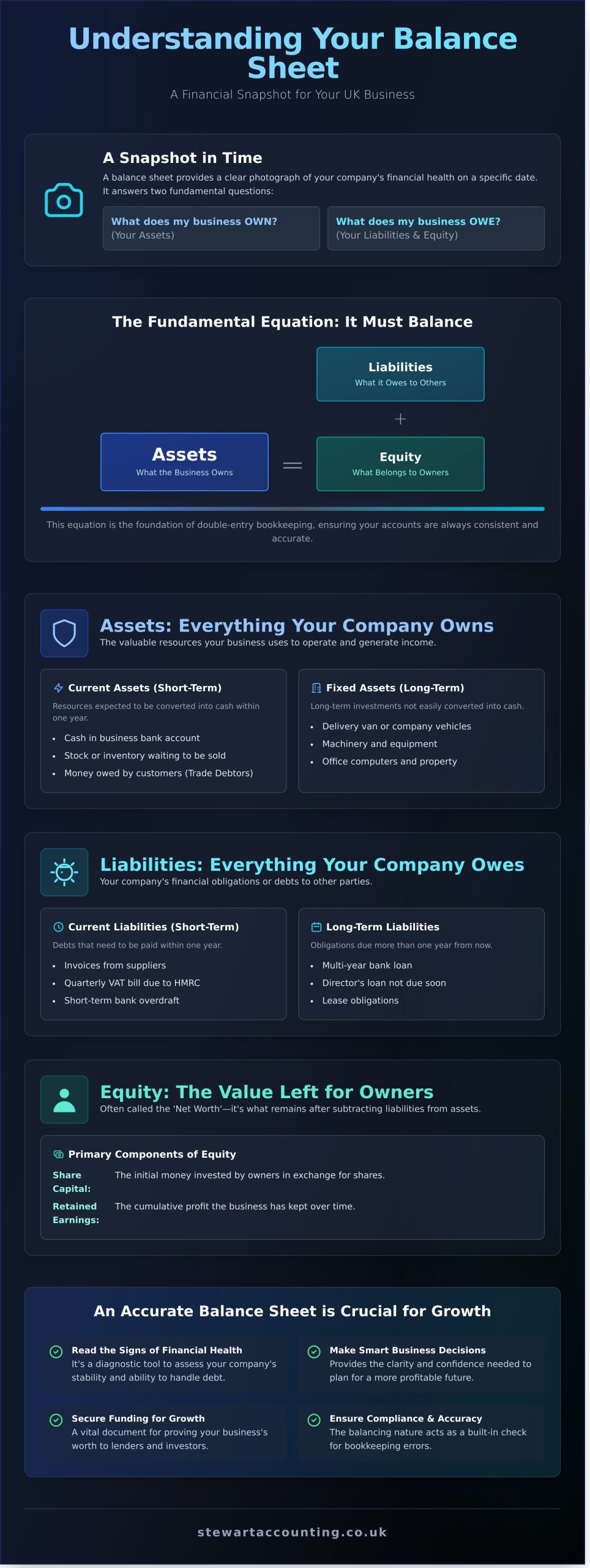
To understand what is a balance sheet explained in simple terms, think of it as a financial snapshot of your business. Unlike a report that shows performance over time (like a profit and loss statement), the balance sheet is a single, clear photograph taken on a specific date-for example, the last day of your financial year. It doesn’t track profit or monthly sales; instead, it reveals your company’s net worth at that precise moment.
At its heart, a balance sheet provides clear answers to two fundamental questions:
- What does my business own? (These are your Assets)
- What does my business owe? (These are your Liabilities & Equity)
The fundamental idea is that everything the business owns has been funded somehow-either with money borrowed from others (like a bank loan) or with money invested by the owners. This simple but powerful concept is the key to gaining clarity on your financial position.
The Basic Accounting Equation Explained Simply
The entire report is built on one straightforward formula that keeps everything in check. While a comprehensive overview of a balance sheet can explore complex details, the core principle is refreshingly simple:
Assets = Liabilities + Equity
In other words: What the Business Owns = What it Owes to Others + What Belongs to the Owners. This equation is the foundation of all double-entry bookkeeping, ensuring your accounts are always consistent and accurate.
Why is it called a ‘Balance’ Sheet?
The name gives away its most important feature: it must always balance. The total value of your assets on one side must perfectly equal the combined value of your liabilities and equity on the other. If they don’t, it’s a clear signal that there’s an error somewhere in your bookkeeping. This built-in check provides a crucial layer of accuracy, giving you confidence that the financial data you’re relying on is sound.
Breaking It Down: The Three Key Components of a Balance Sheet
At its heart, a balance sheet is built on a simple but powerful equation. To truly get to grips with what is a balance sheet explained in practical terms, you only need to understand its three core pillars. Forget the complicated jargon; we’re going to talk about real-world items like your company van, outstanding supplier invoices, and the money you first invested. Each component tells a different part of your business’s financial story, and grasping them is the key to unlocking the insights a balance sheet provides.
Assets: Everything Your Company Owns
Think of assets as all the valuable resources your business uses to operate and generate income. They are the tools that drive your growth, and they are typically split into two categories:
- Current Assets: These are short-term resources that are expected to be converted into cash within a year. This includes cash in your business bank account, stock or inventory waiting to be sold, and money owed to you by customers (also known as ‘trade debtors’).
- Fixed Assets (or Non-Current Assets): These are long-term investments that aren’t easily converted into cash. For a typical UK business, this could be your delivery van, machinery, office computers, or the property you operate from.
Liabilities: Everything Your Company Owes
Liabilities represent your company’s financial obligations or debts to other parties. This section shows what you owe and when it’s due, giving a clear picture of your commitments. These universal categories are central to any official balance sheet definition and components. Like assets, they are also divided into two main types:
- Current Liabilities: These are debts that need to be paid within one year. Common examples include invoices from your suppliers, your quarterly VAT bill due to HMRC, or a short-term bank overdraft.
- Long-Term Liabilities: These are obligations due more than one year from now. This typically includes things like a multi-year bank loan taken out to buy equipment, or perhaps a director’s loan that isn’t due for repayment soon.
Equity: The Value Left Over for the Owners
After you subtract all your liabilities from your assets, what’s left is the owner’s equity. This is often called the ‘net worth’ of the business – it represents the value that belongs to the owners or shareholders. Equity is primarily made up of two things:
- Share Capital: The initial money invested into the company by its owners in exchange for shares.
- Retained Earnings: The accumulated profits that the business has earned over time and has ploughed back into the company rather than paying out to owners.
Understanding these three pillars is the first step to confidently reading your company’s financial statements.
Reading the Signs: What a Balance Sheet Reveals About Your Business
A balance sheet is far more than a compliance document you file once a year. Think of it as a financial health check for your business-a powerful diagnostic tool. When considering what is a balance sheet explained in practical terms, it’s crucial to see it not as a static report, but as a story about your company’s stability. It helps you answer critical questions, spot signs of good health, and identify potential warning flags before they become serious problems. This insight is essential for making smarter, more informed decisions that drive your business forward.
Assessing Liquidity: Can You Pay Your Bills?
This is the most immediate question your balance sheet answers. By comparing your current assets (cash, accounts receivable) to your current liabilities (short-term debts, supplier invoices), you can assess your short-term financial health. Do you have enough cash on hand to cover next month’s payroll and rent? This ratio is one of the first things banks and lenders in the UK look at when considering a loan application, as it demonstrates your ability to manage day-to-day finances.
Understanding Solvency: Is Your Business Built to Last?
While liquidity looks at the short term, solvency assesses your long-term viability. It shows your ability to meet financial commitments over the long haul. A key indicator here is your debt-to-equity ratio-how much of your business is financed by debt compared to your own investment. While some debt is normal, an imbalance can signal risk. For those wanting a deeper dive, Investopedia offers a comprehensive guide to balance sheets that can help. A healthy balance sheet demonstrates a sustainable, resilient business model.
Informing Decisions: Should You Expand or Consolidate?
Ultimately, the goal of understanding your balance sheet is to guide your strategy. Can you confidently afford that new £15,000 piece of equipment, or would it be wiser to pay down existing debt? The data provides the clarity needed to plan for future growth, secure investment, or decide when to consolidate and strengthen your financial position. Interpreting these numbers can feel overwhelming, but you don’t have to do it alone. Need help making sense of your figures? Talk to our experts.
A Practical Example: A UK Small Business Balance Sheet
Theory is useful, but seeing numbers on a page makes everything click. To truly get to grips with what is a balance sheet explained in a practical sense, let’s look at a fictional UK-based company: ‘Alloa Electrical Services Ltd.’. This simple example will help you visualise how your own business’s financial health is represented at a single point in time.
Sample Balance Sheet for ‘Alloa Electrical Services Ltd.’
Here is a simplified balance sheet for our fictional electrical contractor, showing its financial position as at 31st March 2024.
| Assets | Liabilities & Equity |
|---|---|
|
Current Assets Cash in Bank: £5,000 Accounts Receivable: £3,500 Fixed Assets |
Current Liabilities Accounts Payable: £2,000 VAT Payable: £1,500 Long-Term Liabilities Shareholder’s Equity |
| Total Assets: £25,000 | Total Liabilities & Equity: £25,000 |
Annotating the Example: What Each Line Means
As you can see, the total on the left perfectly matches the total on the right. This is the fundamental rule of the balance sheet in action. Let’s break down what these figures represent:
- Assets (£25,000): These are the resources the business owns. It includes cash in the bank, money owed by customers for completed jobs (Accounts Receivable), and the value of its physical equipment like the company van and tools.
- Liabilities (£13,500): This is what Alloa Electrical owes to others. It includes short-term debts like supplier bills (Accounts Payable) and VAT owed to HMRC, plus a long-term bank loan used to purchase the van.
- Equity (£11,500): This represents the owner’s net stake in the company. It’s the initial investment (Share Capital) combined with the profits the business has kept over time (Retained Earnings).
The core formula is clear: Assets (£25,000) = Liabilities (£13,500) + Equity (£11,500). From this snapshot, we can see Alloa Electrical is in a reasonably healthy position; its assets are greater than its debts, and it has positive equity. Creating and interpreting your own balance sheet can feel complicated, but our team is here to help make it clear. If you want support understanding your financial position, we can take it off your hands.
From Stress to Success: How We Take Care of Your Balance Sheet
Throughout this guide, we’ve focused on the question of what is a balance sheet explained in clear terms. Understanding this financial statement is the first crucial step toward financial clarity. But knowledge alone isn’t enough. The real value comes from ensuring your balance sheet is accurate, compliant, and used as a powerful tool for growth. As a core part of preparing your year-end accounts, our goal is to transform it from a stressful obligation into a source of confidence for your business.
Ensuring Accuracy and Compliance
A balance sheet is only useful if the numbers are correct and professionally prepared. As fully qualified Chartered Accountants, we meticulously check your records to ensure every figure is accurate. This diligence is vital when it comes to official filings. We handle all the complexities of submitting your accounts to Companies House, navigating the specific formats and deadlines so you don’t have to. This proactive approach helps you avoid the significant stress of potential errors, investigations, or costly late-filing penalties, giving you complete peace of mind.
Providing Actionable Insights
We believe that financial documents should empower you, not confuse you. Our service goes beyond simply having what is a balance sheet explained; we take the time to sit down and discuss what the numbers actually mean for you and your business. We translate the data into plain English, highlighting trends and opportunities. Our tailored advice helps you use this financial snapshot to:
- Identify opportunities for improving profitability and managing liabilities.
- Plan strategically for future growth, investment, or securing finance.
- Make informed decisions that align with both your business and personal goals.
We don’t just report on the past; we help you build a more profitable future.
Let Us Take It Off Your Hands
Your time and energy are your most valuable assets. They are best spent running and growing your business, not getting lost in spreadsheets and complex accounting rules. Let our team of experts take the entire burden of your year-end accounts and balance sheet preparation off your hands. We provide the financial expertise you need, giving you more time to focus on your operations, more clarity over your money, and more mind (less stress!).
Ready for stress-free accounting and a clearer financial future? Get in touch for a free chat.
Your Balance Sheet: A Tool for Success, Not Stress
Hopefully, this guide has provided a clear and simple answer to the question of what is a balance sheet explained. Remember, it’s not just a compliance document; it’s a powerful snapshot of your business’s financial health, showing exactly what you own and what you owe at a single point in time. Understanding the relationship between your assets, liabilities, and equity is the first step towards making more informed, strategic decisions for your company’s future.
While understanding your balance sheet is crucial, preparing it accurately can be time-consuming and stressful. That’s where we come in. As Fully Qualified Chartered Accountants and experts in small business accounting, our job is to take the complexity off your hands. With local offices in Alloa, Stirling, and Falkirk, we provide the dedicated support you need to achieve financial clarity and peace of mind.
Ready to turn financial data into your greatest asset? Let’s discuss your year end accounts. Contact our team today! We’re here to help you build a stronger, more successful business.
Frequently Asked Questions About The Balance Sheet
What is the difference between a balance sheet and a profit and loss (P&L) statement?
A P&L statement shows your profitability over a period, like a month or year, by listing income against expenses. In contrast, a balance sheet is a snapshot of your financial position on a single day. It summarises what your business owns (assets) and what it owes (liabilities). Think of the P&L as a video of your performance and the balance sheet as a photograph of your financial health at that moment.
How often does a business need to prepare a balance sheet?
For UK limited companies, a balance sheet is legally required at least once a year as part of your statutory accounts. However, for effective financial management, we recommend preparing one more frequently-either monthly or quarterly. This provides a regular, up-to-date view of your business’s health, helping you make informed decisions and spot potential issues early. Regular reporting helps take the stress out of your year-end commitments.
Does a sole trader or a partnership need a balance sheet in the UK?
While sole traders and partnerships in the UK are not legally required to file a balance sheet with HMRC, creating one is highly recommended. When you ask what is a balance sheet explained in simple terms, it’s about knowing your business’s net worth. It is an essential tool for tracking financial health, managing cash flow effectively, and is often required if you apply for a business loan. It helps you run your business with clarity and confidence.
Can I create my own balance sheet using accounting software like Xero?
Yes, absolutely. Modern accounting software like Xero or QuickBooks can automatically generate a balance sheet for you, provided your bookkeeping is accurate and up-to-date. These tools make financial reporting much more accessible for business owners. However, it’s crucial to ensure transactions are categorised correctly to get a reliable report. We can help set this up efficiently to ensure you get the clear picture you need without the worry.
What are ‘current’ vs. ‘non-current’ assets and liabilities?
‘Current’ refers to assets you expect to convert to cash within a year (like inventory or cash itself) and liabilities you expect to pay within a year (like supplier invoices). ‘Non-current’ items are long-term. A non-current asset is something you’ll own for over a year, such as property or machinery. A non-current liability is a debt you’ll pay back over more than a year, like a long-term business loan.
Why might my company’s bank balance be high but the balance sheet shows low equity?
This is a common and often confusing situation. Your bank balance is just one asset. If your business has significant liabilities, such as large loans or supplier debts, these will reduce your total equity (Assets – Liabilities = Equity). For example, you might have £50,000 in the bank from a loan, but that £50,000 loan is also a liability on your balance sheet, so it doesn’t increase your company’s net worth.