

What is Corporation Tax and How Is It Calculated? | UK Guide
Think of Corporation Tax as the business version of Income Tax. Just as individuals pay tax on their earnings, companies pay tax on their profits.
It’s not as simple as taxing every pound that comes into the business, though. The tax is calculated on your taxable profits—the amount left after you've deducted all your legitimate business costs and claimed any available tax reliefs.
What Is Corporation Tax and How Does It Work?
At its heart, Corporation Tax is how profitable companies contribute to public services like the NHS, education, and infrastructure. It's a cornerstone of the UK's tax system, but a common trip-up is thinking it's a tax on total revenue. It’s not.
Your company could bring in £1 million in sales, but that's just the starting point. Once you subtract salaries, rent, stock, and other running costs, your actual profit might be significantly smaller. It's this final profit figure, after a few specific tax adjustments, that HMRC is interested in.
To help break it down, here’s a quick overview of the key ideas.
UK Corporation Tax Fundamentals at a Glance
This table simplifies the core concepts to give you a clear picture of how UK Corporation Tax operates.
| Concept | Simple Explanation |
|---|---|
| Who Pays It? | Primarily limited companies and some other organisations, but not sole traders or partnerships. |
| What's Taxed? | Taxable profits, not total revenue or turnover. |
| How Is It Calculated? | By applying the current tax rate to the profits left after deducting allowable expenses and reliefs. |
| When Is It Paid? | Annually, based on the company's accounting period. |
Grasping these basics is the first step towards managing your company's tax obligations effectively.
Who Needs to Pay Corporation Tax?
Knowing whether you’re liable is the first hurdle. If you run a UK-based business with one of the following structures, you’ll need to register for and pay Corporation Tax:
- Limited Companies: This is the most common business structure that falls into the Corporation Tax net.
- Foreign Companies with a UK Branch: If an overseas company sets up an office or branch here, it must pay Corporation Tax on profits generated from its UK activities.
- Clubs, Co-operatives, and Unincorporated Associations: Even members' clubs, social enterprises, and community groups are often liable.
A key distinction is that sole traders and partnerships do not pay Corporation Tax. Instead, the business owners report their share of the profits on their personal Self Assessment tax returns and pay Income Tax on them.
The key takeaway is simple: Corporation Tax is levied on profit, not revenue. This means that every allowable business expense you claim directly reduces your profit figure and, consequently, your final tax bill.
The Basic Principle of Calculation
The journey from your accounts to your tax payment follows a clear path. You begin with the pre-tax profit shown in your annual financial statements.
From here, you’ll make a few adjustments. You have to add back any "disallowable" expenses (client entertainment is a classic example) and then subtract any tax reliefs or capital allowances you’re entitled to. The figure you're left with is your taxable profit. The current Corporation Tax rate is then applied to this amount to work out what you owe HMRC.
While this guide focuses on the UK system, understanding the principles is vital for any business. For instance, companies with international operations must also get to grips with region-specific rules, such as those covered by strategic accounting and corporate tax services for the UAE. This foundational knowledge is crucial for staying compliant and maintaining financial health, wherever you trade.
A Brief History of UK Corporation Tax
To get a real feel for what corporation tax is and how it works today, it’s useful to look at where it came from. The system we have now wasn’t built overnight; it's the result of decades of economic change, shifting political goals, and the UK's changing place in the world. Its story explains why rates go up and down and how your business fits into the bigger economic picture.
The UK first brought in Corporation Tax as we know it in 1965. This was a big deal because, for the first time, it created a separate tax just for company profits, rather than treating them as shareholders' personal income. Believe it or not, the starting rate was a jaw-dropping 52%—a number that seems almost unbelievable today.
This new tax quickly became a major earner for the government. In the 1969-70 financial year, the money collected from Corporation Tax amounted to 3.3% of the UK's entire GDP, which is still the highest proportion it has ever reached. If you're curious about the numbers, the Office for Budget Responsibility's detailed analysis offers a fascinating deep dive.
The Era of Rate Reductions
Those sky-high rates didn't stick around forever. The 1980s heralded a dramatic change in thinking, with a new economic approach that championed lower taxes to kickstart business investment and make the UK more competitive. This set off a long-running trend where government after government chipped away at the main rate.
The thinking was straightforward: if companies paid less tax, they’d have more cash left over to reinvest in growing their business, hiring more people, and developing new ideas. It was also a strategy to make the UK a more appealing headquarters for international firms, a move often called "tax competition." As a result, rates began a long and steady descent from their post-war peak.
This journey of cuts carried on well into the 21st century, eventually bottoming out at a main rate of just 19%.
The core principle behind these cuts was that a competitive Corporation Tax rate acts as a powerful magnet for global investment, creating a ripple effect that benefits the whole UK economy, even with a lower headline rate.
Recent Shifts and a New Direction
Lately, however, the tide has turned again. Faced with fresh economic challenges and the need to pay for public services, the government reversed this long-standing policy. From April 2023, the main rate of Corporation Tax was raised to 25% for companies with profits above a certain level.
To soften the blow for smaller businesses, this change also brought back a tiered system. A "small profits rate" of 19% now applies to companies with profits under £50,000. For those earning between £50,000 and £250,000, there's a tapered relief to smooth the transition.
This history lesson really shows that Corporation Tax is anything but static. It’s a flexible lever governments pull to manage the economy. Understanding its journey from 52% down to 19% and now back up to 25% gives you a much clearer picture of why today's rules are what they are—and how they could easily change again.
How to Determine Your Company's Tax Rate
Once you've worked out your company's taxable profit, the next step is to apply the correct tax rate. This isn't as simple as just using one single figure. In the UK, the rate your business pays is tied directly to how much profit it makes.
This tiered system is designed to give smaller businesses a bit of breathing room, easing their tax burden to support stability and growth. Since April 2023, the government brought back a structure with two main rates, which are triggered at certain profit levels. Getting to grips with these tiers is absolutely essential for accurate tax planning and making sure you don't over or underpay.
The main rate was recently increased to 25%. But, to help smaller companies, a lower small profits rate of 19% is also in place. Having a lower rate for smaller businesses has been a long-standing feature of the UK tax system. If you're interested in the history of these rates, you can review detailed government statistics on Corporation Tax for more context.
The Current Corporation Tax Rates and Thresholds
The specific rate you'll use is directly linked to your annual taxable profits. Here are the key figures you need to know:
- Small Profits Rate (19%): This applies if your company's taxable profits are £50,000 or less.
- Main Rate (25%): This applies if your company's taxable profits are £250,000 or more.
If your profits fall neatly into one of those brackets, the calculation is refreshingly simple. You just multiply your taxable profit by either 19% or 25%.
But what happens if your business lands somewhere in that middle ground?
Understanding Marginal Relief
For any business with profits between £50,000 and £250,000, a mechanism called Marginal Relief comes into play. You can think of it as a sliding scale that smoothly bridges the gap between the two main tax rates.
Without it, a company earning just £1 over the £50,000 threshold would suddenly face a massive jump in its tax bill. That’s hardly a fair reward for a little bit of growth. Marginal Relief ensures the tax rate effectively climbs gradually as profits rise toward that £250,000 upper limit. While there's a specific formula to work it out, the idea is simple: it gives you partial relief from the full 25% main rate, meaning you pay an effective rate somewhere between 19% and 25%.
The whole point of Marginal Relief is to prevent a sudden, harsh "tax cliff edge" for growing businesses. It creates a much fairer, gradual transition from the small profits rate to the main rate.
This tapered system is a critical part of how corporation tax works for thousands of successful small and medium-sized businesses across the UK.
Handling Accounting Periods That Span Rate Changes
It's a fact of life that tax rates can, and do, change. If your company's accounting period happens to straddle a date when a rate changes (like the April 2023 update), you can't just apply one rate to the entire year's profit. Instead, you have to apportion your profits.
This simply means you need to split your total taxable profit for that period into two chunks:
- The portion of profits earned before the rate change.
- The portion of profits earned after the rate change.
You then apply the old rate to the first part and the new rate to the second. This is usually done on a pro-rata basis, calculated from the number of days in your accounting period that fall before and after the change. It’s the only way to ensure you're paying the correct amount of tax for that financial year.
Calculating Your Corporation Tax Liability Step by Step
Right, this is where the theory hits the road. Let's break down how to actually calculate your corporation tax bill into a clear, manageable process. Forget the jargon for a moment; it all starts with one number from your annual accounts: your pre-tax profit.
From that starting point, we'll make a few essential adjustments. This means adding back any business expenses that HMRC doesn't allow for tax purposes, then subtracting any valuable reliefs and allowances you’re entitled to. Finally, we'll factor in any trading losses.
To make this crystal clear, we'll follow the journey of a fictional UK business. This running example will put real numbers to each step, showing you exactly how to get from your initial profit to your final tax bill.
This simple infographic breaks the core calculation into three clear stages.
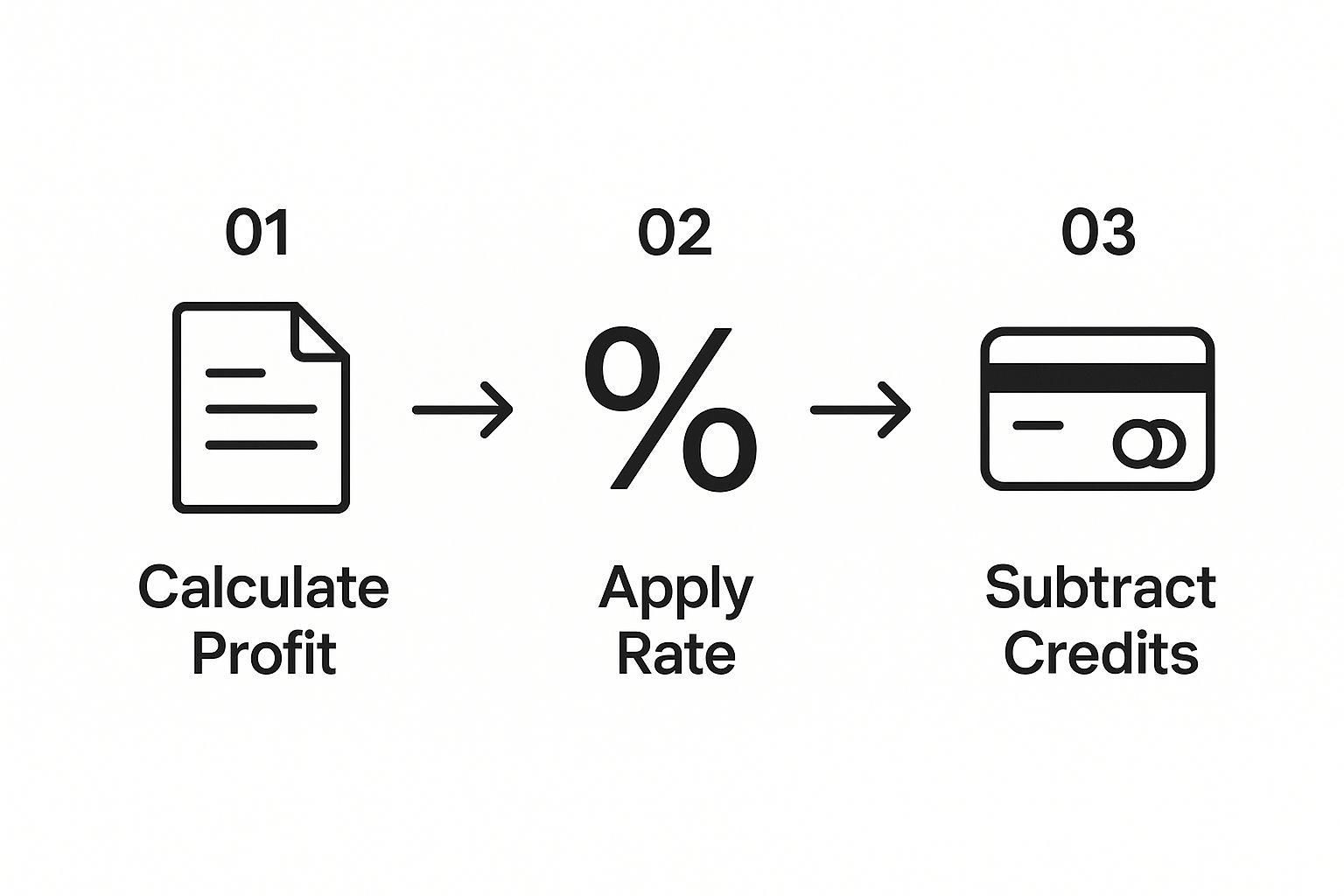
As you can see, the process flows logically. You calculate your profit, apply the correct tax rate, and then reduce the final bill with any available reliefs.
Step 1: Start with Your Pre-Tax Profit
Every Corporation Tax calculation begins with your pre-tax profit, sometimes called 'profit before tax'. This is the bottom-line figure your accountant prepares for your company's statutory annual accounts.
Essentially, it’s your total income minus all the day-to-day running costs of the business—things like staff salaries, rent, utility bills, and marketing spend.
Running Example: 'Artisan Bakers Ltd'
Let's imagine Artisan Bakers Ltd has had a great year. After paying for all its flour, sugar, staff wages, and shop rent, their accounts show a pre-tax profit of £80,000. This is our starting number.
Step 2: Add Back Disallowable Expenses
Next, you need to go through your expenses with a fine-tooth comb. While most of your business costs are 'allowable' for tax, HMRC has a specific list of things that can't be deducted from your profit when working out your tax bill. These are known as disallowable expenses.
You need to find these in your accounts and add their value back to your pre-tax profit.
Common examples of disallowable expenses include:
- Client Entertainment: Taking clients out for dinner or to an event might be great for business, but HMRC won't let you deduct the cost from your profit for tax.
- Personal Items: Any cost that isn't 'wholly and exclusively' for business purposes is a no-go.
- Depreciation of Assets: Your accounts will show depreciation, but you can't claim this for tax. Instead, you can often claim Capital Allowances, which we'll cover next.
Artisan Bakers Ltd Example Continued
Looking through their books, the director of Artisan Bakers Ltd finds they spent £2,000 entertaining potential wholesale clients. Because this is a disallowable expense, it must be added back.
- New Profit Figure: £80,000 (pre-tax profit) + £2,000 (disallowable expenses) = £82,000
Step 3: Subtract Capital Allowances and Reliefs
This is a really important step where you can actively shrink your tax bill. HMRC lets you deduct the value of certain investments and key expenditures from your profit figure.
The most common of these are Capital Allowances. You can think of these as HMRC's version of depreciation. They allow you to write off the cost of 'plant and machinery'—big-ticket items like computers, vans, office furniture, or specialist equipment—against your profit.
You might also be able to claim other reliefs, like R&D tax credits, if your company is involved in genuine innovation.
Artisan Bakers Ltd Example Continued
This year, Artisan Bakers Ltd invested in a shiny new commercial oven costing £10,000. Thanks to the Annual Investment Allowance (a type of capital allowance), they can deduct the full cost from their profit for tax purposes.
- New Profit Figure: £82,000 – £10,000 (capital allowances) = £72,000
This new figure, £72,000, is the company's taxable profit. This is the amount the tax will actually be calculated on.
Step 4: Apply the Correct Corporation Tax Rate
Now that you have your final taxable profit, it's time to apply the right Corporation Tax rate. As we covered earlier, the rate you pay depends on how much profit you’ve made.
For Artisan Bakers Ltd, their taxable profit of £72,000 puts them between the £50,000 and £250,000 thresholds. This means they get the benefit of Marginal Relief.
The precise Marginal Relief calculation can get a bit fiddly, but the idea is that it gives them a blended tax rate that's fairer than jumping straight to the main 25% rate. For the sake of this example, let's say their final Corporation Tax charge comes to £14,500. This is the amount they owe HMRC for the year.
The journey from an £80,000 accounting profit to a £14,500 tax liability shows just how vital these adjustments are. Getting to grips with what corporation tax is and how it is calculated isn't just about ticking boxes for HMRC; it’s about making sure you pay the correct amount and take full advantage of the reliefs your business has earned.
Maximising Your Allowable Expenses and Tax Reliefs

Knowing how to calculate your Corporation Tax is a good start, but it's only half the story. The real skill lies in legally reducing your taxable profit by making sure you claim every single allowable business expense and tax relief your company is entitled to.
So many business owners unwittingly overpay their tax simply because they aren't aware of what they can claim. We're going to move beyond a basic list of costs and explore the deductions that can make a real difference. We'll start with the day-to-day expenses you'd expect and then get into the more powerful (but often misunderstood) areas like Capital Allowances and specialist reliefs.
Getting this right isn't just about saving money on your tax bill. It's about making smarter financial decisions all year round, giving you the confidence that you’re not paying a penny more than you have to.
What Makes an Expense Allowable?
Before you start deducting costs, you need to get your head around HMRC's single most important rule. For any cost to be an "allowable expense," it must be "wholly and exclusively" for the purpose of your business. That means its sole reason for existing was for your trade.
This simple principle is why you can claim for your business mobile but not your personal one, even if you sometimes take a work call on it. It’s also the reason client entertainment, as beneficial as it might be, is specifically disallowed. Understanding this "wholly and exclusively" concept is the bedrock of a solid tax return.
Some common allowable running costs include:
- Staff Costs: This covers everything from salaries and bonuses to pension contributions and the employer's National Insurance you pay.
- Premises Costs: The rent on your office or workshop, business rates, and utility bills like electricity, gas, and water all fall into this category.
- Marketing and Advertising: Money spent promoting your business is allowable. Think website hosting fees, social media ads, or printed flyers.
- Office Supplies: All those everyday essentials like stationery, printer ink, postage, and software subscriptions can be claimed.
Going Beyond Everyday Costs with Capital Allowances
Now, while day-to-day running costs are deducted from your income to find your profit, big-ticket items are handled differently. You can't just expense the full cost of a new delivery van or a high-end computer in one go. Instead, you claim what are known as Capital Allowances.
Think of Capital Allowances as HMRC’s way of letting you claim tax relief on major business assets. They allow you to 'write off' the value of these items against your profits over a period of time, which in turn lowers your Corporation Tax bill.
The most useful type for most small and medium-sized businesses is the Annual Investment Allowance (AIA). This is a real game-changer. It currently lets you deduct 100% of the cost of qualifying assets (like machinery and equipment) in the year you buy them, up to a very generous limit. It's a powerful incentive to invest in the tools you need to grow.
Capital Allowances are a fantastic tool. They actively encourage businesses to invest in themselves by offering immediate tax relief on big purchases, which helps enormously with cash flow and makes vital upgrades more affordable.
Unlocking High-Value Tax Reliefs
Beyond the usual expenses and capital allowances, the government offers some very specific, high-value tax reliefs to reward certain types of business activity. These are often missed but can make a massive difference to your bottom line if you qualify.
Two of the most valuable reliefs are:
- Research and Development (R&D) Tax Credits: This is an incredibly generous government scheme designed to fire up innovation. If your company is working on a project that aims to advance science or technology, you could claim a huge portion of your R&D spending back. This can either slash your tax bill or even come back to you as a cash payment if you're making a loss.
- The Patent Box: This one is for the innovators who protect their ideas. If your company owns and makes money from patents, this scheme lets you apply a much lower rate of Corporation Tax (just 10%) to the profits you earn from those patented inventions.
It's well worth your time to investigate if your business could qualify for these specialist reliefs. They were created to give the UK's most forward-thinking sectors a competitive edge and can provide a serious financial boost. A proper grasp of Corporation Tax means exploring every single avenue for reducing your liability—from the smallest receipt to these major government schemes.
How to Report and Pay Your Corporation Tax
You’ve done the hard work of calculating your Corporation Tax liability—a big milestone for any business owner. But the job isn't finished yet. The final, crucial step is reporting everything to HMRC correctly and paying what you owe on time. Getting this part right is absolutely essential for keeping your company in good standing.
A common trip-up for many businesses is thinking the deadline for filing your return and paying your bill is the same. They aren't, and mixing them up can lead to some painful and easily avoidable penalties. A little bit of organisation here goes a long way.
Getting Registered for Corporation Tax
First things first: before you can file or pay, your company has to be registered with HMRC for Corporation Tax. You need to do this within three months of when you start trading. "Trading" is a broad term and includes everything from making your first sale and buying stock to renting an office or hiring your first employee.
To register, you'll need your company's Unique Taxpayer Reference (UTR). This is a 10-digit number that HMRC will post to your company's registered address not long after you've officially incorporated with Companies House. Once you have it, you can complete your registration online through the Government Gateway portal.
Filing Your Company Tax Return (CT600)
The main document you'll be working with is the Company Tax Return, which is officially known as the CT600 form. This is where you lay out all the details of your company's income, deduct your allowable expenses, and present your final Corporation Tax calculation for the year.
Your deadline for filing the CT600 is usually 12 months after the end of the accounting period it relates to. So, if your company's financial year wraps up on 31st March, you have until the following 31st March to submit your return. You have to file this online, and it must be submitted alongside a copy of your statutory annual accounts.
Staying on top of these administrative duties is just one part of a larger picture. Beyond simply knowing how to report and pay, businesses must also implement robust compliance risk management programs to navigate the complex landscape of regulations and avoid potential penalties.
Paying Your Corporation Tax Bill
Now for the part that often catches people out: your deadline to pay your Corporation Tax is almost always before your deadline to file the return. For most companies, the payment is due 9 months and 1 day after your accounting period ends.
Let's look at that with a clear example:
- Accounting Period Ends: 31st March 2024
- Corporation Tax Payment Due: 1st January 2025
- Company Tax Return (CT600) Filing Due: 31st March 2025
As you can see, you need to pay the tax three months before you officially file the return that shows how you calculated it.
HMRC provides several ways to settle your bill, though you can no longer pay at a Post Office. The most common methods are:
- Online or telephone banking (using Faster Payments)
- CHAPS or Bacs
- Direct Debit (this needs to be set up in advance)
- Through your company’s online tax account
Whatever method you choose, make sure you use your 17-character Corporation Tax payment reference number. This ensures your payment gets matched to your company's account without any hitches.
What Happens if You're Late?
HMRC doesn't mess around with deadlines. The penalties for filing or paying late can add up alarmingly fast. A late filing will land you an immediate £100 penalty the day after the deadline, and that's just the start—more fees are added the longer you delay.
If you pay late, HMRC will charge you interest on the outstanding amount, which can really inflate your final bill. These dates are non-negotiable, so get them in your calendar now. It’s one of the simplest ways to avoid a very expensive mistake.
Common Corporation Tax Questions Answered
Even when you feel you've got a good handle on Corporation Tax, real-world situations can throw up tricky questions. Let's walk through a few common scenarios that business owners often ask about, so you know exactly where you stand.
What Happens If My Company Makes a Loss?
Finding out your company has made a trading loss is never great news, but from a tax perspective, it’s not a complete write-off. In fact, that loss can be a useful tool.
You have a couple of strategic choices:
- Carry it back: You can offset the loss against profits your company made in the previous year. Doing this often results in a welcome tax refund from HMRC.
- Carry it forward: The other option is to carry the loss forward and use it to reduce taxable profits in future years. This is a great way to lower your Corporation Tax bills when your business is back in the black.
Do I Pay Corporation Tax on Selling Assets?
Yes, you do. When your company sells a significant asset—think property, machinery, or even shares—for more than you originally paid, that profit is taxable.
This profit is called a chargeable gain, which is essentially the business version of Capital Gains. You calculate the gain, add it to your other trading profits for the accounting period, and the total figure is taxed at your company's Corporation Tax rate.
It's crucial to remember how your company's accounting period lines up with the government's tax year (which runs from 1st April to 31st March). If they don't align perfectly, your profits have to be split and apportioned across the two financial years, which can sometimes complicate which tax rates and reliefs apply.
Thinking about your company's finances means looking at the whole picture, including both liabilities and support. For a broader perspective on government financial involvement, you might find it interesting to read about the impact of subsidies on small businesses and how they play a role in the wider economy.
Getting your head around everything from trading losses to asset sales can be a lot to manage. Having an expert in your corner makes all the difference. Stewart Accounting Services can take care of your tax obligations, making sure you claim every relief you're entitled to and never miss a deadline. Contact us today for a clearer mind and more time to grow your business.
Recent Posts
22 Oct, 2026
21 Oct, 2026