

What Is Double Entry Bookkeeping? A Simple Guide

At its heart, double entry bookkeeping is a system where every single financial transaction gets recorded in at least two different accounts. It works as a debit in one account and a credit in another.
Think of it like a set of old-fashioned balancing scales. For every bit of weight you add to one side (a debit), you must add an equal amount to the other (a credit). This simple principle ensures your financial records are always complete and, most importantly, balanced.
The Foundation of Modern Accounting

This method has been the bedrock of accounting for UK businesses for centuries, mainly because it has a built-in error-checking system. Unlike basic single-entry methods that just track money coming in and going out, the double entry system gives you a complete picture of your company's financial health.
It doesn't just log cash flow; it tracks your assets, liabilities, and owner's equity too. This dual aspect is what makes it so robust and is fundamental to producing key financial reports like the balance sheet and income statement. For a wider view on how this fits into the bigger picture, you might find these general bookkeeping practices helpful.
Quick Look at Double Entry in Action
Every transaction affects two accounts, creating that perfect balance we talked about. Here’s a simplified preview of how it works for a few common business activities.
| Transaction | Account 1 (Debit) | Account 2 (Credit) |
|---|---|---|
| Receive £500 cash from a sale | Cash (Asset increases) | Revenue (Income increases) |
| Buy a £1,000 computer on credit | Equipment (Asset increases) | Accounts Payable (Liability increases) |
| Pay a £200 utility bill | Utilities Expense (Expense increases) | Cash (Asset decreases) |
As you can see, each entry has an equal and opposite entry elsewhere in the books. This mechanism ensures your accounts always balance and gives you a far more reliable view of your finances.
The Core Principle Keeping Your Books Balanced
At the very heart of double entry bookkeeping is a single, unbreakable rule: the accounting equation. It's the simple formula that keeps the financial world spinning on its axis, and every single transaction your business makes is governed by it.
Think of this equation as a constant, reliable snapshot of your company's financial health. It's the mechanism that ensures, after every transaction, your books remain perfectly balanced. This provides an immediate, built-in check for accuracy.
Assets = Liabilities + Equity
Let’s break that down. In simple terms, everything your company owns (its assets) had to be paid for somehow. The money either came from funds you owe to others (liabilities) or from money the owners invested (equity). It’s that straightforward; there are no other sources.
Putting the Equation into Practice
To see how this works in the real world, let's picture a local bakery in Alloa. The bakery’s shiny new oven and its cash till are both Assets. They are valuable items the business owns to help it make money.

Now, if the bakery took out a business loan to afford that oven, the loan is a Liability. It's a debt owed to the bank. The money the owner originally used to get the business off the ground is their Equity—it’s their personal stake in the whole operation. So, the oven (Asset) is perfectly balanced by the loan (Liability) and the owner's investment (Equity).
Every transaction, whether it’s buying a bag of flour or selling a wedding cake, is just a rebalancing act within this equation. When a customer pays you in cash, your Cash (an Asset) goes up, and your Revenue (which increases your Equity) goes up by the exact same amount. The equation stays in perfect harmony.
This isn't some new fad. The system has been refined over centuries and is now the standard for virtually all UK businesses. In fact, over 99% of registered companies submit records based on double entry accounting, which just goes to show how fundamental it is. If you're interested, you can read more about the evolution of double entry bookkeeping and its universal adoption. Ultimately, it’s the only way to build a trustworthy financial foundation for growth.
Understanding Debits and Credits
To really get your head around double-entry bookkeeping, you first need to ditch a common misconception: that debits are somehow "bad" and credits are "good." In accounting, these terms are completely neutral. It's much more helpful to think of them as the 'left' and 'right' sides of your ledger, simply showing where value is coming from and where it's going.
A debit, for example, isn't automatically a negative thing. When a customer pays an invoice, the cash hitting your bank account is recorded as a debit because it increases your assets. On the flip side, a credit isn't always positive. Taking out a business loan increases what you owe (your liabilities), and that's recorded as a credit.
Every single transaction has this two-sided effect. One side is a debit, the other is a credit.
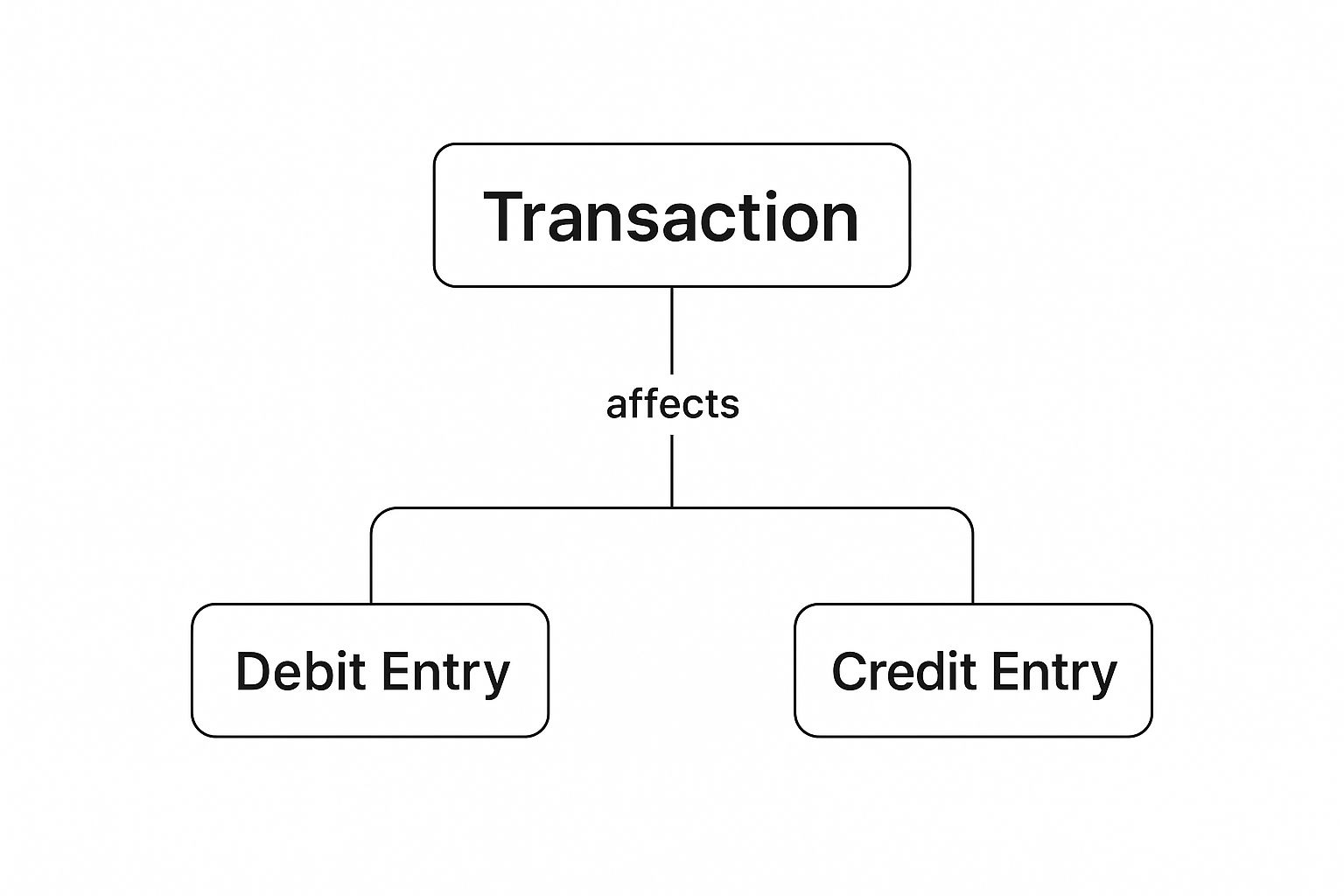
This is the core idea: a single event always impacts at least two accounts, making sure the whole system stays perfectly balanced.
How Each Account Is Affected
Whether a debit or credit increases or decreases an account's balance depends entirely on the type of account we're talking about. There are five main players in your chart of accounts: Assets, Liabilities, Equity, Income, and Expenses. Getting to grips with the rules for each is the key to mastering your books.
The golden rule is this: for any transaction, the total value of the debits must always equal the total value of the credits. This isn't just a suggestion; it's the fundamental law that makes the whole system work.
To make this crystal clear, here’s a table that breaks down how a debit or credit entry affects the balance of each account type.
| Account Type | To Increase the Balance | To Decrease the Balance |
|---|---|---|
| Assets | Debit | Credit |
| Expenses | Debit | Credit |
| Liabilities | Credit | Debit |
| Equity | Credit | Debit |
| Income | Credit | Debit |
Think of this table as your cheat sheet. Once you understand this framework, you can confidently record any business transaction that comes your way, taking all the guesswork out of your financial record-keeping.
Real-World Examples of Double-Entry Bookkeeping
Theory is one thing, but seeing double-entry bookkeeping in action is where it all clicks. Let's walk through a few everyday scenarios for a fictional UK coffee shop start-up to make these concepts crystal clear.

We'll follow four common transactions, looking at the exact journal entry for each. The key is to watch how the fundamental accounting equation (Assets = Liabilities + Equity) stays perfectly in sync every single time.
Transaction 1: The Owner Invests Cash
To get things started, the owner invests £10,000 of their personal savings into the business. This injection of cash gives the company an asset, but it also reflects the owner's stake in the business.
- Debit: The Cash account (an Asset) is debited by £10,000, because the business's cash has increased.
- Credit: The Owner's Equity account is credited by £10,000, showing the owner's investment value has gone up.
The equation is balanced: Assets (+£10,000) = Equity (+£10,000). Simple as that.
Transaction 2: Buying Equipment
Next, the coffee shop buys a professional espresso machine for £4,000 using cash from the bank account. This isn't a loss; it's just swapping one asset (cash) for another (equipment).
- Debit: The Equipment account (another Asset) is debited by £4,000. The business now owns this valuable machine.
- Credit: The Cash account is credited by £4,000, as cash was used to pay for it, reducing the balance.
The total value of assets hasn't changed, so the equation remains balanced. This is a perfect example of why double-entry is so useful for efficiently tracking business expenses — you see exactly where the money went.
Transaction 3: Securing a Business Loan
To buy inventory and cover some marketing, the shop gets a £5,000 loan from the bank.
This transaction increases both what the company owns (its assets) and what it owes (its liabilities). The business now has more cash to work with, but it also has a new debt to repay.
- Debit: The Cash account is debited by £5,000, increasing this asset.
- Credit: The Loans Payable account (a Liability) is credited by £5,000, reflecting the new debt.
Again, the books are balanced: Assets (+£5,000) = Liabilities (+£5,000).
Transaction 4: Making a Sale on Credit
The shop lands a big order, providing coffee for a local corporate client. They send an invoice for £500. The money hasn't hit the bank yet, but the sale has officially been made.
- Debit: Accounts Receivable is debited by £500. This account is an Asset that represents money owed to the business.
- Credit: Sales Revenue is credited by £500. This is an Equity account, and making a sale increases the company's value.
Each of these examples shows how two accounts are always affected, working together to give you a complete and reliably accurate picture of your finances.
Why This System Is a Business Superpower
Think of double entry bookkeeping as less of a chore and more of a superpower for your business. It's not just about tracking money; it's about building a robust, strategic financial foundation. Its most immediate benefit is how it acts as a self-correcting safety net.
If you enter a debit without a corresponding credit, the numbers simply won't add up. Your books won't balance, and the mistake is flagged right away. This simple check-and-balance system has been the bedrock of modern finance since the Renaissance, providing the reliability needed for trade and banking to flourish. You can read more on how this accounting method truly changed the world.
Making Smarter Business Decisions
Catching errors is one thing, but the real magic is in the clarity it gives you. Double entry bookkeeping is the engine that creates the essential financial reports you need to see what’s really going on inside your business.
These aren't just documents; they're your decision-making tools:
- Income Statement: Shows you how profitable you are by laying out your income against your expenses. It tells you exactly where your money came from and where it went.
- Balance Sheet: This is a snapshot of your company's financial health on a particular day. It clearly shows what you own (assets) versus what you owe (liabilities and equity).
With this level of insight, the guesswork disappears. You can confidently answer critical questions about your cash flow, profitability, and financial stability, which is exactly what you need to plan for growth.
Building Credibility and Trust
Finally, having a set of clean, balanced books speaks volumes about your business. It builds a huge amount of credibility. Whether you're approaching a UK bank for a loan, pitching to investors, or getting your accounts ready for HMRC, professional financial records are essential.
They signal that your business is organised, transparent, and a safe bet. This isn't just about compliance; it's about proving you’re a trustworthy partner, which is absolutely vital for long-term success.
A Brief History of This Game-Changing Idea
To really get a feel for double entry bookkeeping, it helps to see it as more than just an accounting rule. It's an idea that literally shaped the modern world. This system wasn't dreamed up in a modern office; it was forged out of necessity in the chaotic, bustling trade hubs of 13th-century Italy.
Picture the scene: merchants and moneychangers juggling complex international deals. Before double entry, trying to track debts, credits, and stock across multiple currencies and business partners was a messy, error-prone nightmare. This new method gave them a logical, self-checking system that finally brought some much-needed order to their finances.
From Italian Merchants to a Global Standard
This new way of tracking money was a quiet catalyst for massive change. It gave businesses the confidence to get bigger, manage huge operations, and bring in investors. As Italian merchant-bankers expanded their reach, the practice spread like wildfire across Europe, becoming an essential tool for anyone serious about growth. You can dive deeper into the historical spread of this accounting method and its journey through the continent.
By the time the Industrial Revolution kicked off in the UK, double entry bookkeeping was already the standard. It provided the financial backbone needed to build factories, run vast supply chains, and report back to shareholders with real accuracy.
It was never just about balancing the books; it was about building trust. It created a universal language for business that allowed capital to move with confidence, fuelling industrial and economic growth on a scale never seen before.
Without this simple but brilliant way of organising financial information, the explosive growth of both the Renaissance and the Industrial Revolution would have been much harder, if not impossible. It's the unsung hero of modern commerce, turning ambitious ideas into real, measurable businesses that still power our economy today.
Got Questions? Let's Get Them Answered
It's completely normal for a few questions to pop up when you're getting to grips with double-entry bookkeeping. Let's tackle some of the most common ones so you can feel confident about how it all works.
Do Sole Traders Really Need to Use Double-Entry?
In the UK, it’s not a strict legal requirement for every sole trader, especially if your turnover is quite small. HMRC will accept simpler cash-based records.
However, it's strongly recommended and considered best practice for a reason. As your business scales, double-entry provides the solid, reliable financial data you'll need for your Self Assessment tax returns, managing cash flow, and proving your financial health to a bank if you need a loan.
Single-Entry vs Double-Entry: What's the Real Difference?
Think of single-entry bookkeeping like keeping a running list of money in and money out in your bank account. It’s a simple log of transactions.
Double-entry, on the other hand, tells a much richer story. It doesn’t just record that money left your account; it also records why it left. It tracks both sides of every single transaction, creating a complete picture of your financial world, including your assets, liabilities, and equity. This dual-sided approach also acts as a clever self-checking system, ensuring everything always balances.
Can Software Handle This for Me?
Yes, absolutely! In fact, that's exactly what modern accounting software is designed to do.
Platforms like Xero, QuickBooks, or FreeAgent are all built on the solid foundation of double-entry bookkeeping. The beauty is that they do all the heavy lifting in the background. When you record a sale or categorise an expense, the software automatically creates the correct debit and credit entries for you. It simplifies the entire process without you having to become a master accountant.
Navigating your financial obligations can feel overwhelming, but you don’t have to go it alone. The experts at Stewart Accounting Services can manage everything from your bookkeeping to tax returns, giving you the clarity and freedom to focus on what you do best: growing your business. Visit us at stewartaccounting.co.uk to learn how we can help.